
Mexican sunflower (Tithonia rotundifolia, )
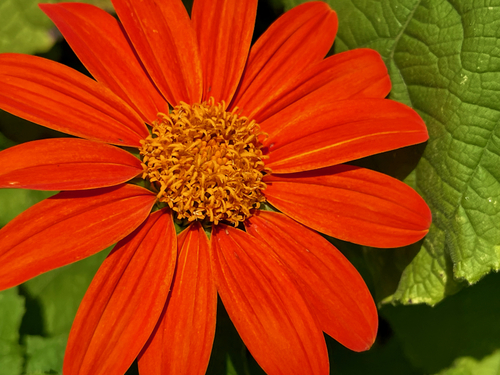

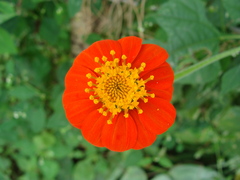
Mexican sunflower (Tithonia rotundifolia) is a tall, sun-loving annual in the Asteraceae family, grown for orange to red-orange flower heads, rapid growth in warm conditions and appeal to bees, butterflies and hummingbirds. It resembles a sunflower but belongs to Tithonia, with often brittle stems and broad, hairy leaves. Its spread needs monitoring in tropical regions where it naturalizes.
Read moreMexican sunflower, Tithonia, Red sunflower and Goldflower of the Incas



© photo
(c) F Delventhal, some rights reserved (CC BY) · cc-by
Murphy Tladi · cc-by-nc
Alexis López Hernández · cc-by
Taken Jul 9, 2021 by mohammad fazel dehkordi (cc-by-sa)
Taken Sep 8, 2020 by Alice Bennett (cc-by-sa)
Taken Jan 15, 2022 by Paula Paula (cc-by-sa)
Taken Sep 22, 2021 by Irmgard Groß (cc-by-sa)
Taken Sep 24, 2022 by Tristan Jaton-Maria (cc-by-sa)
© copyright of the Board of Trustees of the Royal Botanic Gardens, Kew.


Global distribution
POWO/Kew places the native range of Tithonia rotundifolia from Mexico to Central America, with introductions in many tropical and subtropical regions. No invasive status is established for metropolitan France, but it is documented as a weed or invasive plant in other regions.
- Native8
- Introduced3
- Invasive2
- Mexico
- Belize
- Costa Rica
- El Salvador
- Guatemala
- Honduras
- Nicaragua
- Panama
- Florida
- Louisiana
- Hawaii
- South Africa
- East Africa
Hexagons: regions where the plant occurs. Green dots: native range.1
Identity
Mexican sunflower (Tithonia rotundifolia (Mill.) S.F.Blake, 1917) belongs to the genus Tithonia in the Asteraceae family. POWO/Kew accepts this name and places its native range from Mexico to Central America; WFO and GBIF also place it within Tithonia. 1 3 4
Sidney Fay Blake’s name, published in 1917, is based on the basionym Tagetes rotundifolia Mill., as recorded by IPNI and POWO. Horticultural or historical synonyms such as Helianthus speciosus, Tithonia speciosa and Tithonia tagetiflora occur in older catalogs, but Tithonia rotundifolia remains the accepted name. 2 1
“Sunflower” describes the resemblance of the flower heads rather than the botanical genus. Tithonia and Helianthus both belong to the large tribe Heliantheae, but Flora of North America treats them as separate genera. Features of Tithonia include flower stalks that are often hollow and swollen below the heads. 5 6
For temperate gardeners, this is a warm-season annual: sown in spring, it grows rapidly, flowers in summer and fall, and dies with frost. POWO describes it as annual, while RHS, NC State, Wisconsin Extension and Missouri Botanical Garden all treat it as a warm-season ornamental annual. 1 7 8 9 10
Recognition
A large, branching herbaceous plant develops in favorable conditions. NC State gives a height of roughly 0.9–1.8 m (3–6 ft) and a spread of 60–90 cm (2–3 ft). RHS and FNA allow taller plants, to about 2.5 m (8 ft) in cultivation or 3–4 m (10–13 ft) in some settings. A useful temperate-garden range is therefore often 1–2.5 m (3–8 ft), with exceptions in warm soil and long seasons. 8 7 6
Broad green leaves are oval to triangular or pentagonal, with toothed to scalloped margins. FNA describes blades sometimes divided into three or five lobes, reaching 7–38 cm (3–15 in) long and 7–30 cm (3–12 in) wide. EAFRINET also records large, hairy, sometimes lobed leaves. This coarse texture separates tithonia from finer annuals such as cosmos. 6 12 9
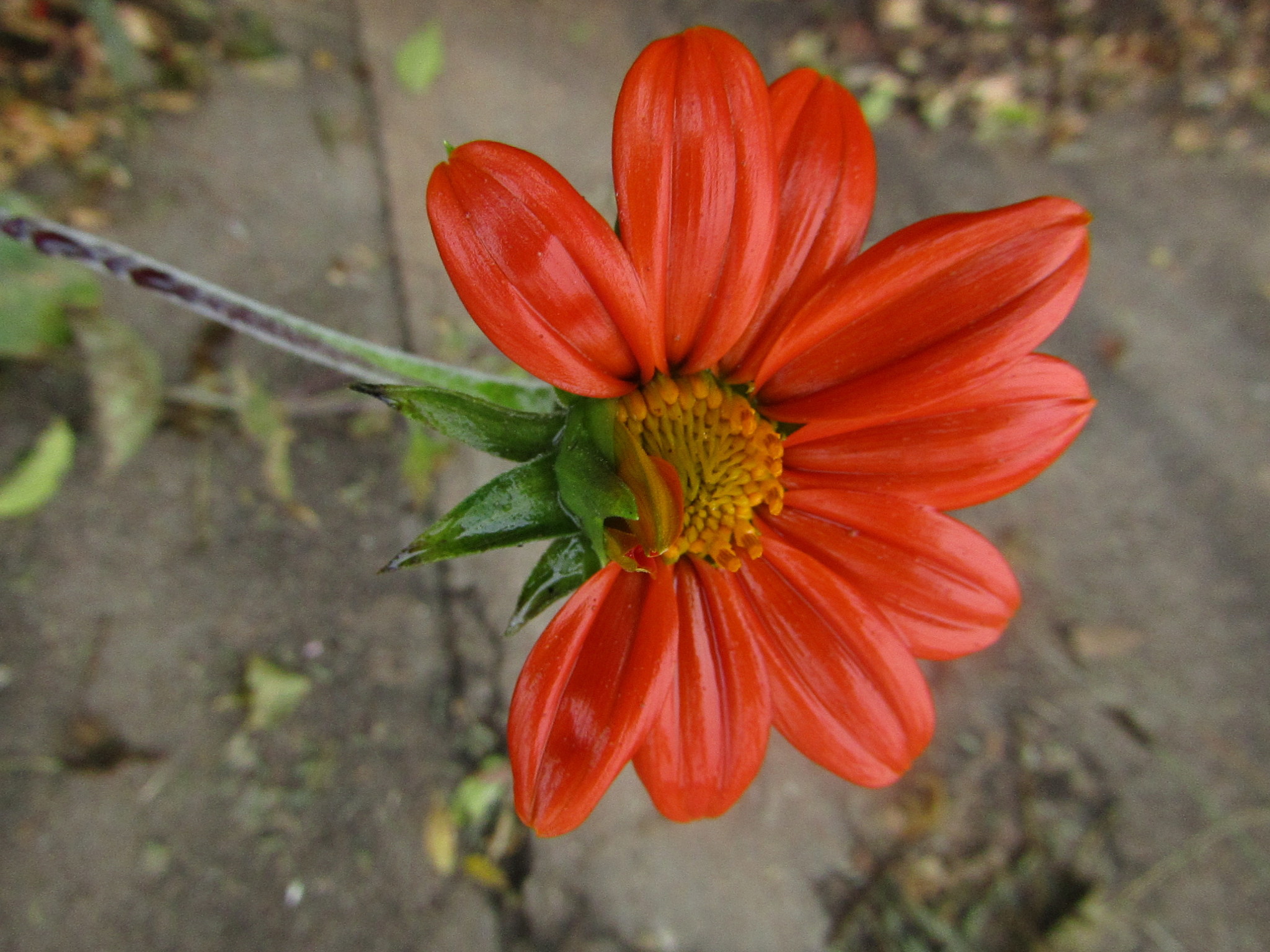
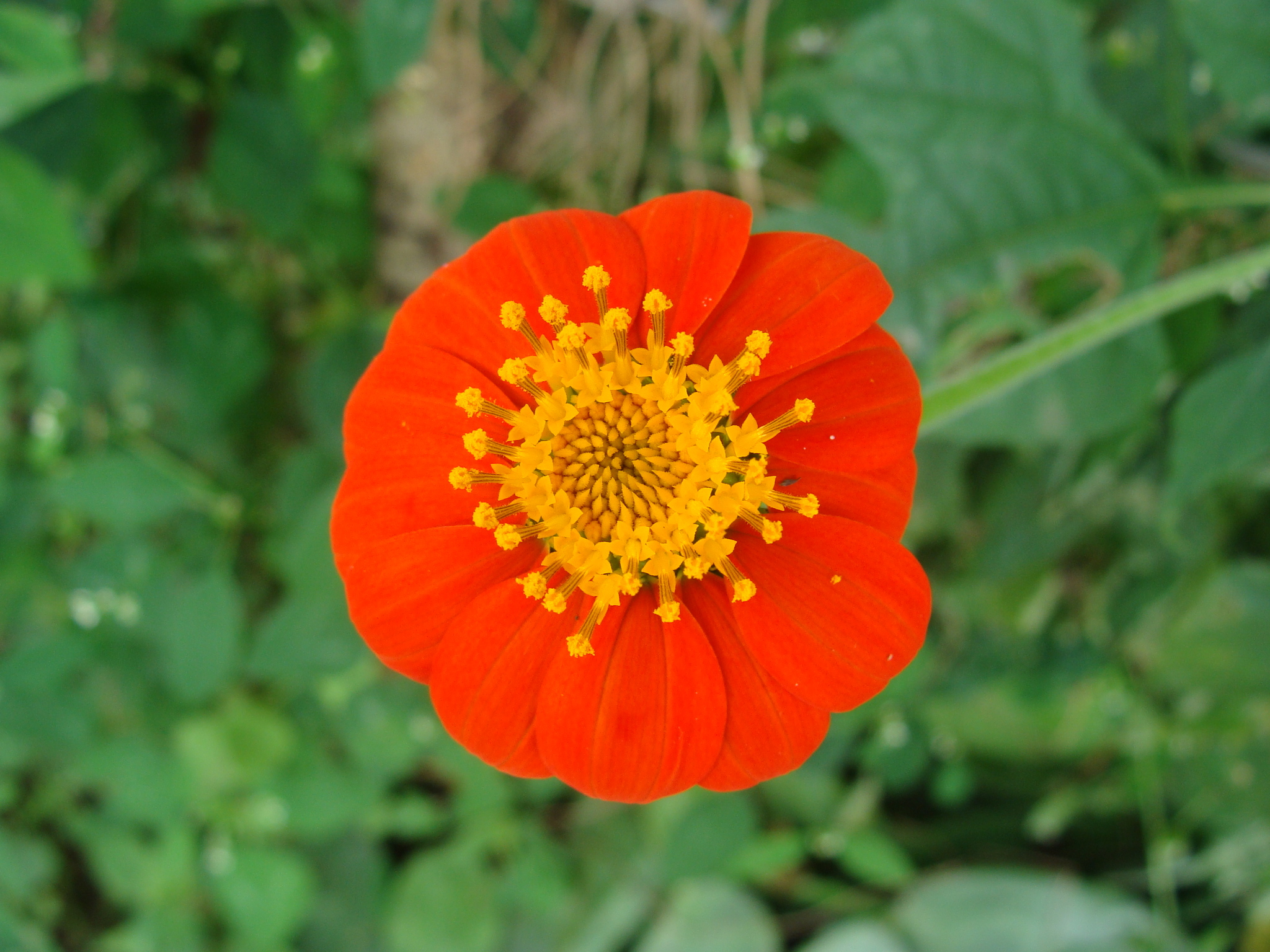
Solitary flower heads sit at the ends of long stalks. FNA usually records 8–13 ray florets, mostly orange but sometimes yellow. EAFRINET describes bright red-orange heads to 90 mm (3.5 in) across; Missouri Botanical Garden and Wisconsin Extension give flowers about 7–8 cm (2.8–3.1 in) across, from midsummer into fall. 6 12 10 9
A yellow to orange central disk is followed by brown to black achenes within the dried heads. Wisconsin Extension notes that the seeds are easy to collect for the following year’s sowing; EAFRINET describes the brown to black fruits clustered in the dry head. 9 12
Taxonomy and look-alikes
Tithonia diversifolia is the most significant look-alike and also goes by Mexican sunflower in some countries. ARC South Africa distinguishes the two: T. rotundifolia is a tall annual with red-orange flowers, whereas T. diversifolia is a taller perennial or evergreen shrub with deeply lobed leaves and more yellow-orange flowers. 13
Before flowering, EAFRINET notes that T. diversifolia can be mistaken for T. rotundifolia, but its leaves often have five more pronounced lobes and its flowers are yellower. The distinction matters for growing conditions and invasion awareness, because the two species do not always behave alike in each region. 12 13
Resemblance to true sunflowers, Helianthus, is mainly horticultural. FNA separates the genera using features of the involucre, receptacle, cypselas and flower stalks, rather than flower color alone. For gardeners, the looser habit, broad hairy leaves and brittle stems offer practical clues. 5 6
Horticultural cultivars are selections rather than separate botanical taxa. Wisconsin Extension lists Torch, Fiesta del Sol, Goldfinger and Yellow Torch among available selections. Height and color are the main reasons to choose between them. 9
Range and invasion awareness
Mexico to Central America forms the native range recorded by POWO/Kew, including Belize, Costa Rica, El Salvador, Guatemala, Honduras, Nicaragua, Panama and several regions of Mexico. WFO, GBIF and EPPO record extensive introduced occurrence outside that area. 1 3 4 11
FNA treats the species as introduced in Florida and Louisiana and notes widespread cultivation in warm climates, with plants sometimes persisting after planting. EPPO likewise gives Mexico and Central America as its origin, followed by introductions in Asia, Africa, North America, the Caribbean, South America and Australia. 6 11
The references used do not establish Mexican sunflower as an invasive alien species in metropolitan France. In temperate gardens it is primarily a frost-tender ornamental annual, grown in beds and for cut flowers. 7 10
In tropical and subtropical regions, greater caution is needed. ARC South Africa identifies T. rotundifolia and T. diversifolia as declared invasive weeds in South Africa. EAFRINET describes T. rotundifolia as naturalized or invasive in parts of East Africa, colonizing savannas, roadsides, disturbed ground and riverbank vegetation. 13 12
Plant Pono rates Tithonia rotundifolia as high risk for Hawaii, citing naturalization, seed production, dispersal by water, animals, clothing or green waste, and dense stands in Africa. Responsible cultivation therefore means preventing seed spread near sensitive habitats and checking local lists, especially in warmer climates. 14
Sowing, cultivation and care
Warmth is the central requirement for successful cultivation. RHS recommends moderately fertile, well-drained soil, full sun, shelter from strong winds and generous watering in dry periods; it also notes poor growth in cool, overcast weather. Missouri Botanical Garden likewise describes an easy warm-season annual for dry to moderately moist, drained soil in full sun. 7 10
Sow directly outdoors after the last frost, or start under cover six to eight weeks before the average last frost for earlier flowers. Wisconsin Extension advises shallow sowing because light encourages germination; Missouri Botanical Garden gives the same early-start window. 9 10
Keep soil fertility restrained. Wisconsin Extension and Missouri Botanical Garden advise avoiding rich soil and heavy feeding, which encourage foliage and weak stems. Poor to average, well-drained soil in full sun generally produces a sturdier plant with more flowers. 9 10
Water is most useful during establishment, in containers and through prolonged drought. NC State, Wisconsin Extension and Missouri Botanical Garden describe drought tolerance, but that does not remove the need for water when continuous summer flowering is the goal. 1–2.5 cm (0.4–1 in) per week is a garden starting point, reduced when rainfall is sufficient. 8 9 10
Brittle stems and flower stalks can snap. Wisconsin Extension recommends wind shelter; Missouri Botanical Garden advises staking or support, and RHS also calls for shelter from strong winds. Group planting, adequate spacing, early pinching or staking can improve stability. 9 10 7
Uses, pollinators and toxicity
Ornamental uses include the back of borders, seasonal screens, pollinator gardens and cut flowers, alongside zinnias, cosmos, grasses and other sun-loving annuals. RHS includes it among plants for pollinators; Missouri Botanical Garden describes flowers attractive to hummingbirds, butterflies and other pollinators. 7 10
NC State records visits by butterflies, bees and hummingbirds. Wisconsin Extension also mentions bumblebees, other bees, hoverflies, monarchs and swallowtails. These wildlife benefits depend on avoiding insecticides on the flowers. 8 9
For cutting, the hollow, brittle stems require careful handling. Harvest in the morning, make clean recuts, avoid crushing the stems and remove lower leaves to improve vase performance. Expect less longevity than a chrysanthemum; its appeal lies mainly in color and summer presence. 9 10
No ASPCA entry specific to Tithonia rotundifolia is among the references used. Plant Pono nevertheless lists it as non-toxic in its risk assessment, and Gardeners’ World reports no toxic effects for cats, dogs, horses, livestock or people. It is therefore treated here as non-toxic, with a dietary caution: reported non-toxicity does not make a plant food. 14 15
Uses as green manure or fodder mentioned by some invasion references should not be read as household recommendations. In a family garden, keep its role ornamental: avoid deliberate ingestion and treated plants, and seek veterinary advice if an animal eats an unusually large quantity. 12 14
Cultivars and buying plants
Torch is the most prominent horticultural name. Wisconsin Extension describes it as the most commonly offered cultivar and records its 1951 All-America Selections award. It is a useful choice for a tall orange plant at the back of a border. 9
Fiesta del Sol offers a more compact plant, around 90 cm (3 ft) tall according to Wisconsin Extension, with an AAS award in 2000. It suits smaller beds and large containers better, although full sun and drainage remain essential. 9
Goldfinger and Yellow Torch are also listed by Wisconsin Extension as available selections. The former is relatively short, while the latter carries yellow-orange flowers. Seed lots vary between suppliers, so read the mature height rather than relying on a photograph. 9
When buying, check mature height, time to flowering, species identity and the local risk of self-seeding. Depending on the country and catalog, “Mexican sunflower” may mean T. rotundifolia or T. diversifolia, so the full botanical name matters. 13 12
Responsible seed management
In a temperate garden, a few dried heads can supply seed for the following year. Wisconsin Extension notes easy seed collection, while Missouri Botanical Garden recommends direct sowing or an early start from seed. 9 10
For warmer settings near natural habitats, waterways, disturbed ground or areas vulnerable to invasive plants, remove heads before seed forms. EAFRINET records dispersal by animals, water, clothing, green waste and contaminated agricultural products. Plant Pono also cites abundant seed production and rapid maturity. 12 14
Mature seed heads need careful disposal. When seeds are fully formed, collect them in a bag or dispose of the heads according to local rules rather than throwing them onto waste ground or a cool compost heap. This precaution fits the South and East African invasion accounts, even though it goes beyond the needs of a frost-prone temperate garden. 13 12
Main sources
- Plants of the World Online / Kew, Tithonia rotundifolia
- International Plant Names Index, Tithonia rotundifolia
- World Flora Online, Tithonia rotundifolia
- GBIF Backbone Taxonomy, Tithonia rotundifolia
- Flora of North America, Tithonia
- Flora of North America, Tithonia rotundifolia
- Royal Horticultural Society, Tithonia rotundifolia
- NC State Extension Gardener Plant Toolbox, Tithonia rotundifolia
- University of Wisconsin Extension, Mexican sunflower
- Missouri Botanical Garden Plant Finder, Tithonia rotundifolia
- EPPO Global Database, Tithonia rotundifolia
- BioNET-EAFRINET, Tithonia rotundifolia red sunflower
- Agricultural Research Council South Africa, Tithonia species
- Plant Pono, Hawaii Pacific Weed Risk Assessment, Tithonia rotundifolia
- BBC Gardeners' World Magazine, Tithonia rotundifolia
Frequently asked questions
Is Mexican sunflower a true sunflower?
No. Its flower heads resemble sunflowers, but it belongs to Tithonia rather than Helianthus. Both are Asteraceae in the tribe Heliantheae.
Is Tithonia rotundifolia annual or perennial?
It is treated as an annual. POWO lists it as annual, and frost ends its life in temperate climates. References to perennial growth mainly concern frost-free climates or other Tithonia species.
When should I sow Tithonia rotundifolia?
Sow under cover six to eight weeks before the last frost for earlier flowers, or directly outdoors after frost when the soil has warmed.
Why is my tithonia growing without flowering?
Common causes include cold, shade, late sowing or excessively rich soil. It needs warmth, full sun and restrained feeding.
Does Mexican sunflower need staking?
Often yes, especially in rich soil, windy sites or tall varieties. Sources describe brittle stems and flower stalks, so discreet support helps prevent lodging.
Is Mexican sunflower good for pollinators?
Yes, in an unsprayed garden. RHS includes it among plants for pollinators, NC State lists butterflies, bees and hummingbirds, and Wisconsin Extension records many visiting insects.
Is Tithonia rotundifolia toxic to cats and dogs?
The references used report no major toxic effect, and Gardeners’ World lists no reported toxic effects for cats, dogs or horses. Deliberate ingestion is still discouraged.
Is Mexican sunflower invasive in France?
Not in metropolitan France according to the references used. However, several sources document naturalization, high risk or invasive behavior in tropical and subtropical regions, especially southern and eastern Africa.
How can I distinguish it from Tithonia diversifolia?
T. rotundifolia is mainly annual, often orange to red-orange, with leaves sometimes having three or five lobes. T. diversifolia is more shrubby or perennial, with deeply lobed leaves and yellower flowers.
Similar plants


If you are unsure about a plant’s toxicity, ask a botanist or veterinarian for advice.