
Bottlebrush asparagus (Asparagus racemosus, )
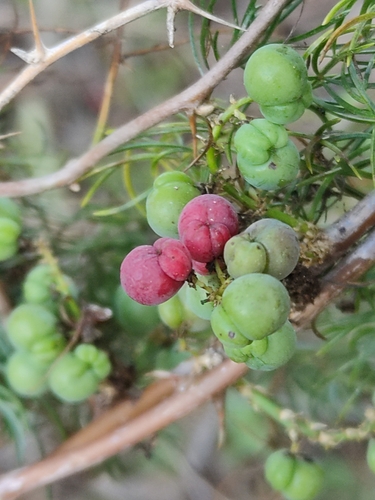

Bottlebrush asparagus (Asparagus racemosus), or Indian asparagus, is a thorny perennial climber in the Asparagaceae, native to tropical Africa, the Indian subcontinent and northern Australia. Its climbing stems carry fine, needlelike cladodes. Underground, a dense cluster of tuberous roots supplies the part harvested for traditional Ayurvedic medicine.
Read moreBottlebrush asparagus, Shatavari, Satavar and Indian asparagus
Allow a few hours of direct sun per day, preferably morning or evening.
Full sun; tolerates light partial shade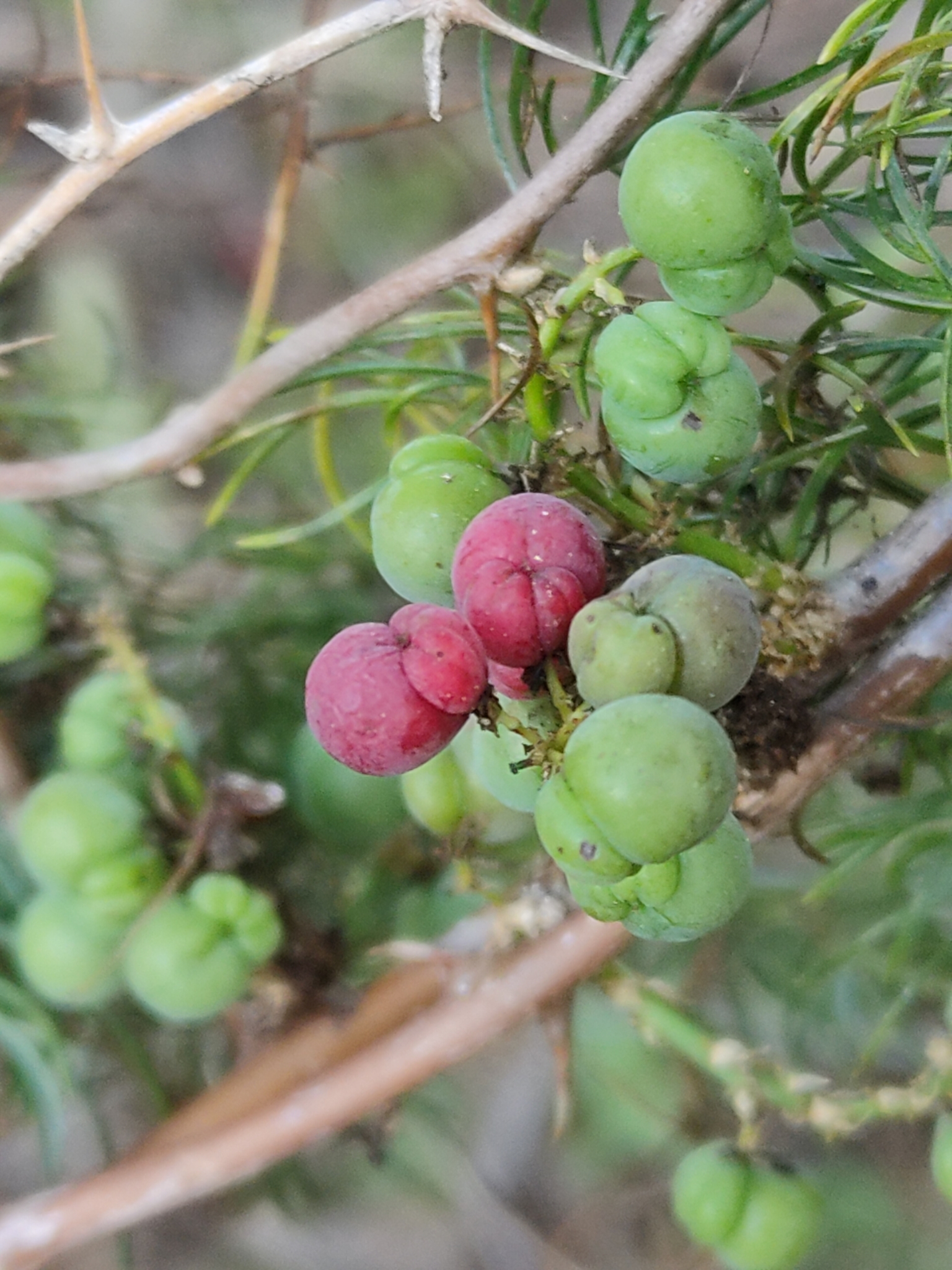


© photo
Tony van Kampen · cc-by
Wikimedia Commons · CC BY-SA or Public Domain
Wikipedia · CC BY-SA
© copyright of the Board of Trustees of the Royal Botanic Gardens, Kew.


Global distribution
The native range of Asparagus racemosus extends from tropical Africa to northern Australia, through the Indian subcontinent, western Himalaya to Kashmir, southern China and island Southeast Asia. Medicinal-root cultivation remains concentrated in India; beyond this range, cultivation is occasional and specialized.
- Native8
- India
- Sri Lanka
- Nepal
- China
- Indonesia
- Malaysia
- Ethiopia
- Australia
Hexagons: regions where the plant occurs. Green dots: native range.1
Identity
Bottlebrush asparagus (Asparagus racemosus Willd., 1799), also known as Shatavari, Satavar or Indian asparagus, is a perennial climber in the Asparagaceae. Its Sanskrit name combines śata, “hundred,” with a second element translated in different ways. Interpretations include “she who has a hundred roots” and “she who has a hundred husbands,” both associated with fertility. 5 2
French names include asperge à grappes, referring to the small axillary flower clusters, and asperge sauvage, distinguishing it from cultivated garden asparagus, Asparagus officinalis. 2
Recognition
Asparagus racemosus is a thorny climber with stems reaching 3–6 m (10–20 ft) in some populations, although the low clump itself often stands only 1–2 m (3.3–6.6 ft) tall. True leaves are reduced to minute scales. The apparent pine needles are cladodes, slender photosynthetic branches 7–40 mm (0.28–1.57 in) long in small bundles. 5 7
The stems bear curved spines sometimes exceeding 1 cm (0.4 in), useful for distinguishing the plant from softer-cladoded asparagus species. Underground, dense clusters of spindle-shaped tuberous roots, sometimes a hundred per plant, measure 30 cm to about 1 m (1–3.3 ft) long. They store water and reserves in seasonally dry climates. 5 3
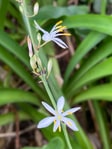
Tiny, scented flowers are white with a green stripe and arranged singly or in pairs at branch axils, in short racemes that give the species its epithet. They are followed by round red to blackish-purple berries, 4–6 mm (0.16–0.24 in) across, containing one to three seeds. 7 5
Useful taxonomy
POWO accepts Asparagus racemosus Willd., described in 1799 by German botanist Carl Ludwig von Willdenow. 1
The species was formerly placed in Protasparagus, now included again in Asparagus. Three varieties have also been described: var. zeylanicus, var. javanicus and var. tetragonus. These chiefly represent regional forms without changing practical identification of the species. 1
It is often confused with garden asparagus, Asparagus officinalis. Both have needlelike cladodes, but of these two species only shatavari develops strings of fleshy tuberous roots and a distinctly more thorny, climbing habit. 1 2
Habitat and range
Across its native range, bottlebrush asparagus grows from tropical Africa to northern Australia, through the Indian subcontinent, the western Himalaya to Kashmir, southern China and island Southeast Asia, from the Malay Peninsula to Java and Indonesia’s Tanimbar Islands. 1 5
It occupies open, well-drained sites: sunny thickets, dry-forest margins, coastal dunes and stony foothill soils. It grows from sea level to about 1,300–1,400 m (4,300–4,600 ft) in the Himalaya and 1,150 m (3,770 ft) in Malaysia. 5
In Australia, it occurs in the Northern Territory, Western Australia and Queensland, often at coastal bushland margins on loam, sandstone or lateritic soils. 7 6
Life cycle and reproduction
Bisexual flowers open chiefly from May to August, with timing varying by region, on branches usually lacking cladodes. Each flower has six white, green-striped segments 2–4 mm (0.08–0.16 in) long and six stamens before developing into a berry. 6 7
Cultivated plants are propagated by seed, soaked for 12 hours in warm water and germinating in 3–6 weeks at 25 °C (77 °F), or by division of tuberous-root clumps at the start of spring in the local growing cycle. 2
The fleshy roots take several years to develop fully. This dense root system allows survival through pronounced dry seasons in its native range, from foothills to coastal dunes. 5
Uses and risks
In India, shatavari root has a central place in the official Ayurvedic pharmacopoeia, traditionally used as a tonic, galactagogue and regulator of the female cycle. Recent clinical trials explore lactation and fertility effects, with findings still considered limited by the studies themselves. 9
Young shoots and tuberous roots are also eaten as vegetables, raw or cooked, notably during food shortages in the Garhwal Himalaya and western Rajasthan. In Indonesia, candied roots are used in a local sweet preparation. 3 5
Among Aboriginal people in the Moyle River region of Australia’s Northern Territory, the liquid from boiled roots has traditionally been used as an external wash for colds and other ailments. 8
Shatavari also appears among the common names of Asparagus densiflorus cv. sprengeri, which the ASPCA lists as toxic to dogs, cats and horses. Digestive upset after berry ingestion and dermatitis after repeated contact described for that different asparagus do not characterize the risks of Asparagus racemosus, whose veterinary status remains unknown. Unknown status does not guarantee safety. 4
Varieties, look-alikes and related plants
No established horticultural cultivar is documented for this species, grown chiefly for its roots rather than selected ornamental foliage or flowers. Recorded variations such as var. zeylanicus in Sri Lanka and var. javanicus in Southeast Asia remain regional botanical forms rather than garden selections. 1
Garden asparagus, Asparagus officinalis, is a frequent source of confusion, whose spears are harvested in spring. The part chiefly sought in Asparagus racemosus is the tuberous root rather than the young shoot, and it retains a distinctly thorny, climbing habit unlike cultivated garden asparagus. 2 1
Other climbing asparagus species from Asia and Africa share a similar thorny outline, needlelike cladodes and armed stems. The number and arrangement of tuberous roots in clusters provide a more dependable field distinction for Asparagus racemosus than this general silhouette alone. 5
Main sources
- Plants of the World Online / Kew, Asparagus racemosus Willd.
- Plants For A Future, Asparagus racemosus (Shatavari)
- Purdue University Famine Foods, Asparagus racemosus
- ASPCA, Asparagus densiflorus cv. sprengeri (Racemose asparagus)
- PROSEA via Pl@ntUse, Asparagus racemosus
- FloraBase Western Australia (DBCA), Asparagus racemosus
- eFlora of the Northern Territory, Asparagus racemosus
- Wikipedia EN, Asparagus racemosus
- NIH Drugs and Lactation Database (LactMed), Asparagus racemosus
Frequently asked questions
Is shatavari the same plant as edible asparagus?
No. Asparagus racemosus and garden asparagus, Asparagus officinalis, share a genus but are distinct species. The part chiefly sought in shatavari is its tuberous root, rather than a spring spear comparable to cultivated asparagus.
Is shatavari toxic to cats and dogs?
The name shatavari can cause confusion: the ASPCA lists Asparagus densiflorus cv. sprengeri, a different species, as toxic to cats, dogs and horses. The veterinary status of Asparagus racemosus remains unknown; this does not guarantee its safety.
Which part of shatavari is used in herbal medicine?
The tuberous root, dried and made into powder or extract, is used in traditional Ayurvedic medicine, notably as a tonic and galactagogue.
Where does the name shatavari come from?
It comes from Sanskrit śata, meaning hundred, referring to the dense cluster of tuberous roots on each plant. Some poetic translations also give she who has a hundred husbands, alluding to traditional fertility-related use.
Can shatavari grow in France?
Only in a container or a very mild climate, protected from frost and brought under protection below 5 °C (41 °F). It needs very well-drained soil and a sunny position, conditions rarely combined outdoors in the ground outside France’s mildest regions.
How do you recognize shatavari in the field?
A thorny climbing habit, fine needlelike cladodes, clusters of tuberous roots beneath the clump and small white, green-striped flowers in short racemes are the most dependable features.
Is shatavari threatened?
It has not been assessed globally by the IUCN, but overharvesting wild roots is regularly reported as a cause of local decline in parts of India.
Similar plants
If you are unsure about a plant’s toxicity, ask a botanist or veterinarian for advice.