
Holy basil (Ocimum tenuiflorum, )
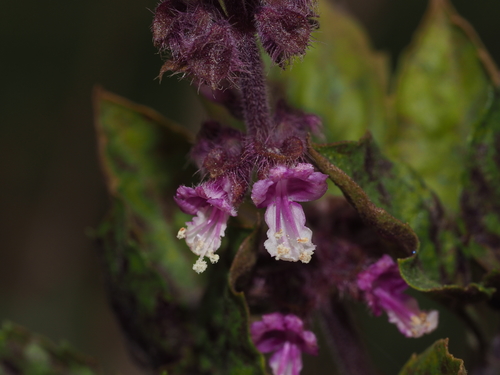


Holy basil (Ocimum tenuiflorum) is an aromatic subshrub in the Lamiaceae, native to the Indian subcontinent and tropical Asia, described by Linnaeus in 1753. Hairy, often purple stems and a peppery, clove-like scent distinguish it from culinary basil. Known as tulsi, it has a central ritual role in Hinduism.
Read moreHoly basil, Tulsi and Tulasi
Place in full sun, with intense direct light all day long.


© photo
(c) 小铖/Smalltown, some rights reserved (CC BY-NC), uploaded by 小铖/Smalltown · cc-by-nc
Wikimedia Commons · CC BY-SA or Public Domain
Taken Sep 5, 1954 by Royal Botanic Garden Edinburgh - Colin Alistair Pendry (cc-by-nc)
© copyright of the Board of Trustees of the Royal Botanic Gardens, Kew.




Global distribution
The native range of Ocimum tenuiflorum spans the Indian subcontinent and tropical and subtropical Asia, reaching Australia and the western Pacific. Widely cultivated beyond this range, it has locally naturalized in tropical parts of the Americas.
- Native4
- Introduced1
- India
- Sri Lanka
- Indonesia
- Northern Australia
- Brazil
Hexagons: regions where the plant occurs. Green dots: native range.1
Identity
Holy basil (Ocimum tenuiflorum L., 1753), or tulsi, is an aromatic subshrub in the genus Ocimum, family Lamiaceae. Carl Linnaeus described it; it long circulated as Ocimum sanctum, now treated as a synonym of the accepted name. 1 5
The name tulsi comes from Sanskrit and literally means “the incomparable one.” Its central ritual role in Hinduism places the plant near temples and homes rather than only in vegetable gardens. 5 6
Around sixty aromatic species belong to Ocimum. Among Lamiaceae cultivated in Europe, O. tenuiflorum combines two unusual roles: a medicinal plant with documented Ayurvedic use and a plant of daily devotion in Hindu households. 5
Recognition
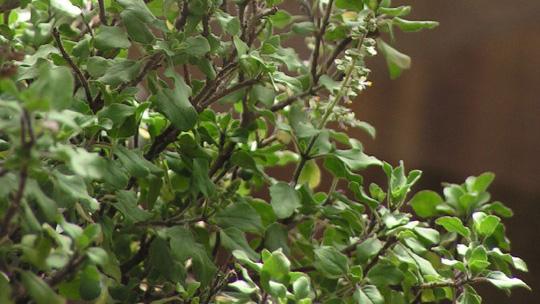
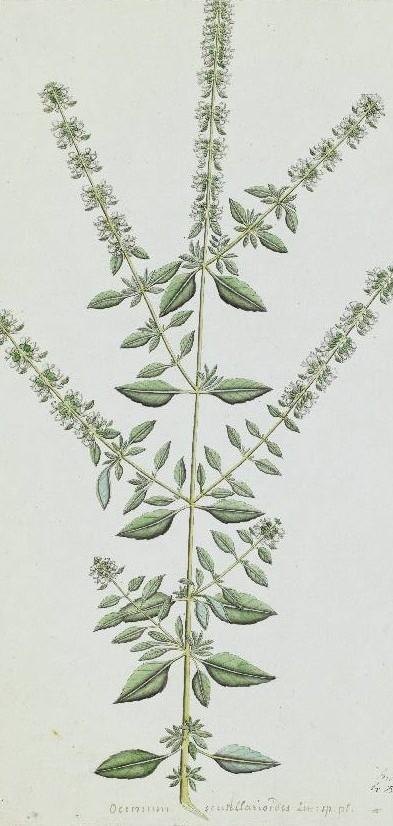
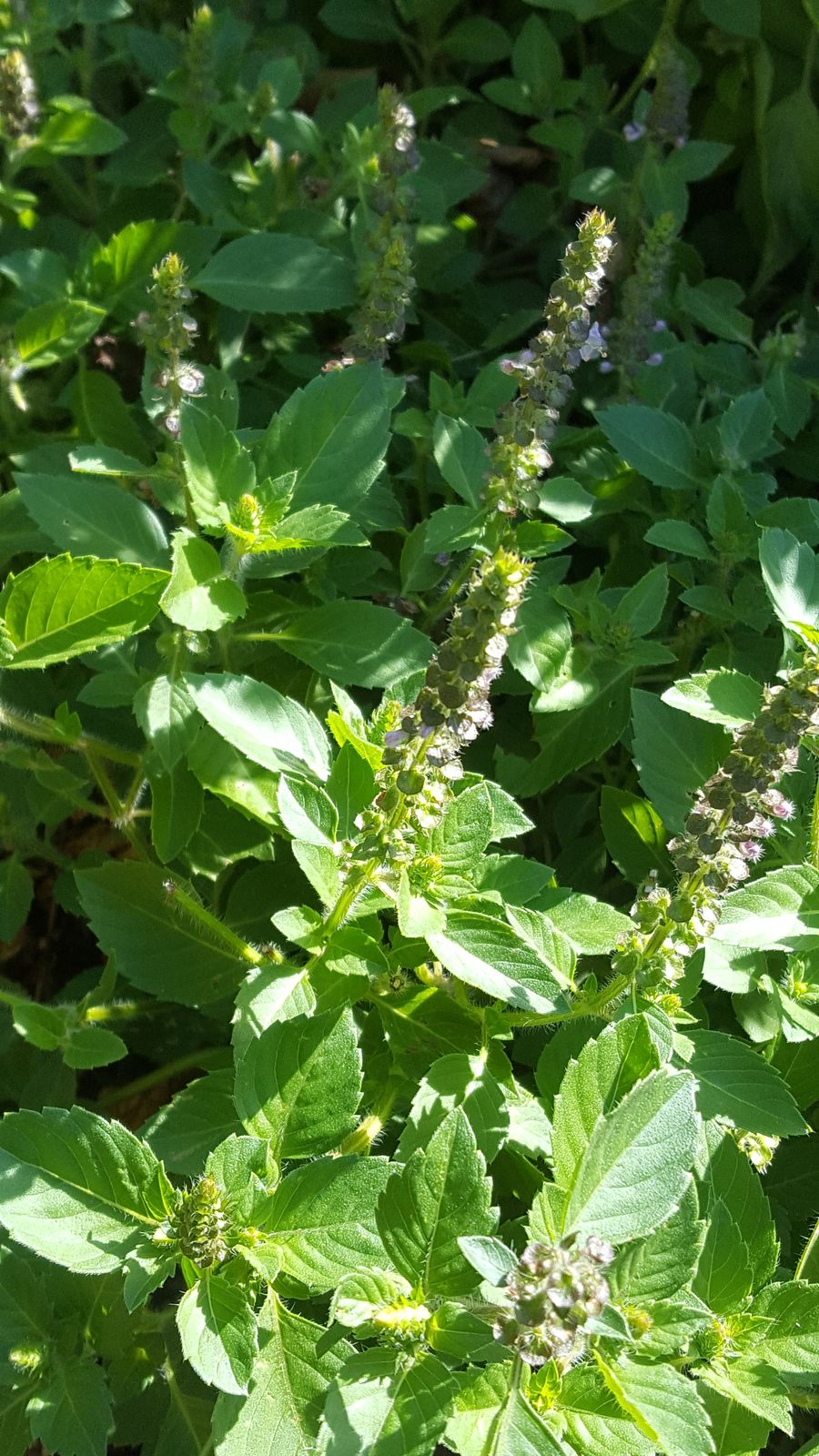
Upright and branched, Ocimum tenuiflorum has square, hairy stems and reaches 30–100 cm (12–39 in) depending on cultivation and climate. Oval, slightly toothed, stalked leaves smell more peppery and clove-like than culinary basil, the most reliable distinction by scent. 4 2
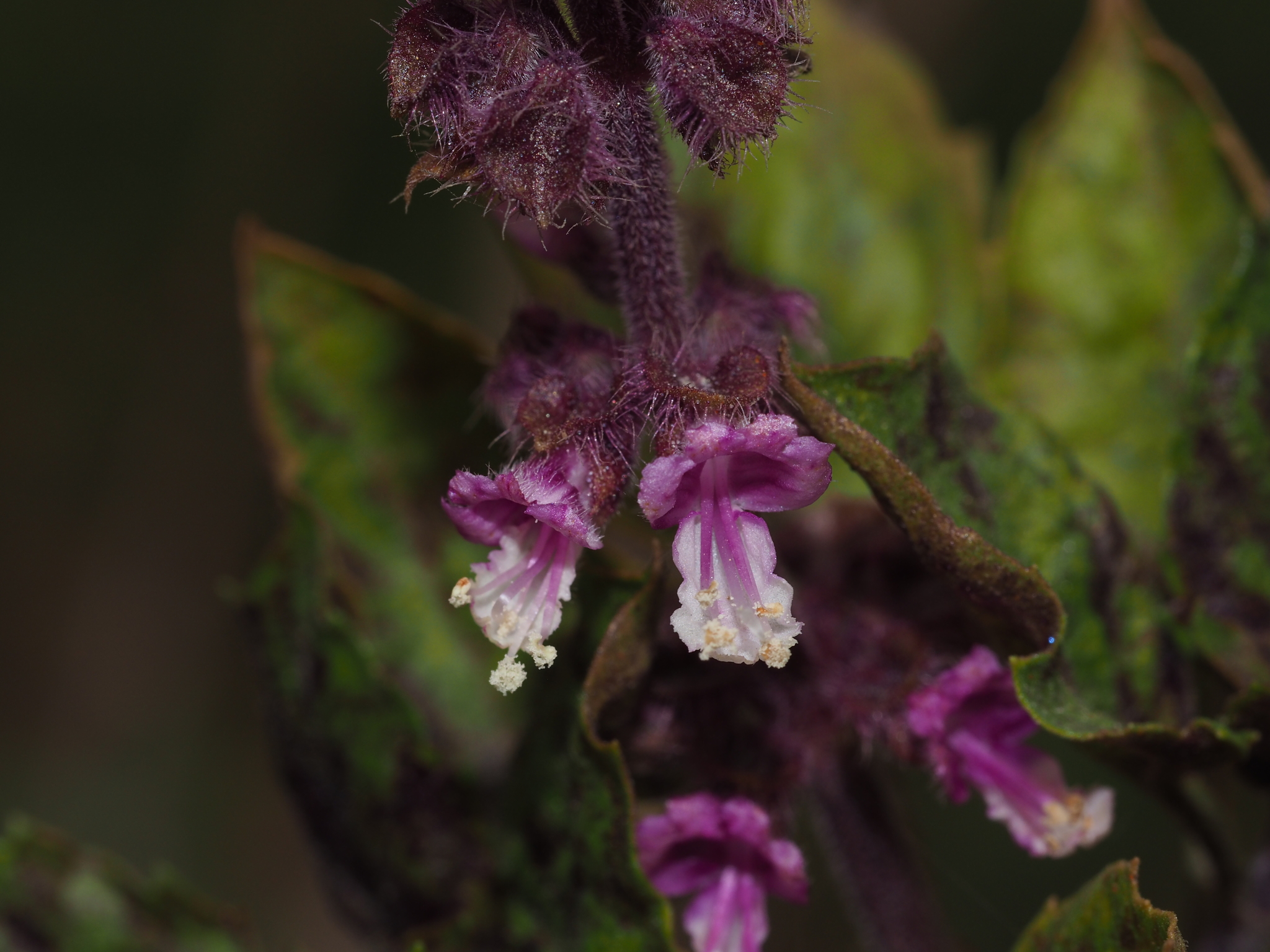
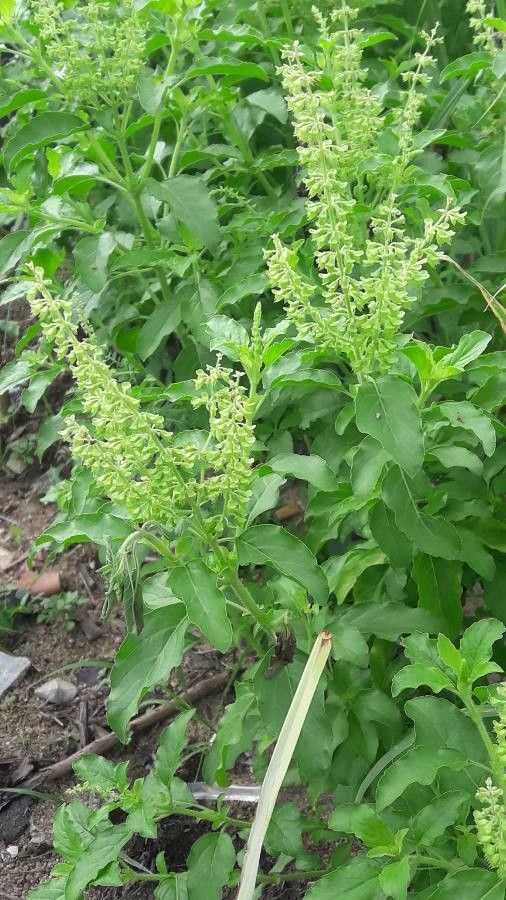
Mauve to white flowers form whorls along upright terminal spikes 4–12 cm (1.6–4.7 in) long. Leaves and stems range from bright green to dark purple according to morphotype; combine color with scent to distinguish other Ocimum species. 3 2
Hairiness on stems and leaves also helps: culinary basil with hairless or sparsely hairy stems is not holy basil, despite a similar seedling habit. Crushing a leaf gives a quick field comparison in seconds, rather than waiting weeks for flowers to provide a visual distinction. 4
Useful taxonomy
For POWO, Ocimum tenuiflorum is the accepted name; Ocimum sanctum L. and Ocimum hirsutum Benth. are among its frequently cited synonyms. The accepted binomial is the dependable reference, since nursery labels and seed packets still mix the two names indiscriminately. 1 8
Historical synonyms (scientific names):
- Ocimum sanctum L.
- Ocimum hirsutum Benth.
- Ocimum villosum Roxb.
- Moschosma tenuiflorum (L.) Heynh.
This extensive synonymy explains why different sources use different names for the same plant, sometimes within a single scientific paper. 1
Habitat and range
Across the Indian subcontinent and tropical and subtropical Asia, the native range reaches Australia and the western Pacific. Before widespread cultivation, the plant grew spontaneously on waste ground, around settlements and in warm-climate thickets. 1 4
Introduced beyond its original range long ago, it has sometimes escaped cultivation and naturalized in tropical parts of the Americas, where it can become an agricultural weed locally. In temperate climates it remains a pot plant, sensitive to cold below 10 °C (50 °F). 5 3
Cultivated plants tolerate soils from sandy to loamy provided they drain well; continuously waterlogged substrate is poorly tolerated. In regions with hot, humid summers, Japanese beetles are reported as the most damaging foliage pest, ahead of less harmful aphids and leafhoppers. 3
Life cycle and reproduction
Fine seed germinates in one to two weeks in warmth at 20–28 °C (68–82 °F). Shoot tips can first be harvested 8–10 weeks after sowing, before stems harden. The plant then forms a branching clump that withstands repeated harvests without exhaustion, provided its substrate drains and never stays waterlogged. 4 3
Left unpruned, the plant produces flower spikes and seeds, then hardens and loses its tender aromatic growth. In favorable climates it self-seeds; in pots in temperate climates, propagation mainly uses seed and, less often, cuttings of soft, nonflowering stems. 2 4
Uses and risks
Tulsi has Ayurvedic and ritual roles far beyond cooking: leaf infusions, traditional preparations for fever or digestive complaints, and daily veneration in Hindu homes, where it is associated with the goddess Lakshmi. 5 6
Culinary use is less prominent than for sweet basil. Dried stems also traditionally repel insects in grain stores, a practice long documented in South Asia. 5
No major toxicity is documented for the species itself. The ASPCA lists culinary basil (Ocimum basilicum) as non-toxic to cats and dogs. With no dedicated holy basil entry, this genus-level assessment is the closest available reference; horse status remains unknown. 7
Varieties, look-alikes and related plants
Three morphotypes dominate Indian cultivation: Rama tulsi, with bright green leaves and a milder flavor; Krishna tulsi, or Shyama tulsi, with dark purple stems and leaves; and Vana tulsi, a wild type sometimes assigned to another species rather than a strict variety of O. tenuiflorum. 5 2
Commonly confused basils include:
- Ocimum basilicum, culinary basil, with a milder scent and no comparable ritual use;
- Ocimum gratissimum, African basil, sometimes sold as vana tulsi;
- Ocimum americanum, a lemon-scented basil with narrower leaves.
Scientific names and the scent of crushed leaves are the most dependable criteria for separating these close basils. Foliage color alone is less reliable because light exposure also changes it. Nurseries often sell these species side by side without dependable botanical labels. 8
Main sources
- Plants of the World Online / Kew, Ocimum tenuiflorum L.
- Royal Horticultural Society, Ocimum tenuiflorum - holy basil
- NC State Extension Gardener Plant Toolbox, Ocimum tenuiflorum
- Plants For A Future, Ocimum tenuiflorum
- Wikipedia EN, Ocimum tenuiflorum
- French Wikipedia, Ocimum tenuiflorum
- ASPCA, Basil (Ocimum basilicum) non-toxic entry
- GBIF Backbone Taxonomy, Ocimum tenuiflorum
Frequently asked questions
Is holy basil the same as culinary basil?
No. Holy basil (Ocimum tenuiflorum) and culinary basil (Ocimum basilicum) are distinct species in the same genus, with different scents and traditional uses.
Is tulsi toxic to cats or dogs?
No major toxicity is documented for the genus Ocimum. The ASPCA lists culinary basil as non-toxic to cats and dogs, the closest genus-level reference in the absence of an entry specifically for holy basil.
Why are tulsi stems sometimes purple?
Purple coloring mainly marks the Krishna (Shyama) tulsi morphotype; Rama tulsi retains greener stems and leaves.
Can holy basil grow in a temperate climate?
Yes, but in a pot brought indoors for winter or as an annual resown each year, as in metropolitan France. It does not tolerate prolonged temperatures below 10 °C (50 °F).
Which plants are confused with Ocimum tenuiflorum?
The commonest confusions involve Ocimum basilicum, Ocimum gratissimum and Ocimum americanum, three other basils with similar habits and scents.
Why is tulsi sacred in Hinduism?
In Vaishnavism, the plant is revered as a plant manifestation associated with the goddess Lakshmi. It is grown near temples and homes and used in daily household rituals.
Similar plants
If you are unsure about a plant’s toxicity, ask a botanist or veterinarian for advice.