
Spider plant (Chlorophytum comosum, )
 +1
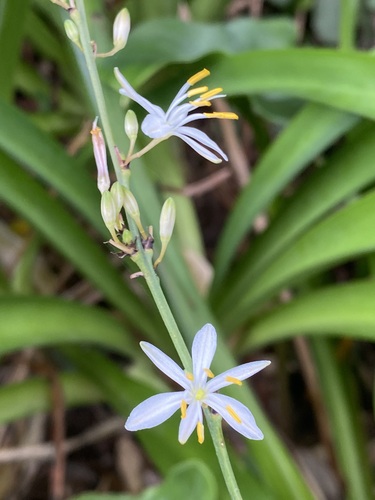
+1The spider plant (Chlorophytum comosum) is a herbaceous perennial in the Asparagaceae, native to tropical and southern Africa. It forms a dense rosette of arching, strap-shaped leaves and sends out long runners tipped with dangling plantlets, which gave it its name. Mostly grown in hanging baskets, it remains one of the most forgiving houseplants and one of the easiest to propagate.
Read moreAirplane plant and Ribbon plant
Place in indirect light or in a shaded room.
Global distribution
The native range of Chlorophytum comosum runs from West and Central Africa (Ivory Coast, Cameroon, Nigeria) to East and southern Africa (Ethiopia, Kenya, Tanzania, South Africa), in the seasonally dry tropical biome. Widely grown as a houseplant, the species has become locally naturalized in Western Australia, so native range, cultivated regions and regions of introduction need to be kept apart.
- Native6
- Introduced1
- South Africa
- Kenya
- Ethiopia
- Cameroon
- Tanzania
- Nigeria
- Western Australia
Hexagons: sourced regions. Green dots: native range. Statuses according to POWO (Kew).
Identity
The spider plant (Chlorophytum comosum (Thunb.) Jacques, 1862) is a herbaceous perennial in the genus Chlorophytum, part of the asparagus family, Asparagaceae. Few houseplants are more widespread, and it owes that place to its toughness and how readily it multiplies. 1 2
Its common name comes from the plantlets hanging at the ends of long, thin runners, like spiders dangling from their threads. In French-speaking horticulture it goes by phalangère, and in western Switzerland by herbe vaudoise. 3 The genus name Chlorophytum joins the Greek chloros, "yellow-green" or "green," with phyton, plant, a nod to the foliage, while the epithet comosum refers to the tufted, hair-like look of the rosette. 4 5 English speakers also call it airplane plant or ribbon plant, and German speakers know it as Grünlilie, "green lily." 6
Recognition
Look first at the rosette: dense, built from narrow, arching, strap-shaped leaves 20–45 cm (8–18 in) long, plain bright green or striped with white or yellow depending on the cultivar. 7 8 In a pot, the foliage typically stands 30–45 cm (12–18 in) tall and spreads 30–60 cm (12–24 in), more once the runners trail from a hanging basket. 5 9
The runners are the giveaway. These long, slender stems carry small plantlets at their tips, already equipped with leaves and root buds. Once they touch moist potting mix, the plantlets root quickly and become new plants. 8 5
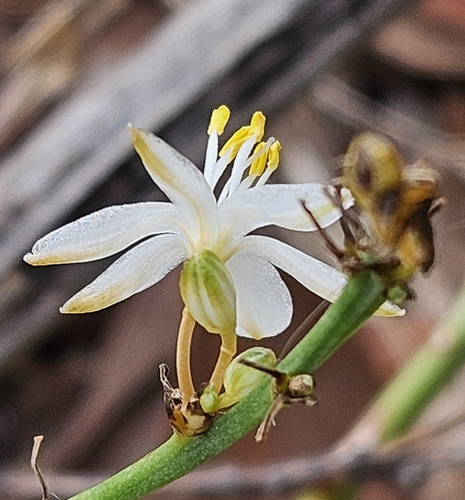
Small white flowers about 1 cm (0.4 in) across open along a branched flowering stem that can grow quite long. 3 7 Below ground, the plant builds fleshy, tuberous roots that store water and eventually distort pots that are too tight. 5
Useful taxonomy
Thunberg described the species, and Jacques moved it to its current genus in 1862; the accepted name is Chlorophytum comosum (Thunb.) Jacques. 1 Beyond the botanical name, most confusion comes from trade names and variegated cultivars. The main reference points are:
- Chlorophytum comosum (Thunb.) Jacques: accepted name
- Anthericum comosum Thunb.: historical basionym
- Chlorophytum comosum 'Vittatum': cultivar with a white central stripe
- Chlorophytum comosum 'Variegatum': cultivar with white margins
The genus Chlorophytum sits in the Asparagaceae, subfamily Agavoideae. Retail names such as "airplane plant" or "ribbon plant" do not mark separate species; the accepted scientific name is the stable reference. 1 2 The reference chromosome number is 2n = 28. 10
The story of its description has a literary twist. In 1827 the still-unknown plant reached the Belvedere botanical garden near Weimar; Goethe received an offshoot, wrote a description and sent it in January 1828 to the Prague botanist Kaspar Maria von Sternberg. Sternberg published the first valid name that same year, Anthericum comosum, the basionym of the species. 1
Habitat and range
Across Africa, the native range of Chlorophytum comosum is broad. In the west it covers Sierra Leone, Liberia, Ivory Coast, Burkina Faso, Nigeria, Cameroon and Equatorial Guinea; in the east and south, Sudan, Ethiopia, Kenya, Uganda, Tanzania, Malawi, Mozambique, Zambia, Zimbabwe, Eswatini and South Africa. 1 1 The plant grows in the seasonally dry tropical biome, in shaded understory and in some coastal areas. 4 8
Brought to Europe around the middle of the 19th century, it went on to become a houseplant worldwide. 3 Outside its home range it is almost always cultivated, but it has naturalized locally in mild climates, notably in Western Australia and Bangladesh. 7 In France the species is known only in cultivation, and it is listed on that basis in the national species inventory run by the Muséum national d'Histoire naturelle. 11 Native African range, regions where it is simply grown and areas of introduction therefore need to be kept apart.
Life cycle and reproduction
Indoors, the plant reproduces mostly vegetatively. Plantlets form at the tips of the runners when the plant gets short days and long, uninterrupted nights, meaning less than twelve hours of light a day, for at least three weeks. 9 5 That photoperiod trigger explains why some plants kept under bright lamps in the evening never produce "babies."
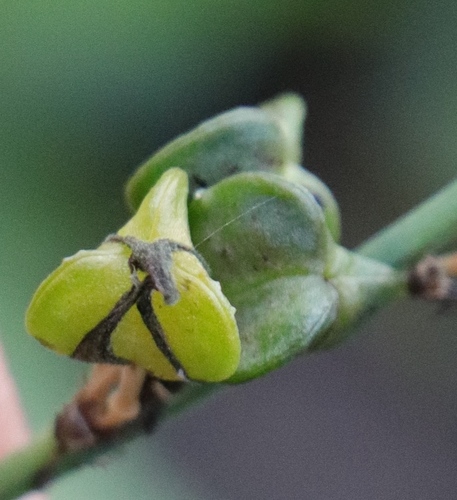
The easiest way to propagate it is to set a plantlet on moist potting mix, where it roots within a few days, or to divide an old clump, whose fleshy roots pull apart easily. 8 2 Growing from seed collected from the capsules works, but it does not faithfully reproduce the variegation of the cultivars. 8
Heavy feeding favors foliage at the expense of runners, so a moderate dose of fertilizer is the better route to plantlets. 5
Uses and risks
Most spider plants are grown as ornamentals, usually in a hanging basket that shows off the trailing runners; where winters stay frost-free, the plant can also serve as a ground cover in partial shade. 2 It suits beginners: very tolerant, it accepts a wide range of conditions as long as it is kept from frost and direct sun. 2 5
On safety, the ASPCA lists Chlorophytum comosum as non-toxic to cats, dogs and horses. 12 9 That makes it one of the few houseplants worth recommending in a home with pets, often the deciding point against irritating species such as the aroids.
In its home range, the species also has a traditional use: the tuberous roots are reported to be edible, and the Nguni peoples of South Africa credit them with a mild laxative effect. 7 4
The spider plant is often promoted as an air purifier since the NASA Clean Air Study, which listed it among species able to absorb certain compounds in a sealed chamber. 7 In real indoor conditions, the measured effect is small and debated; grow it because it is easy, not for a supposed cleaning function. 7
Varieties, look-alikes and related plants
The best-selling forms are variegated cultivars, not separate species. 'Vittatum' carries a broad white central stripe, while 'Variegatum' has white margins on darker green leaves; both have received the RHS Award of Garden Merit. 7 2 'Bonnie' is a compact selection with curly leaves.
Before buying, check the condition of the fleshy roots, the firmness of the rosette and whether the runners are healthy. A plant bought for its plantlets may carry none if it is young or has been grown under long hours of light. Among rosette-forming houseplants, the spider plant stands apart through its arching, strap-shaped leaves and above all its plantlet-bearing runners, which no Sansevieria or Dracaena look-alike produces. 9
Main sources
- Plants of the World Online / Kew, Chlorophytum comosum (Thunb.) Jacques
- Royal Horticultural Society, Chlorophytum comosum, spider plant
- Missouri Botanical Garden Plant Finder, Chlorophytum comosum
- NC State Extension, Chlorophytum comosum
- University of Wisconsin Horticulture Extension, Spider Plant, Chlorophytum comosum
- ASPCA, Spider Plant (Chlorophytum comosum) non-toxic entry
- Wikipedia (FR), Chlorophytum comosum
- Wikipedia (EN), Chlorophytum comosum
- SANBI PlantZAfrica, Chlorophytum comosum
- Encyclopaedia Britannica, spider plant
- INPN / French National Museum of Natural History, Chlorophytum comosum
- Tropicos / Missouri Botanical Garden, Chlorophytum comosum chromosome counts
Frequently asked questions
Is the spider plant toxic to cats and dogs?
No. The ASPCA lists Chlorophytum comosum as non-toxic to cats, dogs and horses. It is one of the few houseplants considered safe around pets.
Why does my spider plant have brown tips?
Brown tips most often come from dry air, a potting mix left too dry, or the fluoride and chlorine in tap water. Filtered water or rainwater and steady moisture keep the problem in check.
How do you propagate a spider plant?
The simplest way is to set a plantlet formed at the end of a runner on moist potting mix, where it roots within a few days. An old clump can also be divided, or the plant grown from seed, but seedlings do not reproduce the variegation.
Why is my plant not producing plantlets?
Plantlets appear mainly when the plant gets short days and long, uninterrupted nights for at least three weeks. A plant that is too young or overfertilized also produces fewer of them.
Does the spider plant really purify the air?
The NASA Clean Air Study listed it among plants able to absorb certain compounds in a sealed chamber. In real indoor conditions, the measured effect is small and still debated by researchers.
Where does the spider plant come from?
Its native range runs from West and Central Africa to East and southern Africa, in seasonally dry tropical habitats. Today it is grown as a houseplant all over the world.
Similar plants
Botanical data compiled from reference sources (RHS, Kew Gardens, POWO). This profile is for guidance only and is not a substitute for advice from a botanist or veterinarian if you have concerns about toxicity.