
Malabar spinach (Basella alba, )
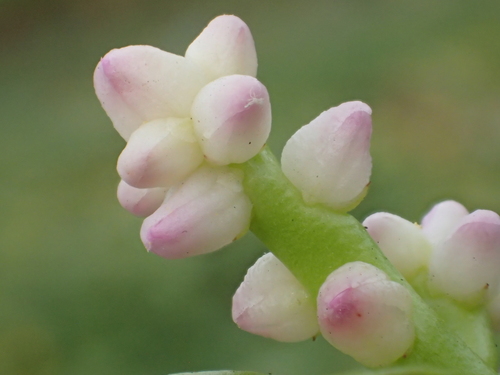

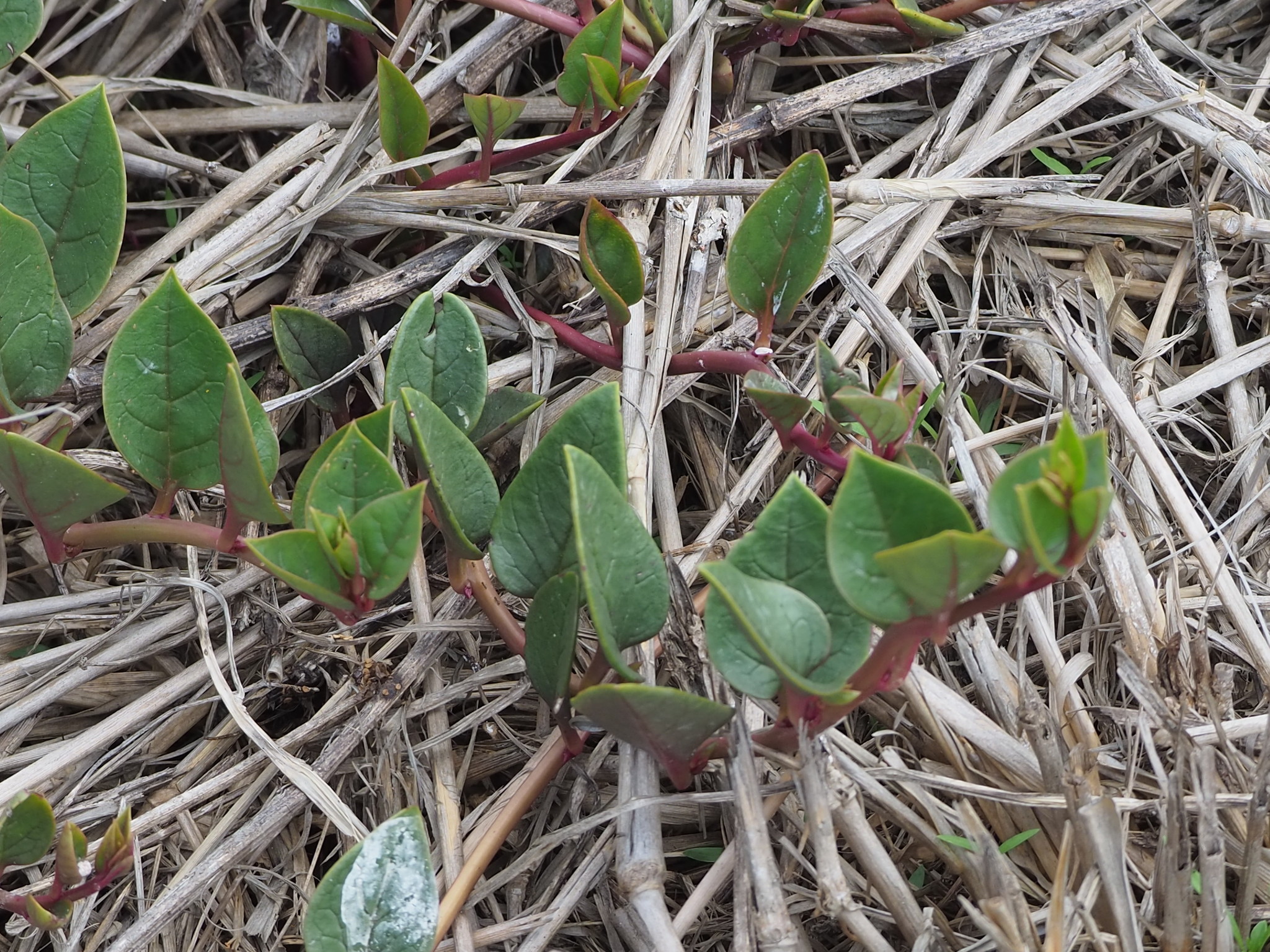
Malabar spinach (Basella alba) is a herbaceous climbing vine in the Basellaceae family, grown as a leafy vegetable throughout tropical Asia and much of Africa. Its fleshy green or reddish-purple stems carry thick, glossy leaves that release mucilage used to thicken broths. Frost kills it, so in temperate climates it is grown as a summer annual on stakes or a trellis.
Read moreMalabar spinach, Ceylon spinach, Vine spinach, Indian spinach and Alugbati
Allow a few hours of direct sun per day, preferably morning or evening.
Full sun; tolerates light partial shade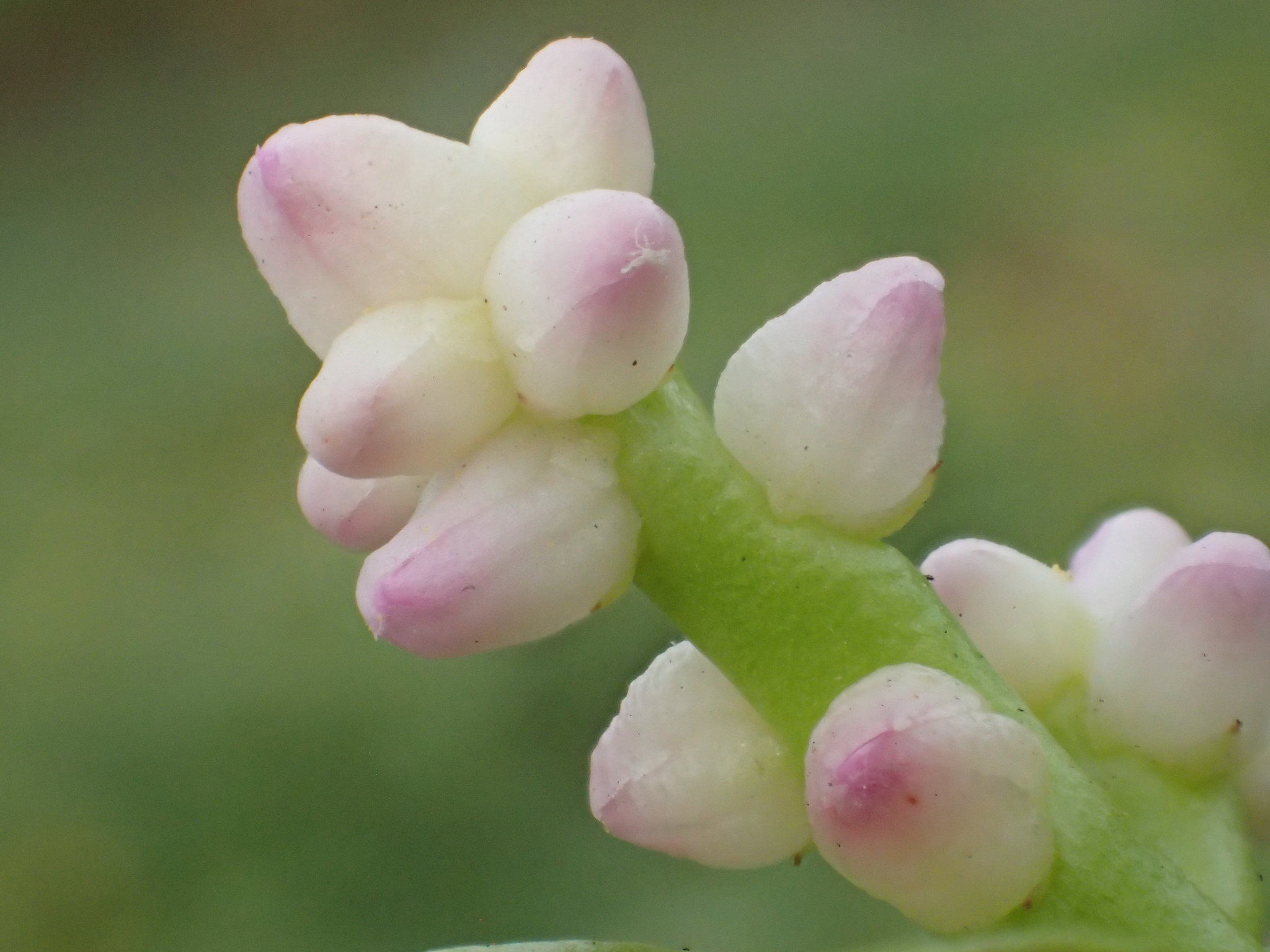

© photo
no rights reserved, uploaded by 葉子 · cc0
葉子 · cc0
Jacek Pietruszewski · cc-by
Taken Aug 31, 2022 by Brasil Bruno (cc-by-sa)
© copyright of the Board of Trustees of the Royal Botanic Gardens, Kew.


Global distribution
Basella alba is native to tropical Asia, from the Indian subcontinent through Southeast Asia to New Guinea, although some authors suggest tropical African origins. It is now cultivated and sometimes naturalized across much of the tropical and subtropical world. In temperate climates, the first frost kills it.
- Native4
- Introduced3
- India
- Sri Lanka
- Indonesia
- Papua New Guinea
- Nigeria
- Brazil
- United States (Florida)
Hexagons: regions where the plant occurs. Green dots: native range.1
Identity
Malabar spinach (Basella alba L., 1753), also known as Ceylon spinach, vine spinach, Indian spinach and alugbati, is a herbaceous climber in Basellaceae, order Caryophyllales. The spinach name describes a culinary resemblance: it is unrelated to true spinach (Spinacia oleracea, Amaranthaceae), though the cooked leaves taste similar. 1 6
The epithet alba, meaning “white,” historically distinguished this form from red-stemmed plants described separately as Basella rubra. Linnaeus published both names on the same day in 1753 in Species Plantarum. In 1832 William Roxburgh selected alba as the accepted name, treating rubra as a synonym. 2
Recognition
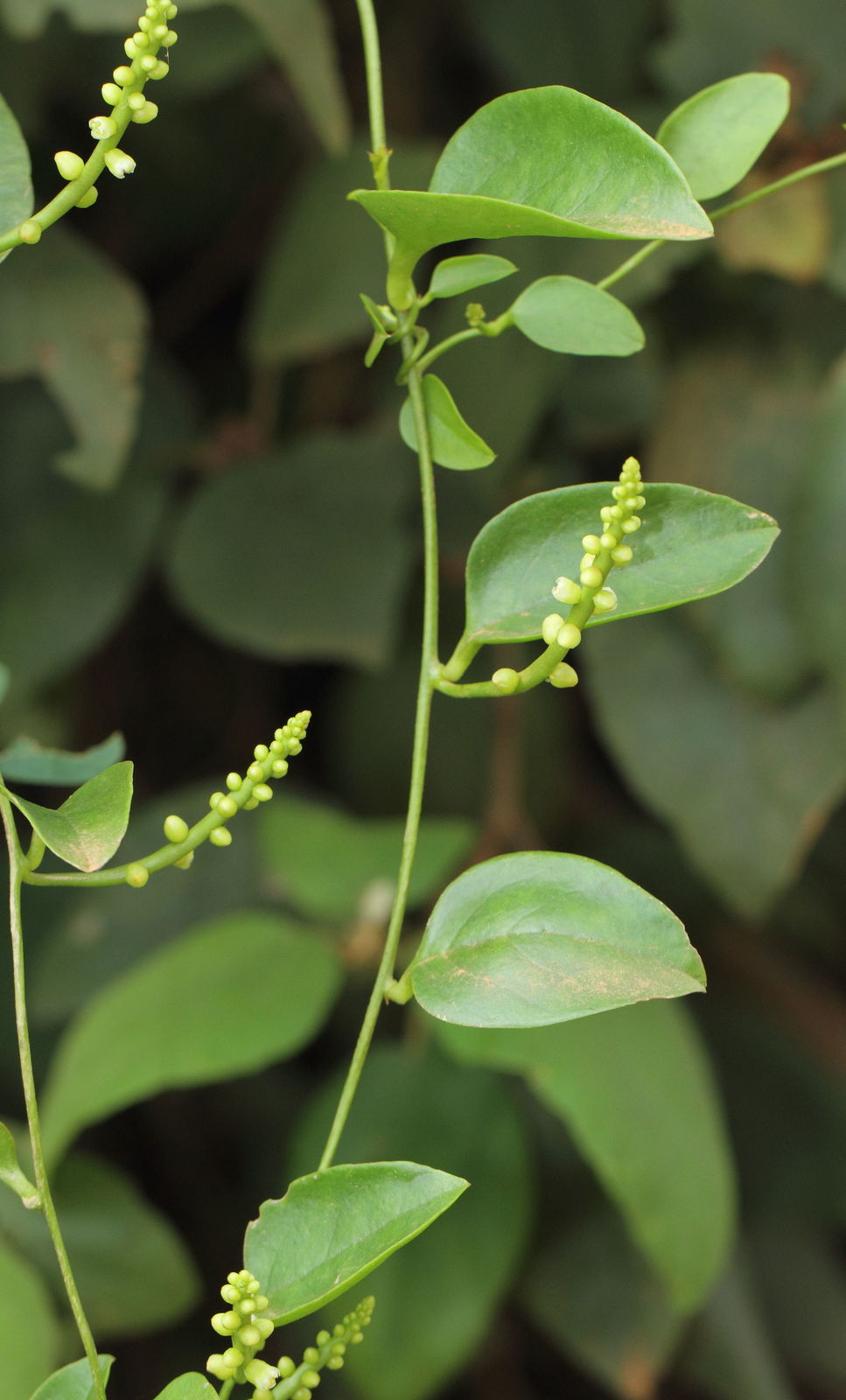
Fleshy, hairless, brittle stems twine around any available support. In strong heat, this herbaceous vine can exceed 4 m (13 ft) in one season. A plant grown in a large container stays more compact, at around 1–2 m (3–7 ft). 6 4
Thick, glossy leaves are simple and oval to heart-shaped, often larger and more tender in partial shade than in full sun. Cutting or cooking releases sticky mucilage, the same kind of texture that makes okra useful for thickening sauces. 5 6
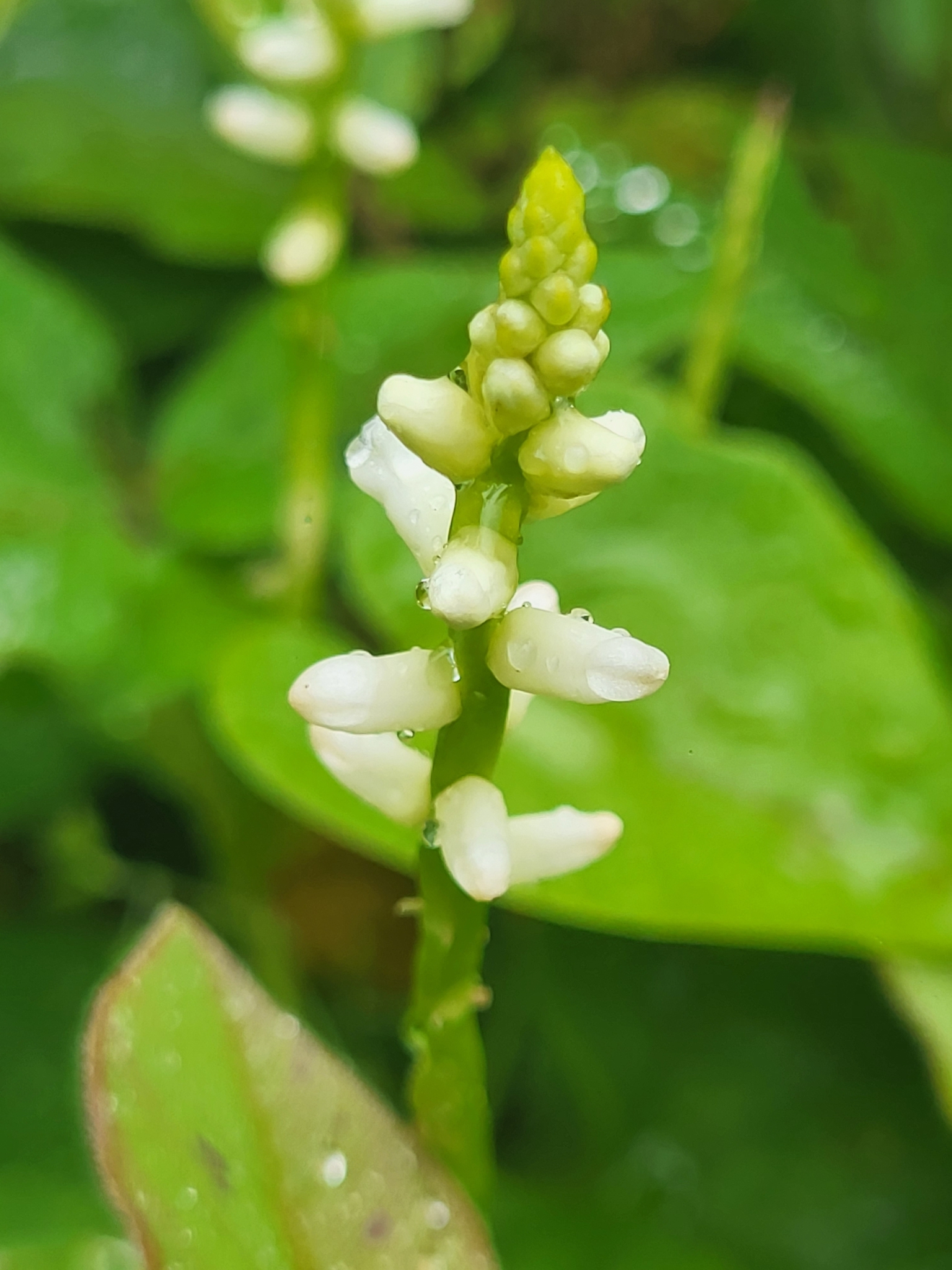
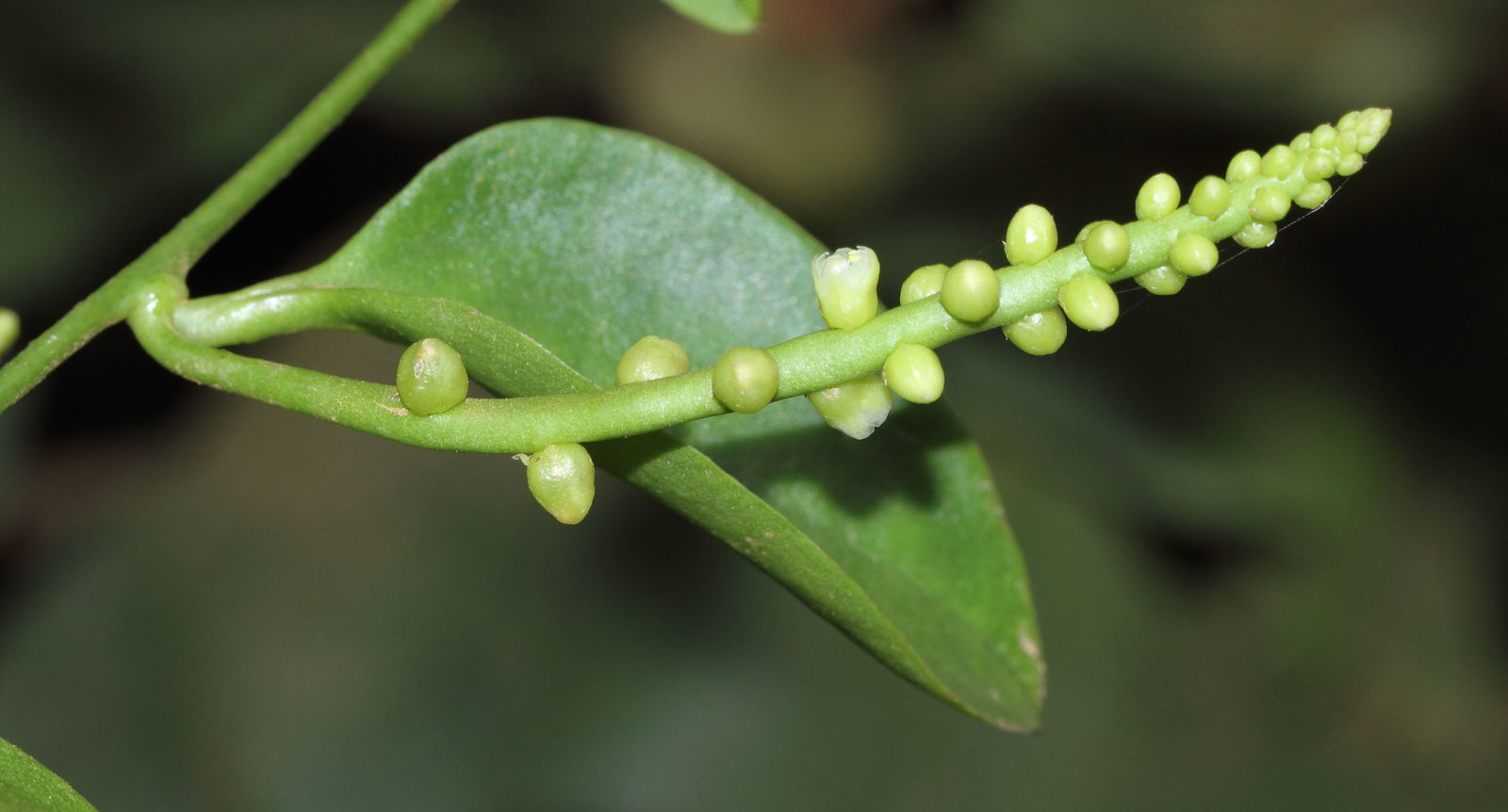
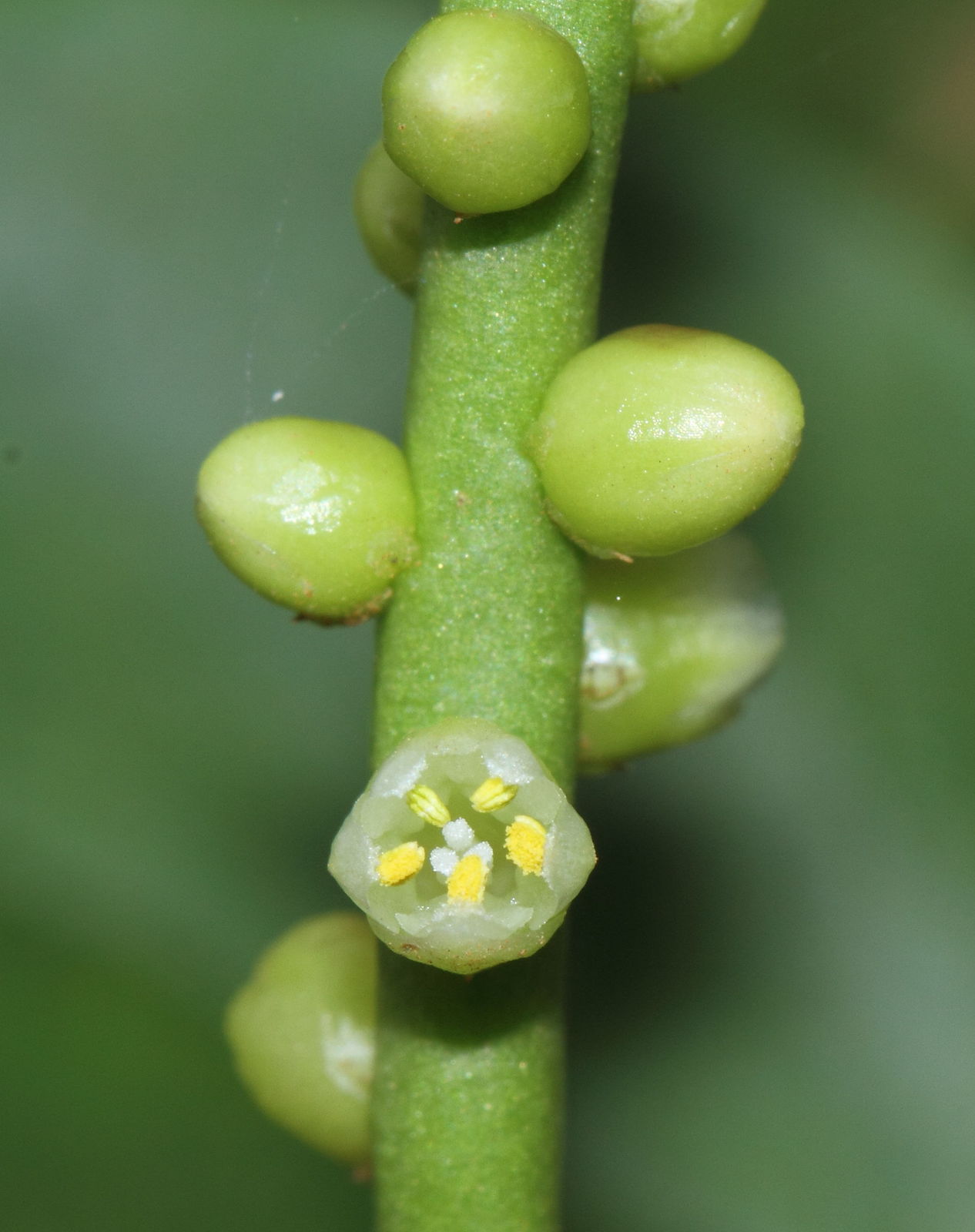
Tiny white to pinkish flowers form upright spikes in the leaf axils. They appear after day length falls below 12 hours, usually in late summer or fall in temperate regions. Small fleshy berries follow, turning dark purple to black at maturity and containing one seed each. 4 5
Useful taxonomy
Green- and red-stemmed plants still circulate under two names in horticulture and older literature:
- Basella rubra L. is the historical synonym for the red-stemmed form.
- Basella alba var. alba denotes the typical green-stemmed form under the currently accepted name.
Whatever its stem color, a plant sold or grown under these names belongs to the accepted species Basella alba. Stem pigmentation alone does not establish a separate species. 1 2
Habitat and range
Tropical Asia, from the Indian subcontinent through Southeast Asia to New Guinea, is its native range, though some authors have suggested tropical African origins. In its original habitat, Malabar spinach grows along hedges, in scrub and in damp places up to about 500 m (1,640 ft) elevation. 5 5
Cultivation now spans almost all tropical and subtropical regions, sometimes with establishment beyond its original range. Florida records describe it as non-native, cultivated and occasionally escaped from gardens, without an officially established invasive status. In frost-prone temperate regions such as metropolitan France, it is a summer crop: the first fall frost ends its growth, preventing the plant from persisting through winter. 7 3
Life cycle and reproduction
Tropical warmth allows perennial growth; where winters fall below 15 °C (59 °F), it is grown as an annual. Growth becomes vigorous above 27 °C (81 °F) and slows below that threshold. Frost kills the entire plant. 6 5
Warm soil, around 18–24 °C (64–75 °F) or above, supports sowing, with germination in one to two weeks. Edible young shoots are ready in 45–60 days, with full production at 70–90 days. 5 6
Seeds and stem cuttings both propagate the vine. A cutting roots readily in water or moist growing medium when a node is submerged. 5
Uses and risks
Young leaves and shoot tips are its main edible products. They can be eaten raw in salads or cooked in soups, stir-fries and side dishes. Their mild spinach-like flavor sometimes has lemony or peppery notes. Mucilage released during cooking thickens broths, much as okra does in several Asian and African cuisines. 6 5 5
Purple-black juice from ripe berries traditionally colors pastries and confectionery. Several Asian vernacular names referring to rouge or cosmetics reflect this coloring use. 5
Reference horticultural databases record no toxicity to people or pets and list Malabar spinach among non-toxic plants. The usual precautions for oxalate-rich leafy vegetables still apply. 5 4
Varieties, look-alikes and related plants
Tropical nurseries chiefly distinguish green-stemmed and red-stemmed Malabar spinach, the latter with reddish-purple stems and veins and associated with the synonym Basella rubra. Both are grown and eaten in the same way; stem color is their main difference. 2
Water spinach (Ipomoea aquatica Forssk.) can cause confusion because it is another green-leaved tropical vegetable vine with a similar cooked texture. It belongs to Convolvulaceae and grows in water or very wet conditions, whereas Malabar spinach climbs above moist soil. Scientific names and the aquatic or terrestrial growing habit offer the clearest distinction. 4
Main sources
- Plants of the World Online / Kew, Basella alba L.
- International Plant Names Index, Basella alba L.
- Royal Horticultural Society, Basella alba details
- Missouri Botanical Garden Plant Finder, Basella alba
- Plants For A Future, Basella alba
- University of Florida IFAS Extension, Malabar spinach
- Atlas of Florida Plants, Basella alba
Frequently asked questions
Is Malabar spinach poisonous to cats and dogs?
No. Basella alba is not listed among plants toxic to pets or people; its cooked leaves are widely eaten as a vegetable in tropical cuisines.
Are green and red Malabar spinach different species?
No. Red Malabar spinach corresponds to the historical synonym Basella rubra, now included in Basella alba. The main difference is stem and vein color: green in the green form, reddish-purple in the red form.
Why does Malabar spinach turn slimy when cooked?
The leaves release mucilage that naturally thickens broths and sauces, much as okra does. This texture is normal and does not indicate a growing problem.
Can Malabar spinach survive cold weather?
No. Growth already slows below 15 °C (59 °F), and the first fall frost kills the whole plant. In temperate climates it is therefore grown as a summer annual rather than outdoors all year.
How do you harvest Malabar spinach without exhausting it?
Pick young shoots and tender leaves rather than cutting the whole main stem. This allows continuous harvests over several weeks. The first edible shoots are ready 45–60 days after sowing.
Can you eat Malabar spinach berries?
Ripe berries are not the part usually harvested for food. Their purple-black juice is traditionally used to color pastries and confectionery rather than eaten on its own.
How can I tell Malabar spinach from water spinach?
Both are tropical leafy vegetable vines, but Malabar spinach belongs to Basellaceae and water spinach (Ipomoea aquatica) to Convolvulaceae. Water spinach grows mainly in water or very wet conditions, while Malabar spinach climbs a support in moist soil.
Similar plants

If you are unsure about a plant’s toxicity, ask a botanist or veterinarian for advice.