
Japanese quince (Chaenomeles japonica, )
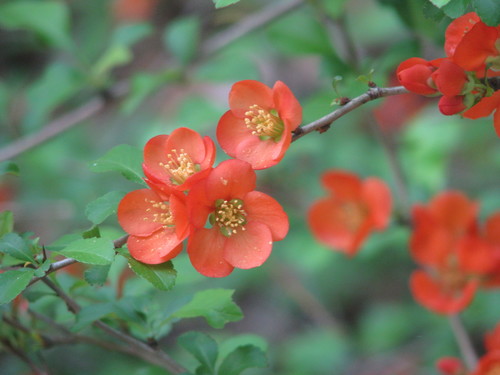
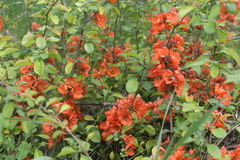
Japanese quince (Chaenomeles japonica) is a thorny deciduous Rosaceae shrub native to Japan and south-central Korea. More compact than Chaenomeles speciosa, it flowers early in spring in scarlet red to pink before producing aromatic, tart fruit. Hardy to −25 °C (−13 °F), it serves as a defensive hedge, container specimen or bonsai.
Read moreJapanese quince and Maule's quince
Allow a few hours of direct sun per day, preferably morning or evening.
Full sun for best flowering; tolerates partial shade


© photo
(c) Denys Davydov, some rights reserved (CC BY-NC), uploaded by Denys Davydov · cc-by-nc
Liubov Ilminska · cc0
Taken Apr 13, 2020 by M Marina (cc-by-sa)
Taken Feb 2, 2020 by Thierry LE COM (cc-by-sa)
Taken Jan 17, 2020 by vall (cc-by-sa)
Taken Apr 3, 2021 by Dieter Wagner (cc-by-sa)
Taken Feb 17, 2022 by Bernard Boutin (cc-by-sa)
© copyright of the Board of Trustees of the Royal Botanic Gardens, Kew.




Global distribution
POWO places the native range in south-central Korea and Japan (Honshu, Kyushu), in mountain woodland up to 2,100 m. Widely cultivated for ornament in Europe, Asia and North America, it is also grown commercially for fruit in Latvia and Lithuania. It occasionally escapes cultivation in France, without an assigned invasive status there.
Identity
Japanese quince (Chaenomeles japonica (Thunb.) Lindl. ex Spach, 1834) is a thorny deciduous shrub in the Rosaceae. POWO accepts the combination published by Lindley and Spach in 1834, replacing earlier names under which the plant had been classified. 1 2
Greek khaïneïn, meaning to split, and mêlea, apple, form the genus name Chaenomeles. Swedish botanist Carl Peter Thunberg described the species in 1784 as Pyrus japonica, believing that the fruit naturally split into five sections, something actually uncommon in this plant. 6
The French quince name preserves that older classification. The species was long called Cydonia japonica, until John Lindley separated Chaenomeles from Cydonia in 1822, using fruit characters rather than foliage. 6 7
Recognition
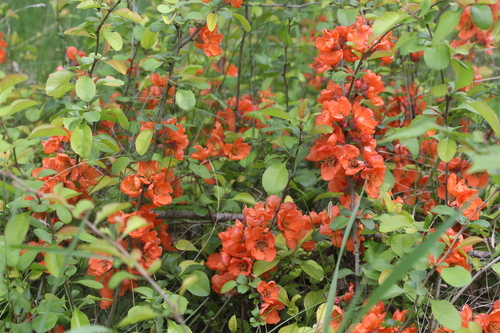
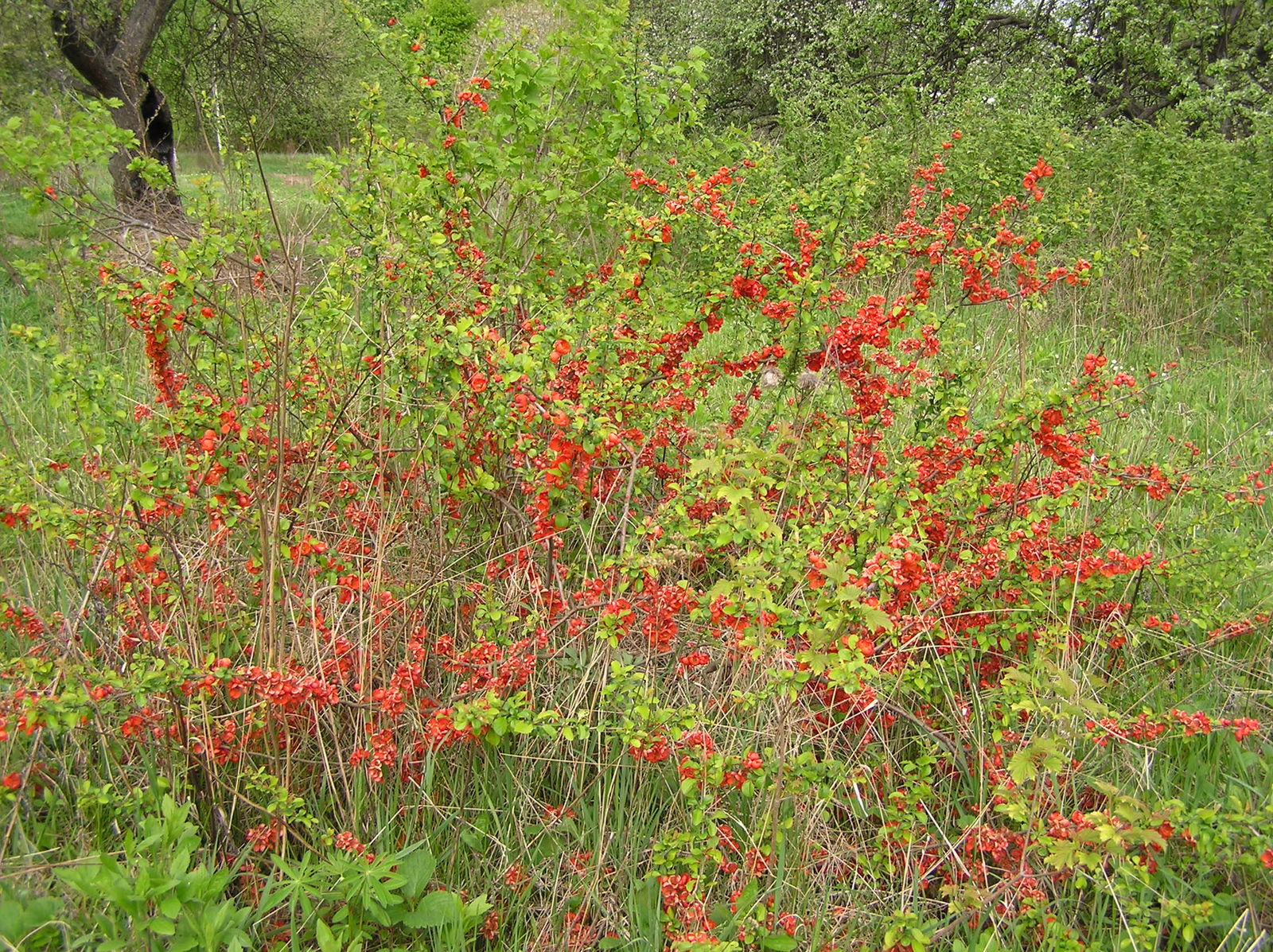
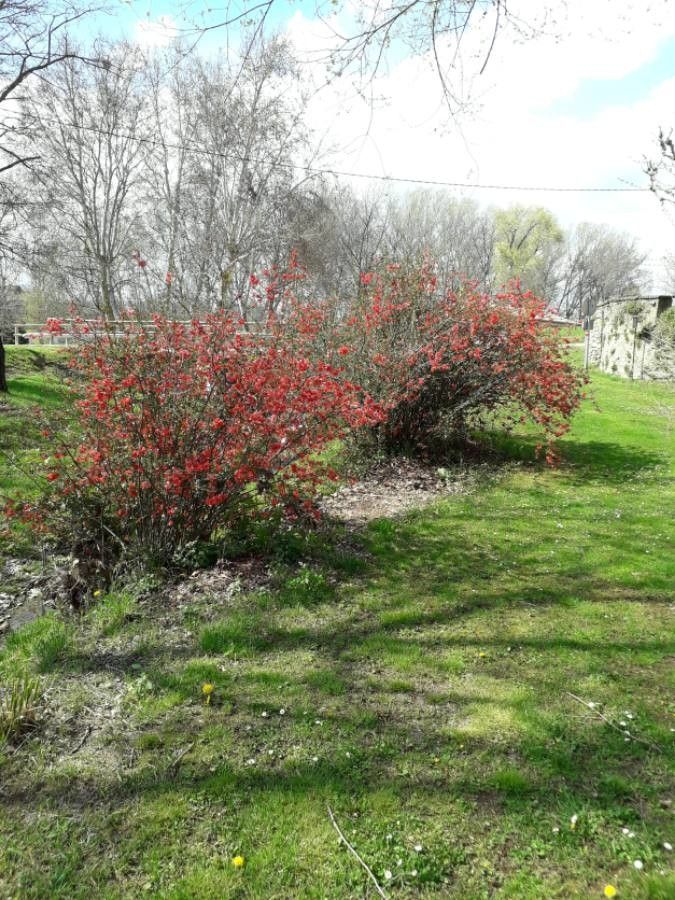
Garden plants form a dense, thorny bush 50 cm–1 m (20–39 in) tall and 1.5–2.5 m (5–8 ft) wide according to the RHS. Wild Japanese plants remain compact, around 1–1.2 m (3–4 ft) tall. 2 6
Gray-brown branches bear thorns 1–5 cm (0.4–2 in) long, making the plant useful for defensive hedges early in the spring gardening season. Glossy green, obovate leaves measure about 3–5 cm (1.2–2 in) long and 2–3 cm (0.8–1.2 in) wide, with finely toothed margins. 6 5
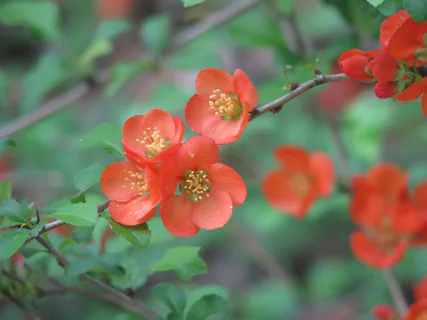
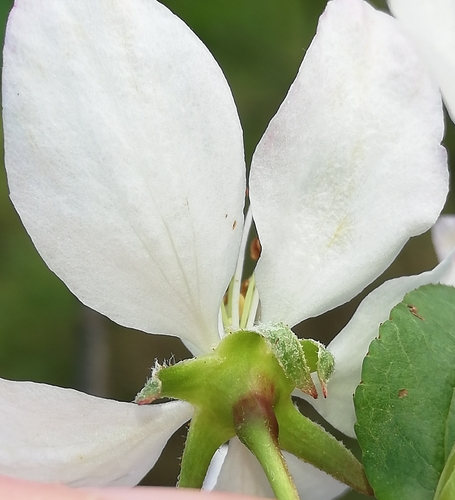
Flowers open early, often before or alongside young leaves, in groups of two to five. Five scarlet-red to pink petals surround 40–60 stamens arranged in two whorls. The aromatic yellow-green pome measures 3–4 cm (1.2–1.6 in) across and ripens in early autumn. 6 3
Taxonomy and look-alikes
Historical names include Pyrus japonica Thunb., the basionym, Cydonia japonica (Thunb.) Pers., Cydonia lagenaria Loisel. and Chaenomeles maulei (Mast.) Lavallée. Maule's quince derives from the last of these names, associated with a nineteenth-century British nursery. 6 7
The accepted POWO name provides a firmer reference than a nursery label. The French trade name cognassier du Japon also encompasses Chaenomeles speciosa, which can exceed 2 m (6.5 ft) while C. japonica stays below 1.5 m (5 ft). It also covers Superba hybrids (C. japonica × C. speciosa, raised around 1900 by G. Frahm) and Clarkiana hybrids (C. cathayensis × C. japonica, developed in California). More than 500 cultivar names circulate; a cultivar name alone cannot guarantee the species planted. 1 6
Habitat and range
The native range recorded by POWO includes south-central Korea and Japan, including Honshu and Kyushu. 1
Wild plants grow in open mountain woodland, often beside streams, at 100–2,100 m (330–6,900 ft) above sea level. 6
Ornamental cultivation is widespread across Europe, Asia and North America. In France it occasionally escapes cultivation, without an assigned invasive status there. Fruit is also grown commercially in the Baltic states: Latvia had around 300 hectares (740 acres) in production in 1993, with yields of 12–15 tonnes per hectare (5.4–6.7 US tons per acre). Lithuania likewise produces the fruit commercially. 6
Life cycle and propagation
Late-winter or early-spring flowers develop on the previous year’s wood, before or with the young leaves. Heavy winter pruning therefore removes some of the coming display. These early flowers provide bees with one of the first nectar resources at the end of winter. 5 3
Fruit ripens in early autumn. Propagation uses softwood cuttings in midsummer, harder-wood cuttings in late autumn, layering over about twelve months, division of suckers in late winter, or seed sown fresh or in late winter. The original Northern Hemisphere timings are July–August for softwood, November for harder wood and February for stored seed. 4
Uses and risks
Its main ornamental roles are low defensive hedges, specimens, wall-trained shrubs and, for dwarf forms, rock-garden plants. 'Hime' is suited to bonsai, with dense branching and miniature deep-red flowers. Cut flowering shoots can also be forced indoors for an early winter display. 6 3
Fruit is cooked into jam, jelly or liqueur; raw, it is hard, astringent and acidic. The RHS states that seeds contain toxins and should be removed before the fruit is eaten. It also advises against allowing pets to eat the fruit. No dedicated ASPCA species account was found in the source’s review, a reason to retain caution rather than declare complete safety. 6 2 4
Wet spring weather encourages fungal leaf spots. Fire blight, scab, aphids and mites can also affect the shrub, while excessively alkaline soil causes leaf chlorosis. 5 3
Cultivars and related plants
The usual nursery confusion is with Chaenomeles speciosa, a taller species also sold under the same flowering-quince names. Superba and Clarkiana hybrids broaden the available colors from red through orange and pink to white, making a pure-species plant difficult to guarantee outside a specialist nursery. 6
Two botanical forms are useful to recognize: var. alpina, a prostrate plant from the mountains of Kyushu, and var. pygmaea, with underground shoots. More than 500 cultivars circulate under the French Japanese-quince trade name without distinguishing the dwarf species, at most 1.5 m (5 ft) tall, from C. speciosa, which exceeds 2 m (6.5 ft). Checking the full scientific name against POWO resolves this ambiguity before purchase. 1 7
Main sources
- Plants of the World Online / Kew, Chaenomeles japonica (Thunb.) Lindl. ex Spach
- Royal Horticultural Society, Chaenomeles japonica
- Missouri Botanical Garden Plant Finder, Chaenomeles japonica
- Plants For A Future, Chaenomeles japonica
- NC State Extension Gardener Plant Toolbox, Chaenomeles japonica
- Wikipedia, Japanese quince (French article)
- International Plant Names Index, Chaenomeles japonica
- GBIF Backbone Taxonomy, Chaenomeles japonica
Frequently asked questions
Is Japanese quince poisonous to cats and dogs?
The RHS states that seeds contain toxins and advises against allowing pets to eat the fruit. No dedicated ASPCA account was found for the species, so caution is appropriate rather than an assumption of complete safety.
How does it differ from Chaenomeles speciosa?
Chaenomeles japonica stays more compact, at 50 cm–1.5 m (20 in–5 ft), whereas Chaenomeles speciosa can exceed 2 m (6.5 ft). Both are sold under the same Japanese-quince trade name, making that label unreliable for distinguishing them.
Can the fruit be eaten?
Only cooked. Raw fruit is hard, astringent and acidic; jam, jelly and liqueur bring out its fragrance. Remove the seeds before eating it.
When should Japanese quince be pruned?
Just after flowering, because the flowers develop on the previous year’s wood. Winter pruning removes many of the coming buds.
Is Japanese quince invasive?
It suckers readily into dense clumps, but no invasive status is assigned in France, where occasional escapes occur around cultivated areas.
Can it grow in a pot or as bonsai?
Yes. 'Hime' is particularly suited to bonsai, with dense branching and miniature deep-red flowers. In containers, use well-drained substrate and repot in late winter.
How hardy is Japanese quince?
Very hardy. It tolerates temperatures down to −25 °C (−13 °F), corresponding to USDA zones 5–9 in the horticultural sources.
Similar plants
If you are unsure about a plant’s toxicity, ask a botanist or veterinarian for advice.