
Lesser calamint (Clinopodium nepeta, )
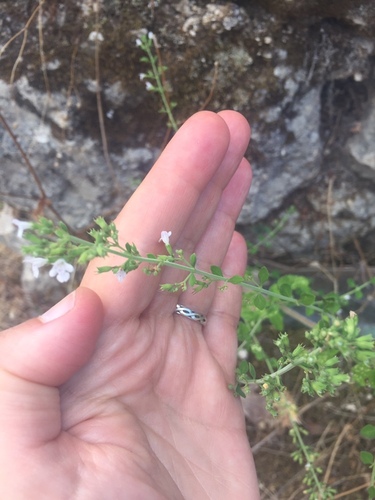
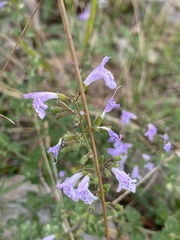
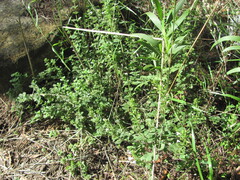
Lesser calamint (Clinopodium nepeta) is an aromatic perennial in the Lamiaceae family, also known as mentuccia. It ranges from Mediterranean hills to limestone Alpine habitats. Small pale mauve flowers in loose cymes and a mint-oregano scent distinguish it from pennyroyal, which shares similar dry banks and limestone waste ground.
Read moreLesser calamint, Calamint, Mentuccia and Nepitella
Allow a few hours of direct sun per day, preferably morning or evening.
Full sun; tolerates light partial shade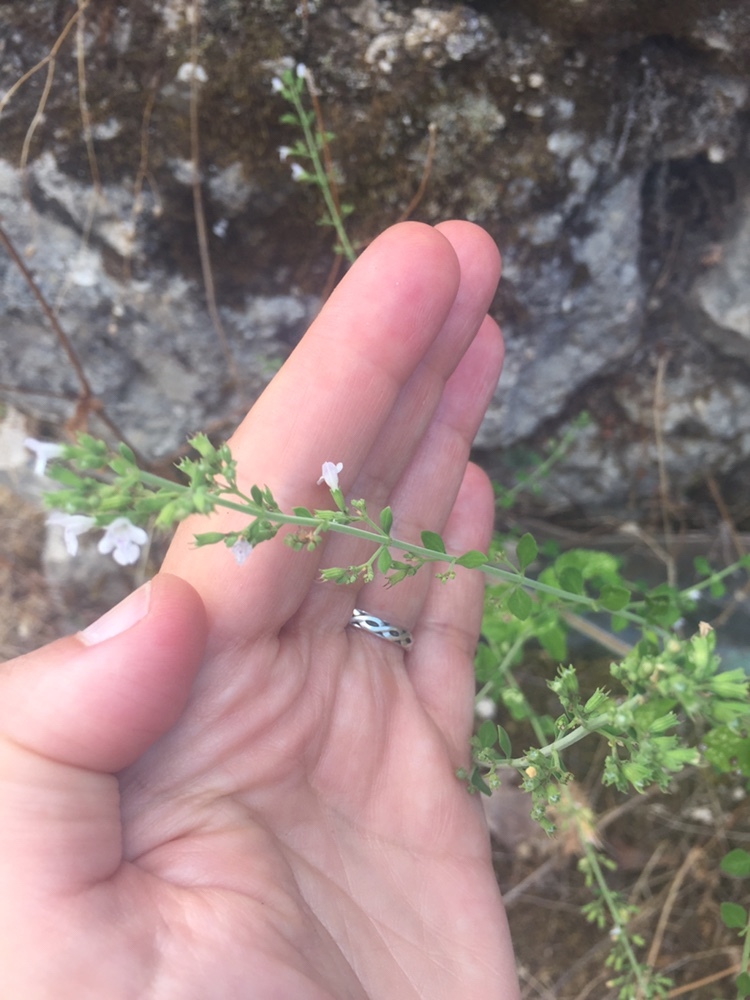


© photo
iNaturalist User · cc0
Thomas Dreux · cc-by
zebedeugalinha · cc-by
Taken Jan 1, 1970 by Photoflora - L'Abbé COSTE (©)
Taken Sep 17, 2020 by Alain Bigou (cc-by-sa)
Taken Sep 11, 2022 by Ludovic Lavigne (cc-by-sa)
Taken Oct 8, 2017 by Andrew Watts (cc-by-sa)
© copyright of the Board of Trustees of the Royal Botanic Gardens, Kew.




Global distribution
WCVP places the native range of Clinopodium nepeta from northwestern and central Europe through the Mediterranean to northern Iran. Its Mediterranean mountain distribution accounts for its presence both on dry coastal hills and in limestone Alpine ranges up to 1,500 m.
- Native7
- Introduced1
- Metropolitan France
- Italy
- Spain
- Greece
- Switzerland
- Austria
- Iran
- United Kingdom
Hexagons: regions where the plant occurs. Green dots: native range.1
Identity
Lesser calamint (Clinopodium nepeta (L.) Kuntze, 1891), also known as calamint, mentuccia or nepitella, is an aromatic perennial in the Lamiaceae family, subfamily Nepetoideae. Plants of the World Online accepts its placement in Clinopodium, following a long taxonomic history that moved it through Melissa, Calamintha, Thymus and Satureja. 1 2
First described by Carl Linnaeus in 1753 as Melissa nepeta, the species received its current combination from German botanist Otto Kuntze in his 1891 Revisio Generum Plantarum. Clinopodium derives from Greek klino (to incline, a bed) and podos (foot), used by the Greek physician Dioscorides to describe the knoblike inflorescence. The epithet nepeta goes back to Pliny the Elder’s name for an aromatic plant called erba gatta, referring to the Etruscan town of Nepi. 5 3
Corsican cooks call this herb nepita and have long used it in local dishes. The English name lesser calamint distinguishes it from other calamints. The French name meaning “false marjoram” reflects a similar culinary role to marjoram, although the two plants have different taxonomic identities. 3
Recognition
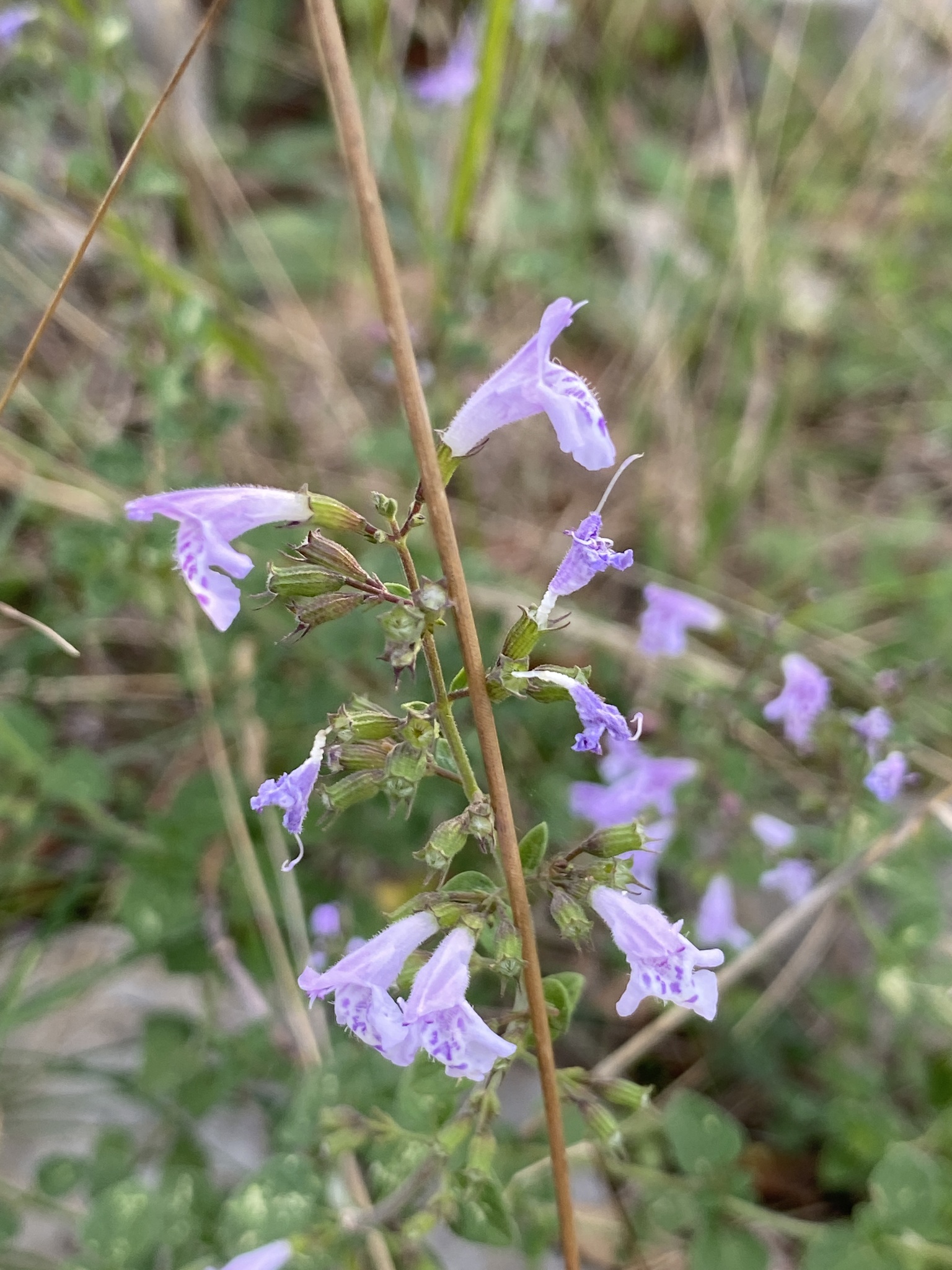
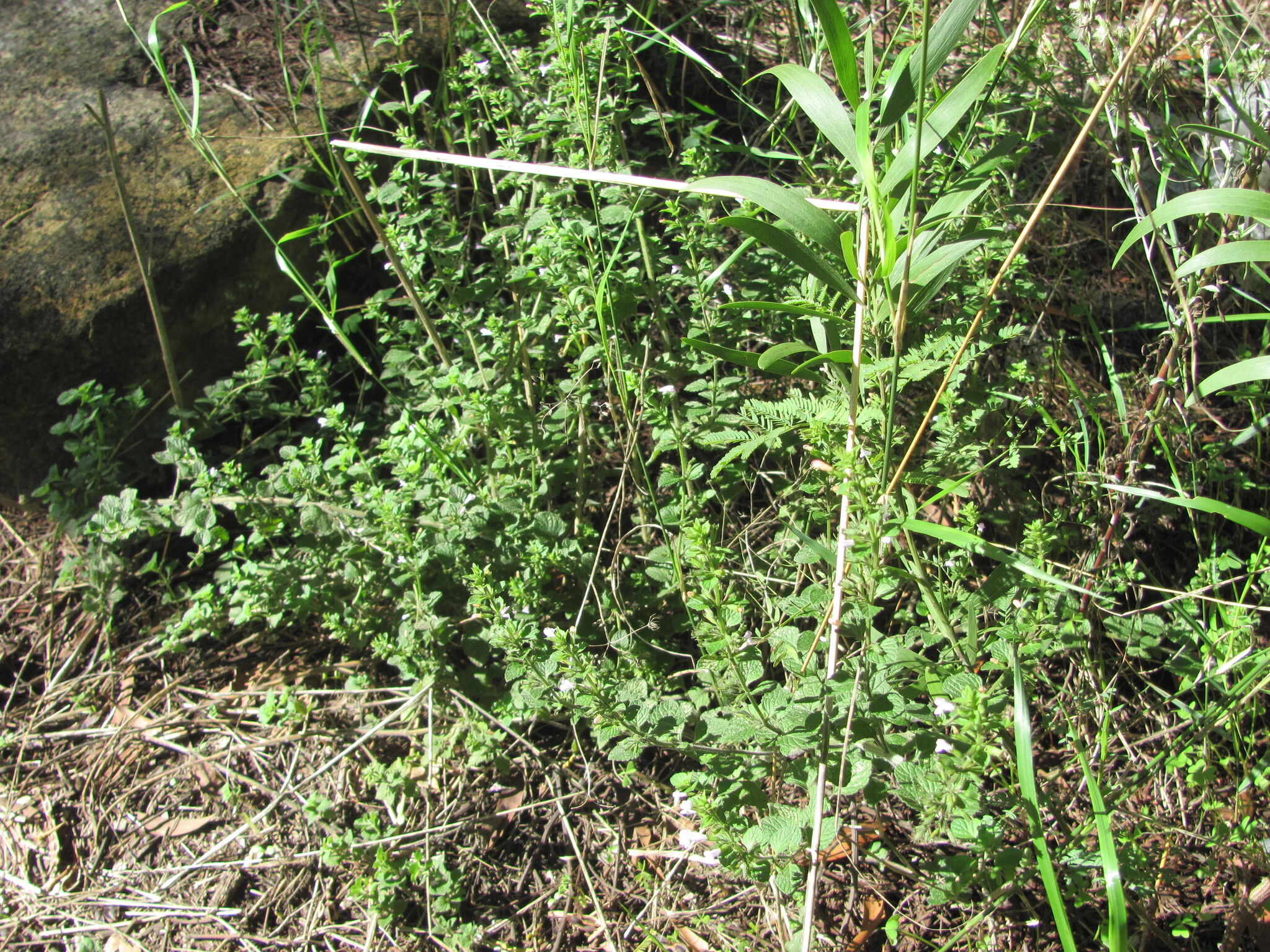
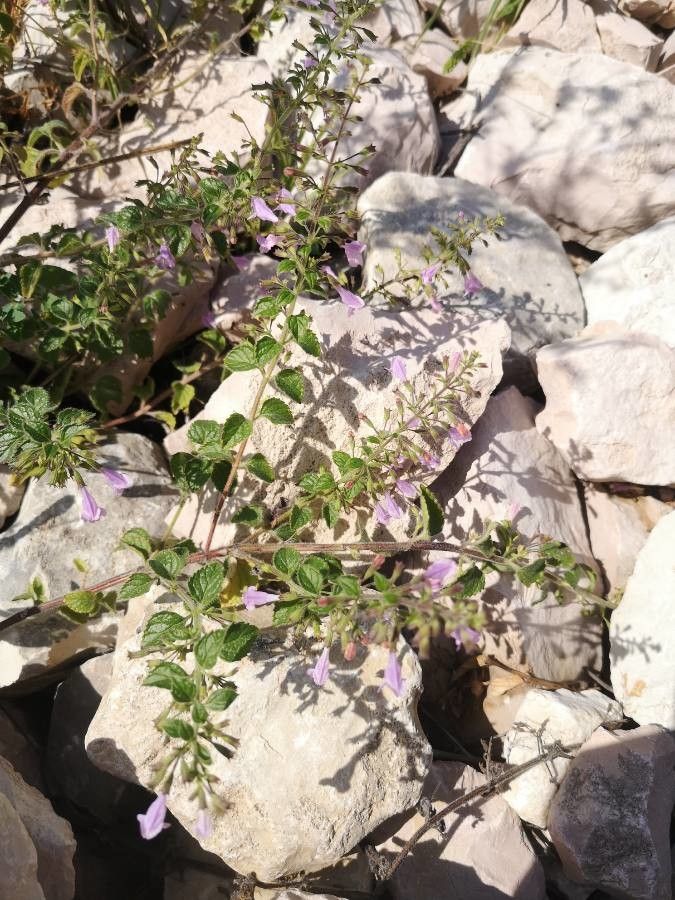
A low, woody-based subshrub reaches 20 to 80 cm (8 to 31 in), usually 20 to 40 cm (8 to 16 in). Its ascending stems are densely clothed in slanting hairs. Every part releases a mint-oregano scent when crushed, a better clue than silhouette alone when separating it from nearby low-growing Lamiaceae without a comparable fragrance. 5
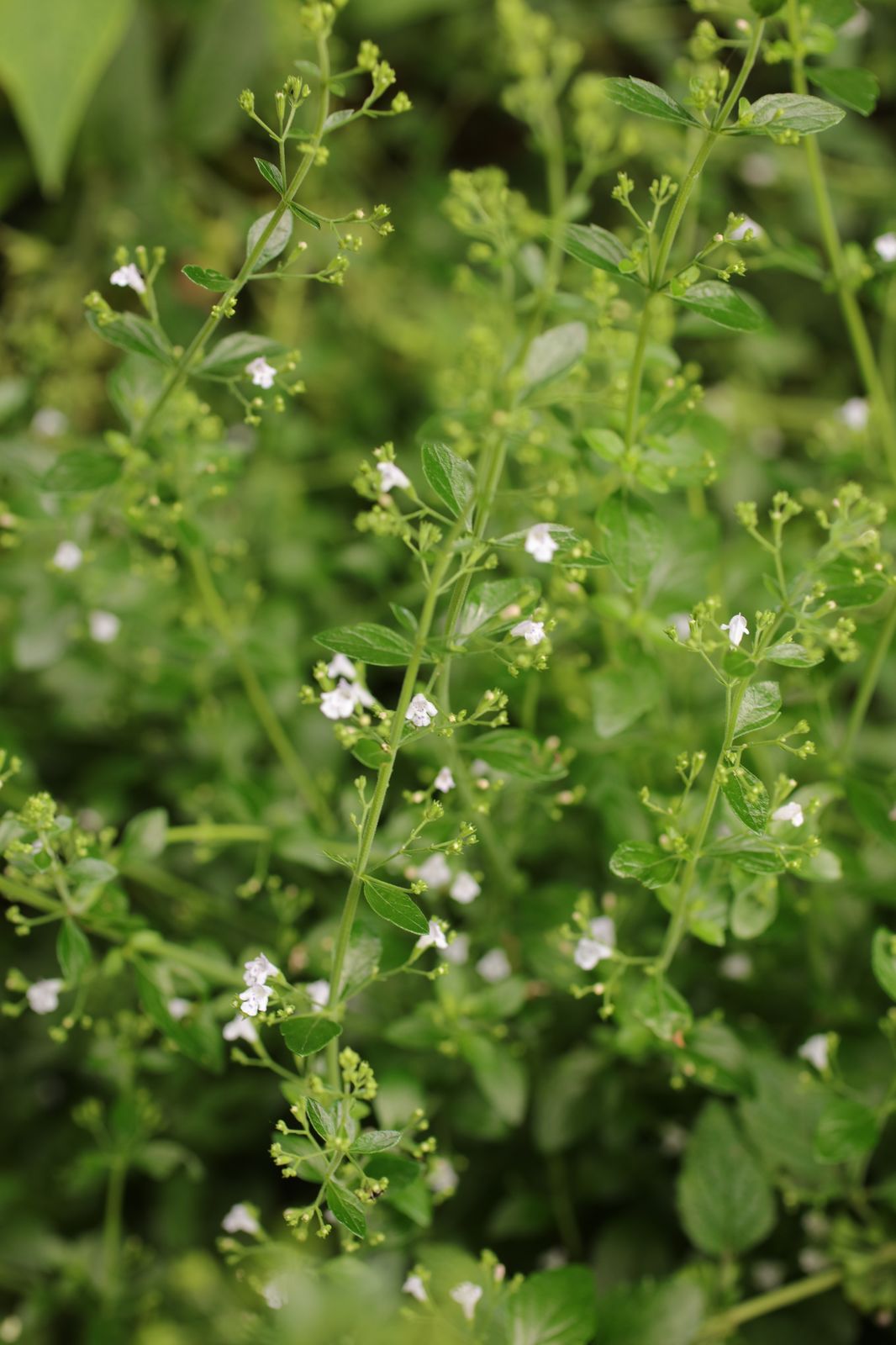
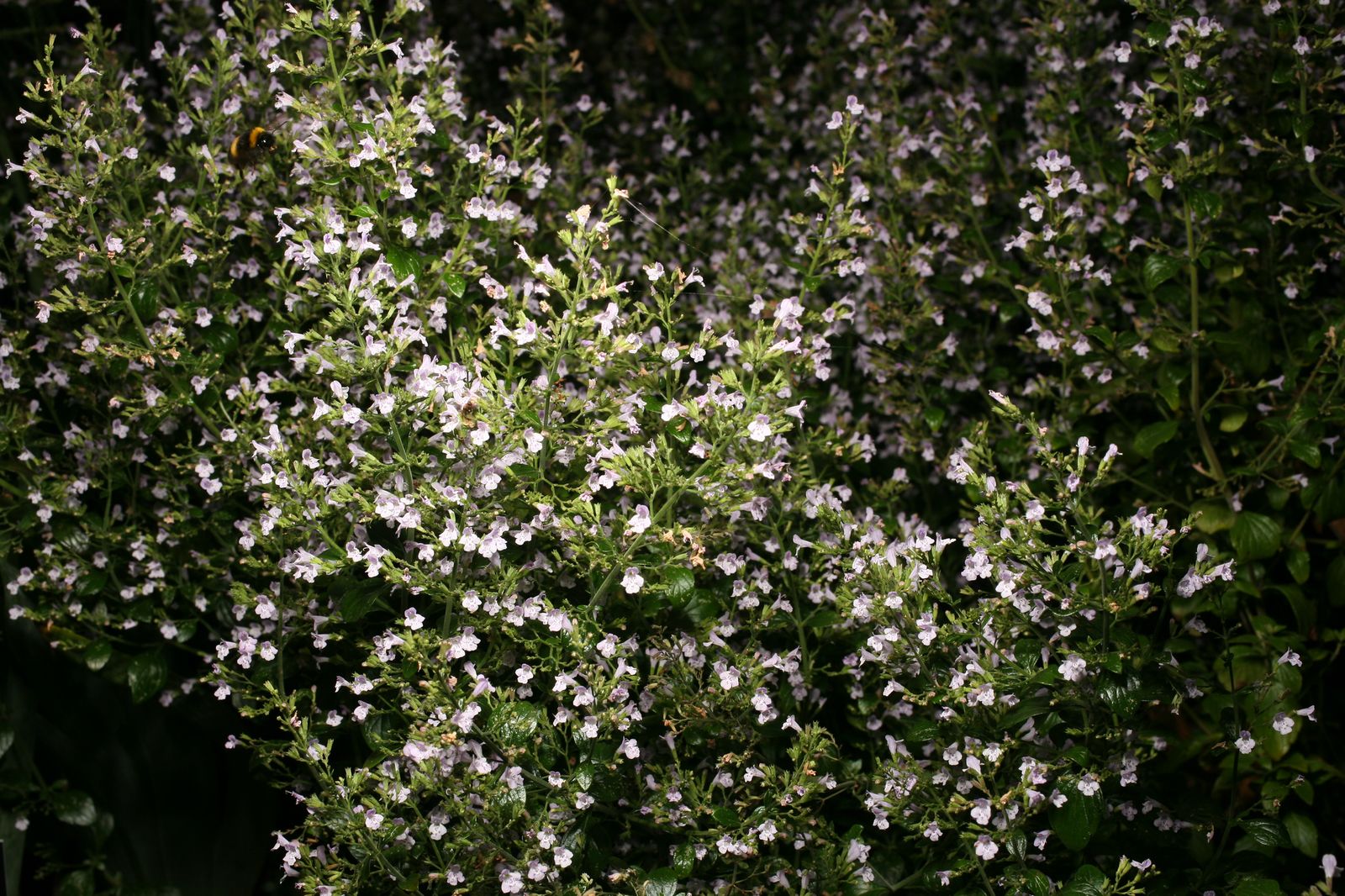
Opposite pairs of oval leaves have slightly toothed margins that roll downward. The inflorescence consists of loose cymes, with 5 to 20 stalked flowers per whorl, each whorl subtended by two opposite leaves. This open arrangement, rather than a compact round flower cluster, separates lesser calamint from several neighboring mint-family plants. 5
Each two-lipped flower measures about 1 to 1.5 cm (0.4 to 0.6 in), with a tube 8 to 10 mm (0.3 to 0.4 in) long. Colors range from pale mauve to purplish white, with two violet spots in the center of the lower lip. Flowering lasts from summer into fall, July to October in its northern seasonal context, longer than in most Mediterranean herbs. 5 6
A dry schizocarp splits into four small brown nutlets; there is no pulp or berry. A flowering plant without woody stem bases, or with compact round flower clusters, probably belongs to a different species. 5
Useful taxonomy
For Clinopodium nepeta (L.) Kuntze, Plants of the World Online accepts a Lamiaceae species whose range runs from northwestern and central Europe through the Mediterranean to northern Iran. 1
Its extensive synonymy reflects a long-unstable generic placement. Calamintha nepeta (L.) Savi, still common in French floras and horticultural trade, Satureja nepeta (L.) Scheele, Melissa nepeta L. and Thymus nepeta (L.) Sm. all denote the same plant under successive generic combinations. 1 4
Three subspecies are recognized: Clinopodium nepeta subsp. nepeta, from south-central and southern Europe to northern Iran; Clinopodium nepeta subsp. spruneri (Boiss.) Bartolucci & F.Conti, from the Mediterranean to the Caucasus; and Clinopodium nepeta subsp. subisodontum (Borbás) Govaerts, confined to east-central and southeastern Europe. 1 4
This taxonomic history has a practical consequence: nursery labels may use either Calamintha nepeta or Clinopodium nepeta for the same plant. The different genus name alone does not indicate a different species. 6
Habitat and range
Northwestern and central Europe connect through the Mediterranean region to northern Iran in the native range recorded by WCVP. Its Mediterranean mountain distribution accounts for its occurrence both on dry coastal hills and in limestone Alpine ranges. 1 5
Wild populations occupy dry grassland, waste ground, walls, scree, rocky slopes and warm woodland edges, consistently on limestone soil that is alkaline and nutrient-poor. Lesser calamint reaches 1,500 m (4,900 ft) above sea level, occupying both hill and mountain vegetation zones. 5
In France, it occurs in all Alpine departments and the main limestone ranges associated with the Alps, including the Jura, Massif Central and Pyrenees; elsewhere in Europe it also occurs in Balkan mountains. The species is not considered threatened, and the IUCN classes it as Least Concern. 3 7
Life cycle and reproduction
Late nectar production accompanies flowering from summer into fall, corresponding to July through October in its northern range. Insect pollination is provided mainly by bees, with some flies and other hymenopterans also contributing. This late season fills a nectar gap left by Mediterranean Lamiaceae that bloom earlier. 6 5
Following fertilization, each flower produces a schizocarp containing four nutlets. Dispersal begins with wind; once seeds reach the ground, ants carry them, attracted by an elaiosome rich in fats, proteins and sugars. This ant-mediated second stage helps explain the often slow but lasting colonization of banks and scree. 5
Garden propagation mainly uses spring sowing, division of established clumps, or cuttings from young, nonflowering shoots. Division is the quickest of these three approaches. Seed takes longer to germinate, while a cutting must first establish roots before forming a new clump true to the parent. 9
Uses and risks
Italian and Corsican cooking gives lesser calamint its chief role as a culinary herb, under names such as nepita, mentuccia, nipitella and nepitella. Traditional uses include Roman-style artichokes, Tuscan mushroom dishes, the brine for Sicilian table olives and an Irpinian ricotta preparation called zenzifero. 4 3
Traditional medicinal uses include an infusion described as diaphoretic, expectorant and stomachic, taken for flatulence, insomnia or menstrual pain. Lesser calamint should not be consumed in excess during pregnancy: at high doses, tradition attributes an emmenagogue effect to it, potentially stimulating uterine contractions. 5
No major toxicity is documented for people or domestic animals in normal culinary use. Caution centers on concentrated essential oil, whose antifungal, insecticidal and repellent properties have been demonstrated in laboratory work. 4
A 2024 study found nepetalactone in some Clinopodium nepeta cultivars, the same compound that causes catnip’s euphoric effect on cats. Concentrations vary substantially between populations. Its presence is not consistent, so a plant bought under this name is not guaranteed to attract cats. 8
Varieties, look-alikes and related plants
Field variation in lesser calamint chiefly separates three botanical subspecies, rather than garden selections: it has no stable, widely distributed horticultural cultivar. 1
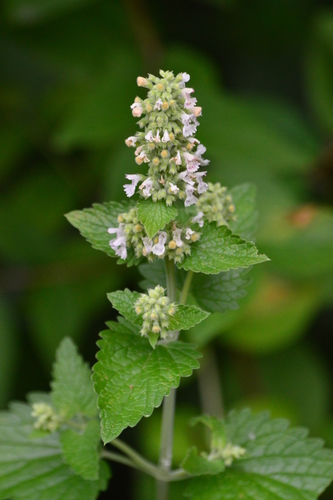
Pennyroyal, Mentha pulegium, is the most frequent source of confusion. Both occupy similar waste ground and dry banks, but pennyroyal has dense, round flower clusters and a very powerful scent. Lesser calamint instead has loose cymes of individual flowers and a milder fragrance. 5
Other members of the same genus may also look similar, particularly Clinopodium menthifolium, whose subspecies overlap in range and floral appearance. Compare details of the inflorescence and calyx species by species; judging from a distant outline is less reliable. 5
Historical transfers through Calamintha, Satureja, Thymus and Melissa still create confusion on labels more often than confusion between actual species. A plant sold as Calamintha nepeta and another sold as Clinopodium nepeta are, in the great majority of cases, the same plant. 1
Main sources
- Plants of the World Online / Kew, Clinopodium nepeta (L.) Kuntze
- International Plant Names Index, Clinopodium nepeta
- French Wikipedia, Clinopodium nepeta
- Wikipedia EN, Clinopodium nepeta (lesser calamint)
- Wikipedia IT, Clinopodium nepeta (mentuccia)
- Tela Botanica / eFlore BDTFX, Clinopodium nepeta subsp. nepeta
- INPN, Clinopodium nepeta (L.) Kuntze, 1891
- Zorde et al., 2024, Chemical Variability in Clinopodium nepeta - A New Source of Nepetalactones
- Vlachou, Papafotiou & Bertsouklis, 2019, Studies on Seed Germination and Micropropagation of Clinopodium nepeta
Frequently asked questions
Is lesser calamint toxic?
No major toxicity is documented for people or domestic animals. The main caution concerns concentrated essential oil, which should not be used in excess during pregnancy because the plant has traditionally been used as an emmenagogue.
Is lesser calamint the same as pennyroyal?
No. Both mint-family plants occupy similar waste ground and dry banks, but pennyroyal has dense, round flower clusters and a very strong scent. Lesser calamint has loose cymes with individual flowers and a milder mint-oregano fragrance.
Does lesser calamint attract cats like catnip?
A study published in 2024 found nepetalactone, the compound responsible for catnip’s euphoric effect on cats, in some cultivars. This feature varies and is not guaranteed in every cultivated plant.
Can you eat lesser calamint?
Yes. Fresh or dried leaves flavor many Italian and Corsican dishes, including Roman-style artichokes and mushroom dishes, with a scent often compared to mint mixed with oregano.
Where does lesser calamint come from?
Its native range covers northwestern and central Europe, the Mediterranean and northern Iran. It is particularly associated with limestone Alpine habitats up to 1,500 m.
Does lesser calamint have subspecies?
Three subspecies are recognized, with distinct geographical ranges between southern Europe and the Caucasus. For gardeners, they do not differ greatly in the main field identification features.
How can I recognize lesser calamint in a garden?
Look for a low, bushy clump, pale mauve flowers in loose cymes, late flowering from summer into fall and a mint-oregano smell when the leaves are crushed.
Similar plants


If you are unsure about a plant’s toxicity, ask a botanist or veterinarian for advice.