
Robusta coffee (Coffea canephora, )


Robusta coffee (Coffea canephora), also called robusta, is an evergreen shrub in the Rubiaceae, native to tropical West and Central Africa. It supplies nearly half the world's coffee, chiefly for instant coffee and espresso blends, and differs from arabica in its higher caffeine content and greater disease resistance.
Read moreRobusta coffee and Robusta
Give plenty of ambient light without direct sun on the leaves.
Bright light; tolerates some direct sun outdoors in tropical climates


© photo
Wikimedia Commons · CC BY-SA or Public Domain
Taken Apr 17, 2019 by OTS - R. Aguilar (cc-by-nc-sa)
© copyright of the Board of Trustees of the Royal Botanic Gardens, Kew.


Global distribution
Plants of the World Online places the native range from Guinea and Liberia in West Africa through the Congo Basin to South Sudan, Uganda and northern Angola. Introduced to Southeast Asia in the late 19th century, it is now cultivated chiefly outside its native range; Vietnam has become the largest robusta producer.
- Native6
- Guinea
- Liberia
- Democratic Republic of the Congo
- Uganda
- Angola
- South Sudan
Hexagons: regions where the plant occurs. Green dots: native range.1
Identity
Robusta coffee (Coffea canephora Pierre ex A.Froehner, 1897), often shortened to robusta, is an evergreen shrub in the Rubiaceae, genus Coffea. It supplies about 40–45% of the world's coffee, chiefly for instant coffee and espresso blends. 5 1
Robusta describes an agronomic character: the plant grows faster than its relative Coffea arabica, resists disease better and yields more per hectare, or per acre. Yet it was not recognized as a distinct species until 1897, more than a century after Linnaeus described arabica in 1753. 3
Recognition
Shallow roots support the shrub or small tree of Coffea canephora, which can reach 10 m (33 ft) in the wild. Cultivation and pruning usually keep it to 2–4 m (6.5–13 ft). The opposite, simple leaves are glossy dark green, slightly larger and more rippled than those of arabica. 5 2
White, fragrant, five-petaled flowers grow in clusters in the leaf axils. Unlike arabica, whose flowering follows a marked dry season, robusta flowers irregularly, several times a year under favorable climatic conditions. 2 5
The fruits are drupes, green at first and red when ripe. They take 10–11 months to mature after flowering, longer than arabica. Each cherry generally holds two oval seeds, slightly smaller and rounder than arabica beans. 5
Useful taxonomy
German botanist Albrecht Froehner described the species in 1897 from a manuscript name supplied by the French botanist Émile Pierre, hence the authority Pierre ex A.Froehner. It belongs to Coffea, subfamily Ixoroideae, within the Rubiaceae. 1 3
Its genetics distinguish it clearly from arabica. Coffea canephora is diploid, with 22 chromosomes (2 × 11), and depends on cross-pollination. A single gene with multiple alleles governs gametophytic self-incompatibility, preventing a plant from fertilizing itself. Arabica, by contrast, is allotetraploid and self-fertile, which partly explains its lower genetic diversity. 7
This diversity has a dated consequence for breeding: a natural hybrid between Coffea arabica and Coffea canephora was discovered on Timor in 1927. Resistant to coffee rust, the hybrid has since underpinned many arabica breeding programs. 3
Two agronomic varieties are commonly distinguished:
- Coffea canephora var. robusta (L.Linden) A.Chev., the most widely cultivated;
- Coffea canephora var. nganda Haarer, widespread in Uganda and East Africa.
The accepted scientific name, Coffea canephora, remains the stable point of reference. 1
Habitat and range
The native range spans tropical West and Central Africa, from Guinea and Liberia to South Sudan, Uganda and northern Angola. Robusta grows in the understory and at the edges of humid lowland tropical forests, often near water, unlike arabica's mountain-forest habitat. 1 5
French colonists introduced it to Vietnam in the late 19th century. The country now accounts for more than 40% of world robusta production. Brazil, Indonesia and India are other major production areas, far from its African origin. 3 4
Wild Coffea canephora is assessed as Least Concern, unlike wild arabica, classified as Endangered when climate change is taken into account. Its broad native range and obligatory cross-pollination support a less vulnerable pool of wild genetic diversity. Tolerance of lowland conditions also reduces its exposure to the shrinking mountain forests that weigh more heavily on arabica. 8 5
Life cycle and reproduction
Cultivation chiefly relies on fresh seed, which germinates in one to two months in warm, moist substrate. Cuttings also preserve a productive clone, useful because each plant needs a genetically different partner to set fruit. 2 7
First flowering occurs at about 3–4 years, but a fertilized flower takes 10–11 months to become ripe fruit, compared with 6–9 months for arabica. Flowers, green fruit and ripe cherries can occur on one plant together, reflecting flowering spread through the year rather than confined to one season. 5
Despite its lowland origin, robusta is more cold-sensitive than arabica. The RHS rates it H1A, requiring temperatures above 15 °C (59 °F) throughout the year, compared with about 13 °C (55 °F) for arabica. 2
Uses and risks
Robusta is an important coffee crop. Its roasted seeds are used chiefly in instant coffee and espresso blends, where they provide body and a thicker crema, the foam on the surface. 5
Caffeine content is substantially higher than in arabica: 1.7–4%, compared with about 0.8–1.4%. This helps explain both the more pronounced bitterness in the cup and the plant's greater natural resistance to insects. 4 5
The plant itself has low toxicity, but its seeds and coffee grounds contain caffeine and saponins. The ASPCA notes that these substances can cause vomiting, restlessness, excessive thirst and abnormal heart rhythm in animals. Caution is therefore warranted around dogs, cats and horses, particularly with seeds and grounds. 6
Varieties, look-alikes and related plants
The two agronomic varieties, robusta and nganda, resemble one another in general form and are distinguished chiefly by regional selection criteria. The scientific name Coffea canephora remains the reliable guide when buying plants or seeds. 1
The commonest confusions occur within Coffea:
- Coffea arabica L., allotetraploid, with less caffeine and lower disease resistance;
- Coffea liberica W.Bull ex Hiern, with substantially larger leaves and fruits.
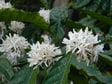
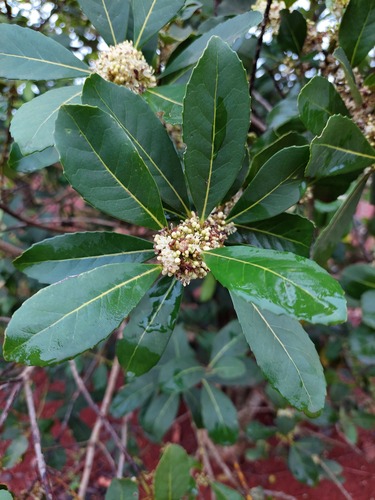
Indoors, glossy leaves and fragrant white flowers also give robusta a superficial resemblance to other ornamental Rubiaceae. Seed shape and caffeine content remain the most reliable criteria for distinguishing cultivated Coffea species. 2
Main sources
- Plants of the World Online / Kew, Coffea canephora Pierre ex A.Froehner
- Royal Horticultural Society, Coffea canephora - Robusta coffee
- Wikipedia (EN), Coffea canephora
- Wikipedia (FR), Coffea canephora
- Encyclopaedia Britannica, Coffea canephora (robusta coffee)
- ASPCA, People Foods to Avoid Feeding Your Pets (caffeine and saponins)
- Self-Incompatibility and Pollination Efficiency in Coffea canephora Using Fluorescence Microscopy (Agronomy, 2024)
- IUCN Red List, Coffea canephora assessment (2017)
Frequently asked questions
Is robusta a variety of arabica?
No. Coffea canephora is a distinct species, described in 1897. It is diploid, with 22 chromosomes; arabica is allotetraploid, with 44 chromosomes, and arose partly through natural hybridization involving robusta.
Why does robusta have more caffeine than arabica?
Robusta contains 1.7–4% caffeine, compared with about 0.8–1.4% in arabica. The higher caffeine content contributes to natural insect resistance and a more bitter taste in the cup.
Is robusta coffee poisonous to animals?
The plant itself has low toxicity, but its seeds and coffee grounds contain caffeine and saponins. The ASPCA reports that these substances can cause vomiting, restlessness and cardiac problems in dogs and cats.
Can robusta coffee grow in an apartment?
Yes, in a warm, bright interior. Keep temperatures at least 15 °C (59 °F) at all times, humidity at least 60%, and the substrate well drained. Irregular flowering remains possible year-round under favorable conditions.
Why is robusta cheaper than arabica?
Robusta grows faster, resists diseases such as coffee rust better and yields more per hectare, or per acre. Higher yields largely account for lower production costs.
Where does robusta coffee really come from?
It is native to tropical West and Central Africa, from Guinea to South Sudan and Uganda. Introduced to Vietnam in the late 19th century, Vietnam is the world's leading robusta producer.
Is wild robusta coffee threatened with extinction?
No. Unlike wild arabica, assessed as Endangered, Coffea canephora is assessed as Least Concern by the IUCN. Its broad native range and obligatory cross-pollination support less vulnerable genetic diversity.
Similar plants
If you are unsure about a plant’s toxicity, ask a botanist or veterinarian for advice.