
Green cardamom (Elettaria cardamomum, )
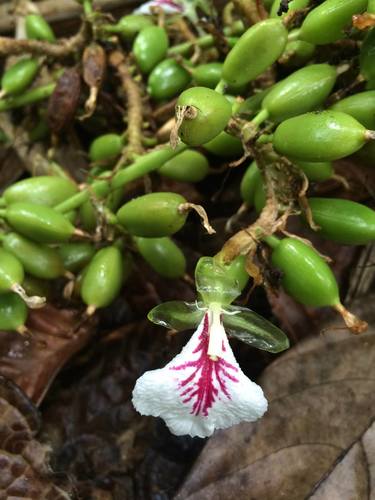

Green cardamom (Elettaria cardamomum), also called true cardamom, is a rhizomatous herbaceous perennial in the Zingiberaceae, native to the Western Ghats of southwestern India. Its leafy pseudostems accompany flower panicles that trail along the ground and produce small, gray-green, three-sided capsules. The intensely aromatic black seeds inside are the source of the world’s third most expensive spice.
Read moreGreen cardamom, Cardamom and True cardamom
Place in indirect light or in a shaded room.
Light to partial shade; avoid direct sun


© photo
(c) permaculturacaimito, some rights reserved (CC BY-NC), uploaded by permaculturacaimito · cc-by-nc
Wikimedia Commons · CC BY-SA or Public Domain
Wikipedia · CC BY-SA
Taken Sep 16, 2022 by Joey F (cc-by-sa)
Taken Jan 28, 2017 by Yoan MARTIN (cc-by-sa)
Taken Nov 25, 2022 by Blue Bottle (cc-by-sa)
Taken Jan 23, 2010 by Tela Botanica − Geneviève Botti (cc-by-sa)
© copyright of the Board of Trustees of the Royal Botanic Gardens, Kew.


Global distribution
Elettaria cardamomum is native to the Western Ghats of southwestern India and nearby Sri Lanka. Introduced to Guatemala in 1914, it became a leading export crop there; since 2000, Guatemala has led world production, well ahead of India in second place.
- Native2
- Introduced3
- India
- Sri Lanka
- Guatemala
- Tanzania
- Costa Rica
Hexagons: regions where the plant occurs. Green dots: native range.1
Identity
Green cardamom (Elettaria cardamomum (L.) Maton, 1811), also known as true cardamom, is a rhizomatous herbaceous perennial in the Zingiberaceae, native to the Western Ghats of southwestern India. After saffron and vanilla, it ranks as the third most expensive spice by weight. Slow maturation and picking every capsule by hand explain this cost. 1 7 3
The name cardamom derives from ancient Greek kardamomon, combining kardamon, cress, and amomon, an Indian spice mentioned in antiquity. The French spelling cardamone, with an n, is considered incorrect in that language; French cardamome denotes both the plant and the spice from its dried capsules. 8
The nickname queen of spices refers chiefly to its price rather than any particular botanical property. It circulated for centuries in Arab and Indian trade before cardamom reached Western kitchens.
Recognition
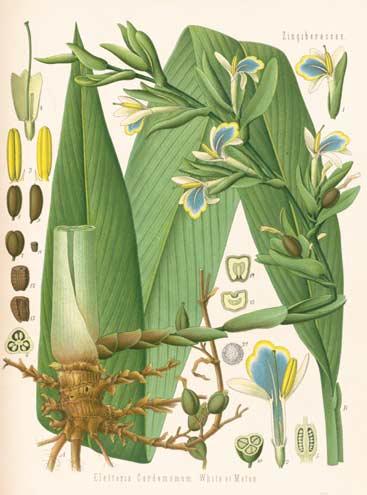
Dense clumps of leafy pseudostems reach 2–4 m (6.6–13 ft), occasionally taller in especially favorable climates. Lance-shaped leaves measure about 50 cm (20 in) long and 3–5 cm (1.2–2 in) wide, with a sheathing petiole clasping the stem. 8 4
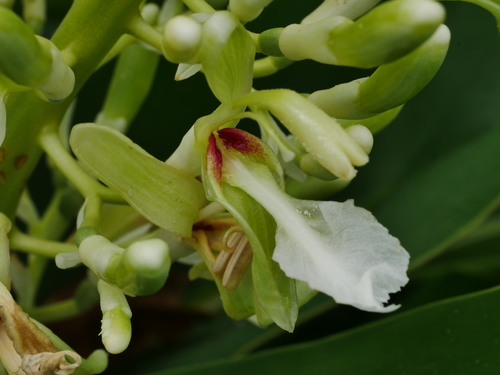
Unlike most ornamental gingers, green cardamom bears flowers away from the tops of its pseudostems: its panicles trail along the ground, carrying small white flowers streaked with purple. Nearly hidden beneath the foliage, this prostrate inflorescence distinguishes it from upright-flowering ornamental gingers more reliably than leaf color. 2 8
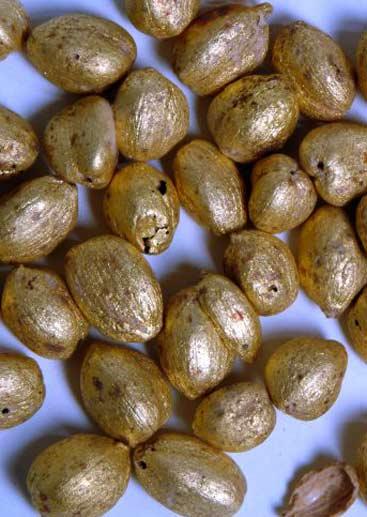
Each gray-green, three-sided capsule, 1–2 cm (0.4–0.8 in) long, encloses 15–20 intensely aromatic black seeds. A whole capsule protects their aroma after drying; once ground, the spice loses it within weeks. Cooks who use much cardamom therefore crush it only just before serving. 8 5
Useful taxonomy
Kew and POWO accept Elettaria cardamomum (L.) Maton, 1811, the only species of Elettaria grown extensively for spice. Linnaeus initially placed it in Amomum. William Maton separated it in 1811 to establish Elettaria, a distinction retained in modern botany. 1 7
Horticultural synonymy includes Elettaria cardamomum var. major and var. minor. They broadly overlap with two commercial groups: Mysore, with larger capsules and upright growth, and Malabar, with smaller capsules and prostrate panicles. Outside Indian trade, that division does not establish separate taxa. 1
France’s INPN records three French common names: élettari cardamone, cardamome and cœur d’amant. The last is chiefly a horticultural catalog name, rarely used beyond specialist nurseries; these French names refer to the same spice plant. 7
Habitat and range
Wild green cardamom grows in humid tropical forest understory at 600–1,500 m (1,970–4,920 ft), especially in clearings and at edges. Beneath a closed canopy, insufficient light prevents lasting establishment. 6
Its original range covers the Western Ghats of Kerala, Karnataka and Tamil Nadu, together with neighboring Sri Lanka. Cultivation requires abundant annual rain, 2,500–3,800 mm (98–150 in), and a mean annual temperature near 22 °C (72 °F). Growth almost stops below a mean of 17 °C (63 °F). 6 5
In 1914, German settler Oscar Majus Kloeffer introduced cardamom to Cobán, Guatemala. Cool, humid conditions in the Alta Verapaz highlands suited it so well that Guatemala became the world’s leading producer by 2000, far ahead of India, which remained the second exporter. 3
Life cycle and reproduction
A fleshy rhizome produces around 30 pseudostems in a clump each year. New plantings need 3–5 years to establish roots before flowering and fruiting. Production then lasts 10–15 years, after which the clump needs renewal. 6
Flowers appear chiefly in local spring and the rainy season. Many clones are self-sterile, so a lack of bees or mixed varieties sharply reduces cross-fertilization. Without adequate pollination, panicles abort before forming capsules. 6
Pickers harvest individual capsules by hand in the dry season before they open fully. Overripe capsules release their seeds and lose most of their commercial value. Dried capsules retain their natural gray-green color, although some batches are bleached for markets that prefer a paler product. 8 6
Uses and risks
Aromatic seeds flavor Indian chai, Middle Eastern cardamom coffee, Scandinavian baking and many rice dishes and curries. Traditional Ayurvedic medicine also uses the plant for digestive and pulmonary complaints. 6 3
Green cardamom is not toxic to people or the main domestic animals. No toxicity is documented for cats or dogs; its status remains uncertain for horses because specific data are lacking. 4 5
Full sun can scorch exposed leaves within hours, while repeatedly drying soil persistently inhibits flowering. Indoors or under glass, green cardamom therefore needs light shade and constant moisture, resembling a humid tropical conservatory. 6 4
Varieties, look-alikes and related plants
Four groups feature in Indian cultivation. Malabar has prostrate panicles and tolerates lower rainfall. More vigorous Mysore has upright panicles and dark capsules but needs regular rain. Vazhukka, their natural hybrid, predominates because of its higher yield. Njallani, a farmer selection from Kattappana in Kerala, improves yield further on a Vazhukka background. 8 3
The main culinary confusion involves black cardamom (Amomum subulatum), a distinct species from the eastern Himalayas. Its much larger brown capsules have a smoky, camphor-like aroma quite different from the minty freshness of Elettaria cardamomum. The spices serve different purposes: black cardamom suits slow-cooked dishes, while green cardamom flavors pastries and drinks. 8
Other Zingiberaceae grown as spices or ornamentals, including ginger (Zingiber officinale) and galangal (Alpinia galanga), share aromatic rhizomes and the same botanical family. None belongs to the same genus or has exactly the same culinary use as green cardamom.
Main sources
- Plants of the World Online / Kew, Elettaria cardamomum (L.) Maton
- Encyclopaedia Britannica, Elettaria cardamomum
- Encyclopaedia Britannica, Cardamom - origins, description and uses
- NC State Extension Gardener Plant Toolbox, Elettaria cardamomum
- Missouri Botanical Garden Plant Finder, Elettaria cardamomum
- Useful Tropical Plants Database, Elettaria cardamomum
- INPN MNHN, Elettaria cardamomum (L.) Maton, 1811
- Wikipedia FR, Cardamom
Frequently asked questions
Is green cardamom toxic to cats and dogs?
No toxicity is documented for cats or dogs. Its status remains uncertain for horses because specific information is lacking.
How do green and black cardamom differ?
They belong to distinct genera in the Zingiberaceae. Green cardamom, Elettaria cardamomum, has small pale capsules with a minty flavor; black cardamom, Amomum subulatum, has larger brown, smoky capsules. They are not directly related within the same genus.
Why is cardamom so expensive?
Capsules are picked by hand, individually, before they fully open, and plants take three to five years to begin producing. These demands explain its rank as the third most expensive spice after saffron and vanilla.
Can green cardamom grow indoors in a cool climate?
Yes, in a humid conservatory or heated greenhouse, but fruiting is rare without a stable tropical climate. Most indoor plants remain ornamental.
Why is Guatemala the leading cardamom producer?
Oscar Majus Kloeffer, a German settler, introduced it in 1914 to the cool, humid highlands of Alta Verapaz. Since 2000, Guatemala has overtaken India through favorable climatic conditions and an organized export industry.
Should cardamom capsules be peeled before cooking?
No. Whole capsules preserve flavor better than shelled or ground seeds. Crush them lightly just before use to release the seeds’ aroma.
Does cardamom flower at the tops of its stems?
No. Its flower panicles trail at ground level rather than standing at the tops of the leafy pseudostems, providing a useful identification feature.
Similar plants
If you are unsure about a plant’s toxicity, ask a botanist or veterinarian for advice.