
Hemp agrimony (Eupatorium cannabinum, )
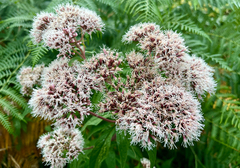
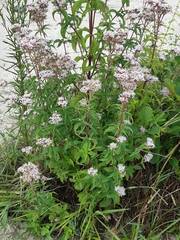
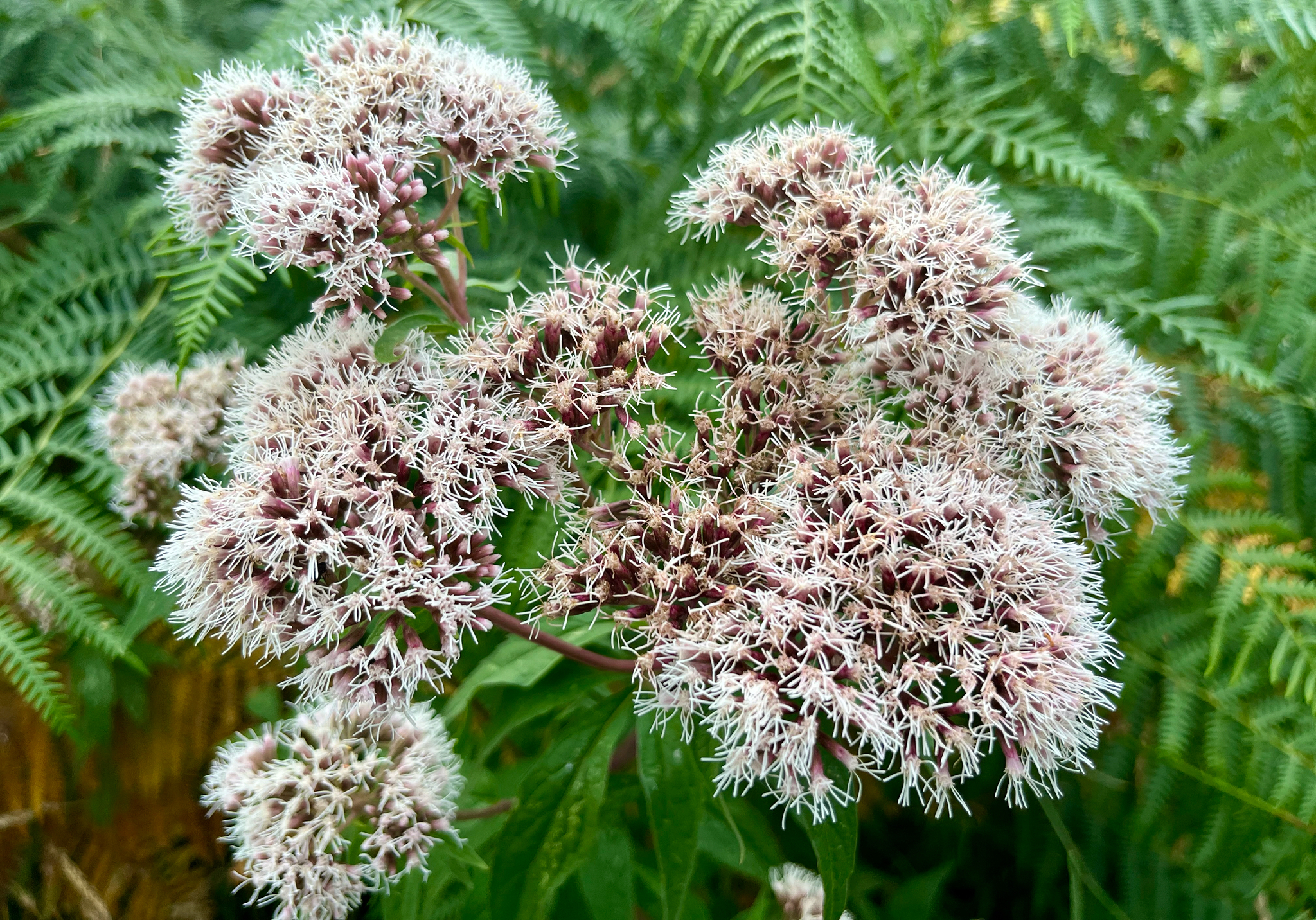
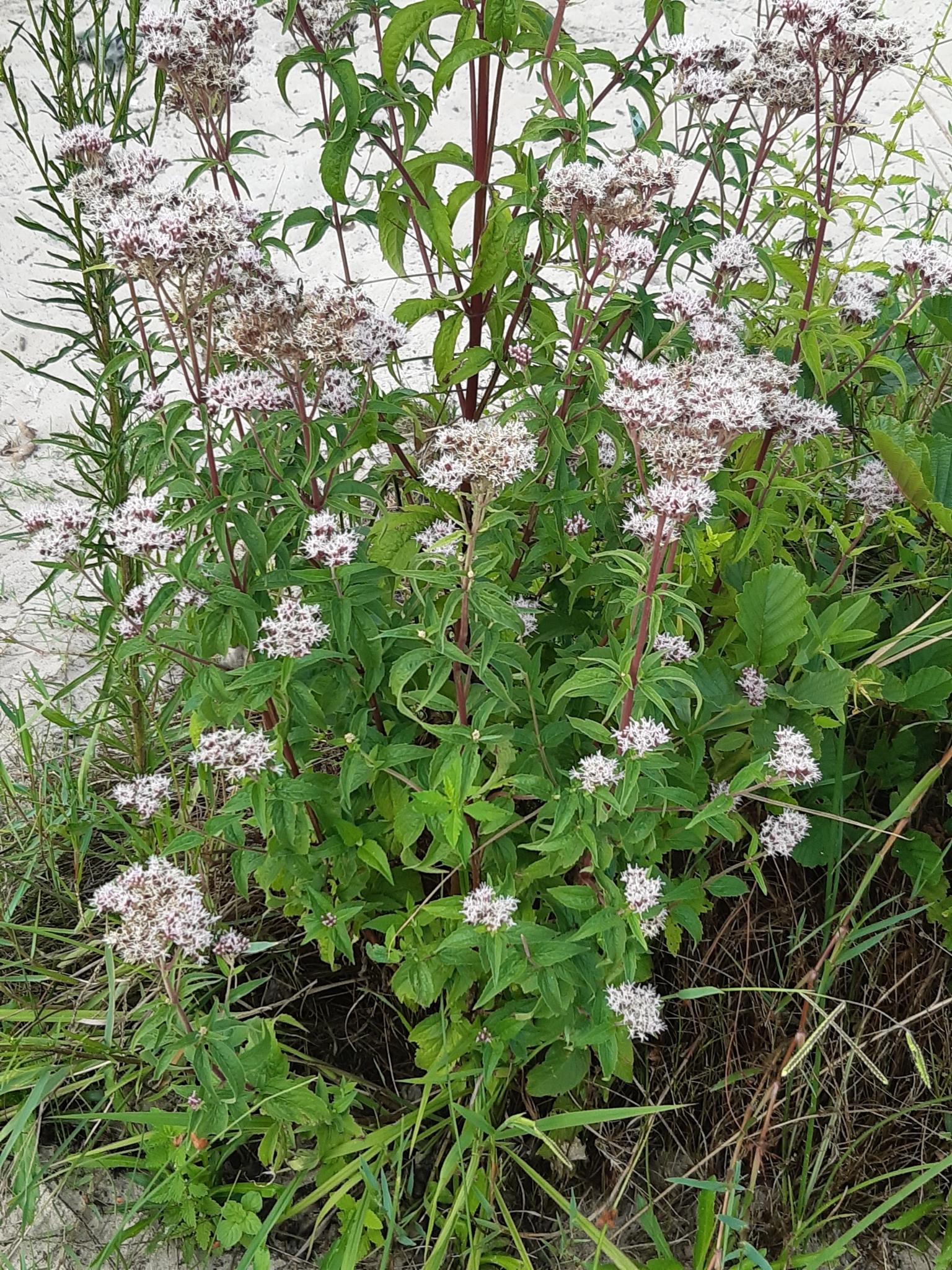
Hemp agrimony (Eupatorium cannabinum L., 1753) is a perennial in the Asteraceae from riverbanks and wet meadows of Europe, North Africa and western Asia. Its upright reddish stems carry opposite leaves deeply divided into three to five toothed leaflets, resembling hemp. In its European range, dense clusters of pink to mauve flowers appear from July to September and attract many butterflies.
Read moreHemp agrimony
Allow a few hours of direct sun per day, preferably morning or evening.
Full sun to light partial shade
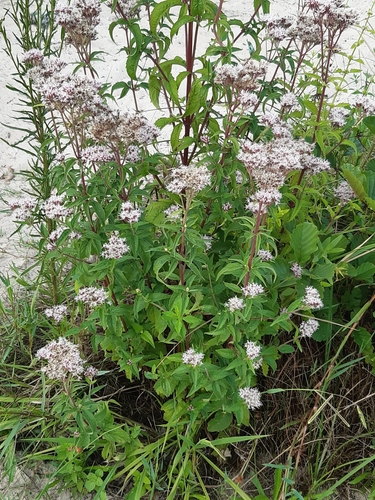
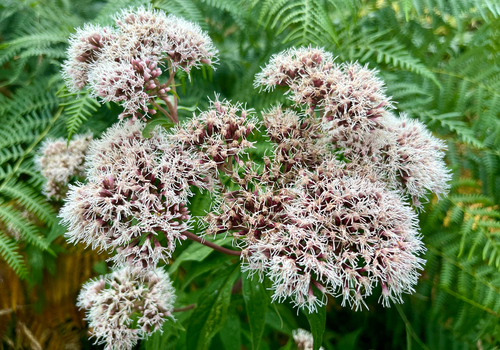
© photo
no rights reserved, uploaded by Hayley · cc0
Kieran Roy Powell · cc0
Catherine Faber · cc0
(c) Catherine Faber, some rights reserved (CC BY) · cc-by
(c) Kieran Roy Powell, some rights reserved (CC BY) · cc-by
Global distribution
Plants of the World Online places the native range in Europe, northwestern Africa, Türkiye, Syria, Iran, Iraq, Jordan, the Caucasus and Central Asia. Hemp agrimony has naturalized locally in China, North America and Oceania; New Zealand lists it as an environmental weed.
- Native7
- Introduced2
- Invasive1
- France
- United Kingdom
- Germany
- Spain
- Morocco
- Türkiye
- Iran
- Canada
- Australia
- New Zealand
Hexagons: regions where the plant occurs. Green dots: native range.1
Identity
Hemp agrimony (Eupatorium cannabinum L., 1753) is a clump-forming perennial in the Asteraceae, with upright reddish stems, palmate leaves and a height of 0.5–1.8 m (1.5–6 ft). Plants of the World Online accepts this name dating from 1753, for a native range spanning Europe, northwestern Africa, Türkiye and Central Asia. 1 3
The genus honors Mithridates VI Eupator, king of Pontus in the first century BC, renowned for his knowledge of antidotes. The epithet cannabinum, however, describes only a leaf resemblance: toothed, palmate leaves recall hemp, without a botanical or chemical connection to Cannabis sativa. 5
A historical French name associated with Saint Cunegund also left a botanical trace. Cunigunda vulgaris Bubani is now a homotypic synonym of the accepted name, preserving that older naming tradition. 1
Recognition
Reddish, finely hairy stems rise straight from the base without branching low down. They commonly reach 0.5–1.5 m (1.5–5 ft), or 1.8 m (6 ft) on favorable riverbanks. 2 4
Opposite leaves are deeply divided into three to five lance-shaped, toothed leaflets arranged like a spread hand. This palmate outline recalls hemp. On older plants, upper leaves sometimes remain undivided, a useful distinction between mature stems and young shoots. 5
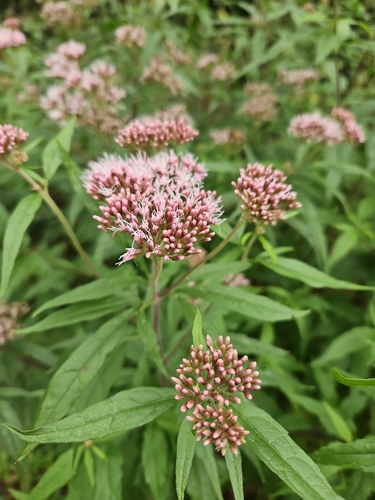
Dense, flattened terminal corymbs contain many small flower heads measuring 2–5 mm (about 0.1–0.2 in). Each head holds five or six tubular florets, pink to mauve and occasionally almost white. Long projecting white styles give the flowers a fluffy appearance at close range and help pollinators locate plants in full light. In Europe flowering lasts about three months, from July to September. 5 2
Useful taxonomy
Older names and infraspecific treatments form a long history around Eupatorium cannabinum in Plants of the World Online. Two subspecies are distinguished chiefly by geography: Eupatorium cannabinum subsp. syriacum (Jacq.) Nyman and Eupatorium cannabinum subsp. corsicum (Req. ex Loisel.) P.Fourn. 1
The genus itself has undergone substantial reclassification. Many North American species formerly placed in Eupatorium, including purple-flowered Joe-Pye weeds, have moved to Eutrochium. Hemp agrimony remains among the few European species retaining the historical genus name. 1
The abandoned genus Cunigunda Adans. included the same plant as Cunigunda vulgaris Bubani. That synonym retains the connection with the old French name referring to Saint Cunegund. 1
Habitat and range
Europe and northwestern Africa form part of a native range continuing through Türkiye, Syria, Iran, Iraq and Jordan to the Caucasus and Central Asia, as recorded by Plants of the World Online. 1
France's INPN records the species widely across the country, chiefly in lowland wetlands. It occurs less often at higher elevations; British records reach 410 m (1,350 ft). 3 2
Riverbanks, ditches, wet meadows, tall-herb vegetation and waterlogged woodland edges are its main habitats. It favors neutral to calcareous soils over acidic ones. Introduced populations occur in North America, China and Oceania. New Zealand lists hemp agrimony as an environmental weed because it can form dense stands along wetland margins. 5 6 7
Life cycle and pollinators
An underground rhizome produces fresh shoots each spring; aboveground stems die in autumn after fruiting. In its European range the palmate foliage develops from April to June, with growth peaking in July and August during the main flowering period. 2
Pink corymbs rank among Europe's most butterfly-visited flowers. The Royal Horticultural Society includes hemp agrimony in Plants for Pollinators for this nectar value, which also benefits many other flower-visiting insects. 2
After flowering, small achenes topped with a pappus disperse on the wind, as in many Asteraceae. Seeds germinate the following spring on bare, moist soil. In cultivation, clump division is the fastest propagation method. Raising plants from seed takes longer but can supply large numbers of young plants. 4
Uses and risks
Traditional medicine used leaves and flowering tops as purifying, diuretic and sometimes fever-reducing remedies, historically for fevers and flu-like illness. Plants For A Future states that medicinal use requires professional supervision because the plant contains toxic alkaloids. 4
Its pyrrolizidine alkaloids are liver-toxic compounds documented in several Asteraceae. Repeated consumption by livestock can progressively damage the liver and lead to liver failure. Contaminated hay is a particular concern because drying removes the plant's deterrent bitterness. 4
A study in BMC Complementary and Alternative Medicine reported marked cytotoxic activity of an ethanolic extract against cultured colorectal cancer cells, with synergy when combined with doxorubicin. This remains preclinical research. Activity in cell cultures does not justify unsupervised medicinal use of hemp agrimony. 8
Varieties, look-alikes and related plants
Double flowers, white flowers and cream-variegated foliage distinguish a few garden forms grown for cutting or naturalistic planting. They are commonly sold as 'Flore Pleno', 'Album' and 'Variegatum', respectively. These horticultural cultivars remain secondary to the wild form, which dominates the landscape. 2
Palmate leaves can suggest hemp, Cannabis sativa, although the plants share neither botanical relationship nor psychoactive compounds. Dense pink corymbs, absent in hemp, settle the distinction at flowering. 5
Another wetland look-alike is Eutrochium purpureum, a tall Asteraceae with a similar habit. Its leaves form whorls rather than opposite pairs, and its flower heads contain more florets. A head with only five or six florets is the most dependable feature for separating hemp agrimony from that species.
Main sources
- Plants of the World Online / Kew, Eupatorium cannabinum L.
- Royal Horticultural Society, Eupatorium cannabinum - hemp agrimony
- INPN / MNHN, Eupatorium cannabinum L., 1753
- Plants For A Future, Eupatorium cannabinum
- First Nature, Eupatorium cannabinum - Hemp Agrimony
- Global Invasive Species Database (IUCN SSC), Eupatorium cannabinum
- New Zealand Plant Conservation Network, Eupatorium cannabinum
- Ribeiro-Varandas et al. 2014, Cytotoxicity of Eupatorium cannabinum ethanolic extract against colon cancer cells, BMC Complementary and Alternative Medicine
Frequently asked questions
Is hemp agrimony poisonous?
It contains liver-toxic pyrrolizidine alkaloids, of particular concern for livestock when the dried plant contaminates hay. Human toxicity is documented mainly in connection with inadequately supervised medicinal use.
Why is hemp agrimony named after hemp?
The epithet cannabinum and common name refer only to the palmate, toothed leaves resembling hemp. This Asteraceae has no botanical or chemical connection with Cannabis.
Where does hemp agrimony usually grow?
On riverbanks, in ditches, wet meadows and tall-herb communities, and along waterlogged woodland edges, almost always in moist to wet soil.
Does hemp agrimony attract butterflies?
Yes. Its pink flower clusters are among the most visited by butterflies in Europe. The Royal Horticultural Society lists it as Plants for Pollinators for its nectar value.
What plants can be confused with hemp agrimony?
Mainly Eutrochium purpureum, another tall wetland Asteraceae, or Cannabis sativa when judged only by its palmate leaves. The shape of the flower clusters and the five or six florets per head are reliable distinguishing features.
Where does the name Eupatorium come from?
It refers to Mithridates VI Eupator, king of Pontus in the first century BC, traditionally credited with using plants of this kind in antidotes to poisons.
Is hemp agrimony invasive?
Not in Europe, where it is native. In New Zealand it is listed as an environmental weed: introduced populations can form dense stands in wet habitats.
Similar plants
If you are unsure about a plant’s toxicity, ask a botanist or veterinarian for advice.