
Common St. John's wort (Hypericum perforatum, )
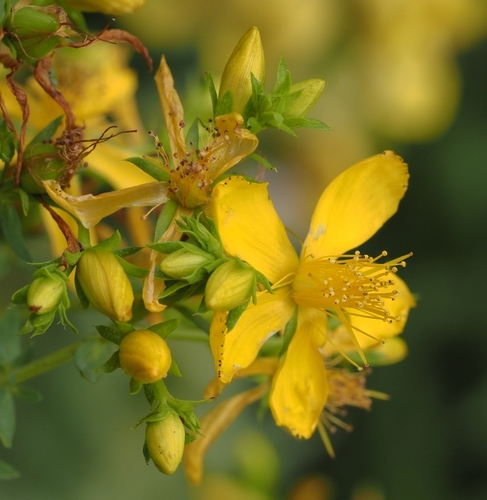
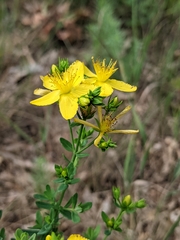
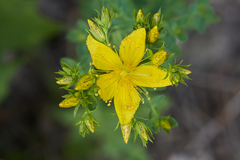
Common St. John's wort (Hypericum perforatum L., 1753) is an herbaceous perennial in the Hypericaceae, native from Europe through the Caucasus and Siberia to China, with populations in northwestern Africa. Its two-ridged stems and translucent leaf glands distinguish this long-used medicinal plant, which has also become an invasive weed outside its native range.
Read moreCommon St. John's wort, St. John's wort and Klamath weed
Allow a few hours of direct sun per day, preferably morning or evening.
Full sun to light partial shade
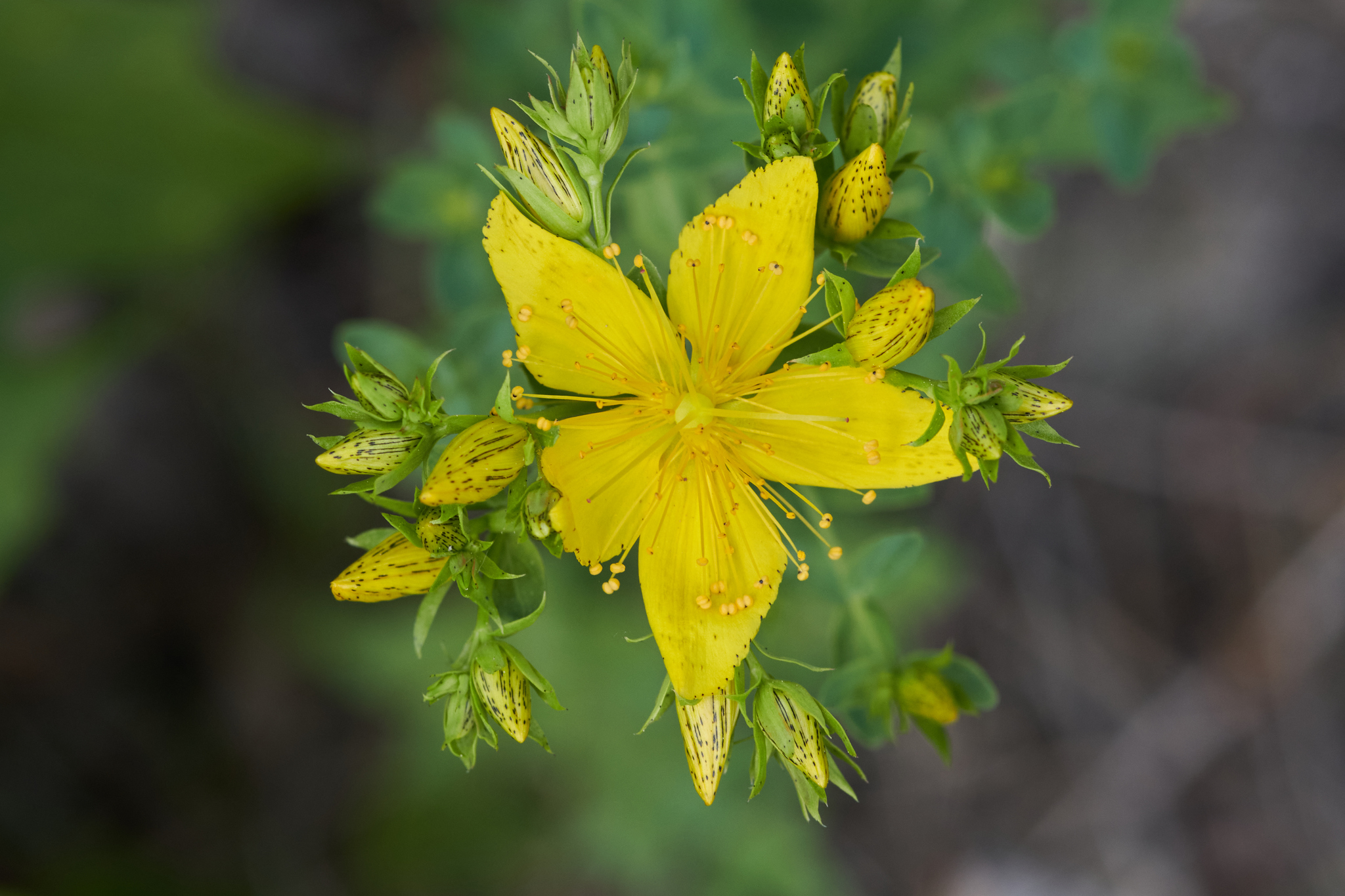
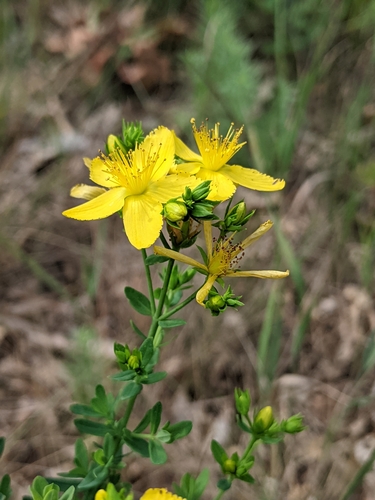
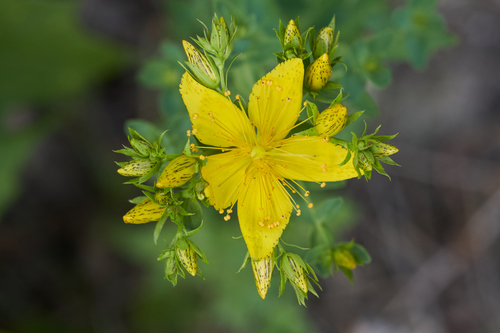
© photo
(c) akolter, some rights reserved (CC BY-NC) · cc-by-nc
Alan Prather · cc0
Ivan Wiljanen · cc-by
(c) Alan Prather, some rights reserved (CC BY) · cc-by
(c) Ivan Wiljanen, some rights reserved (CC BY) · cc-by
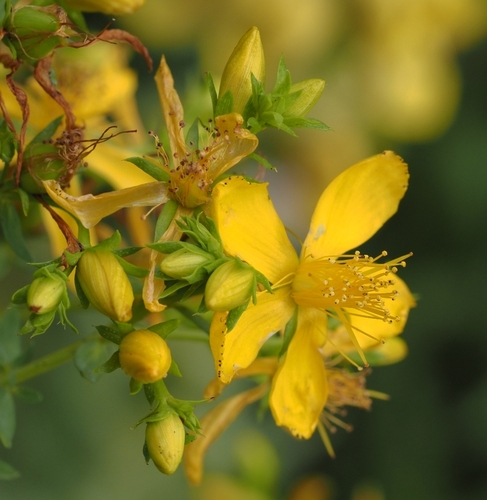
Global distribution
The native range of Hypericum perforatum covers Europe, the Caucasus, Siberia and northwestern Africa, extending to China. Beyond this range, it is widely naturalized in North America, Australia and New Zealand, where it is sometimes classified as an invasive weed.
- Native5
- Introduced1
- Invasive3
- Metropolitan France
- Europe
- Northwestern Africa
- Western Asia and Siberia
- China
- New Zealand
- United States
- Canada
- Australia
Hexagons: regions where the plant occurs. Green dots: native range.1
Identity
Common St. John's wort (Hypericum perforatum L., 1753), often shortened to St. John's wort, is an herbaceous perennial in the genus Hypericum, family Hypericaceae. Its upright, hairless stem has two prominent lengthwise ridges, visible without magnification. These distinguish it from the meadow look-alike Hypericum maculatum, with its hollow, four-angled stem. POWO accepts the name published by Linnaeus in 1753 and places the native range from Europe through the Caucasus and Siberia to China, including northwestern Africa. 1 6
The epithet perforatum refers to the apparently perforated leaves seen against the light. The dots are not holes: they are translucent glands containing essential oils. The English name refers to a tradition of gathering the plant around June 24, the feast of St. John the Baptist, following an older pre-Christian summer-solstice ritual. That cultural date belongs to the European tradition and is not a universal flowering calendar. 7 6
Recognition
A solid, hairless stem with branches near the top gives Hypericum perforatum its upright outline. Plants commonly reach 30–80 cm (12–31 in), occasionally 1 m (3.3 ft) on nitrogen-rich soil. Stem structure is more reliable than flower color for separating it from H. maculatum: the latter has four angles and a hollow interior, while both species bear very similar yellow flowers. 7 6
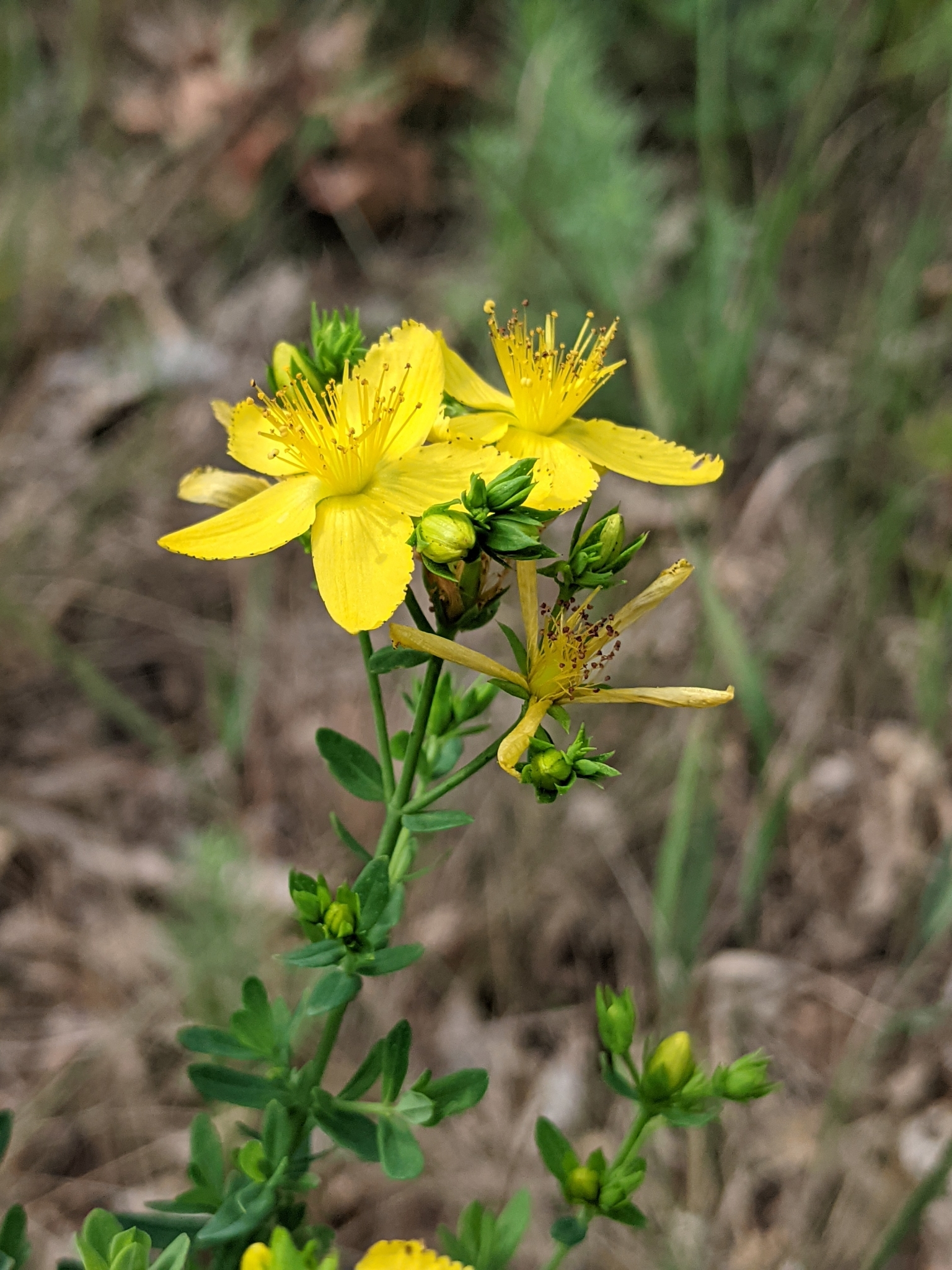
Opposite, stalkless leaves are about 2.5 cm (1 in) long and 1 cm (0.4 in) wide. Held to the light, they reveal many translucent dots, appreciably more than in H. maculatum. A few black glands also occur on the blade and its margins. The combination of gland pattern and stem structure is more useful than either feature considered alone. 3 6
Flat-topped cymes at the ends of the branches open in late spring and summer under the temperate conditions described. Each flower has five golden-yellow petals, with small black marks along their edges. Numerous stamens are gathered into three bundles. These floral details complement the leaf and stem characters when checking a flowering specimen. 3
Useful taxonomy
Linnaeus published Hypericum perforatum L. in 1753, and POWO retains that accepted name. Regional floras also use several synonyms and infraspecific names. Recognizing them helps connect older descriptions with the currently accepted species: 1
- Hypericum perforatum var. angustifolium DC., a variety
- Hypericum perforatum subsp. veronense (Schrank) Ces., a subspecies
- Hypericum quadrangulum var. perforatum Tourlet, a varietal synonym
- Hypericum vulgare Spenn., a synonym
The genus Hypericum contains several hundred species in the Hypericaceae, a family formerly included within the Clusiaceae. Gland-dotted leaves and yellow flowers with numerous stamens arranged in bundles recur across the group. These shared features explain why a generic resemblance is insufficient to establish which St. John’s-wort has been found. 1
Habitat and range
Dry meadows, woodland edges, sunny banks and roadsides provide typical habitat for Hypericum perforatum. Calcareous or otherwise well-drained soils suit it best. Dense shade and waterlogged soil are unfavorable; in saturated ground, the crown can rot before flowering. Its association with sunny, freely drained ground is therefore useful when interpreting a field identification. 7 3
From its native range in Europe, the Caucasus, Siberia, northwestern Africa and China, the species has spread widely beyond Eurasia. It is naturalized in North America, Australia and New Zealand and can be invasive in these introduced regions. The name Klamath weed recalls the Californian area where its spread was closely studied. Imported leaf beetles of the genus Chrysolina, from the plant’s native range, subsequently reduced invasive populations by eating leaves and young shoots. 1 3
A single plant can produce as many as 100,000 seeds a year, and seeds may remain viable in soil for several decades. This combination helps explain the rapid appearance of seedlings on disturbed ground. Removing visible flowering stems does not in itself remove the long-lived reserve of seed already present in the soil. 3
Life cycle and reproduction
During its late-spring and summer flowering season in temperate conditions, the flowers attract many insects despite producing no nectar; bees chiefly collect pollen. The species can also form viable seed without fertilization through apomixis. This allows seed production even when pollinators are absent, an important feature of its ability to establish new populations. 6
A ripe capsule releases hundreds of tiny seeds, each less than 1 mm (0.04 in) long. Sowing and division of the crown both propagate the plant in cultivation or meadow management. Creeping rhizomes also enlarge established clumps from year to year, so the spread of a stand involves underground growth as well as seed dispersal. 2 6
Uses and risks
Dried flowering tops were used in wound preparations as early as the first century CE, and the plant continued through medieval and Renaissance medical traditions. In the Middle Ages, hanging it on doors on St. John’s Day was also believed to protect a home against evil spirits. These are records of historical use and belief. 6
Extracts standardized for hypericin are sold for mild to moderate depression, with availability and product status varying by country. They can accelerate the liver’s elimination of many medicines and reduce their effectiveness. Oral contraceptives, anticoagulants and some antiretroviral treatments are among the affected drugs. This interaction risk is central to understanding medicinal use of the plant. 5
Livestock that eat large amounts of fresh or dried plant can develop hypericin-related photosensitivity. Sunlight then causes redness, blisters and eventually tissue death on unpigmented skin, particularly in cattle, horses and sheep. Young animals and light-coated individuals are most vulnerable; young spring shoots often have the highest hypericin content. The ASPCA also lists Hypericum perforatum as toxic to cats and dogs. 4
Varieties, look-alikes and related plants
Widely distributed ornamental cultivars are not a defining feature of Hypericum perforatum. Unlike ornamental relatives such as Hypericum calycinum and Hypericum x moserianum, it is primarily a meadow species and a medicinal crop. Garden selection has played a smaller role in its familiar identity than wild gathering and the production of herbal preparations. 2
The closest familiar look-alike is Hypericum maculatum. Its hollow, four-angled stem bears fewer translucent glands but more black ones. The two species can hybridize, producing Hypericum x desetangsii Lamotte, with intermediate characters. A specimen that does not fit either description cleanly therefore needs more careful examination than a quick comparison of yellow flowers. 6
Moist-ground relatives can also cause confusion outside flowering: Hypericum tetrapterum has winged stems, while Hypericum humifusum has a creeping habit. For Common St. John's wort, the decisive combination remains a solid stem with two ridges and leaves densely dotted with translucent glands. Both characters should be checked rather than relying on habitat alone. 3
Main sources
- Plants of the World Online / Kew, Hypericum perforatum L.
- Plants For A Future, Hypericum perforatum
- NC State Extension, Hypericum perforatum - St. John's-wort
- ASPCA, St. John's Wort toxicity entry
- National Center for Complementary and Integrative Health, St. John's Wort
- Wikipedia EN, Hypericum perforatum
- Wikipedia FR, common St. John’s wort
- GBIF, Hypericum perforatum L.
Frequently asked questions
Is Common St. John's wort poisonous?
Yes, to livestock and pets. Its hypericin causes skin photosensitivity in cattle, horses and sheep exposed to sunlight after eating it. The ASPCA also lists the plant as toxic to cats and dogs.
How can I tell Hypericum perforatum from Hypericum maculatum?
The stem is the most reliable guide: solid with two lengthwise ridges in Hypericum perforatum, but hollow and four-angled in Hypericum maculatum. The latter also has fewer translucent glands in its leaves.
Why is it called St. John's wort?
Traditional harvesting centered on June 24, the feast of St. John the Baptist. This followed an older, pre-Christian summer-solstice ritual in which the plant symbolically protected the home.
Can St. John's wort interact with medicines?
Yes. Extracts standardized for hypericin can reduce the effectiveness of many medicines, including oral contraceptives, anticoagulants and some antiretrovirals, by speeding their elimination through the liver.
Is Common St. John's wort invasive?
In its native European range, it is a common dry-meadow plant. Introduced to North America and Australia, it has become an invasive weed, controlled in part with leaf beetles of the genus Chrysolina.
How does Common St. John's wort reproduce?
Mainly by seed, with hundreds of thousands dispersed from dry capsules, but also through apomixis, reproduction without fertilization that allows viable seed production even without pollinators.
Can Common St. John's wort grow in a garden?
Yes, in poor, well-drained soil in full sun, although it is primarily gathered from meadows or grown in fields for pharmaceutical production rather than selected as an ornamental.
Similar plants
If you are unsure about a plant’s toxicity, ask a botanist or veterinarian for advice.