
Elecampane (Inula helenium, )
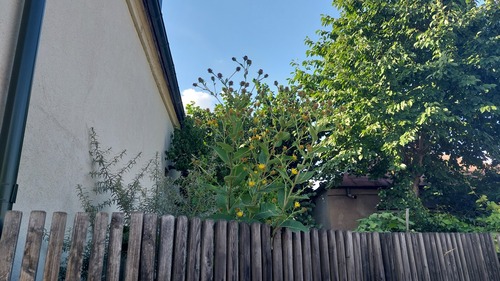
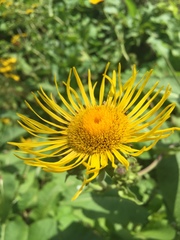
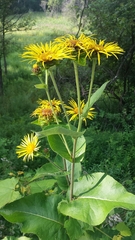
Elecampane (Inula helenium L., 1753) is a perennial in the Asteraceae family, native from southeastern Europe to western Siberia and Iran, and widely naturalized elsewhere in Europe and North America. Its tall hairy stems, large leaves with whitish woolly undersides and huge yellow flower heads with very narrow rays stand above wet meadows and ditches throughout summer.
Read moreElecampane, Horse-heal, Elfdock and Elecampane inula
Allow a few hours of direct sun per day, preferably morning or evening.
Full sun to partial shade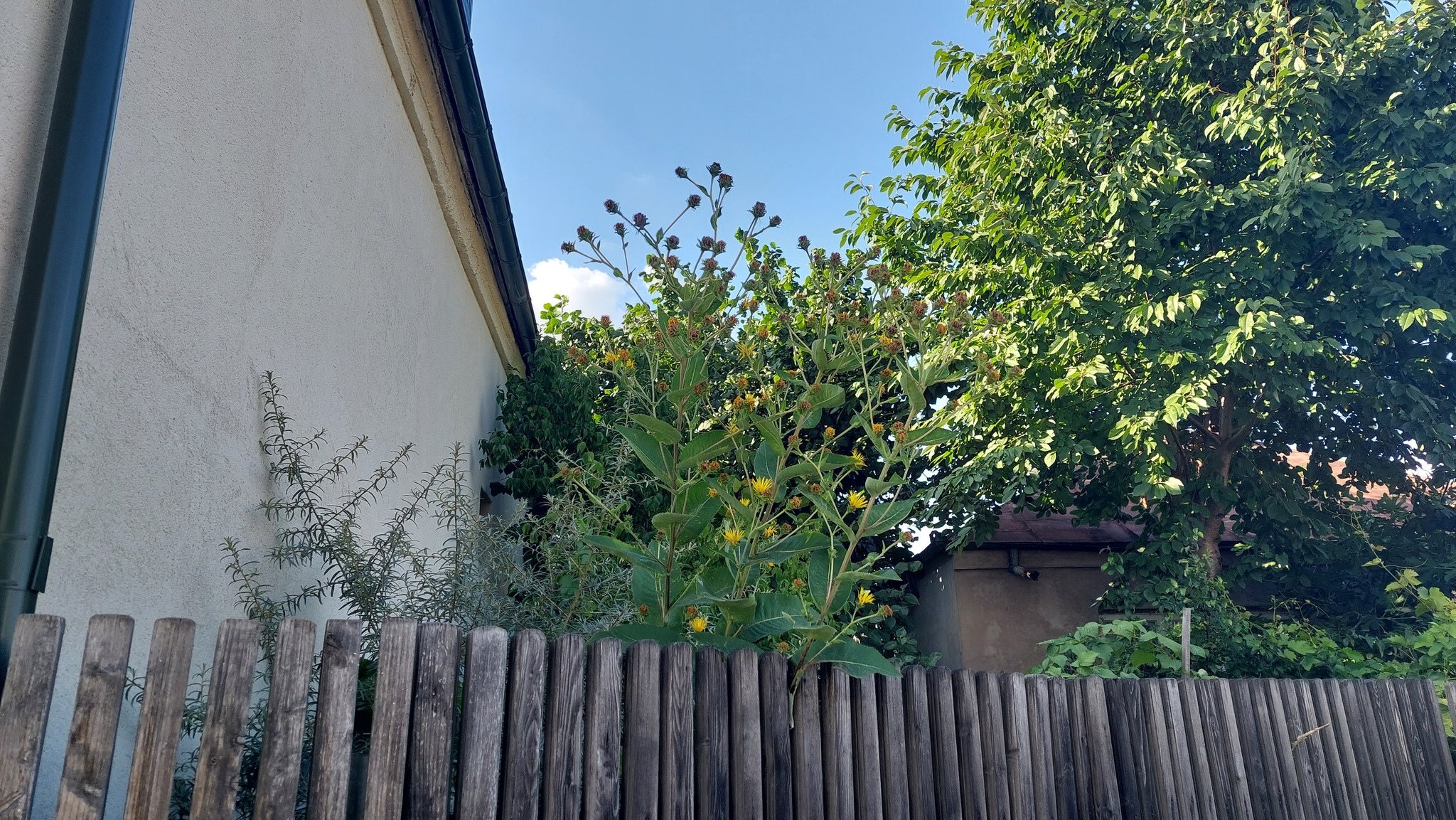


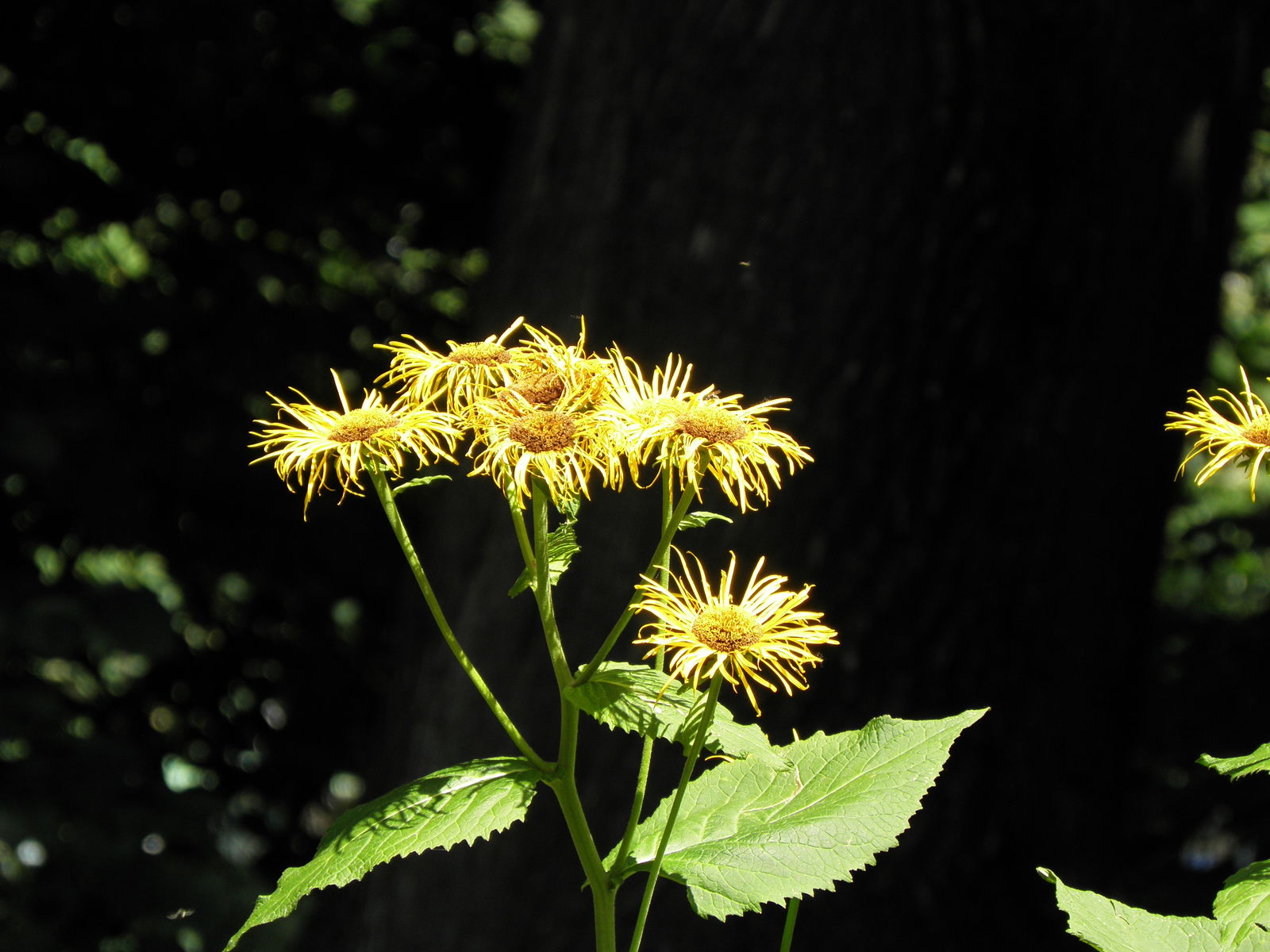
© photo
Patrascu Lucian-Marius · cc0
Елена Патерикина · cc-by
Tom Norton · cc-by
Taken Jul 15, 2009 by Photoflora - Benoit BOCK (©)
Taken Aug 20, 2019 by willem (cc-by-sa)
Taken Jun 27, 2022 by Tristan Jaton-Maria (cc-by-sa)
Taken Jul 24, 2020 by Charles Palmer (cc-by-sa)
Taken Oct 6, 2022 by Sonya Charest (cc-by-sa)
© copyright of the Board of Trustees of the Royal Botanic Gardens, Kew.




Global distribution
Elecampane is native from southeastern Europe to western Siberia and Iran, on rich, moist soils. Cultivation for its medicinal root since antiquity encouraged early naturalization elsewhere in Europe, including France, and more recent introduction to North America as a garden escape.
- Native4
- Introduced5
- Turkey
- Iran
- Russia
- Romania
- France
- Germany
- United Kingdom
- United States
- Canada
Hexagons: regions where the plant occurs. Green dots: native range.1
Identity
Elecampane (Inula helenium L., 1753) is a perennial member of Inula in the Asteraceae family. Yellow flower heads 5–8 cm (2–3 in) wide stand on stems 1–2 m (3.3–6.6 ft) tall, making its outline conspicuous in a summer garden. According to Pliny the Elder, helenium recalls the tears of Helen of Troy; French aunée derives directly from Latin enula, a deformation of ancient Greek helénion. 7 1
Elecampane’s English name comes from enula campana, literally “field enula,” once used to distinguish the wild plant from a cultivated variant. The French folk name œil-de-cheval, or “horse’s eye,” refers to its yellow flower head, 5–8 cm (2–3 in) across, larger than those of most wild European Asteraceae. 6 5
Freshly cut roots offer an unusual identification clue: they smell of ripe banana. Once dried, their scent becomes closer to violet. 4
Recognition
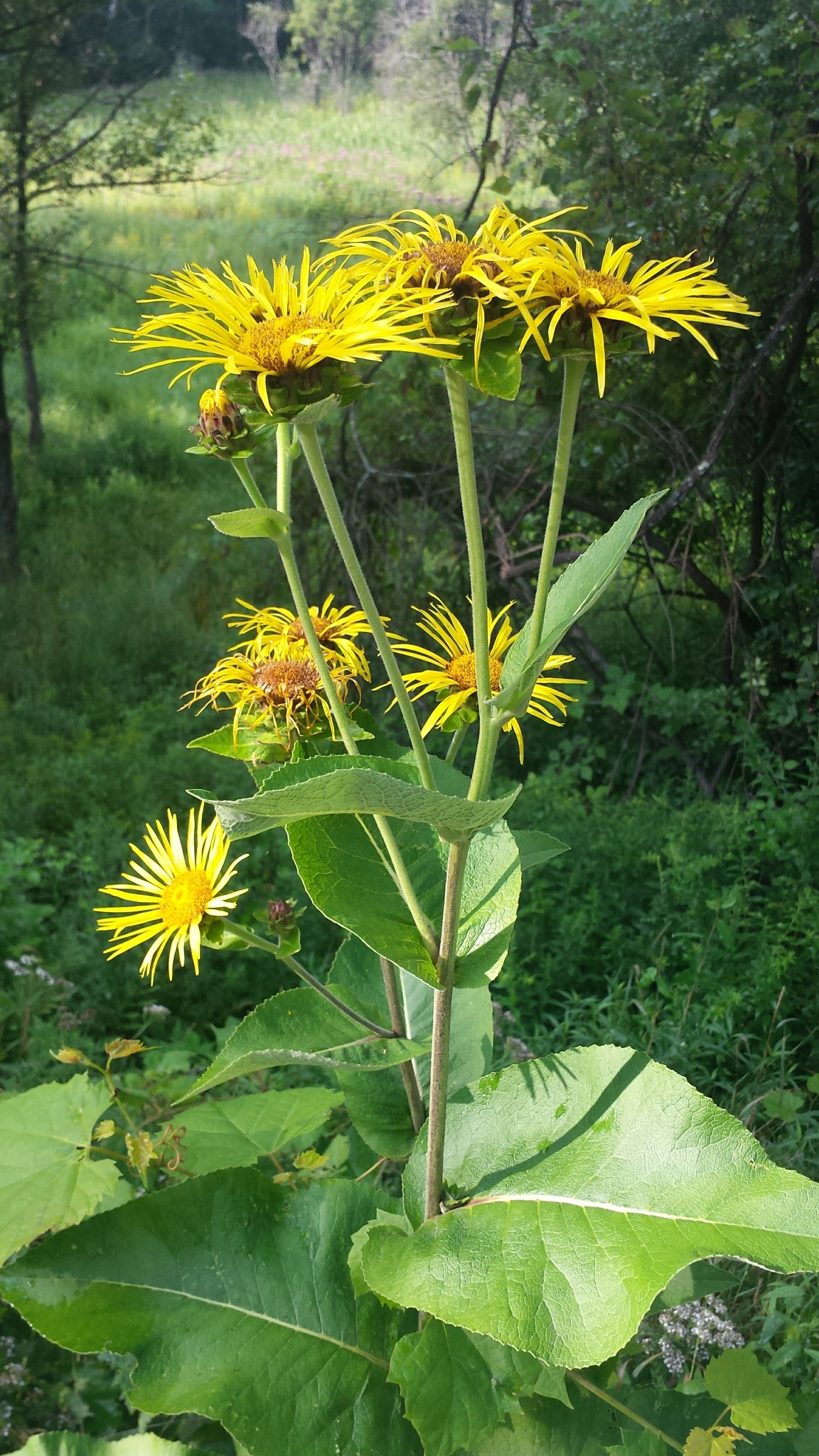
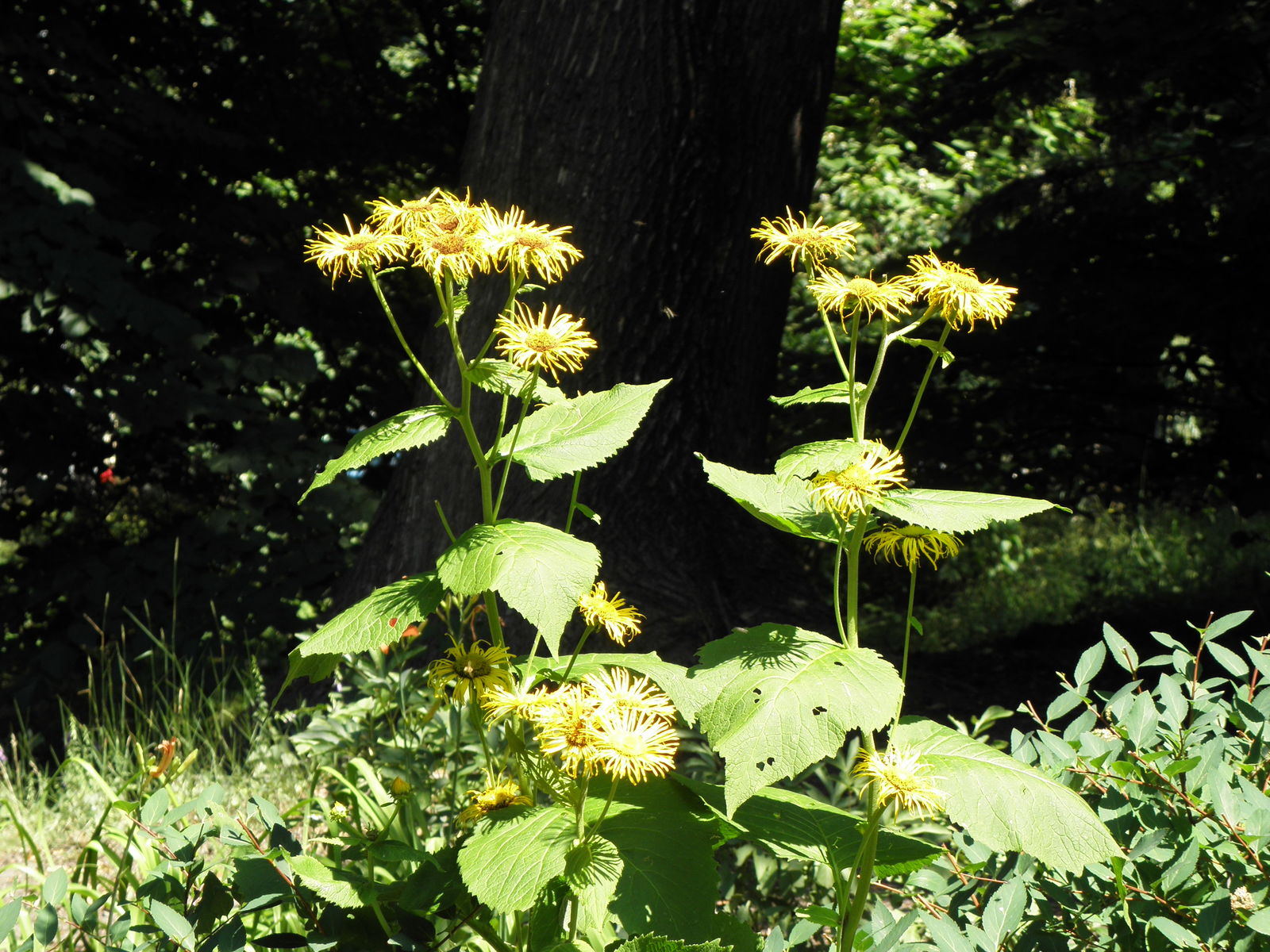
Robust clumps usually reach 1–2 m (3.3–6.6 ft) tall, occasionally 2.5 m (8.2 ft) in very favorable soil, and spread 0.6–1 m (2–3.3 ft). Hairy, grooved stems branch toward the top. Excessively rich soil or an exposed position can cause the tall stems to fall in wind. 2 4
Large oval basal leaves, often 30 cm (12 in) long, have a conspicuous white midrib, a rough upper surface and a whitish woolly underside. That felted reverse distinguishes elecampane by touch even before flowering from Telekia speciosa, whose leaves are heart-shaped and toothed. 5
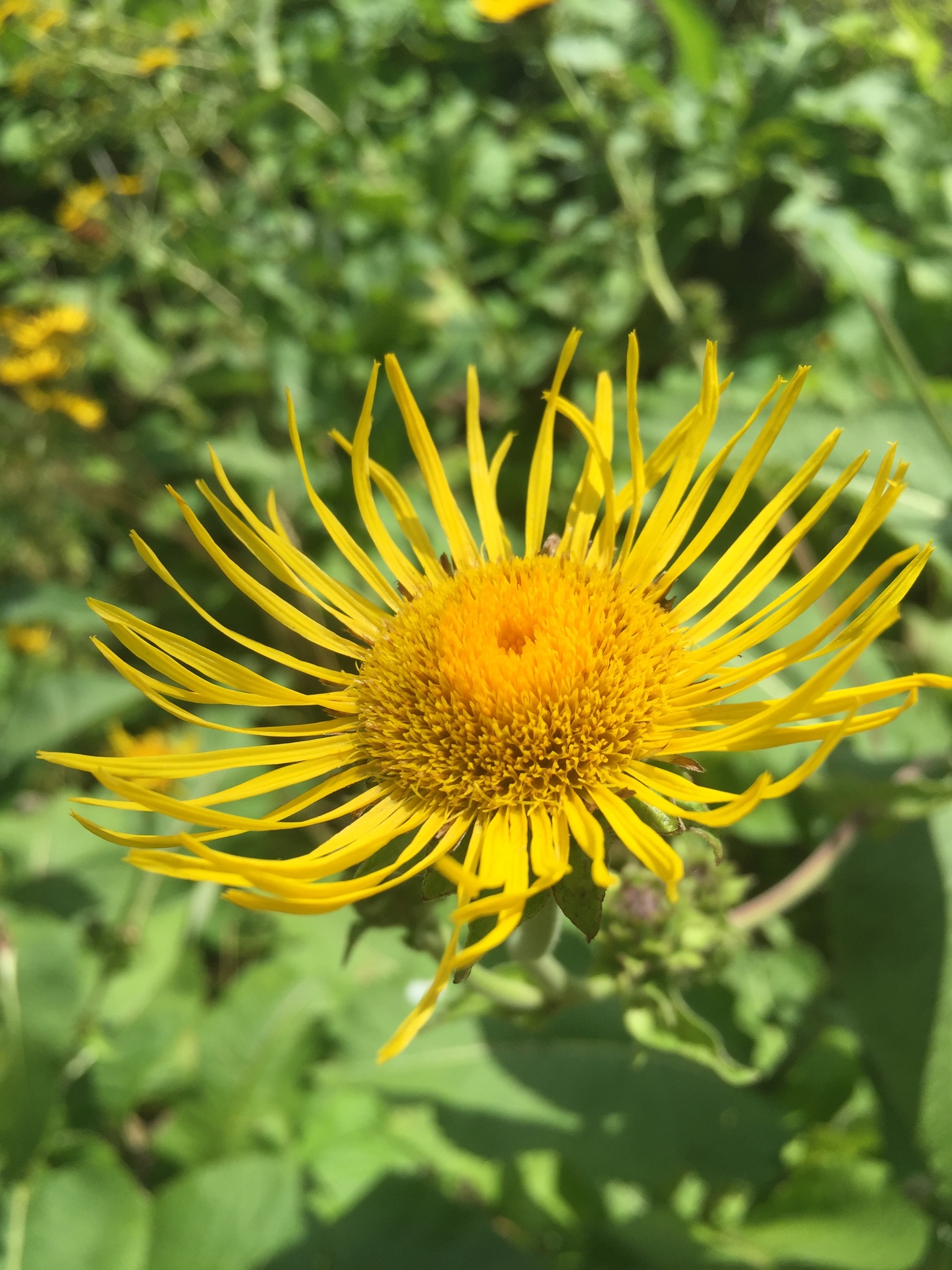
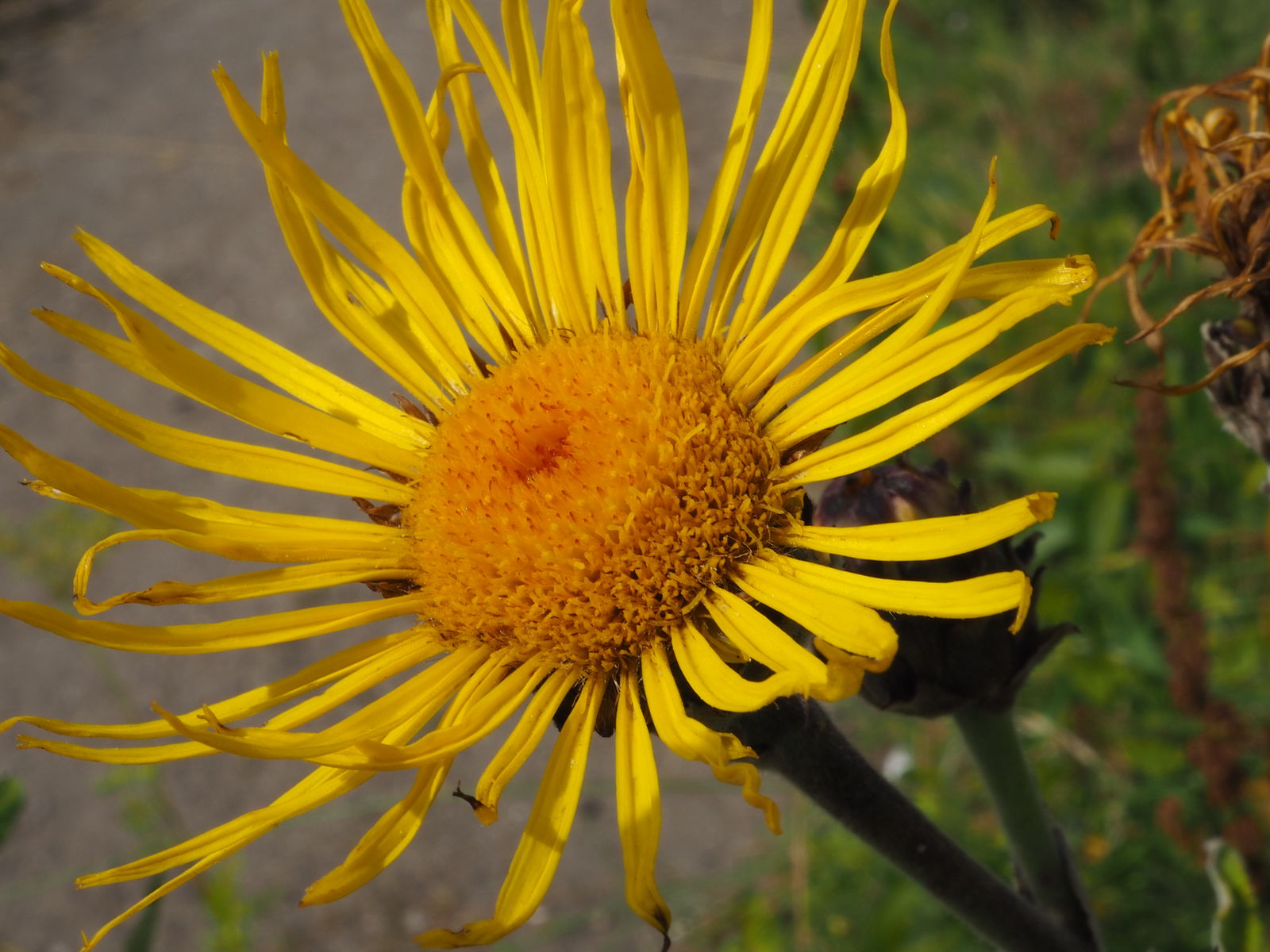
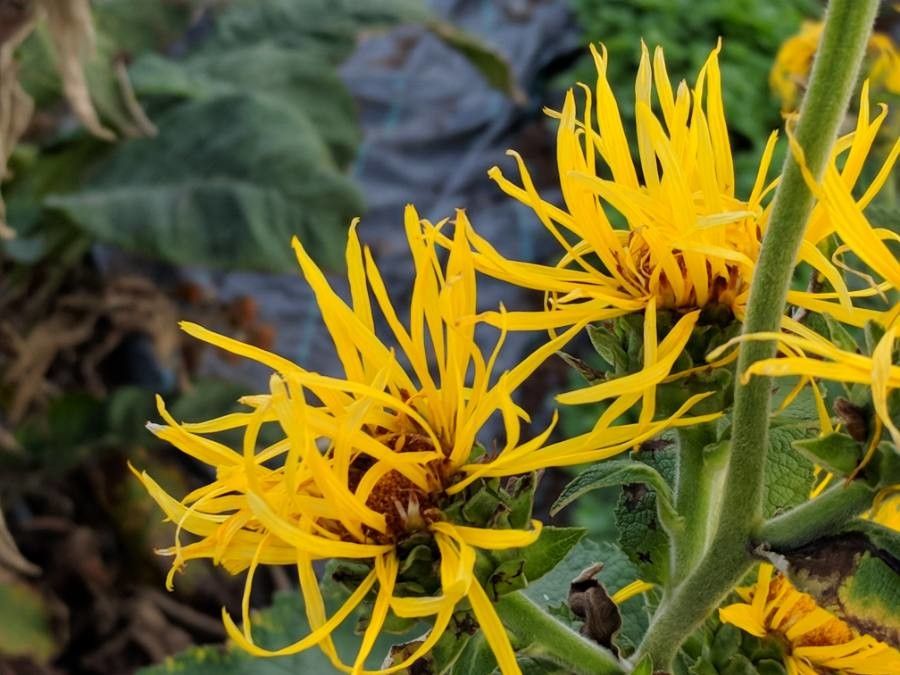
From June to September in its northern temperate setting, yellow flower heads 5–8 cm (2–3 in) wide open with many very narrow, tapering ray florets around a raised central disc, sometimes tinged orange. Each head later produces brown achenes 3–4 mm (0.12–0.16 in) long with a pappus for wind dispersal, whereas burdock achenes use hooks to catch animal fur. 5 2
Useful taxonomy
Kew accepts Inula helenium L., published in 1753, in the Asteraceae family. Plants of the World Online describes its origin as southeastern Europe to western Siberia and Iran. 1
Historical botanical synonyms can help when comparing seed labels or older books:
- Aster helenium (L.) Scop., a historical botanical synonym
- Aster officinalis All., a historical botanical synonym
- Corvisartia helenium Mérat, a historical botanical synonym
- Helenium grandiflorum Gilib., a historical botanical synonym
Despite the similar spelling, Inula helenium has no connection with the North American genus Helenium, the sneezeweeds. The two names share an etymological root associated with Helen of Troy, but represent different Asteraceae lineages. 4 1
Habitat and range
Southeastern Europe, western Siberia and Iran make up elecampane’s native range. There it grows in wet meadows, ditches and roadsides on rich, moist soil. 1
Ancient cultivation for the medicinal root encouraged long-established naturalization elsewhere in Europe, including France. Plants there now occur around former cultivation sites rather than within a strictly native range. 6 1
North American populations spread as garden escapes along roads and damp waste ground. NC State Extension lists elecampane among ruderal plants to watch in that region; this regional status does not negate its ornamental use in Europe. 5
Life cycle and reproduction
Perennial growth begins with a first-year leaf rosette and underground rhizome, usually without a flower stem. From the second year onward, that same rhizome sends up a new flowering stem each spring. Burdock, by comparison, is monocarpic and dies after flowering once. 5
Climate affects the June–September flowering period described for northern temperate conditions, with a clear summer peak. Spent heads develop light achenes with a pappus, allowing wind dispersal and potentially abundant self-seeding unless stems are cut in time. 2 5
Garden propagation by rhizome division in spring or fall can produce flowers the following year, provided each piece retains a living bud. Seed raising is also possible but delays first flowering by 2–3 years, compared with one season for a well-grown rhizome division. 4
Uses and risks
Pliny the Elder recorded the use of the root for coughs and respiratory complaints in antiquity. Mixed with honey or raisins, he described it as beneficial to the stomach. 7
Bitter and aromatic when fresh, the root contains up to 44% inulin, a storage carbohydrate humans cannot digest. It also contains alantolactone, a sesquiterpene lactone whose antiseptic properties have been studied against certain bacilli. Candied root was long sold as a confection, known in French as aunée candie. 4
NC State Extension reports no toxicity from ingestion in people or domestic animals, but does identify a risk of contact dermatitis when handling leaves or sap. Gloves are recommended when harvesting or dividing the rhizome. 5
Varieties, look-alikes and related plants
Widely grown ornamental cultivars are absent, but several close relatives may be sold under elecampane’s name or confused with it in the wild:
- Telekia speciosa, with toothed, heart-shaped leaves clearly different from the entire, oval leaves of Inula helenium;
- Inula racemosa, long confused with Inula helenium in cultivation, notably under the cultivar “Sonnenspeer”;
- Inula magnifica, with fewer but much larger flower heads, sometimes 15 cm (6 in) across.
Basal leaf shape, oval and entire in Inula helenium, is a more reliable guide than flower-head size, which varies considerably between plants. The camphor-like banana scent of a freshly cut root supports identification and is absent from its close relatives. 5
Main sources
- Plants of the World Online / Kew, Inula helenium L.
- Royal Horticultural Society, Inula helenium - elecampane
- Missouri Botanical Garden Plant Finder, Inula helenium
- Plants For A Future, Inula helenium — Internet Archive, 2026-02-12
- NC State Extension Gardener Plant Toolbox, Inula helenium
- French Wikipedia, elecampane
- Pliny the Elder, Natural History, Book XIX, chapter XXIX
Frequently asked questions
Is elecampane toxic to cats and dogs?
No toxicity from ingestion is documented. NC State Extension mainly reports a risk of contact dermatitis in humans; wear gloves when harvesting or dividing the rhizome.
Why does its scientific name refer to Helen of Troy?
According to Pliny the Elder, helenium comes from Helen of Troy’s tears, from which the plant sprang. The French name aunée derives directly from Latin enula, a deformation of the Greek helénion mentioned in the same tradition.
Can elecampane be confused with other large yellow-flowered Asteraceae?
Yes, especially Telekia speciosa, with its distinctive toothed, heart-shaped leaves, and Inula racemosa, a very close relative long confused with Inula helenium in cultivation.
Can you eat elecampane root?
Yes. It was traditionally candied as a sweet or used as a bitter seasoning by the Romans. PFAF describes the fresh root as bitter and aromatic and reports up to 44% inulin.
When should I harvest elecampane root?
In fall, from the second or third year onward, once the rhizome is well developed. Harvesting too early gives a thin root with little aroma.
How do I propagate elecampane in a garden?
Sow in spring or divide the rhizome in spring or fall. Division is the quickest way to obtain a plant that flowers the following year.
Where does the French name aunée come from?
The French name aunée comes from Latin enula, itself derived from ancient Greek helénion, which also gave the scientific epithet helenium. It is not linked to the genus name Inula.
Similar plants
If you are unsure about a plant’s toxicity, ask a botanist or veterinarian for advice.