
Prickly lettuce (Lactuca serriola, )
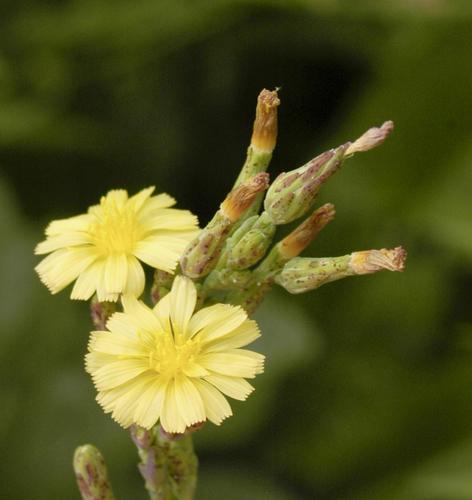

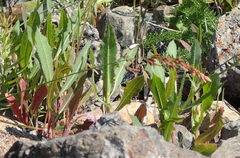
Prickly lettuce (Lactuca serriola L., 1756) is an annual or biennial herb in the Asteraceae, considered the closest wild relative of cultivated lettuce. Widespread from temperate Europe to southwestern Asia, it grows on roadsides, in orchards and in crop fields. Its upper leaves turn upright in a north–south plane, giving it the name compass plant.
Read morePrickly lettuce, compass plant and willowleaf lettuce
Allow a few hours of direct sun per day, preferably morning or evening.






© photo
(c) George F Mayfield, some rights reserved (CC BY-SA) · cc-by-sa
Carrie Seltzer · cc0
iNaturalist User · cc-by
Taken Aug 3, 2014 by Tela Botanica − Marie PORTAS (cc-by-sa)
Taken Jun 24, 2008 by Tela Botanica − Daniel MATHIEU (cc-by-sa)
Taken Sep 29, 2020 by Denisse Pellegrino (cc-by-sa)
Taken Aug 29, 2021 by Philippe Bissières (cc-by-sa)
© copyright of the Board of Trustees of the Royal Botanic Gardens, Kew.




Global distribution
According to POWO, Lactuca serriola is native from Europe to southwestern Siberia and the western Himalaya, and from North Africa to Somalia, in temperate climates. It has become widely naturalized in North America and Australia, colonizing orchards, roadsides and open-field crops.
- Native4
- Introduced2
- Metropolitan France
- Temperate and Mediterranean Europe
- North Africa
- Southwestern Asia and the western Himalaya
- North America
- Australia
Hexagons: regions where the plant occurs. Green dots: native range.1
Identity
The name prickly lettuce refers to Lactuca serriola L., 1756, an herb in the genus Lactuca, family Asteraceae and tribe Cichorieae. Botanists regard it as the closest wild relative of cultivated lettuce (Lactuca sativa), closer than any other wild Lactuca. POWO lists Lactuca sativa subsp. serriola (L.) Frietema as a homotypic synonym of L. serriola: this records an alternative subspecific treatment, rather than genetic evidence. 1 3
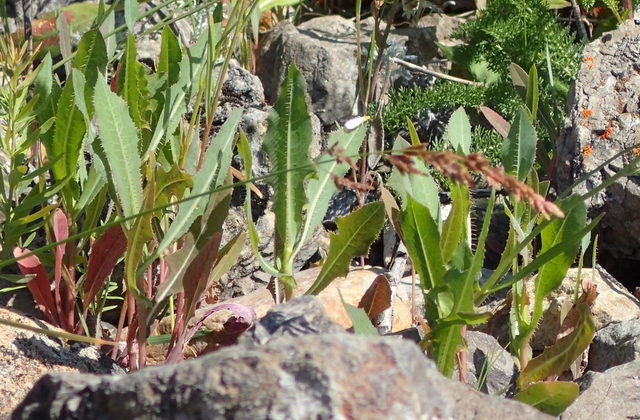
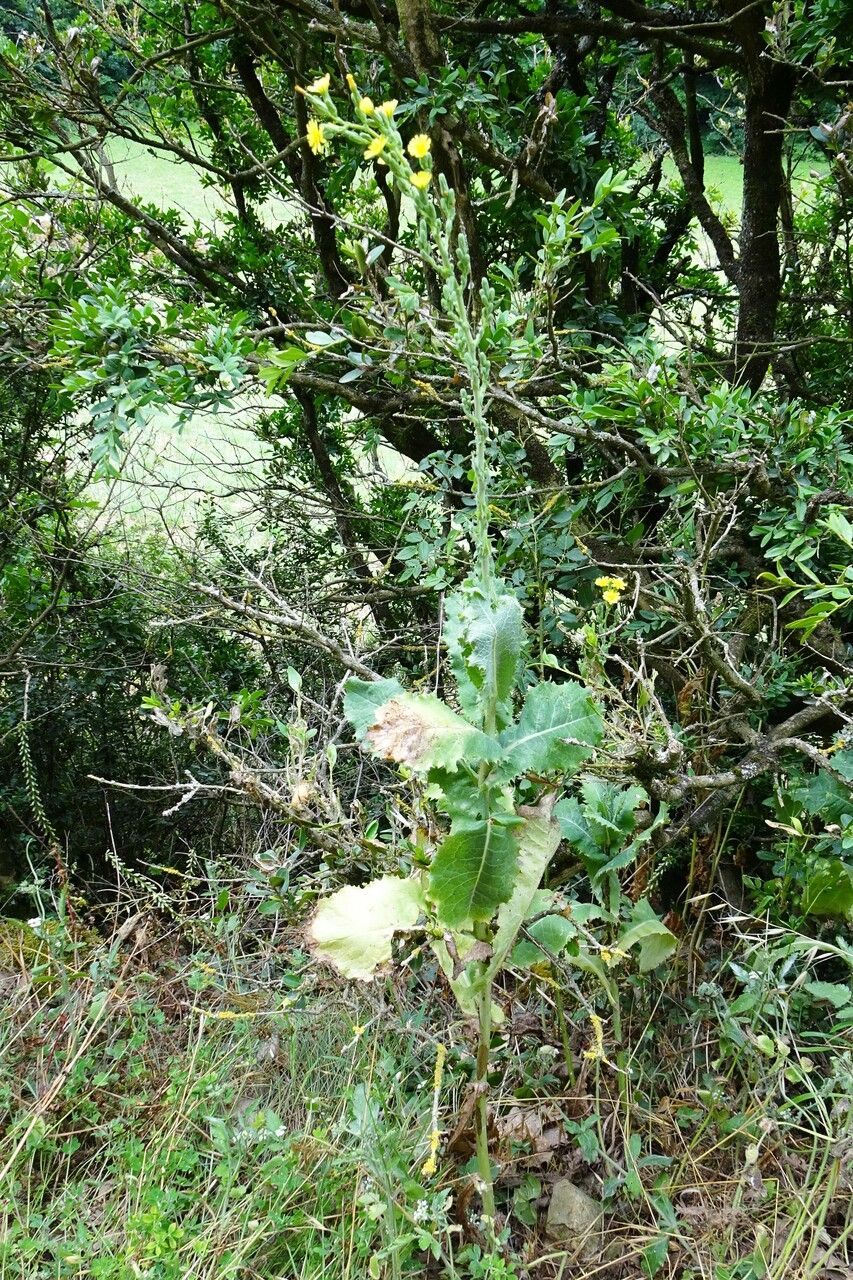
On the flower stalk, upper leaves turn upright into a north–south rather than east–west plane. Ecophysiologists Werk and Ehleringer documented this behavior as early as 1980: it reduces exposure to midday sunlight and limits water loss, benefiting plants growing in full sun. This leaf orientation gives it the English name compass plant.
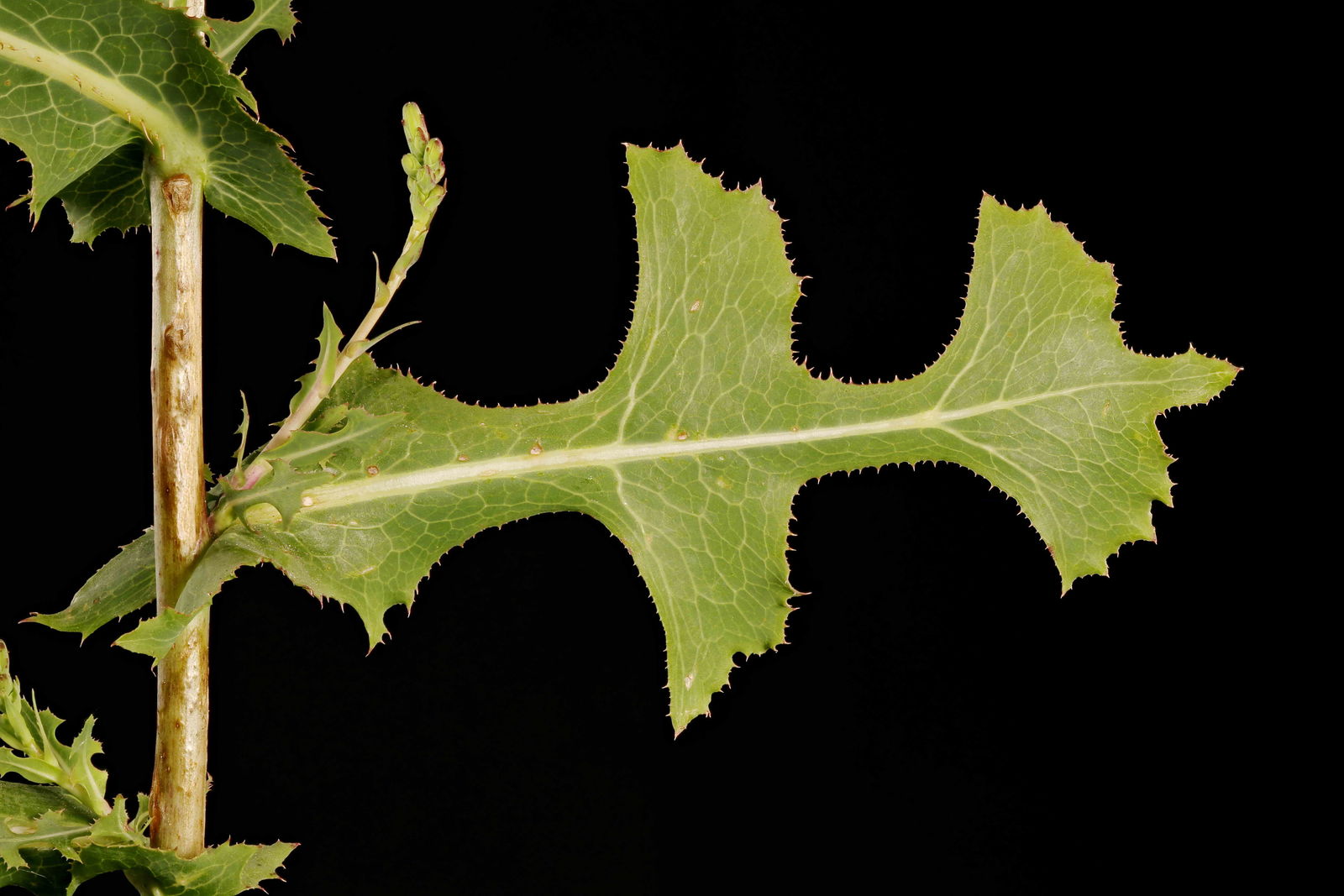
The French vernacular escarole can be misleading: in French cooking it primarily means broad-leaved endive (Cichorium endivia), botanically separate from Lactuca serriola. The epithet serriola may refer to the saw-toothed leaf margins. Another established English name is willowleaf lettuce. 2
Recognition
A basal rosette develops first, followed by an upright, hairless stem, often reddish at the base. It can reach 2 m (6.5 ft) tall and resists wind well once woody, helping it stay upright on exposed banks. Damage releases milky white latex, less abundant than in its relative Lactuca virosa. 6 5
A row of fine but rigid prickles runs along the underside of each leaf’s midrib, stiffer than in other Lactuca. This is the most reliable feature at the rosette stage, before flowering. 6
Before bolting, rosette leaves remain horizontal, so position alone is not diagnostic. Only the upper leaves on the later flower stalk adopt the north–south alignment behind the name compass plant. 8
Flower heads 1–1.5 cm (0.4–0.6 in) across are pale yellow, sometimes purple-tinged. Depending on the individual, each has 12–20 ray florets and no disk florets. The achenes have grayish tips and a pappus of white bristles. 4
Useful taxonomy
POWO accepts Lactuca serriola L. Several synonyms and historical names persist in databases and older literature:
- Lactuca serriola f. integrifolia Hegi
- Lactuca serriola var. integrata (Gren. & Godr.) Farw.
- Lactuca serriola subsp. integrifolia (Gray) G.H.Loos
- Lactuca sativa subsp. serriola (L.) Frietema
The last synonym treats prickly lettuce as a subspecies of Lactuca sativa; it does not mean that the two accepted species share a nomenclatural type. Separately, Lactuca serriola is a closely studied genetic resource for lettuce breeders, including in the search for resistance to downy mildew (Bremia lactucae). 1 9
Habitat and range
According to POWO, the native range extends from Europe to southwestern Siberia and the western Himalaya, and from North Africa to Somalia, in temperate climates. 1
Outside this range it has become widely naturalized, particularly in North America and Australia, in orchards, roadsides and open-field crops. In California it occurs up to 2,000 m (6,560 ft) above sea level, in farmland and urban waste ground. It is among the most widespread weeds of the genus Lactuca worldwide. 6
Life cycle and reproduction
The life cycle is annual or biennial, depending on climate. Rosettes establish in fall or early spring, and seeds have no pronounced primary dormancy. Germination is optimal at 12–24 °C (54–75 °F), depending on the seed lot; it stops below 8 °C (46 °F), while secondary dormancy develops above 26–35 °C (79–95 °F). 6
Flowering runs from April to October depending on latitude, in the Northern Hemisphere context. An isolated, vigorous plant about 1.5 m (5 ft) tall can produce up to 50,000 seeds, compared with only 330 on a weak 30 cm (12 in) plant under dense competition. Seed production therefore varies enormously with vigor. 7
The pappus-bearing achenes disperse mainly by wind close to the parent, but also in surface irrigation water. This helps them spread rapidly into neighboring fields, especially untreated winter cereals. 7
Uses and risks
Young rosette leaves are less bitter and can be eaten raw in salads or steamed; cooked young shoots resemble asparagus. Bitterness increases sharply as plants age beyond the rosette stage. 5
The dried latex, related to the lactucarium of Lactuca virosa but less concentrated, was historically used as a mild sedative and antispasmodic. Mature plants remain mildly toxic: large amounts of leaves cause digestive upset, while excessive latex use first causes agitation and, in a major overdose, cardiac paralysis. 5
In agriculture, prickly lettuce is a troublesome winter-cereal weed because flower buds present at harvest contaminate the grain. White mustard seed meal incorporated into soil reduces emergence through allelopathy, offering an alternative to herbicides in affected fields. 7
Varieties, look-alikes and related plants
Lactuca serriola has no recognized horticultural cultivar. It is a wild plant, never selected for ornament, but actively studied as a source of genes for cultivated lettuce. 9
The main look-alike is great lettuce (Lactuca virosa), followed by smooth sow-thistle (Sonchus oleraceus). Great lettuce has purplish-black achenes and more horizontal leaves, whereas prickly lettuce has paler achenes and upright upper leaves. Young smooth sow-thistle rosettes have hollow stems that are never reddish at the base. 4
The name escarole creates one final trap: in cooking it means broad-leaved endive (Cichorium endivia), botanically distinct from prickly lettuce despite the shared vocabulary.
Main sources
- Plants of the World Online / Kew, Lactuca serriola L.
- International Plant Names Index, Lactuca serriola L.
- GBIF Backbone Taxonomy, Lactuca serriola L.
- USDA PLANTS Database, Lactuca serriola plant profile
- Plants For A Future, Lactuca serriola
- UC ANR Statewide IPM Program, Prickly lettuce (Lactuca serriola)
- SARE, Manage Weeds on Your Farm - Prickly lettuce
- PubMed, Effect of nonrandom leaf orientation on reproduction in Lactuca serriola L.
- European Journal of Plant Pathology, Bremia lactucae populations on cultivated lettuce originate from prickly lettuce
Frequently asked questions
Is prickly lettuce toxic?
Mature plants are mildly toxic. Eating large amounts of leaves can cause digestive upset; overdosing on the dried latex, related to lactucarium, can cause drowsiness.
Can prickly lettuce be eaten?
Young rosette leaves are less bitter and can be eaten raw in salads or steamed. Bitterness increases markedly as the plant ages beyond the rosette stage.
Why is Lactuca serriola called compass plant?
The upper leaves on the flower stalk turn upright into a north–south plane. This reduces exposure to midday sun and limits water loss.
Is prickly lettuce related to cultivated lettuce?
Yes. It is regarded as the closest wild relative of Lactuca sativa, cultivated lettuce. Lactuca sativa subsp. serriola (L.) Frietema treats prickly lettuce at subspecies rank; that homotypic synonymy is not genetic evidence.
How can prickly lettuce be distinguished from great lettuce?
Prickly lettuce has upright upper leaves and paler achenes; Lactuca virosa has more horizontal leaves and dark purplish-black achenes.
Is garden escarole the same plant?
No. In cooking, escarole is a broad-leaved endive, Cichorium endivia, botanically separate from Lactuca serriola despite an occasionally shared name.
Is prickly lettuce an agricultural problem?
Yes, particularly in winter cereals, where flower buds present at harvest contaminate the grain. One isolated plant can produce up to 50,000 seeds.
Similar plants


If you are unsure about a plant’s toxicity, ask a botanist or veterinarian for advice.