
ridged gourd (Luffa acutangula, )
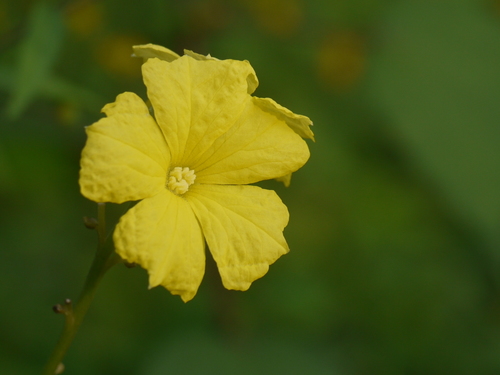

Ridged gourd (Luffa acutangula) is an annual climbing vine in the Cucurbitaceae family, grown for its ribbed fruits harvested young as vegetables. Its angular stem and sharply ridged fruits distinguish it from the smooth-fruited Luffa aegyptiaca. Depending on the variety, the flesh ranges from sweet to intensely bitter, explaining both its culinary popularity and reported livestock poisonings.
Read moreridged gourd, Angled loofah, Chinese okra and Sing-kwa
Place in full sun, with intense direct light all day long.
Full sun in a warm, sunny position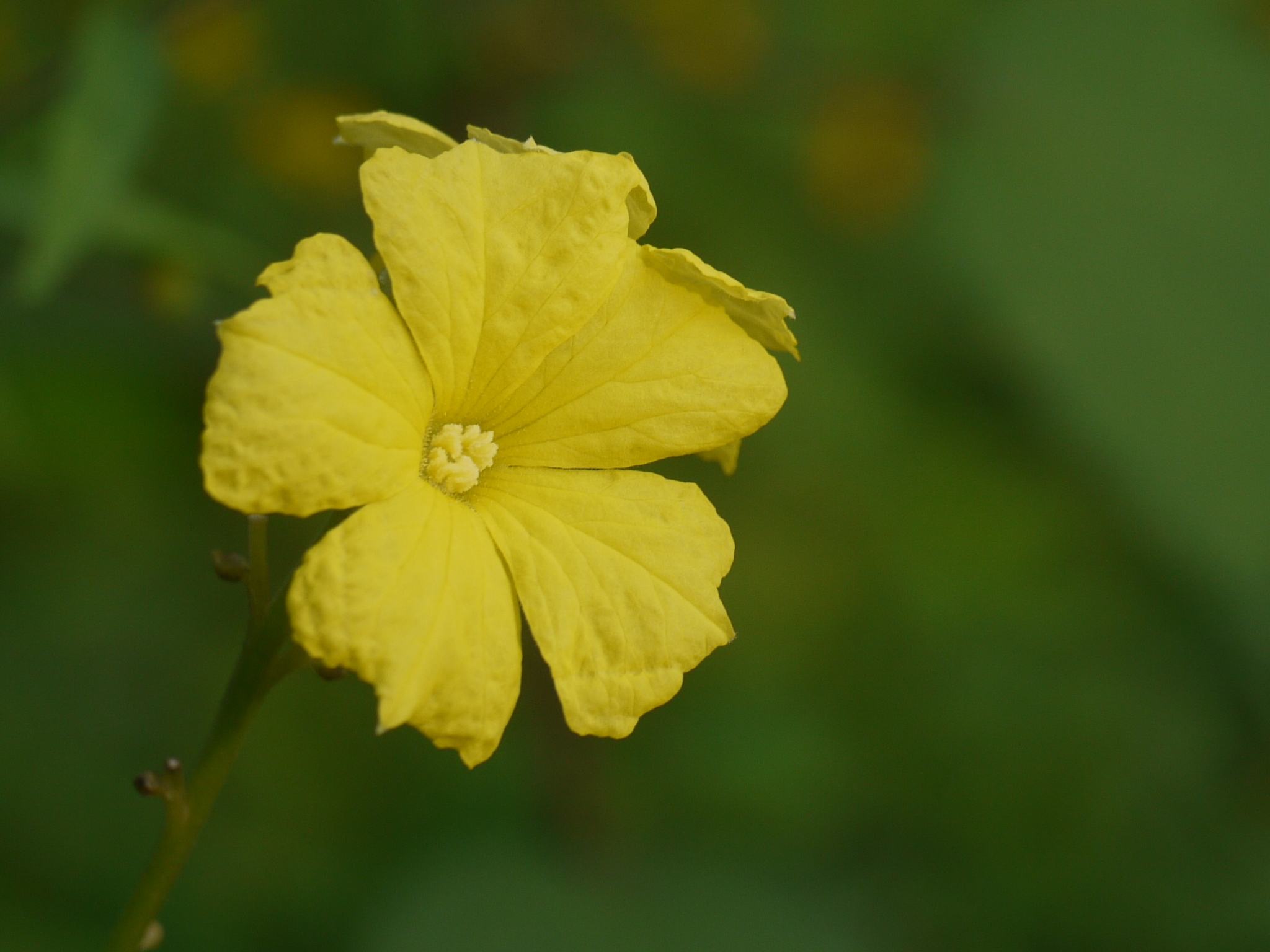




© photo
(c) Dinesh Valke, some rights reserved (CC BY-SA) · cc-by-sa
Wikimedia Commons · CC BY-SA or Public Domain
Wikipedia · CC BY-SA
© copyright of the Board of Trustees of the Royal Botanic Gardens, Kew.


Global distribution
Luffa acutangula originated in the Indian subcontinent, where wild forms still survive. Cultivation spread through the humid tropics and subtropics of Asia and Africa, and more locally into the Americas. It is now encountered far more often in cultivation than growing spontaneously.
- Native1
- Introduced1
- India
- United States
Hexagons: regions where the plant occurs. Green dots: native range.1
Identity
Ridged gourd (Luffa acutangula (L.) Roxb., 1832) is an annual vine in the Cucurbitaceae family and the genus Luffa. Known as pétole in Mauritius, it takes its Latin epithet, acutangula, from the sharp angles of its stems and fruits. The fruit bears 10 longitudinal ribs, unlike the smooth fruit of its close relative Luffa aegyptiaca. 1 2
The English name Chinese okra compares its elongated fruit to okra by shape alone. Botanically, the plants belong to different families: okra is a member of the Malvaceae, while ridged gourd belongs to the Cucurbitaceae. Angled loofah and Sing-kwa are other names encountered for the crop. A scientific name is more reliable than resemblance when deciding which plant a label describes. 5 4
Recognition
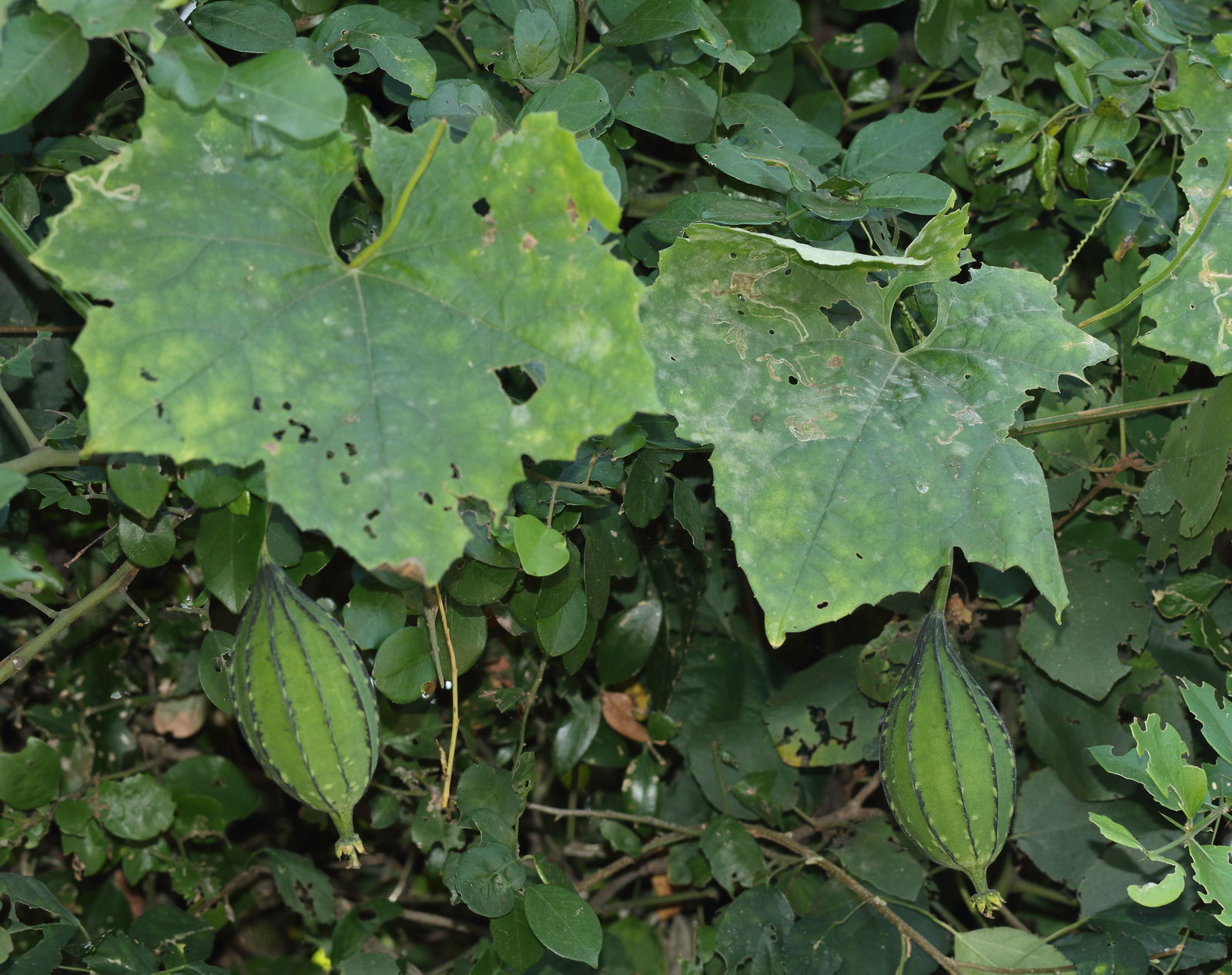
A distinctly angular climbing stem is an early clue to Luffa acutangula. Branched tendrils arise at the nodes and attach the vine to its support. The same angular character lies behind the species name. Pale, rough leaves are nearly circular and shallowly to moderately lobed, reaching 25 cm (10 in) across. In the ground, the vine can extend 1.5–5 m (5–16 ft). 4 2
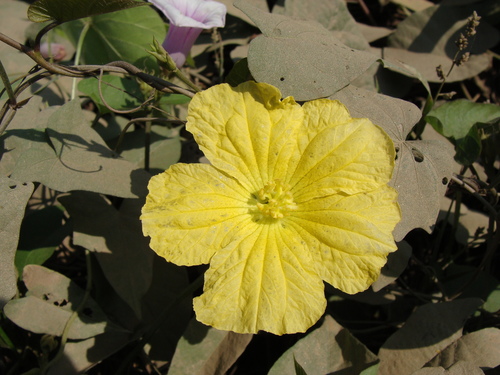
Male and female flowers occur on the same plant, making it monoecious. Pale yellow male flowers open in clusters, while solitary female flowers have an already swollen ovary at the base. The fragrant flowers measure 4–5 cm (1.6–2 in) and open late in the day, an unusual feature among vegetable cucurbits. They attract evening pollinators as well as bees the following morning. 4 3
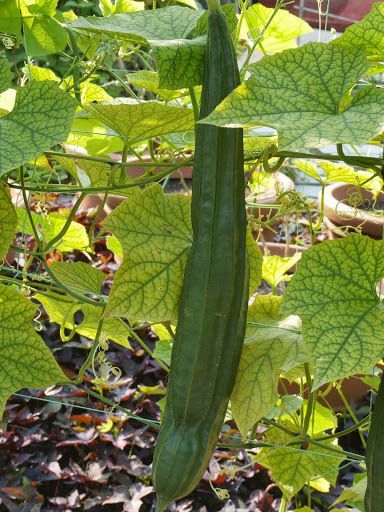
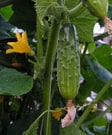
Fruit provides a more dependable distinction from related species than stems or leaves alone. A young fruit is green and club-shaped, with ten conspicuous, sharply raised longitudinal ribs, and commonly reaches 30 cm (12 in) long. Left on the vine, it turns brown and dries completely, revealing a fiber network coarser than that of Luffa aegyptiaca. 2 4
Useful taxonomy
Linnaeus first described this species as Cucumis acutangulus. Scottish botanist William Roxburgh transferred it to Luffa in 1832, explaining the parenthesized author abbreviation (L.) Roxb. Several botanical forms and varieties have been associated with the accepted name:
- Luffa acutangula f. amara (Roxb.) W.J.de Wilde & Duyfjes
- Luffa acutangula var. amara (Roxb.) C.B.Clarke
- Luffa acutangula var. forskalii (Schweinf. ex Harms) Heiser & E.E.Schill.
- Luffa acutangula var. subangulata (Miq.) Cogn.
The amara form is more useful to recognize than ordinary differences in fruit size or color. It represents the bitter variety close to the wild Indian ancestor, in contrast to modern vegetable selections grown for mild flesh. Both share the same underlying scientific name; that name alone does not distinguish their botanical status or culinary suitability. 1
Habitat and range
Wild populations of Luffa acutangula still survive in its homeland, the Indian subcontinent. Cultivation spread through tropical and subtropical lowlands up to about 500 m (1,640 ft) above sea level, from Vietnam to Egypt, including China, Japan and the Philippines. Its presence in a vegetable plot therefore does not by itself establish that the species is native to the region. 3 4
Frost is fatal to the vine: a single night below 0 °C (32 °F) can kill it. Outdoor cultivation consequently needs warm, well-exposed conditions. Excess moisture during flowering also favors powdery mildew and downy mildew, the two most frequent fungal diseases reported for this species. Where temperate summers are cool, a greenhouse or sunroom is needed, or at least a very sunny, sheltered position beside a fence. 2 4
Life cycle and reproduction
Insect visits determine whether Luffa acutangula sets fruit. Male flowers open in clusters, whereas the fragrant, solitary female flowers open in the evening and need a pollinator to transfer pollen. Without that visit, young fruits yellow and drop prematurely. Flowering alone is therefore no guarantee of a harvest, even on a vigorous vine. 4 3
Propagation is by seed only. After an overnight soak in cold water, seeds sown at 21–24 °C (70–75 °F) germinate in 4–7 days. Germination stops below 15 °C (59 °F). A well-grown plant can yield its first edible fruit just two months after sowing, then produce 15–20 fruits over a harvest lasting two to three months. These intervals describe plant development rather than fixed calendar dates. 3
Harvest stage matters as much as timing. Fruit picked 12–15 days after fruit set, at around 300–400 g (11–14 oz), remains tender and relatively free of fiber. Leave it longer and the flesh hardens, losing its value as a vegetable. 3
Uses and risks
Young fruit is primarily a vegetable, harvested at about 10–15 cm (4–6 in) and cooked in soups, curries or stir-fries, much like zucchini. Flavor ranges from sweet to decidedly bitter according to the variety. Young shoots, leaves and flower buds are also cooked, and the seeds are roasted as a snack. 3 4
The main toxic risk concerns bitter forms close to the wild amara variety, rich in the cytotoxic compound cucurbitacin B. Brazilian livestock farmers have reported abortions in cattle and sheep after the animals ate Luffa acutangula fruits. Around twenty calves reportedly died after uncontrolled use of the fruits as a deworming treatment. These reports concern particular exposures, rather than every culinary use of young cultivated fruit. 6 7
In laboratory rodents, plant extracts caused no mortality at doses up to 2,000 mg/kg, but reduced fetal weight in pregnant rats. Traditional medicinal use therefore does not establish complete safety, particularly during pregnancy. The absence of deaths in one experimental setting is a narrower finding than proof that every preparation is harmless. 7
Varieties, look-alikes and related plants
Horticultural diversity in Luffa acutangula includes variation in bitterness and the prominence of the fruit ribs. Sweet-fruited types selected as vegetables contrast with amara, which is closer to the original wild fruit and unsuitable for routine eating. 1
Two particularly frequent look-alikes are:
- Luffa aegyptiaca, whose rounded stem and smooth fruit contrast with the angular stem and ribbed fruit of L. acutangula;
- young Momordica charantia fruits, whose skin is warty and knobbly rather than regularly ribbed.
The five-ribbed stem, the ten fruit ribs and variation in bitterness between varieties distinguish Luffa acutangula more effectively than green color alone, shared by many vegetable gourds. Checking these features helps establish identity before deciding how to use the fruit in cooking. 2 5
Main sources
- Plants of the World Online / Kew, Luffa acutangula (L.) Roxb.
- Royal Horticultural Society, Luffa acutangula - angled loofah, sing kwa
- Useful Tropical Plants Database, Luffa acutangula
- NParks Singapore Flora & Fauna Web, Luffa acutangula
- Sorting Luffa Names, University of Melbourne, Luffa acutangula vernacular names
- Feedipedia, Luffa - toxicity and reported poisoning notes
- PMC, Therapeutic potential of Luffa acutangula - a review
Frequently asked questions
How does Luffa acutangula differ from Luffa aegyptiaca?
Luffa acutangula has an angular stem and ten sharp longitudinal fruit ribs; Luffa aegyptiaca has a rounded stem and smooth fruit. Their cultivation and culinary uses are very similar.
Is ridged gourd poisonous?
Young fruits are edible, but bitter forms close to the wild amara variety contain cucurbitacin B. Abortions and deaths have been reported in livestock after fruit ingestion, so caution is warranted around domestic animals.
Can you eat the whole Luffa acutangula fruit?
Only young fruits, harvested around 10–15 cm (4–6 in), are cooked as vegetables. At maturity they become fibrous and bitter, suitable for extracting fiber or other nonfood uses.
Why are some fruits bitter and others sweet?
Flavor depends strongly on the cultivated variety. Forms close to the wild Indian ancestor produce bitter, cucurbitacin-rich flesh, whereas modern vegetable selections have been bred for mild flesh.
Where should I grow ridged gourd?
Full sun and a sturdy support such as a trellis or fence are essential. In cool climates, a greenhouse with good light gives better results.
Where does Luffa acutangula come from?
The species originated in the Indian subcontinent, where wild populations still survive. Cultivation later spread throughout tropical Asia, then Africa and other warm regions.
What does the name Luffa acutangula mean?
The Latin epithet acutangula means sharp-angled, describing both the five-ribbed stem and the ten-ribbed fruit. These features distinguish it from its smooth-fruited close relatives.
Similar plants

If you are unsure about a plant’s toxicity, ask a botanist or veterinarian for advice.