
Grape hyacinth (Muscari, )
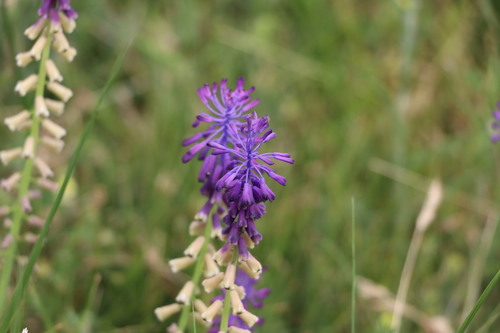
Grape hyacinth (Muscari) is a genus of small bulbous plants in the Asparagaceae. Dense conical clusters of tiny, usually blue bell-shaped flowers open in early spring, sometimes carrying a faint musk scent that explains the genus name. Easy to grow and quick to naturalize, they carpet beds, rock gardens and lawns; Muscari armeniacum is by far the most widely grown species.
Read moreGrape hyacinth, Armenian grape hyacinth (Muscari armeniacum) and Tassel hyacinth (Muscari comosum)


© photo
Florencia Grattarola · cc0
SteveM4560 · cc-by
Taken Apr 20, 2022 by Elie Eid (cc-by-sa)
Taken May 10, 2020 by Sebastien (cc-by-sa)


Global distribution
Muscari is native to Europe, the Mediterranean basin, North Africa and southwestern Asia, extending to Central Asia in some species. Temperate regions where garden grape hyacinths are merely planted or naturalized must be distinguished from this wild native range.
- Native5
- Metropolitan France
- Italy
- Greece
- Turkey
- Armenia
Hexagons: regions where the plant occurs. Green dots: native range.1
Identity
Grape hyacinth (Muscari Mill.) is a genus of small bulbous plants in the Asparagaceae, order Asparagales. Its common name describes conical clusters of tiny, usually blue, bell-shaped flowers carried in early spring. Philip Miller described the genus in 1754, and it includes several dozen wild species. 1 4
The name Muscari refers to the faint musk fragrance of the flowers in several species. The most familiar garden representative is Muscari armeniacum, Armenian grape hyacinth, planted in beds and rock gardens or naturalized in lawns, where it forms dense sheets of spring blue. 3 2
Recognition
A dense conical flower cluster provides the first recognition clue. Its tightly packed little bells or urns have six fused lobes constricted at the mouth and often edged in white. Colors range from deep to pale blue, through purple and, less commonly, white. Medium-green leaves are linear and channeled, and often emerge as early as fall. 3 5
Below ground sits a small, rounded true bulb with tunics, rather than a corm as in crocuses. Plants remain low, 10–25 cm (4–10 in) tall. Each bulb renews itself annually and produces small offsets around its edge, explaining the tendency to spread. 1 3
One species offers a particularly clear clue: tassel hyacinth (Muscari comosum) has a tousled tuft of sterile purple flowers above the fertile flowers lower down. Most other species have a regular cluster whose flowers all look similar. 4 2
Useful taxonomy
Philip Miller established Muscari in 1754. The genus is now placed in the Asparagaceae, subfamily Scilloideae. This placement is relatively recent: grape hyacinths were long included in the Liliaceae, then in the Hyacinthaceae, before molecular classification grouped them with asparagus and hyacinths. 1 4
Garden use centers on several species:
- Muscari armeniacum, Armenian grape hyacinth, the most widely cultivated species;
- Muscari botryoides, with small bright blue flower clusters;
- Muscari comosum, tassel hyacinth, topped by sterile flowers;
- Muscari latifolium, with broad leaves and two-tone clusters.
The accepted genus name, Muscari, remains the stable reference, because cultivar names identify horticultural selections rather than separate botanical species. The genus is also close to hyacinths (Hyacinthus), with which it shares the same subfamily. 1 3
Habitat and range
Wild grape hyacinths occur naturally in Europe, the Mediterranean basin, North Africa and southwestern Asia, with the genus extending east into Central Asia in some species. Habitats include meadows, grassland, Mediterranean scrub, woodland edges and well-drained rocky ground, from lowlands to mountain elevations. 1 4
Sunny or lightly shaded sites with well-drained soil suit these plants, which are adapted to climates with contrasting seasons. Growth and flowering occupy a short spring period, followed by summer dormancy, with the bulb sheltered underground. This ecology explains both their hardiness and their sensitivity to waterlogged soil. 5 3
Beyond the native range, garden grape hyacinths occur in cultivation or as naturalized plants. In France, the United States and Japan, bulbs are planted in fall for spring flowers, then spread by offsets and self-seeding, sometimes carpeting suitable lawns. 2 5
Life cycle and reproduction
As a hardy bulbous perennial, grape hyacinth follows a short favorable growing season. A fall-planted bulb roots and often produces leaves in fall or winter, flowers in early spring, then replenishes its reserves through the foliage before it yellows. Summer dormancy follows until the next season. 5 3
Offsets provide the easiest form of propagation. Each bulb produces them around its edge; they can be separated when clumps become crowded and flower less freely. Division maintains vigorous flowering over the years. Always let leaves yellow completely before removing them so the bulbs can recover well. 2 5
Ready self-seeding also speeds naturalization, but may make grape hyacinths troublesome in a small garden. Removing spent flower stalks before seed forms limits unwanted seedlings. Deliberate seed propagation is slow, since young plants take several years to reach flowering size. 3 2
Uses and risks
Blue spring carpets in lawns and beneath deciduous trees are a familiar ornamental use, alongside beds, rock gardens, edging and containers. Tassel hyacinth (Muscari comosum) also has a long food use: its bitter bulbs, called lampascioni, are eaten as a vegetable in Italy and Greece. 2 4
Toxicity is generally low: the ASPCA lists grape hyacinth as non-toxic to cats, dogs and horses. Bulbs nevertheless contain saponins, and eating large quantities may cause mild digestive upset, including vomiting or diarrhea, without particular severity. Keep bulbs away from animals and young children as a precaution. 6 5
Varieties, look-alikes and related plants
Garden selections are sold by species and cultivar rather than as a single interchangeable group. Muscari armeniacum supplies most common plantings, Muscari botryoides offers a valued white form, Muscari comosum has its sterile tassel, and Muscari latifolium carries a two-tone flower cluster. 3 2
Look-alikes encountered among spring bulbs include:
- Hyacinthus orientalis, hyacinth, much larger with strongly scented star-shaped flowers;
- Bellevalia, a neighboring genus with similar clusters, sometimes sold as grape hyacinth;
- Scilla, squill, another small blue spring bulb in the same subfamily.
Dense conical clusters, small bell-shaped flowers with constricted mouths and a low habit remain the most reliable signs that a blue spring bulb is a grape hyacinth rather than a hyacinth or squill. 4 5
Main sources
Frequently asked questions
Is grape hyacinth toxic to cats and dogs?
Grape hyacinth has only low toxicity. The ASPCA lists it as non-toxic to cats, dogs and horses; eating large quantities of bulbs may cause no more than mild digestive upset. Keep bulbs out of reach as a precaution.
When should you plant grape hyacinths?
Plant bulbs in fall, 8–10 cm (3–4 in) deep, in well-drained soil and close groups. They flower in early spring the following season and then return every year.
Do grape hyacinths come back every year?
Yes. These hardy bulbous perennials return each year and multiply through offsets and self-seeding. They readily naturalize into carpets in suitable lawns.
Why are my grape hyacinths growing leaves but few flowers?
Excess leaves at the expense of flowers often result from nitrogen-rich soil, overcrowded clumps or immature bulbs. Limit feeding and divide clumps if needed.
Are grape hyacinths invasive?
Grape hyacinths naturalize quickly through offsets and self-seeding, and can become troublesome in a small garden. Removing faded flower stalks before seed forms and regularly dividing clumps keeps them contained.
How do grape hyacinths differ from hyacinths?
Both belong to the Asparagaceae, but grape hyacinths are much smaller and have conical clusters of tiny bell-shaped flowers. Hyacinths carry sturdy stalks of large, strongly scented star-shaped flowers.
Why do grape hyacinth leaves appear in fall?
This is a normal part of the genus’s cycle. In many species leaves emerge in fall and remain through winter before spring flowering; it is not a problem and needs no action.
Can you grow grape hyacinths in pots?
Yes. Use a container with drainage holes and a sandy, free-draining medium, planting bulbs closely in fall. In cold regions keep the pot frost-free, as winter cold helps trigger flowering.
Species in this genus
Similar plants
If you are unsure about a plant’s toxicity, ask a botanist or veterinarian for advice.