
Granadilla (Passiflora ligularis, )
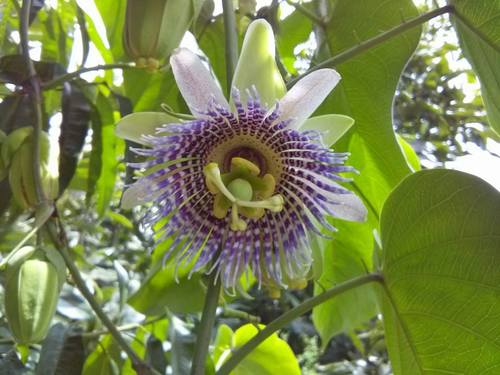

Granadilla (Passiflora ligularis Juss., 1805) is a vigorous vine in the Passifloraceae family, native to the Andes and the Central American isthmus. Tendrils carry it several meters upward. Its spectacular flowers last just one day and are followed by oval orange fruit speckled with white, with fragrant pulp especially valued in tropical highlands.
Read moreGranadilla, Sweet granadilla, Grenadia and Sugarfruit
Allow a few hours of direct sun per day, preferably morning or evening.
Full sun; light afternoon shade is helpful in very hot climates


© photo
(c) chioOlalde, some rights reserved (CC BY-NC), uploaded by chioOlalde · cc-by-nc
Wikimedia Commons · CC BY-SA or Public Domain
Wikipedia · CC BY-SA
Taken Aug 14, 2022 by alvine (cc-by-sa)
Taken Aug 30, 2019 by Blue Bottle (cc-by-sa)
© copyright of the Board of Trustees of the Royal Botanic Gardens, Kew.




Global distribution
POWO places the native range from Panama to Venezuela and south to Peru along the Andean slopes. Horticultural accounts often extend it to southern Mexico and all of Central America, where the species has long been cultivated. Introductions farther afield are more recent and sometimes problematic.
- Native5
- Introduced2
- Invasive3
- Panama
- Colombia
- Venezuela
- Ecuador
- Peru
- Hawaii
- India
- Australia
- Haiti
- Jamaica
Hexagons: regions where the plant occurs. Green dots: native range.1
Identity
Granadilla (Passiflora ligularis Juss., 1805) is a perennial vine in the passionflower genus Passiflora, family Passifloraceae. POWO accepts this name, published by Antoine Laurent de Jussieu in 1805. 1 2
The names sweet granadilla and sugarfruit emphasize the sweetness of its pulp compared with the much more acidic ordinary passion fruit. Grenadia is another established name. Granadilla is also the Spanish name for the fruit; the French name likewise distinguishes its sweetness. 3 5
Recognition
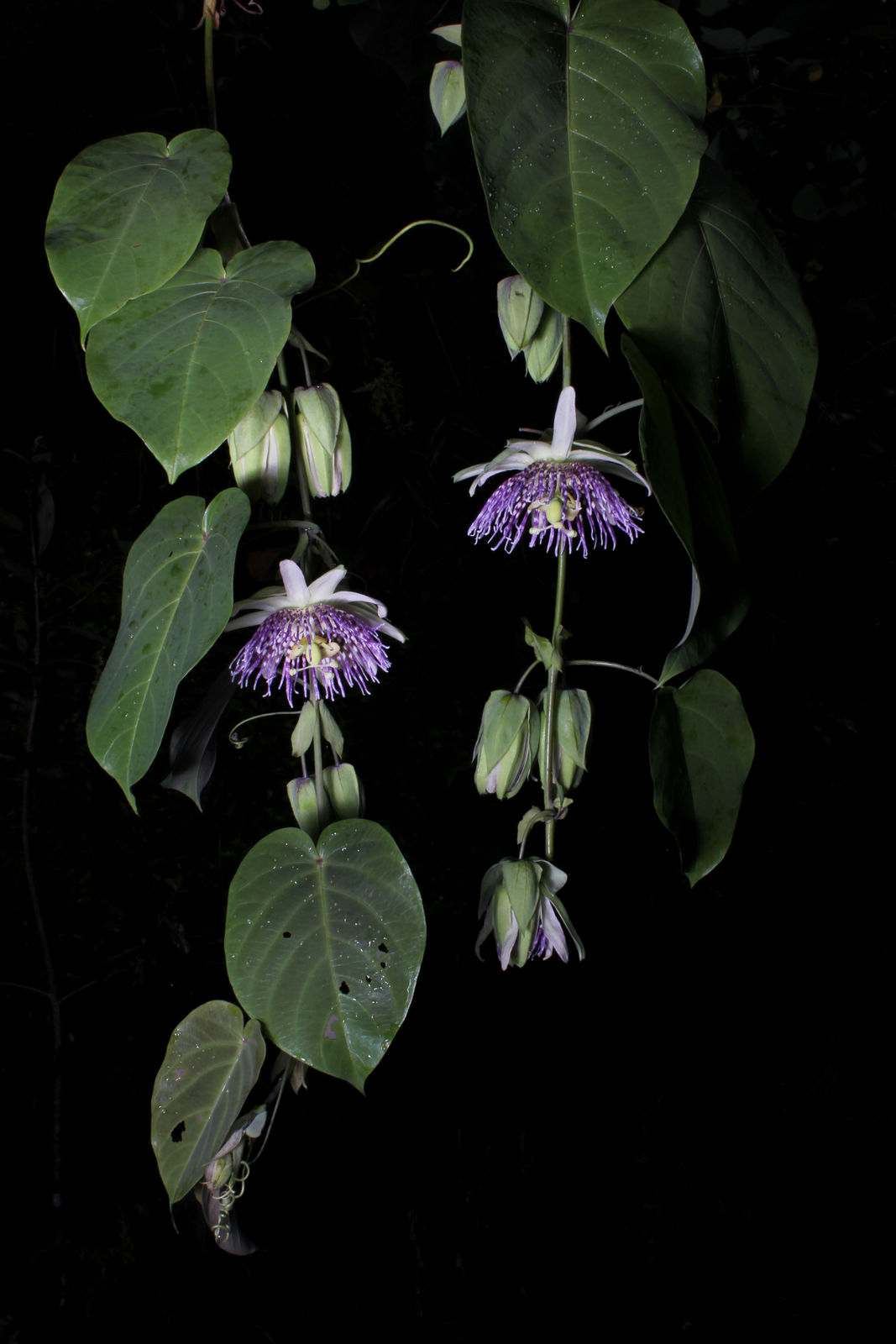
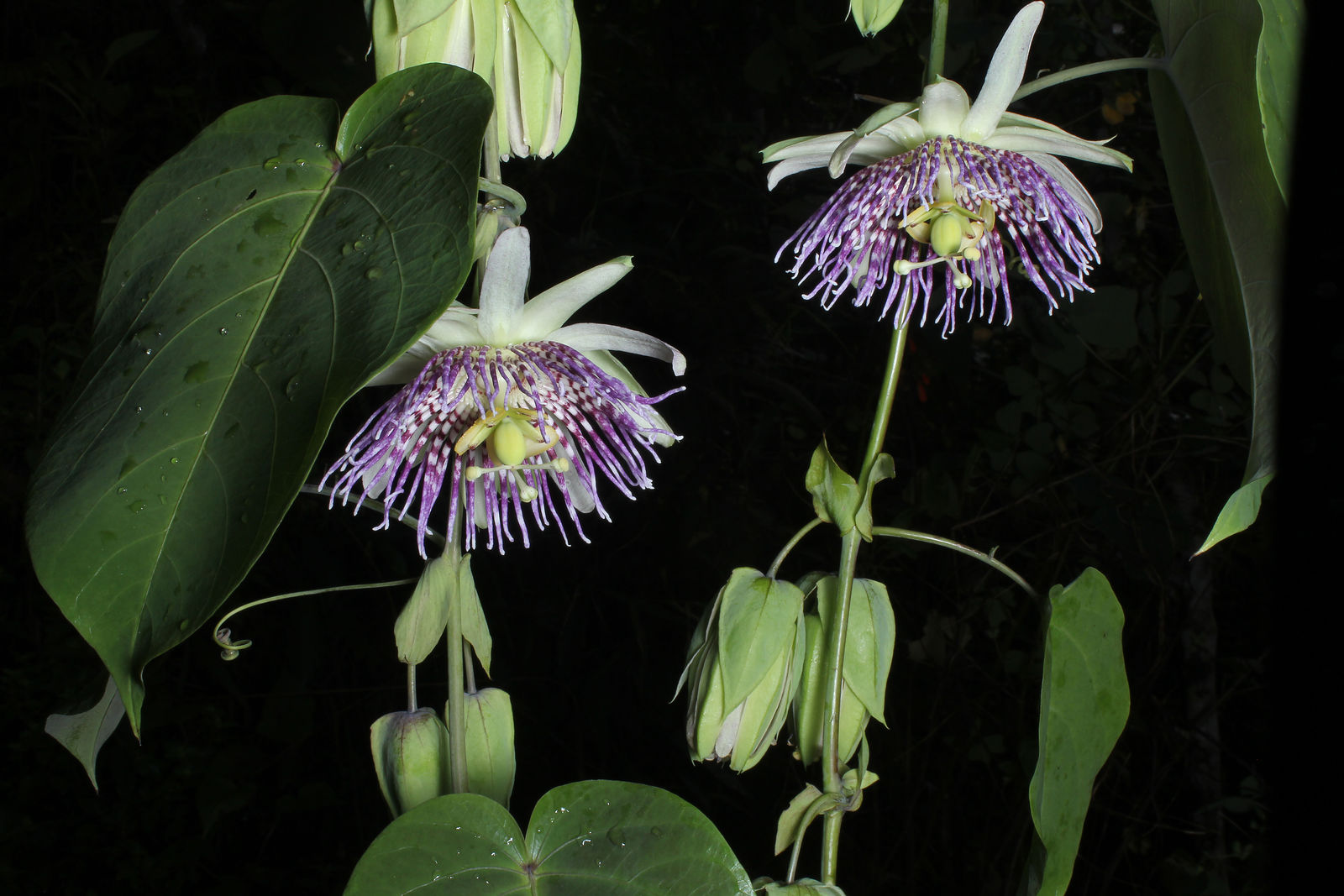
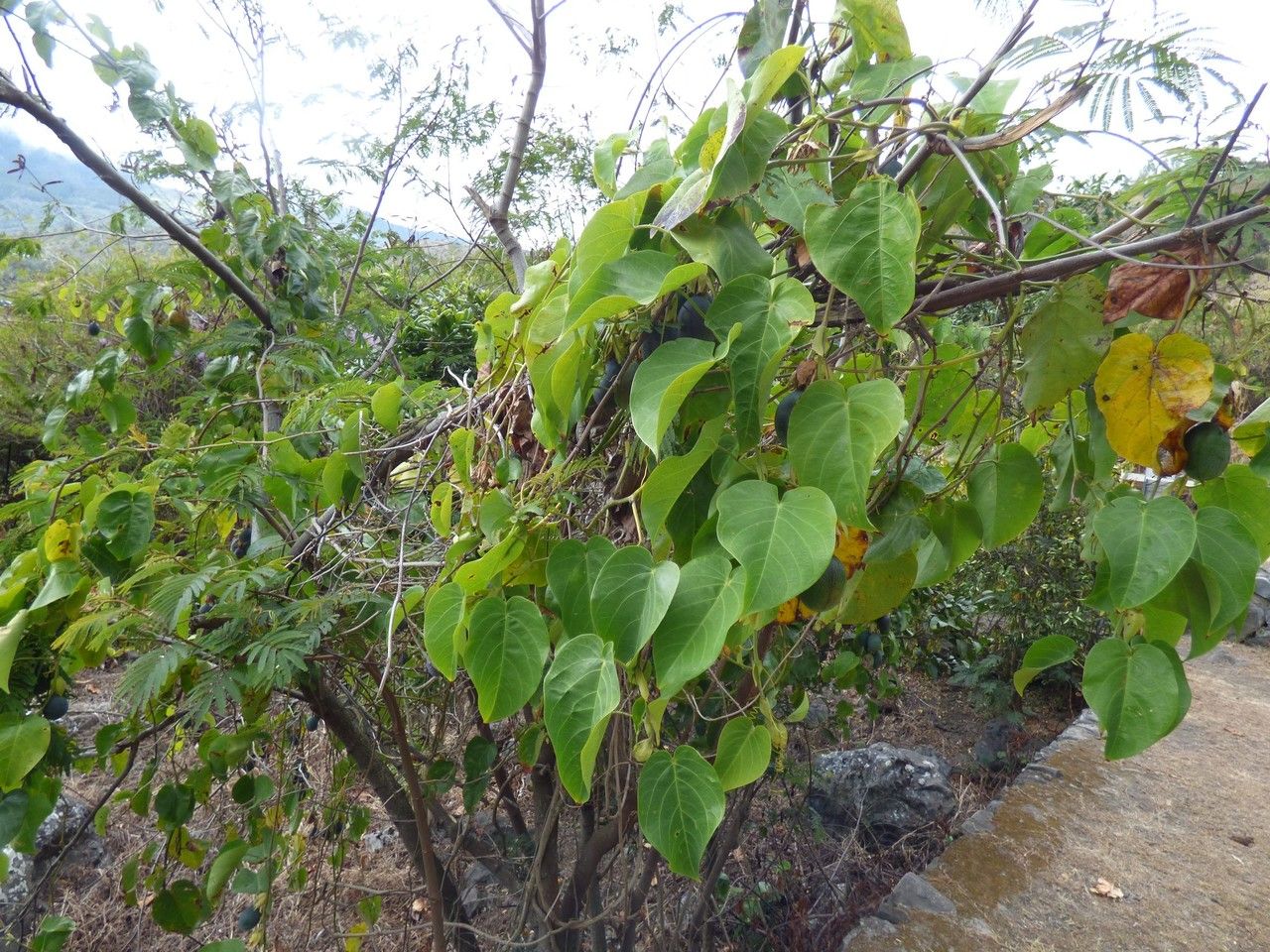
A woody base anchors this tendril-climbing vine, which attaches to any available support. Stems extend several meters and form dense foliage on a well-established trellis or pergola. Oval to heart-shaped leaves usually measure 8 to 22 cm (3 to 9 in) long and 6 to 17 cm (2.4 to 6.7 in) wide, bright green above and gray-green beneath, with prominent veins. 3 4
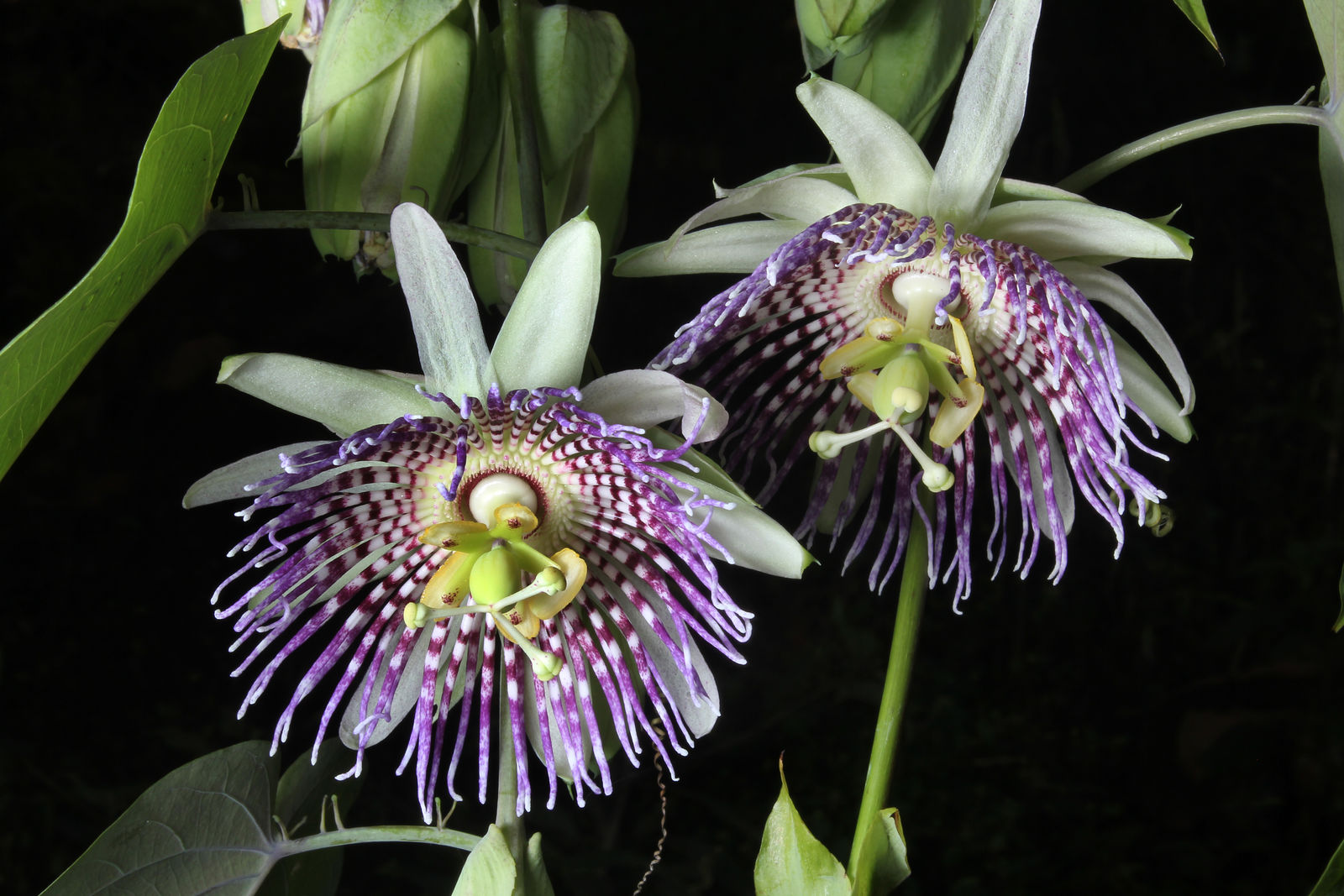
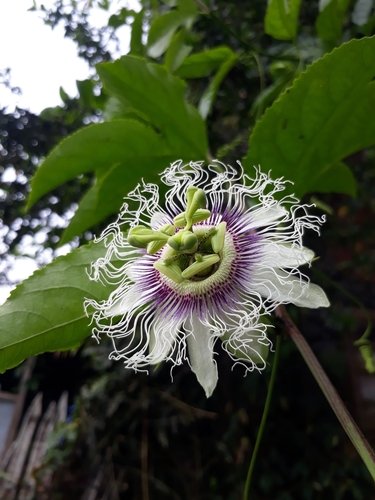
Musky, fragrant flowers span 6 to 12 cm (2.4 to 4.7 in). Greenish-white sepals surround pinkish-white petals, while blue-violet-striped corona filaments make the bloom conspicuous from a distance. Each flower opens for just one day: bees or bumblebees must pollinate it before it closes that evening. 3
Oval to ellipsoid fruit measures 6 to 8 cm (2.4 to 3.1 in) long and 5 to 7 cm (2 to 2.8 in) across. Green fruit with purple patches turns orange with white speckles when ripe; this color change is a better readiness cue than size. Whitish to orange, fragrant gelatinous pulp surrounds 250 to 300 black seeds. 3 4
Useful taxonomy
Several hundred species belong to Passiflora, although only a small number are grown widely for fruit. Within Passiflora ligularis, POWO recognizes the following two botanical varieties:
- Passiflora ligularis var. lobata Mast., described from Colombia, with more pronounced leaf lobes
- Passiflora ligularis var. ligularis, the type variety, throughout the native range
The historical name Passiflora ligularis var. geminiflora DC. remains a synonym associated with a separate variety in the same complex. The full binomial, followed by a variety name where relevant, is the dependable reference for avoiding commercial confusion. 1 2
Habitat and range
Panama to Venezuela and south to Peru along the Andean slopes is the native range accepted by POWO. Morton extends the account to southern Mexico and all of Central America, an area of ancient cultivation rather than a strictly native origin. 1 3
Humid mountain forest, generally between 1000 and 3000 m (3300 to 9800 ft) in tropical regions, provides its habitat. Afternoon cloud cover moderates the heat. PFAF gives a seasonal temperature tolerance of -1 to 31 °C (30 to 88 °F), with young shoots suffering marked damage from 0 °C (32 °F). 4
Fruit production brought the vine beyond its native range, notably to Hawaii and India. It has also naturalized elsewhere, sometimes becoming invasive. CABI Compendium records it in Australia, Haiti and Jamaica, where it covers understory vegetation and displaces local species. 8 7
Life cycle and fruiting
Warm soil at 20 to 30 °C (68 to 86 °F) allows germination to begin in 15 to 20 days. An established vine flowers about six months after planting; greater warmth and light bring flowering forward. 3
With only a single day of opening, each flower depends entirely on insects present during that brief window. After pollination, the fruit ripens in about 70 days, changing from green through purple to the orange-and-white-speckled appearance of full maturity. 3
Fresh seed and cuttings of young shoots are used for propagation, with cuttings rooted in a neutral to slightly acidic medium. Stored seed germinates more slowly, sometimes taking up to twelve months, which explains growers' preference for fresh seed. 4
Uses and risks
Food is the principal use: ripe fruit is eaten fresh with a spoon or made into juice and sorbet in producing regions. Rich in vitamin C, it is a valued snack in tropical highlands where ordinary passion fruit grows less well. 3
Species-specific toxicity information remains limited. PFAF reports traces of potentially irritating compounds in foliage and unripe fruit without specifying the exact substance. Fully ripe fruit, by contrast, is widely consumed without documented problems. 4
Two recurring cultivation threats are defoliation by Agraulis vanillae caterpillars and anthracnose, favored by foliage that stays wet too long. Waterlogged soil adds collar rot, usually fatal if drainage is not corrected in time. CABI Compendium also documents woodiness virus, which hardens and distorts fruit, as an economic threat in production fields. 8
Varieties, look-alikes and related plants
Unlike some other fruiting passionflowers, Passiflora ligularis has no widely distributed, named horticultural cultivar. Selections are mainly regional production lines, particularly Colombian ones, without international registration. 3
Four other members of the genus are often confused with granadilla:
- Passiflora edulis, ordinary passion fruit, with much more acidic purple or yellow pulp ;
- Passiflora quadrangularis, giant granadilla or barbadine, with fruit much larger than sweet granadilla ;
- Passiflora caerulea, blue passionflower, grown mainly as a hardy ornamental rather than for fruit ;
- Passiflora incarnata, purple passionflower, a hardy temperate-garden vine valued more for flowers than for high-quality edible fruit.
Ripe fruit size and color provide a dependable way to distinguish these four species. Flower appearance alone is insufficient, since the general floral form varies relatively little within the genus. 1
Main sources
- Plants of the World Online / Kew, Passiflora ligularis Juss.
- International Plant Names Index, Passiflora ligularis Juss.
- Julia Morton, Fruits of Warm Climates, Sweet Granadilla
- Plants For A Future, Passiflora ligularis
- INPN / MNHN, Passiflora ligularis Juss., 1805
- USDA Plants Database, Passiflora ligularis
- GBIF, Passiflora ligularis Juss.
- CABI Compendium, Passiflora ligularis
Frequently asked questions
Can you eat granadilla fruit?
Yes. Ripe orange fruit speckled with white is usually eaten with a spoon for its fragrant, mildly sweet pulp. Green fruit is not sought after: the pulp lacks flavor and the rind remains brittle.
How does sweet granadilla differ from ordinary passion fruit?
Ordinary passion fruit comes from Passiflora edulis and has markedly acidic purple or yellow pulp. Granadilla, Passiflora ligularis, has sweeter pulp and a smooth orange rind speckled with white, rather than a wrinkled skin.
Is granadilla toxic to cats or dogs?
Evidence for this species remains limited. PFAF reports traces of potentially irritating compounds in foliage and unripe fruit; ripe fruit is widely consumed without documented problems.
Why is my granadilla not producing fruit?
A shortage of pollinators is the most common cause, since each flower opens for only one day. A plant that is too young or receives too much shade may also set fewer fruit.
Can granadilla grow outdoors in a cool climate?
Outside very mild, sheltered climates it is generally grown in a greenhouse or conservatory, since temperatures below 0 °C can cause frost damage. Tropical highlands, including those on Réunion, offer favorable outdoor conditions.
Does this vine need support?
Yes. Shallow roots and tendril-climbing stems need a sturdy trellis or pergola from the first year; otherwise stems break easily in wind.
Which plants are confused with granadilla?
The most common confusions are Passiflora edulis, with more acidic fruit, and Passiflora quadrangularis, the giant granadilla, whose fruit is much larger.
Similar plants
If you are unsure about a plant’s toxicity, ask a botanist or veterinarian for advice.