
Black pepper (Piper nigrum, )


Black pepper (Piper nigrum) is a woody climbing vine in the Piperaceae family, native to the Malabar Coast of southwestern India and Sri Lanka. Its dried fruit provides black, white and green pepper, three products made from the same berry harvested at different stages.
Read moreBlack pepper and Pepper
Give plenty of ambient light without direct sun on the leaves.
Partial shade to bright filtered light



© photo
Wikimedia Commons · CC BY-SA or Public Domain
Taken Apr 19, 2022 by manuseitz (cc-by-sa)
Taken Feb 20, 2019 by Daniel Barthelemy (cc-by-sa)
Taken Mar 5, 2009 by Tela Botanica − Geneviève Botti (cc-by-sa)
Taken May 28, 2021 by Sébastien TRASBOT (cc-by-sa)
Taken Jan 11, 2020 by Chee Keong Chan (cc-by-sa)
© copyright of the Board of Trustees of the Royal Botanic Gardens, Kew.




Global distribution
Piper nigrum is native only to southwestern India, including the Western Ghats and Malabar Coast, and Sri Lanka. Commercial cultivation later spread through most humid tropical regions; those growing areas are not part of its native range.
Identity
Black pepper (Piper nigrum L., 1753), also called pepper, is a woody climbing vine in the genus Piper, family Piperaceae, grown for its berries across most humid tropical regions. Its name derives from Sanskrit pippali, originally referring to long pepper. The word passed into Greek and then Latin piper before coming to refer mainly to this species in most European languages. 1 9
A single berry of Piper nigrum can yield black pepper, white pepper or green pepper, depending on when it is harvested and how it is processed. These three peppercorn colors all belong to one species; none comes from a separate plant. 7 8
Recognition
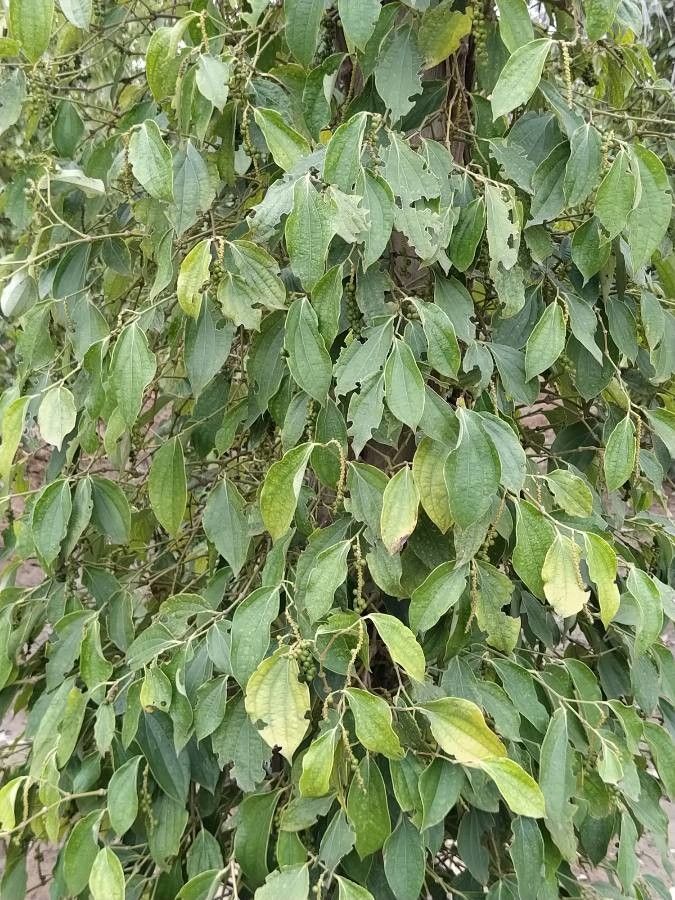
On the same plant, Piper nigrum develops upright main stems and more horizontal fruiting branches, with adventitious roots at each node that grip a support or tree trunk. In tropical conditions the vine can exceed 9–10 m (30–33 ft); trained on a support in a conservatory, it often stays around 4–6 m (13–20 ft). 2 8
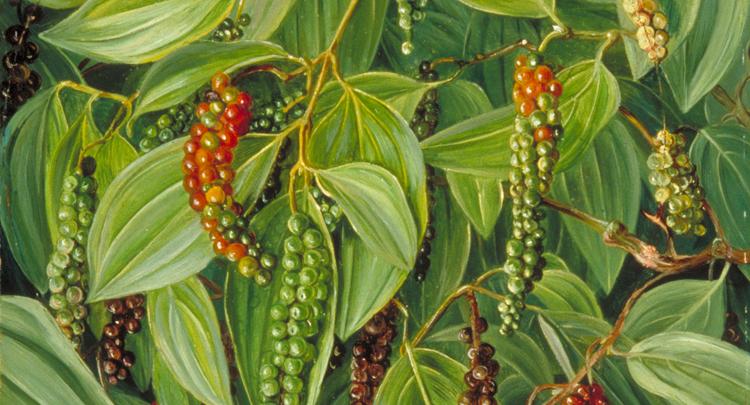
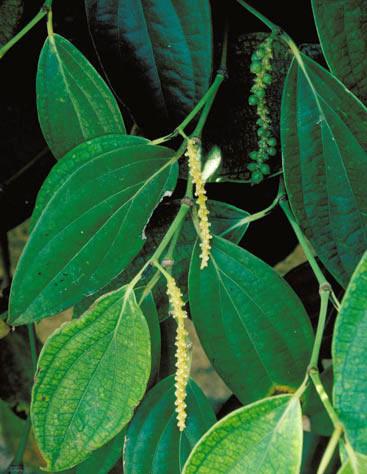
Alternate, leathery leaves are glossy, oval to heart-shaped and palmately veined. They commonly measure 13–18 cm (5–7 in) long, helping distinguish mature vines from tender young growth. Tiny greenish flowers form dense hanging spikes 5–15 cm (2–6 in) long, with up to 150 flowers lacking visible petals. These spikes distinguish the vine from plants with petaled flowers. 2 8
Each fruit is a small round drupe 4–6 mm (0.16–0.24 in) across, green at first and red when fully ripe, then black and wrinkled after drying. Enzymatic oxidation of colorless compounds in the skin causes this darkening; no added dye is involved. 9 8
Useful taxonomy
Kew recognizes Piper nigrum L. as the accepted name, in the Piperaceae family and Piperales order, alongside the related genus Peperomia. Several varieties have been described within the species without displacing its accepted name:
- Piper nigrum var. hirtellosum Asokan Nair & Ravindran, a named variety
- Piper nigrum var. macrostachyum C.DC., a historical botanical name
- Piper trioicum (Roxb.) C.DC.
The complete scientific name remains the reliable identifier. Trade grades such as Tellicherry and Malabar, and origin names such as Sarawak and Lampung, describe provenance or peppercorn size rather than separate species. 1 5
Habitat and range
Southwestern India, particularly the Western Ghats and Malabar Coast, and Sri Lanka make up the native range of Piper nigrum. There it grows in humid tropical lowland and foothill forests up to about 500 m (1,640 ft) above sea level. 1 3
Tree trunks provide support without being parasitized: the adventitious roots anchor the vine rather than drawing sap. Beyond its native range, the species is now cultivated across most humid tropical regions. Vietnam leads world production and exports, ahead of India, Indonesia, Brazil and Malaysia. 4 6
Life cycle and reproduction
Wild black pepper plants are dioecious, with separate male and female individuals. Cultivated varieties instead bear bisexual flowers, facilitating commercial production. The flowers are also protogynous: the female part matures before the male part within the same flower. 8
Following pollination, Piper nigrum berries take about 8–9 months to ripen. Harvest timing, rather than a different variety, determines peppercorn color. Green berries dried in the sun turn into black pepper; fully ripe red berries soaked and stripped of their skin become white pepper. Berries picked very young and preserved fresh or in brine remain green pepper. 7 9
Growers almost always propagate the vine through stem cuttings with nodes. A section with 3–4 nodes roots in 3–4 weeks in a warm, moist growing medium. A cutting-grown vine fruits after 3–4 years, reaching full production around 7 years. Without a rough support from the start, it remains vegetative and never flowers. 3 2
Uses and risks
Cooking is the principal use of black pepper. Dried Piper nigrum peppercorns contain about 5% piperine, the alkaloid responsible for their pungency, and about 3% essential oil rich in monoterpenes. Pepper was eaten in ancient Rome and served as a medium of exchange in the Middle Ages, reflected in the term “peppercorn rent.” Vasco da Gama’s sea route in 1498 disrupted the Mediterranean trading monopolies that had controlled its price. 9 6
For people and domestic animals, the reference lists no known hazards from the plant. Eating very large quantities of berries may nevertheless cause mild digestive irritation from piperine, a different effect from true poisoning. 3
Varieties, look-alikes and related plants
Several spices sold as “pepper” fall outside the genus Piper. Pink pepper comes from Schinus, in the Anacardiaceae family: it contains no piperine and may trigger allergic reactions in people sensitive to cashews. Sichuan pepper comes from Zanthoxylum, in the Rutaceae, the same distant family as citrus. 7 9
Within Piper, long pepper (Piper longum) is a close relative and the original source of the word “pepper” before the name shifted toward Piper nigrum. Ornamental pepper (Capsicum annuum) belongs to the Solanaceae. The shared English name creates a linguistic confusion rather than a botanical relationship. 9 1
Trade grades such as Tellicherry and Malabar, and regional origins such as Sarawak and Lampung, leave this botanical identity unchanged. To check that a pepper belongs to Piper nigrum, look for the complete scientific name on the label: a grade or regional name indicates only provenance or peppercorn size.
Main sources
- Plants of the World Online / Kew, Piper nigrum L.
- Missouri Botanical Garden, Plant Finder, Piper nigrum
- Plants For A Future, Piper nigrum - Black Pepper
- Conservation Nature, Black pepper (Piper nigrum) - Botanical profile
- INPN / MNHN, Piper nigrum L., 1753
- International Pepper Community, History of Pepper
- NCBI PMC, Insights into the phytochemistry of the genus Piper
- Botanical-Online, Characteristics of black pepper plant
- Gernot Katzer's Spice Pages, Pepper (Piper nigrum)
Frequently asked questions
Do black, white and green pepper come from the same plant?
Yes. All three come from the same berry of Piper nigrum. Black pepper is dried while still green, white pepper comes from ripe berries with the skin removed, and green pepper is picked very young and preserved fresh or in brine.
Is pink pepper a true pepper?
No. Pink pepper comes from Schinus in the Anacardiaceae family and is botanically unrelated to Piper nigrum. It contains no piperine and may trigger allergic reactions in people sensitive to cashews.
How long does black pepper take to produce a harvest?
A vine grown from a cutting produces its first berries after 3–4 years and reaches full production around 7 years, provided it has a sturdy support from the start.
Is black pepper toxic to cats and dogs?
No danger is listed for pets. However, eating very large amounts of berries may cause mild digestive irritation from piperine.
Why will my black pepper plant not flower indoors?
Flowering requires a mature vine several meters long, stable support and consistent warmth. In an indoor pot, the plant often remains vegetative because these conditions are not all met.
Where does black pepper come from?
Its native range is limited to southwestern India, particularly the Malabar Coast, and Sri Lanka. Vietnam is now the leading producer and exporter, well ahead of India, its historic source.
What is piperine?
Piperine is the alkaloid responsible for pepper’s pungency, making up about 5% of the dried peppercorn. Researchers also study its effect on the absorption of other active compounds.
Similar plants
If you are unsure about a plant’s toxicity, ask a botanist or veterinarian for advice.