
Asian pear (Pyrus pyrifolia, )
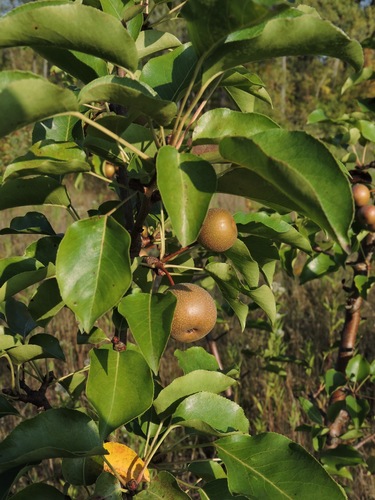

Asian pear (Pyrus pyrifolia) is a deciduous fruit tree in the Rosaceae family, native to southern China. Domesticated early and later spread to Japan and Korea, it bears round fruit that stays crisp and juicy even when fully ripe, unlike European pears. It is propagated by grafting and usually needs cross-pollination.
Read moreAsian pear, Nashi pear, Nashi, Chinese pear, Japanese pear and Apple pear



© photo
(c) Michael Kielb, some rights reserved (CC BY-NC), uploaded by Michael Kielb · cc-by-nc
Wikimedia Commons · CC BY-SA or Public Domain
Wikipedia · CC BY-SA
© copyright of the Board of Trustees of the Royal Botanic Gardens, Kew.




Global distribution
Pyrus pyrifolia is native to southern China, centered on the middle Yangtze valley and Sichuan and Yunnan provinces, extending into northern Laos and Vietnam. Early domestication was followed by its spread to Japan and Korea, where three major cultivar groups developed from the same wild ancestor.
- Native3
- Introduced4
- China
- Vietnam
- Laos
- Japan
- South Korea
- United States
- Australia
Hexagons: regions where the plant occurs. Green dots: native range.1
Identity
Asian pear (Pyrus pyrifolia (Burm.f.) Nakai, 1926), also called Chinese pear, is a deciduous fruit tree in the genus Pyrus and family Rosaceae. Dutch botanist Nicolaas Laurens Burman first described it as Ficus pyrifolia in 1768. Japanese botanist Takenoshin Nakai moved it to Pyrus in 1926, explaining the combined authorship of its accepted name. 1 6
Its commercial name apple pear describes a true pear whose round, crisp fruit resembles an apple, rather than a cross between apple and pear. Nashi, Nashi pear and Japanese pear reflect its domestication journey from China to Japan and Korea. 3
Recognition
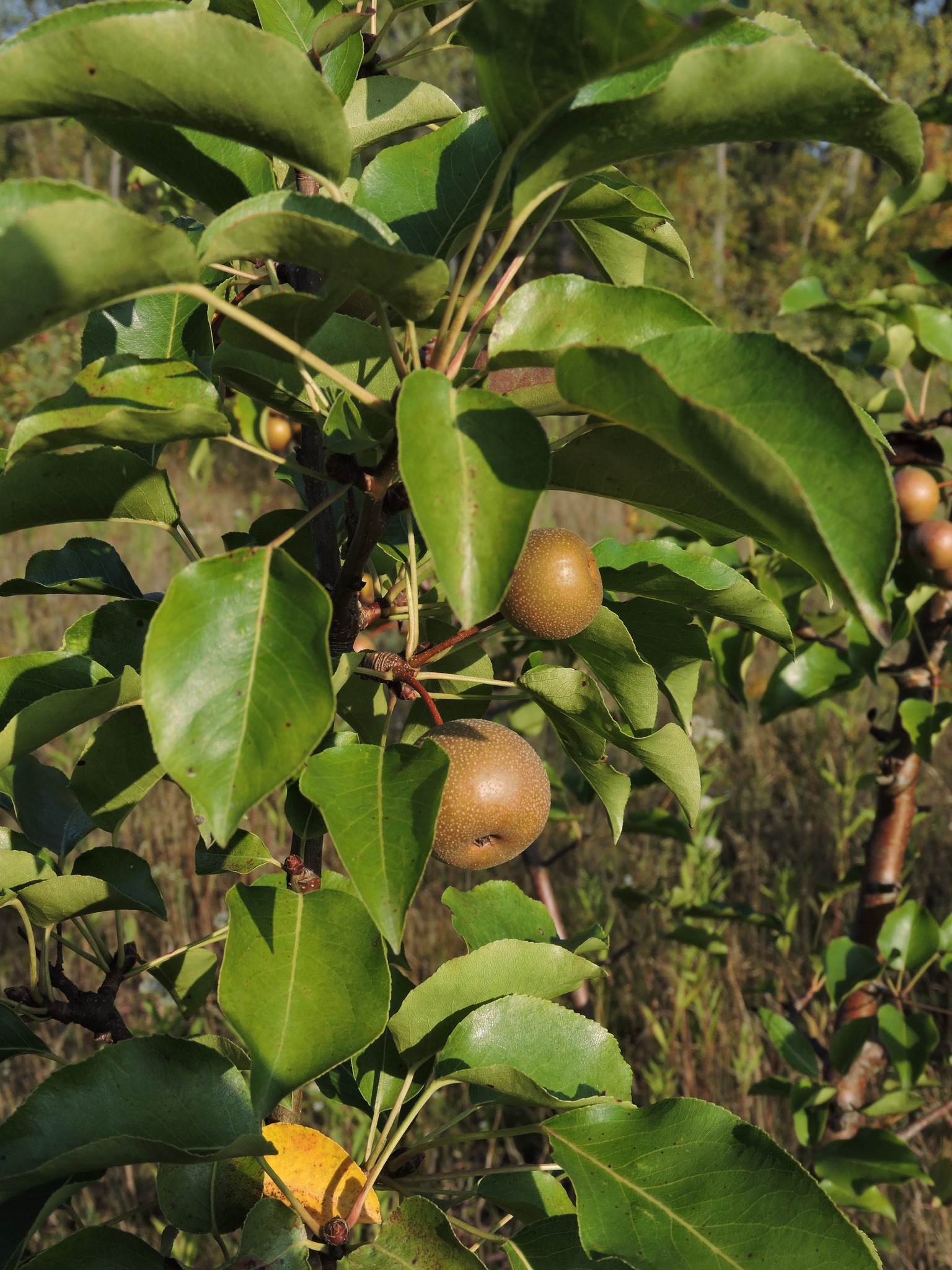
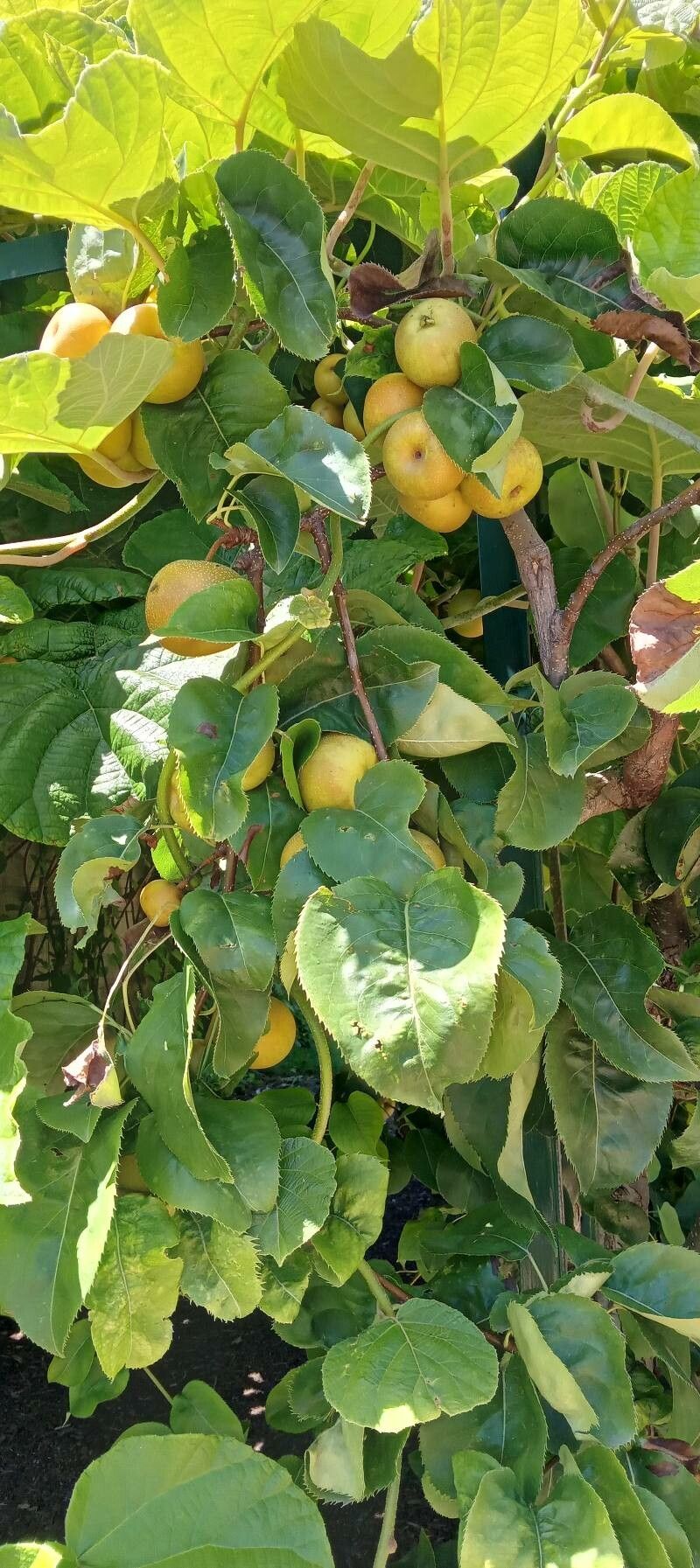
Round, almost spherical fruit distinguishes Pyrus pyrifolia from European pear. It measures 6–8 cm (2.4–3.1 in) across depending on cultivar, with beige, brown or yellow-green skin dotted with pale lenticels. White flesh stays firm and crisp even when fully ripe, while Pyrus communis softens. 2 3
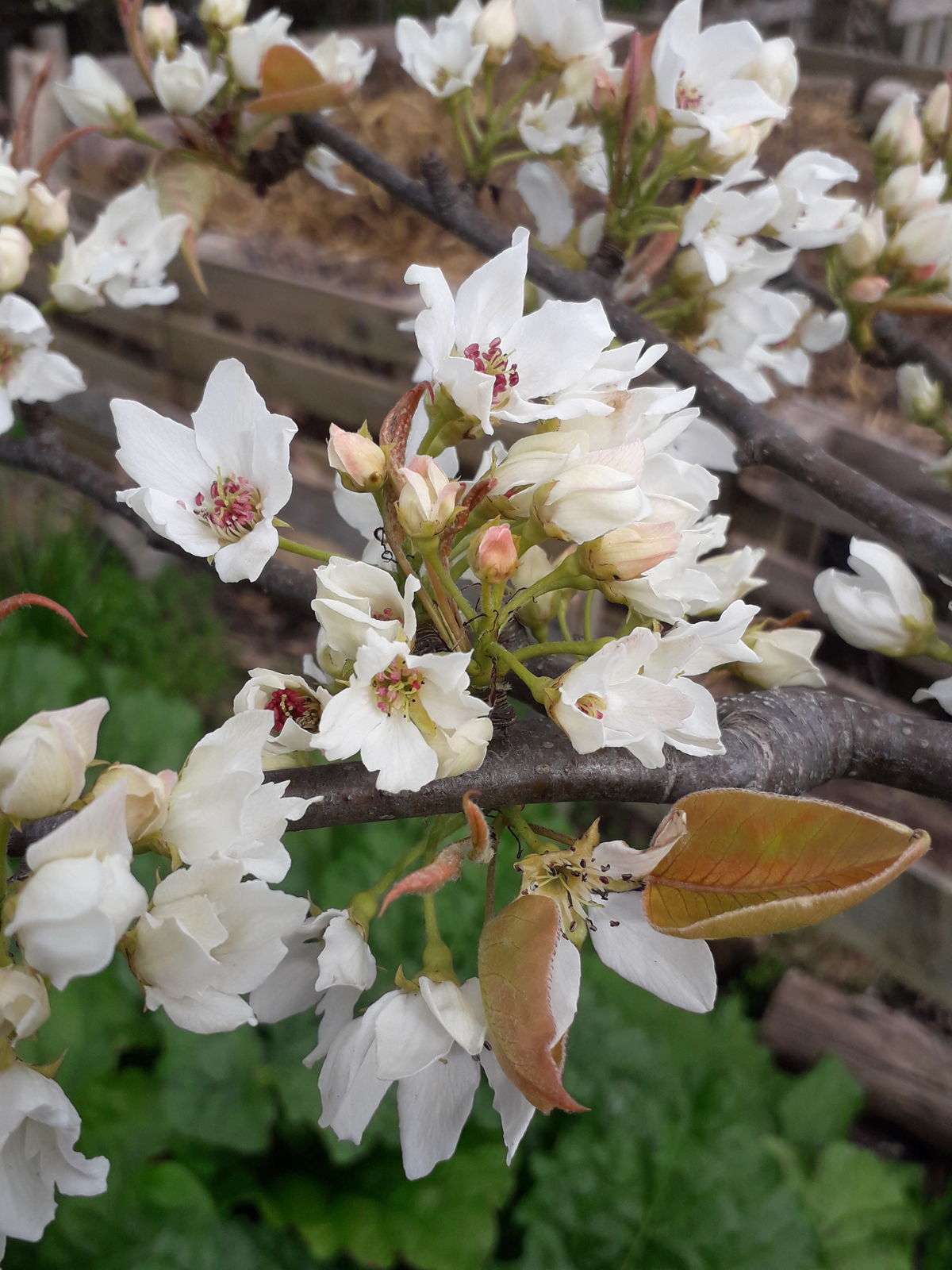
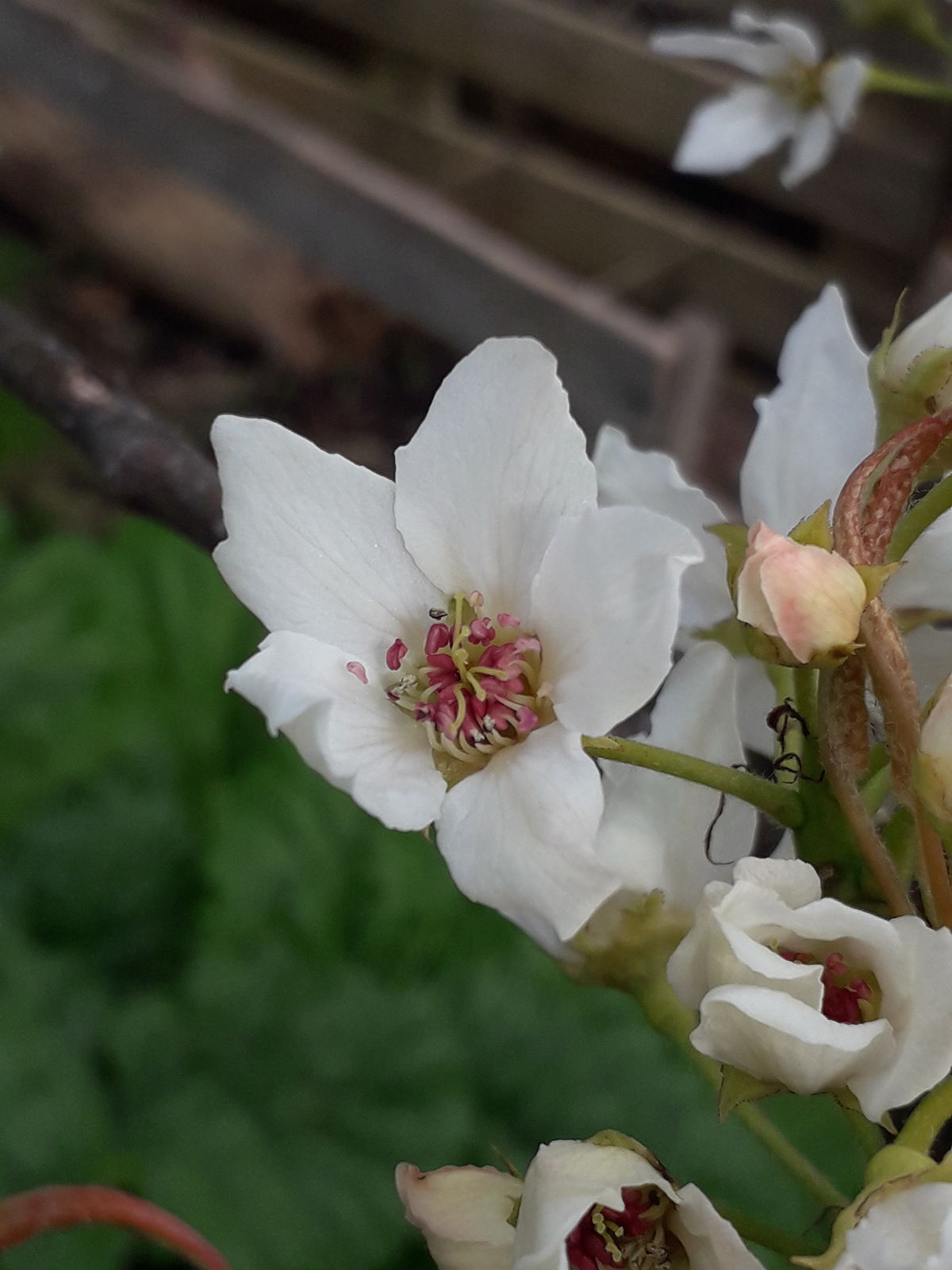
A spreading crown, broader than that of European pear, carries glossy, finely toothed oval leaves that turn red in fall. White five-petaled flowers appear in corymbs in midspring, before or with the first leaves. Orchard trees usually reach 4–8 m (13–26 ft); wild trees may reach or exceed 10–15 m (33–49 ft). 2 3 8
Cultivated fruit measures 6–8 cm (2.4–3.1 in) across, compared with just 2–2.5 cm (0.8–1 in) in the astringent, gritty wild fruit. Selection tripled its size without eliminating the stone cells responsible for grittiness. Commercial cultivars concentrate these cells mainly around the core. 3
Useful taxonomy
The full name Pyrus pyrifolia (Burm.f.) Nakai illustrates a nomenclatural curiosity: pyrifolia literally means “pear-shaped leaves,” a tautology arising from naming conventions rather than deliberate choice. Principal synonyms include:
- Pyrus serotina Rehder, an alternative name;
- Pyrus pyrifolia var. culta (Makino) Nakai, a named variety;
- Pyrus pyrifolia f. hiemalis (Siebold) Nakai, a named form;
- Ficus pyrifolia Burm.f., the original name.
Alfred Rehder independently proposed Pyrus serotina in 1915, but it was eventually set aside in favor of Pyrus pyrifolia under botanical priority rules. Kew's accepted name provides the stable reference. 1 6
Habitat and range
Southern China holds the native range of Pyrus pyrifolia, centered on the middle Yangtze valley and Sichuan and Yunnan provinces, extending into northern Laos and Vietnam. A recent genetic study locates its center of origin in southwestern China, from which cultivation spread north and east along the Yangtze. 7 5
Wild Asian pears grew in open woodland and on warm slopes at 100–1400 m (330–4,590 ft) elevation. Truly wild populations have now disappeared from both China and Japan following habitat destruction and excessive land use. 7
Early domestication preceded the spread of Asian pear to Japan and Korea. Three major cultivar groups share the wild ancestor Pyrus pyrifolia: Chinese white pears, Chinese sand pears and Japanese nashi. Their common ancestry was long misunderstood because historical accounts lacked enough detail to trace East Asian cultivar development. 7
Life cycle and reproduction
Midspring flowers are hermaphroditic and insect-pollinated, but most cultivars are self-sterile. As with European pear, cross-pollination by another compatible cultivar is usually needed. 3 2
Fall-sown seeds need 8–10 weeks of cold stratification at about 1 °C (34 °F) to germinate in late winter. Temperatures above 15–20 °C (59–68 °F) instead induce secondary dormancy. Seedlings do not reproduce the cultivar faithfully: true-to-type propagation requires grafting onto a seedling rootstock or quince. 3
A grafted tree takes about three to five years to produce its first substantial crop, sooner than many European pears. Unlike common pears picked firm and ripened off the tree, Asian pears must ripen fully on the tree, generally in late summer, without becoming overripe from the core. 4 8
Uses and risks
Fruit production dominates its uses: Asian pears are eaten fresh and raw for their crisp, juicy texture. Global production far exceeds that of European pear. China alone harvested more than 16 million metric tons in 2017, compared with 2.5 million metric tons of common pears throughout the European Union that year. 7
No known toxic risk is reported for this species in humans or domestic animals. As with other pome-bearing Rosaceae, a theoretical precaution applies to large quantities of crushed seeds, but no documented case specifically concerns Asian pear. 3
Orchard health risks chiefly affect the tree itself. Fire blight, caused by Erwinia amylovora, is the most serious disease, alongside scab, pear rust and insects such as codling moths and aphids. 4
Varieties, look-alikes and related plants
Cultivars of Pyrus pyrifolia form several groups sharing a Chinese wild ancestor. Nijisseiki, the twentieth-century pear, Kosui and Hosui are among the most widely grown Japanese nashi cultivars. Chojuro and Shinko offer better keeping quality; Korean Hwangkeum produces large, very juicy yellow fruit weighing about 500 g (1.1 lb) each, depending on the orchard. 7
Three related pears cause confusion for different reasons:
- Pyrus communis, European pear, bears elongated fruit with soft ripe flesh, unlike round, crisp Asian pears;
- Pyrus ussuriensis, Ussurian pear, sometimes hybridized naturally with Asian pear in the north of its range, blurring species boundaries;
- Pyrus × bretschneideri, another Chinese pear, is sometimes sold as “nashi” without sharing its characteristic texture.
To confirm Pyrus pyrifolia, combine its round fruit shape, 6–8 cm (2.4–3.1 in) cultivar diameter, lenticel-dotted skin and flesh that remains crisp even at full maturity. 2 1
Main sources
- Plants of the World Online / Kew, Pyrus pyrifolia (Burm.f.) Nakai
- Royal Horticultural Society, Pyrus pyrifolia
- Plants For A Future, Pyrus pyrifolia
- North Carolina State Extension, Pyrus pyrifolia
- USDA PLANTS Database, Pyrus pyrifolia (Burm.f.) Nakai
- International Plant Names Index, Pyrus pyrifolia (Burm.f.) Nakai
- Yue et al. 2018, origin and dissemination route of cultivated pears native to East Asia
- Missouri Botanical Garden, Pyrus pyrifolia 'Nijisseiki'
Frequently asked questions
Is Asian pear an apple or a pear?
It is a pear, belonging to Pyrus like European pear. Apple pear describes its round shape and crisp texture, not a botanical cross with apple.
Why does Asian pear stay crisp when ripe?
Unlike Pyrus communis, whose flesh softens at maturity, Pyrus pyrifolia retains firm, juicy flesh even when fully ripe, inherited from the wild southern Chinese species.
Do I need two trees to get fruit?
Usually, yes. Most cultivars are self-sterile and need cross-pollination from a compatible cultivar flowering at the same time; some combinations with European pears also work.
When should Asian pears be harvested?
Unlike European pears picked while firm, Asian pears should ripen fully on the tree before harvest, usually from late summer into fall, depending on cultivar.
Are Asian pears toxic to cats or dogs?
No known risk is reported for this edible fruit. Large quantities of crushed seeds warrant a theoretical precaution, as with other pears, with no documented cases specific to Asian pear.
Which plants are confused with Asian pear?
Main look-alikes are Pyrus communis, with elongated fruit and soft ripe flesh, and Pyrus ussuriensis, the Ussurian pear, with which Asian pear sometimes hybridized naturally in the north of its range.
Where did cultivated Asian pears originate?
In southern China, in the middle Yangtze valley and Sichuan and Yunnan provinces. Cultivation spread to Japan and Korea, producing the three major cultivar groups recognized today.
Similar plants
If you are unsure about a plant’s toxicity, ask a botanist or veterinarian for advice.