
Rough bindweed (Smilax aspera, )
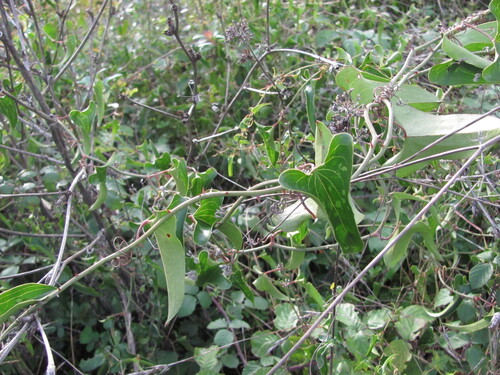
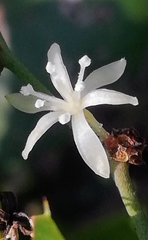
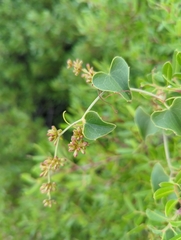
Rough bindweed (Smilax aspera L., 1753) is a thorny woody climber in the Smilacaceae family, found around the Mediterranean and eastward into East Africa and temperate Asia. Its twining stems grip shrubs with paired tendrils, carry evergreen heart-shaped leaves and produce dark red berries late in the year after small but strongly fragrant flowers.
Read moreRough bindweed, Common smilax, Mediterranean smilax, Catbrier, Greenbrier and Prickly-ivy
© photo
zebedeugalinha · cc-by
Gianni Del Bufalo bygdb · cc-by
Maria G · cc-by
(c) zebedeugalinha, some rights reserved (CC BY) · cc-by
(c) Gianni Del Bufalo bygdb, some rights reserved (CC BY) · cc-by
Global distribution
The native range covers the Mediterranean and Macaronesia (Canary Islands, Madeira and Azores), extending into tropical East Africa and temperate Asia as far as Myanmar. In mainland France it is native along the Mediterranean coast and hills, absent from colder oceanic and continental regions.
- Native9
- Mainland France (Mediterranean)
- Spain
- Portugal
- Italy
- Greece
- Turkey
- Macaronesia (Canary Islands, Madeira, Azores)
- Ethiopia and Kenya
- India and Myanmar
Hexagons: regions where the plant occurs. Green dots: native range.1
Identity
Rough bindweed (Smilax aspera L., 1753), also called common smilax, is an accepted species in the genus Smilax and the Smilacaceae family. Linnaeus described it in his Species Plantarum in 1753. POWO places it among climbers of temperate biomes, occurring from Portugal to Myanmar. 1 2
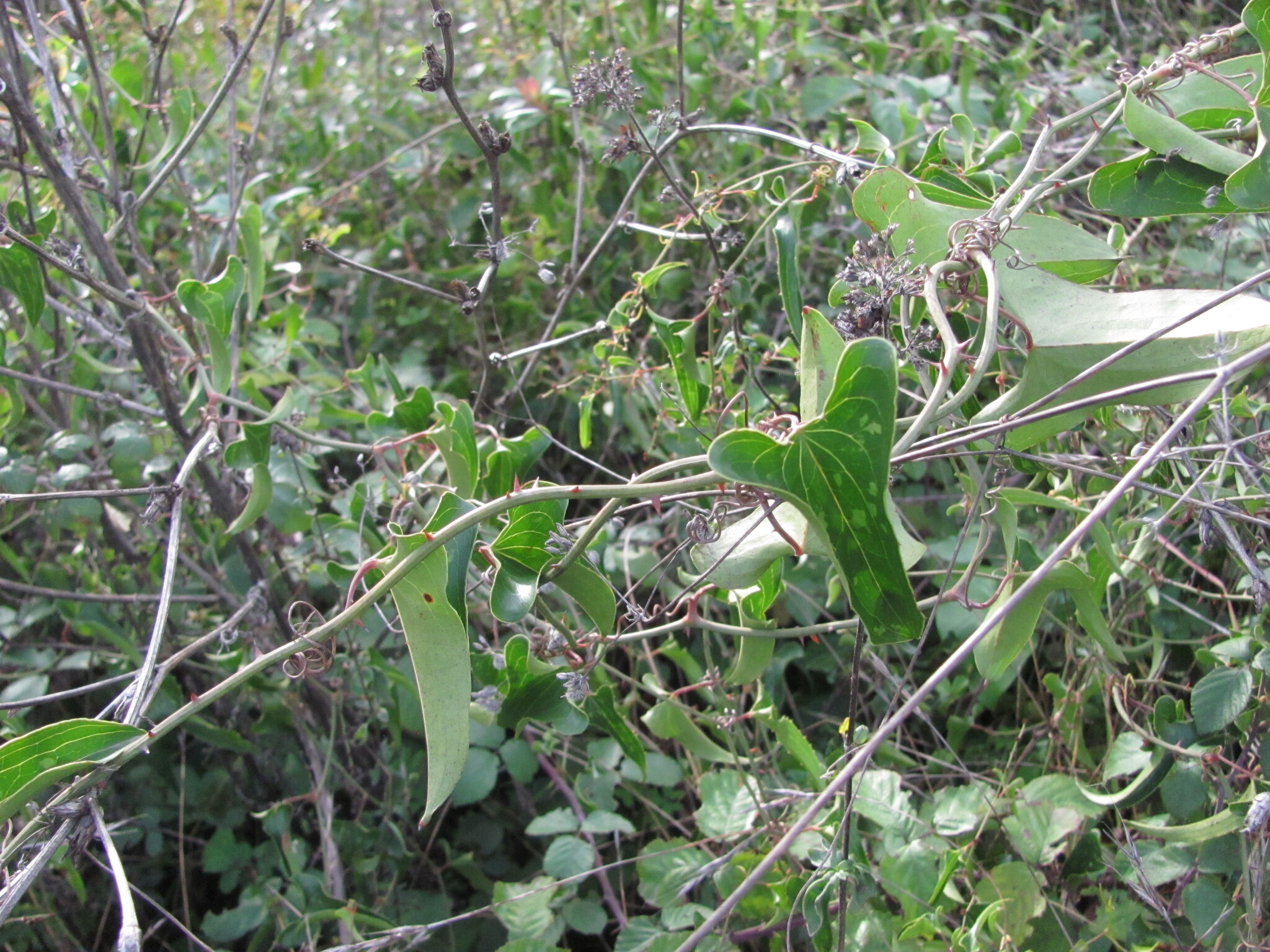
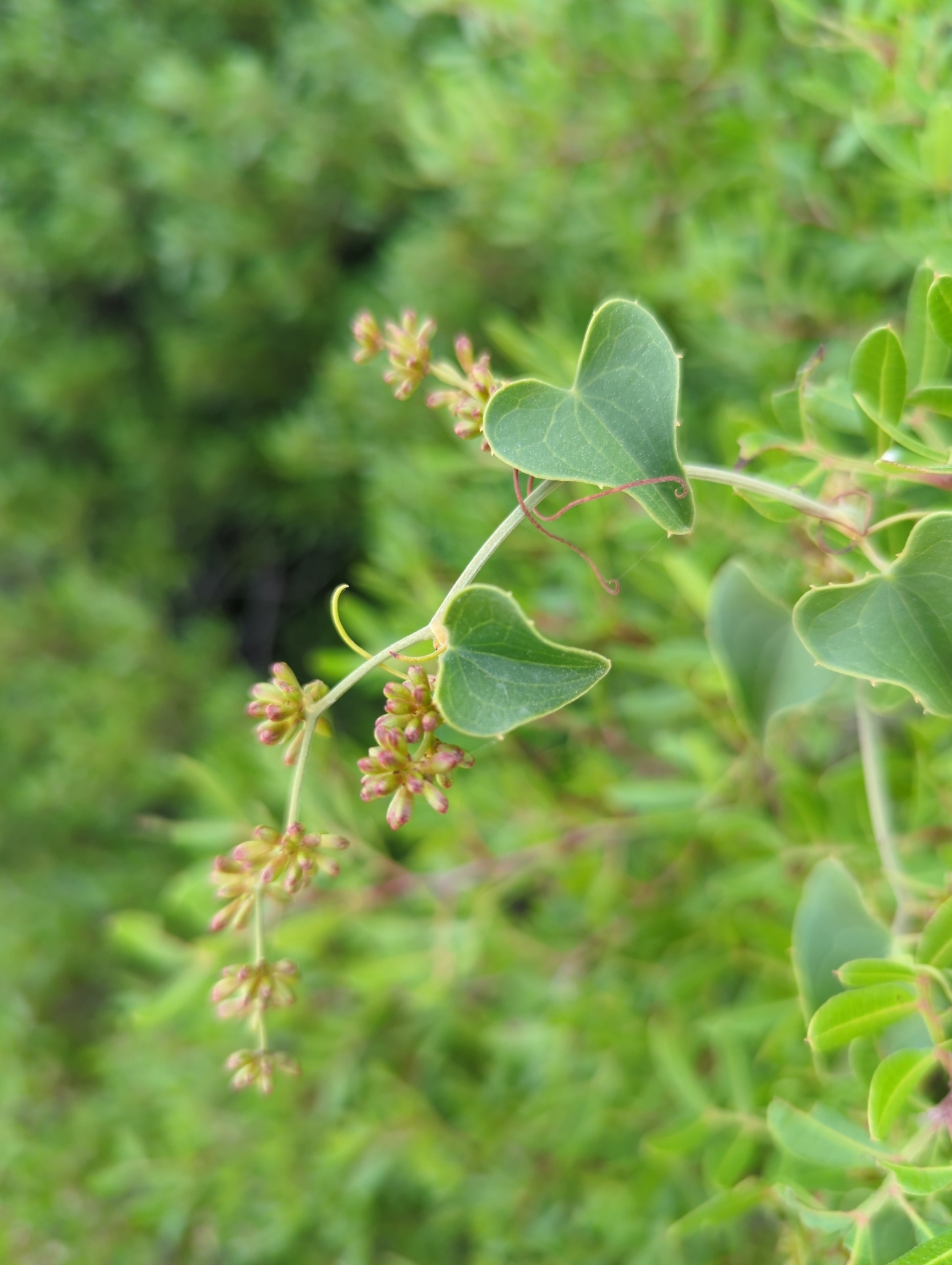
Two tendrils at the base of each leaf stalk let the stem grip neighboring shrubs without making the adventitious roots used by ivy. Curved prickles arm the twining stem along its length. It commonly reaches 1–3 m (3–10 ft) tall and can climb to 4 m (13 ft) with suitable support in a mild Mediterranean climate. 4 3
The French name salsepareille comes from Spanish zarzaparrilla, combining zarza, meaning bramble, with parrilla, a diminutive of parra, meaning vine arbor. It reached French through Portuguese salsaparrilha. The English name rough bindweed describes a prickly climber, although this species is unrelated to true bindweeds in the genus Convolvulus. 8
Recognition
Leathery, glossy leaves alternate along the stem and remain evergreen. Their heart-shaped or spade-shaped blades have prickly margins and five to seven main veins running almost parallel, linked by a network of smaller veins. This unusual arrangement for a monocot looks more like a dicot leaf than a grass or lily leaf. 6 5
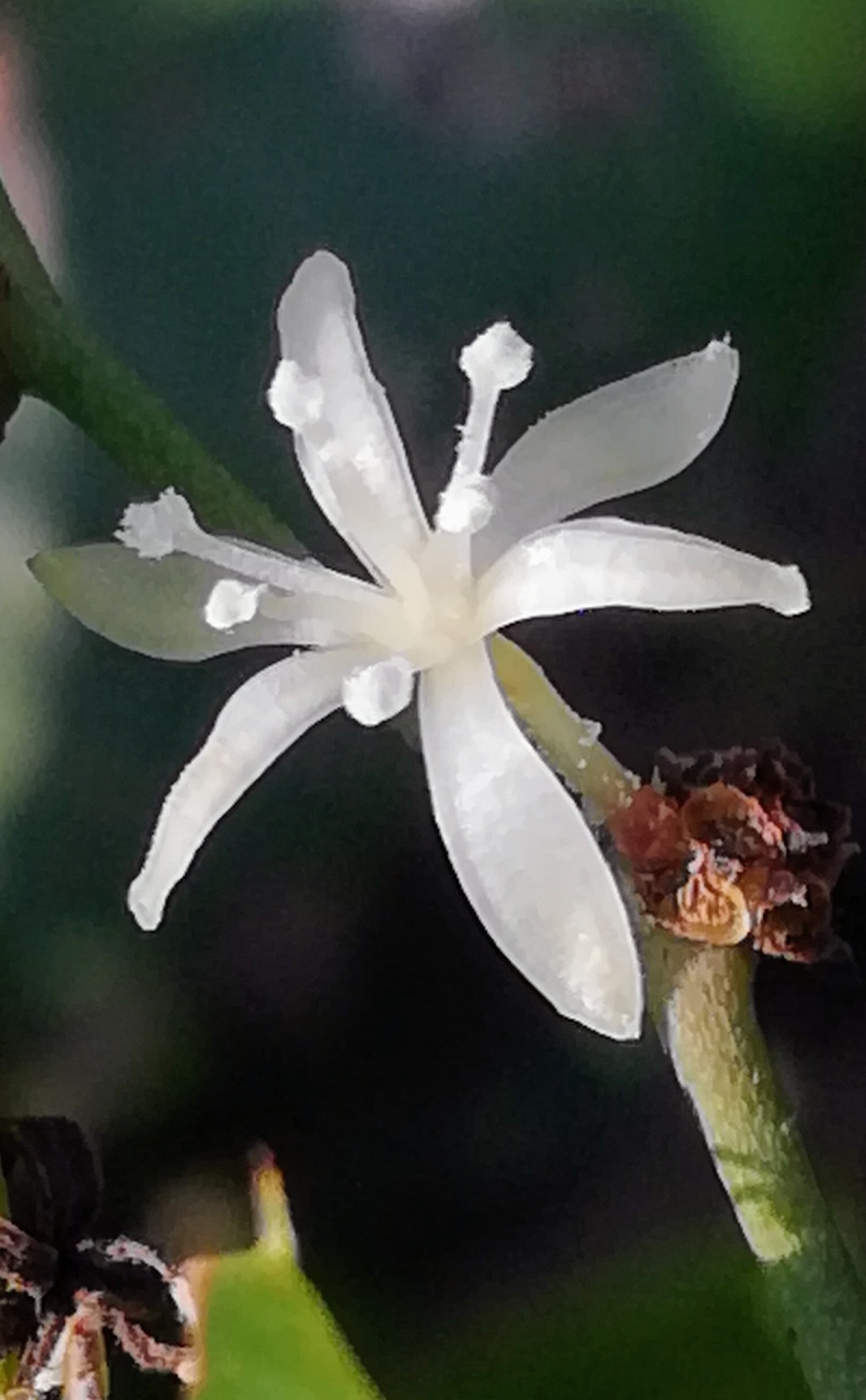
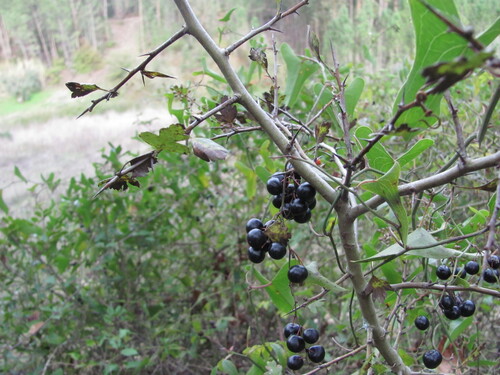
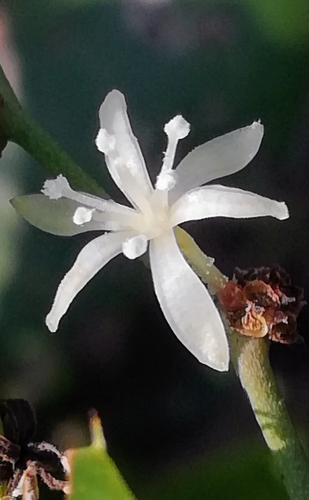
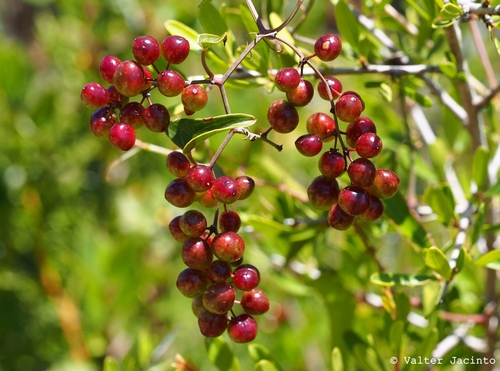
Separate plants bear male and female flowers, making the species dioecious. Tiny, strongly fragrant, yellowish-white flowers gather in small umbels in the leaf axils. A male and a female plant must grow near each other for fruit to develop; abundant flowering alone does not ensure berries. Dark red to nearly black berries form currant-like clusters and reach 4–6 mm (about 0.2 in) across when ripe. 4 6
Useful taxonomy
The accepted botanical name is Smilax aspera L. POWO and WCVP place several formerly separate varieties and subspecies under it, including Smilax aspera var. nigra (Willd.) A.DC., Smilax aspera var. balearica Willk. ex A.DC., Smilax aspera var. mauritanica (Poir.) Gren., and the synonym Smilax picta K.Koch. 1
French floras sometimes still use the subspecies names aspera, balearica, mauritanica and nigra, whereas reference databases treat them as synonyms of the species. The complete name with its author and date, Smilax aspera L., 1753, helps avoid confusion on a nursery label or in field notes when these subdivisions differ between references. 1 6
Habitat and range
Mediterranean shores and Macaronesia form part of a native range extending into tropical East Africa, including Ethiopia, Kenya and Tanzania, and temperate Asia, from Turkey through India to Myanmar. Macaronesia includes the Canary Islands, Madeira and the Azores. In mainland France, the species is native along the Mediterranean coast and hills but absent from colder oceanic and continental regions. 1
Limestone, well-drained ground in garrigue, coastal maquis or oak woodland edges suits this climber. Full sun and partial shade both support flowering. Its woody stems resist breaking by hand and intertwine with other thorny shrubs, making some Mediterranean scrub difficult to cross. Hardy to about −10 °C (14 °F) without frost protection, rough bindweed is absent where cold is harsher and more prolonged. 5 6 4
Life cycle and reproduction
Strongly scented flowers open from late summer into early fall, depending on local climate. Their fragrance attracts insects that transfer pollen between male and female plants, whether they share a host shrub or grow on neighboring shrubs. 3 4
After fertilization, female flowers develop into berries that ripen slowly and remain visible into winter. Birds eat the berries and carry the seeds to new host shrubs. Germination on the scrubland floor is slow and irregular, so dispersal does not immediately produce a new mature climber. 4
Propagation in cultivation uses seed, after several weeks of cold stratification; division of the rhizomatous rootstock in spring; or semi-ripe stem cuttings taken in summer. These seasonal timings refer to the local growing cycle. Without a firm support from planting onward, a young climbing stem stays short and takes several years to flower. 3
Uses and risks
Young shoots, sometimes called turions, are eaten cooked like asparagus. Brief blanching reduces their natural bitterness. Reported traditions in Italy and Turkey serve them boiled with olive oil and lemon or add them to omelets. 3
Historically, the roots were used in medicinal preparations, traditionally as a diuretic and to promote sweating for rheumatism, gout or certain skin complaints. PFAF lists no known hazards for this species. Several North American relatives in the genus Smilax appear in the ASPCA database as non-toxic to dogs, cats and horses. 3 7
Ripe berries are not a common food. They remain bitter when fresh, and a reported Sicilian tradition of making jam represents a limited, local use. Where an unfamiliar plant lacks reliable identification and documentation, consumption is best restricted to well-established traditional preparations. 6
Varieties, look-alikes and related plants
Recognized horticultural cultivars are not listed for Smilax aspera. It remains a wild plant, occasionally grown in Mediterranean parks and gardens, without commercial selection. 4
Black bryony (Dioscorea communis) is the most useful look-alike to distinguish in the field because it climbs in the same habitat. Its smooth stem has neither prickles nor tendrils and winds directly around its support. Rough bindweed instead grips with paired tendrils on a prickly stem. Examining the stem surface and the way it attaches quickly separates the two. 6 5
Outside Europe, the French name salsepareille also refers to plants unrelated to Smilax aspera. In Quebec it denotes Aralia nudicaulis, a woodland member of the Araliaceae; some popular uses even apply it to hops (Humulus lupulus). Checking the complete scientific name before any culinary or medicinal use avoids confusing plants that share this vernacular name. 8
Main sources
- Plants of the World Online / Kew, Smilax aspera L.
- International Plant Names Index, Smilax aspera L.
- Plants For A Future, Smilax aspera
- Royal Horticultural Society, Smilax aspera
- INPN, Smilax aspera L., 1753, rough bindweed
- Tela Botanica / eFlore BDTFX, Smilax aspera L.
- ASPCA, Greenbrier (Smilax) toxicity entry
- CNRTL, etymology of salsepareille
Frequently asked questions
Is rough bindweed poisonous?
No toxicity is documented. Plants For A Future lists no known hazards for Smilax aspera, and several North American species of the same genus appear on the ASPCA non-toxic plant list.
Can you eat rough bindweed?
Young shoots are eaten cooked like asparagus after brief blanching. Ripe fruits are rarely regarded as edible, apart from jam in some regional traditions.
How do you tell rough bindweed from black bryony?
Rough bindweed climbs with paired tendrils on a prickly stem. Black bryony (Dioscorea communis) twines directly around its support on a smooth stem without prickles or tendrils.
Where does rough bindweed grow in France?
Along the Mediterranean coast and hills, in garrigue, maquis and limestone hedges in southern France. It is absent from colder oceanic and continental regions.
Does rough bindweed have garden cultivars?
No recognized cultivar is listed. This wild plant is occasionally grown in Mediterranean gardens but has not been commercially selected.
Why is scrub containing rough bindweed hard to cross?
Its woody stems have prickles along their entire length and are too strong to break by hand. Together with other shrubs, they form the dense thickets typical of Mediterranean garrigue.
Do you need male and female plants for berries?
Yes. Smilax aspera is dioecious; an isolated male or female plant cannot fruit without a plant of the other sex nearby.
Similar plants
If you are unsure about a plant’s toxicity, ask a botanist or veterinarian for advice.