
Walking palm (Socratea exorrhiza, )

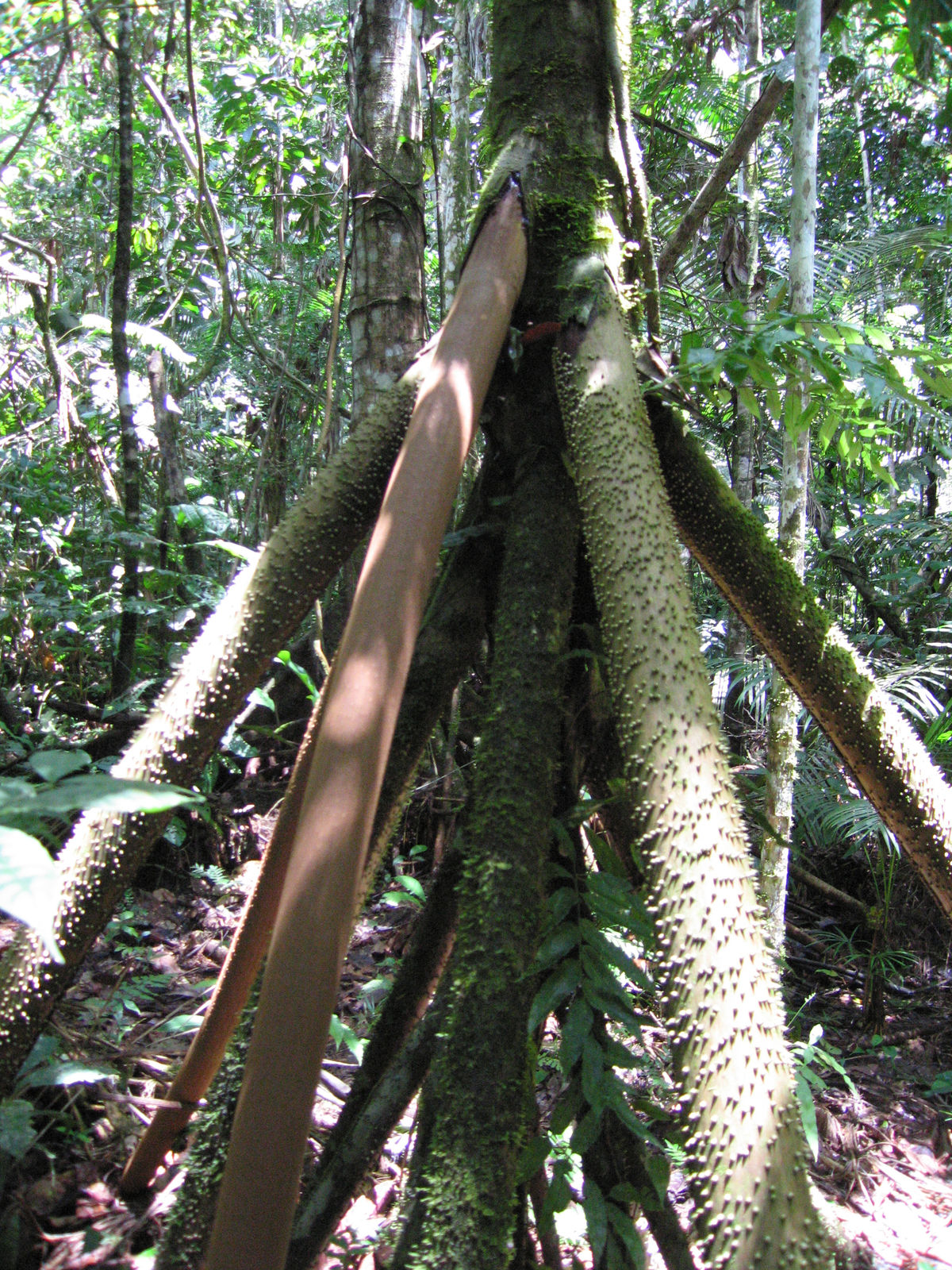
Walking palm (Socratea exorrhiza) belongs to the Arecaceae family and is native to tropical rainforests of Central and South America. A cone of spiny stilt roots supports its slender trunk above the forest floor. A local legend claims these roots let the tree walk toward light, an idea contradicted by botanical studies.
Read moreWalking palm, Stilt palm, Cashapona and Pona
Give plenty of ambient light without direct sun on the leaves.
Partial shade when young; filtered light to full sun when mature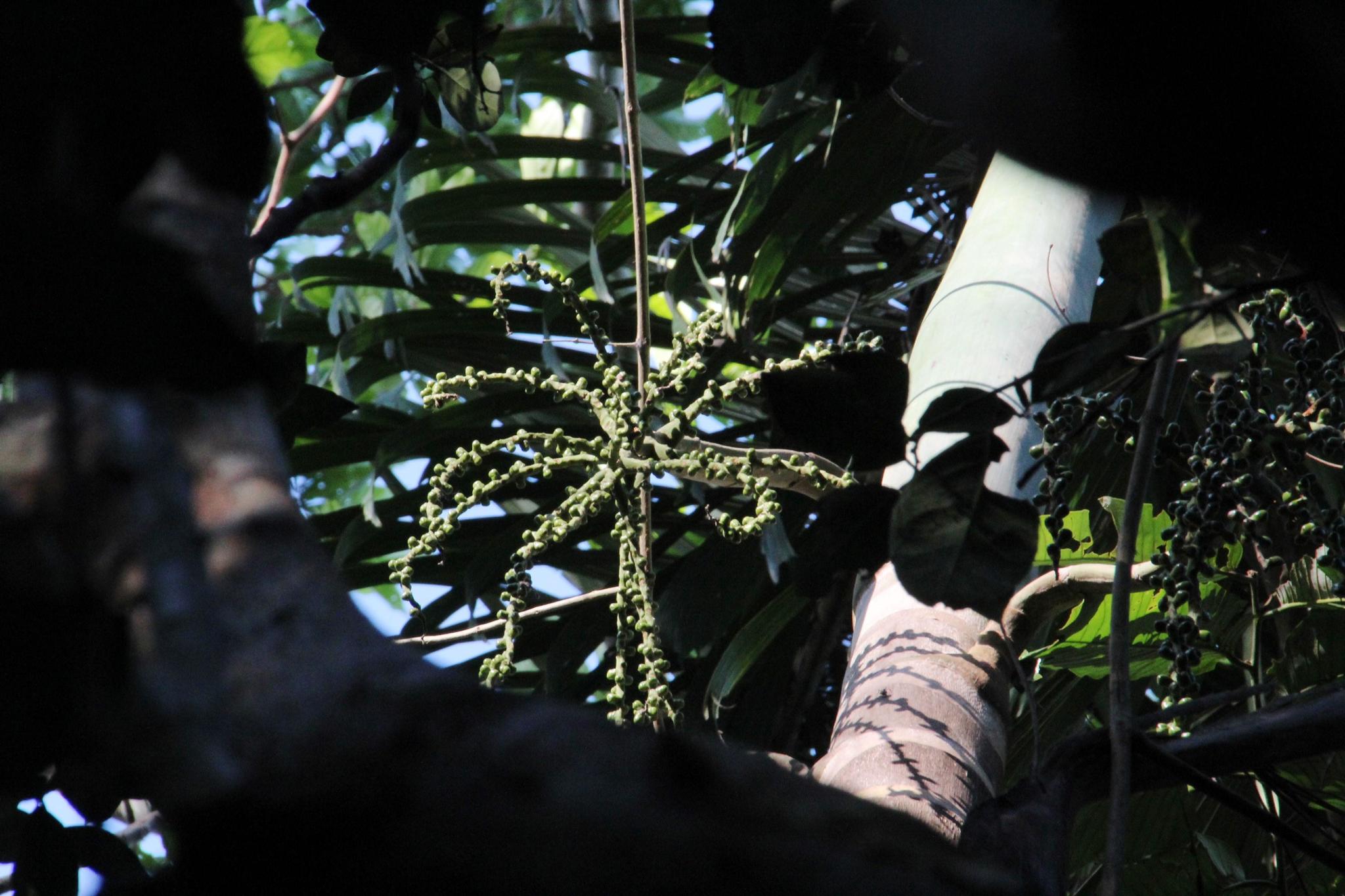



© photo
Tony Rebelo · cc-by-nc
Wikimedia Commons · CC BY-SA or Public Domain
Wikipedia · CC BY-SA
© copyright of the Board of Trustees of the Royal Botanic Gardens, Kew.


Global distribution
The native range extends from southeastern Nicaragua through Costa Rica and Panama to the Amazon basin in Colombia, Venezuela, the Guianas, Ecuador, Peru, Bolivia and Brazil. Elsewhere the species occurs only in tropical greenhouse collections at botanical gardens, without naturalized populations.
- Native9
- Nicaragua
- Costa Rica
- Panama
- Colombia
- Venezuela
- Ecuador
- Peru
- Bolivia
- Brazil
Hexagons: regions where the plant occurs. Green dots: native range.1
Identity
Walking palm (Socratea exorrhiza (Mart.) H.Wendl., 1860), also known as stilt palm or cashapona in the Peruvian Amazon, belongs to the Arecaceae family. Carl Friedrich Philipp von Martius first described it as Iriartea exorrhiza in 1824. Hermann Wendland transferred it to Socratea in 1860, establishing the scientific name still used today. 1 2
Its common name preserves an Amazonian legend repeated to visitors for decades: the tree supposedly moves toward light by producing new roots on one side of its cone and abandoning old roots on the other. Researchers Bodley and Benson proposed this hypothesis in 1980, but no direct observation has confirmed it. 7
Recognition
A cone of stilt roots gives walking palm its most distinctive outline. These tapering, spiny, gray-brown roots support the base of the trunk above the forest floor. The slender, smooth trunk commonly grows 15–20 m (49–66 ft) tall and 10–16 cm (4–6 in) across; exceptional individuals exceed 25 m (82 ft). 4 1
Root texture provides a quick field clue. The roots are smooth and fleshy on young plants, then harden and develop prickles as the cone begins to bear the weight of the adult trunk.
The cylindrical, feathery crown carries five to eight pinnate leaves, blue-green and almost 2 m (6.5 ft) long, on short leaf stalks. Young plants have leaflets arranged in a single plane, rather like Howea. Mature plants carry them in several planes, a useful indication of age without counting leaf scars on the trunk. 3
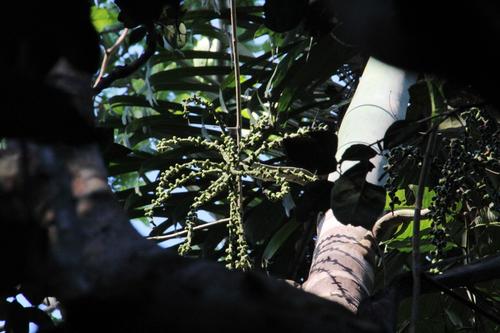
Male and female flowers occur on the same individual, making the species monoecious. Each palm produces one to four white inflorescences. Smooth, ellipsoid fruits measure about 2.5–3 cm (1–1.2 in) long and 1.5–2.5 cm (0.6–1 in) across. Their color changes to yellowish-brown as they ripen. 4
Useful taxonomy
Hermann Karsten described the genus Socratea. Several competing names have appeared in its taxonomic history before usage settled around the type species. The main synonyms relevant to identifying older records are:
- Iriartea exorrhiza Mart. (basionym, original description published in 1824)
- Socratea durissima (Oerst.) H.Wendl.
- Socratea elegans H.Karst.
- Socratea albolineata Steyerm.
- Socratea orbignyana (Blume ex Mart.) H.Karst.
- Socratea philonotia (Barb.Rodr.) Benth. & Hook.f.
The genus Socratea currently contains three recognized species: S. exorrhiza, Socratea rostrata and Socratea salazarii. Older literature often confuses them because their root cones were not compared directly, although the density of prickles differs clearly among species. The accepted name retained in reference databases is Socratea exorrhiza. 1 2
Habitat and range
Southeastern Nicaragua marks the northern end of the native range, which passes through Costa Rica and Panama into the Amazon basin. It includes Colombia, Venezuela, the Guianas, Ecuador, Peru, Bolivia and Brazil. Walking palm occupies lowland tropical rainforest and also reaches premontane forest at about 1,000 m (3,300 ft) above sea level. 3 5
Walking palm supports a remarkable community of epiphytes. A study of 118 palms in Panama recorded 66 epiphytic and hemiepiphytic species from 15 families, with mosses covering as much as 30% of some trunks. Substantial colonization begins only after about 20 years, once the palm trunk is stable enough to support the accumulated epiphytes. 8
Beyond its native range, this palm is cultivated only in tropical greenhouse collections in botanical gardens. No naturalized population is known outside Central America and the Amazon basin. 3
Life cycle and reproduction
Flowering mainly follows the local dry season. Beetles pollinate the flowers, including weevils in the genera Phyllotrox and Mystrops, rather than wind carrying the pollen. Each plant bears one to four white inflorescences, which later develop into hanging clusters of fruit. 3
Seeds are about 2 cm (0.8 in) long and weigh around 3.5 g (0.12 oz). Their germination rate is limited, at roughly 45%. About a quarter of germinated seedlings fail to survive their first few months. White-lipped peccaries also eat a large share of seeds on the forest floor, directly limiting the number of young palms that establish. 3
The stilt-root cone forms gradually after germination as the young trunk gains height without substantial thickening. Instead of increasing trunk girth in place, the palm grows upward with support from new roots year after year. This vertical growth, rather than actual movement across the ground, explains most observations behind the walking palm legend. 7
Uses and risks
Traditional construction uses the trunk split lengthwise or hollowed into tubes for partitions, floors, posts and fences. A hard, durable outer layer contrasts with its softer, fibrous center. Leaves provide temporary roof thatch, while shaped stilt roots have also been used to make spears for hunting peccaries. 3
The ripe yellowish-brown fruit is eaten locally. The apical bud is prepared as a vegetable, with several sources reporting a good flavor. Harvesting that bud is destructive: the palm has only one growing point, and removing it kills the tree, which can no longer produce new leaves or branches. No known toxicity in humans or animals is reported. 3
Varieties, look-alikes and related plants
Named horticultural cultivars are not documented for this predominantly forest species, which is rarely a domestic ornamental. Botanical literature mainly distinguishes a lowland form, the most widespread and best described, and a less documented premontane form occurring up to 1,000 m (3,300 ft). 5
Other stilt-root palms in the Iriarteeae tribe are the main source of confusion, especially Iriartea deltoidea. Its general habit resembles walking palm, but the root cone differs in shape and density of prickles. In Amazonian forest, Socratea exorrhiza also grows alongside Euterpe precatoria and Oenocarpus bataua. These two understory palms are not close relatives, although their distant silhouettes can appear similar. 1
Main sources
- Plants of the World Online / Kew, Socratea exorrhiza (Mart.) H.Wendl.
- International Plant Names Index, Socratea exorrhiza record
- Useful Tropical Plants Database, Socratea exorrhiza
- Tropicos / Missouri Botanical Garden, Socratea exorrhiza name record
- Inventaire National du Patrimoine Naturel (MNHN), Socratea exorrhiza
- NCBI Taxonomy, Socratea exorrhiza
- Bodley & Benson, 1980, Stilt-root walking by an iriateroid palm in the Peruvian Amazon, Biotropica
- Zotz & Vollrath, 2003, epiphyte load of a stilt-root palm, Journal of Tropical Ecology
Frequently asked questions
Does walking palm really move?
No. This Amazonian legend, popular with tourists, was contradicted by a 2007 study comparing stilt-root growth with changes in understory light, which occur far too quickly for actual movement to be possible.
What do the stilt roots actually do?
Their exact function remains debated. Proposed explanations include supporting the trunk on loose or unstable soil, allowing rapid upward growth without thickening the trunk, and possibly allowing a fallen young palm to resume growth.
Is walking palm fruit edible?
Yes. The ripe yellowish-brown fruit is eaten locally and by several forest monkey species. The apical bud is also eaten as a vegetable, but harvesting it kills the tree by removing its only growing point.
Is walking palm poisonous?
No known toxicity in humans or animals is reported. Several parts of the plant are used as food or in traditional Amazonian medicine.
Where does walking palm grow?
Its native range extends from southeastern Nicaragua through Central America to the Amazon basin, including Colombia, Venezuela, the Guianas, Ecuador, Peru, Bolivia and Brazil.
Can you grow walking palm at home?
In practice this is very difficult. Its mature height, need for constant humidity around 70–90% and bulky root cone restrict cultivation to large tropical greenhouses in botanical gardens.
Which plants resemble walking palm?
Other palms in the Iriarteeae tribe have similar stilt roots, particularly Iriartea deltoidea. The scientific name and exact shape of the root cone are the most reliable guides to telling them apart.
Similar plants
If you are unsure about a plant’s toxicity, ask a botanist or veterinarian for advice.