
Quito-orange (Solanum quitoense, )
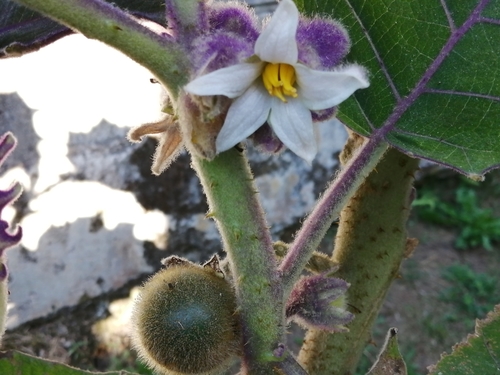

Quito-orange (Solanum quitoense) is a hairy perennial shrub in the Solanaceae family, native to northwestern South America. Grown for orange fruit with tart pulp, called lulo in Colombia and naranjilla in Ecuador, it grows in humid mountain forests at 1,200–2,400 m elevation, sheltered from direct sun.
Read moreQuito-orange, Lulo and Naranjilla
Place in indirect light or in a shaded room.
Partial shade; does not tolerate intense full sun



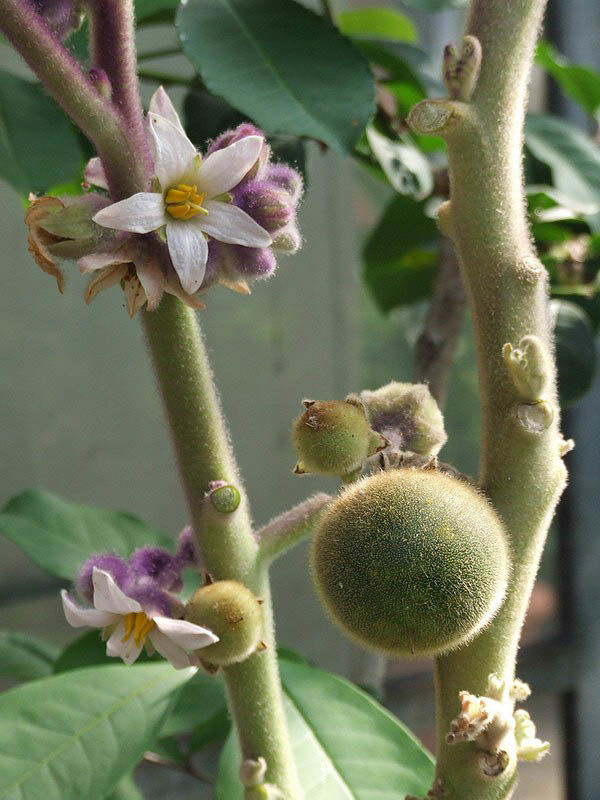
© photo
(c) Julián Maya, some rights reserved (CC BY-NC), uploaded by Julián Maya · cc-by-nc
Morten Ross · cc-by
Wikimedia Commons · CC BY-SA or Public Domain
Taken Nov 23, 2022 by Francois Mansour (cc-by-sa)
Taken Oct 2, 2021 by huy HO (cc-by-sa)
Taken Feb 5, 2022 by Zumbado Manuel (cc-by-sa)
Taken Jul 3, 2022 by Trap Hers (cc-by-sa)
© copyright of the Board of Trustees of the Royal Botanic Gardens, Kew.


Global distribution
Solanum quitoense is native to northwestern South America, mainly Peru, Ecuador and southern Colombia. Cultivation has spread to Costa Rica, Panama and Venezuela, where it is not considered native. Elsewhere it remains a protected crop or greenhouse curiosity.
- Native3
- Introduced3
- Peru
- Ecuador
- Colombia
- Costa Rica
- Panama
- Venezuela
Hexagons: regions where the plant occurs. Green dots: native range.1
Identity
Quito-orange (Solanum quitoense Lam., 1794), sold as lulo in Colombia and naranjilla in Ecuador, is a perennial member of the Solanaceae family. Purple star-shaped hairs cover its stems, leaves and unripe fruit, distinguishing it from other large-leaved Andean nightshades even before flowering. The epithet quitoense refers to Quito, the Ecuadorian capital near its center of diversity. 1 6
Regional names vary: naranjilla is used in Ecuador, Costa Rica, Nicaragua and Panama, while lulo is the Colombian name. The English name Quito-orange and French names such as morelle de Quito, naranjille and orange de Quito refer to the same species. 4 6
Recognition
A spreading, soft-stemmed shrub, Solanum quitoense grows 1.5–2.5 m (5–8 ft) tall, with stems becoming woody as they age. Wild populations have spines on stems, leaf stalks and major veins. Ecuadorian and Colombian growers almost exclusively cultivate the spineless form, which is easier to harvest by hand. 2
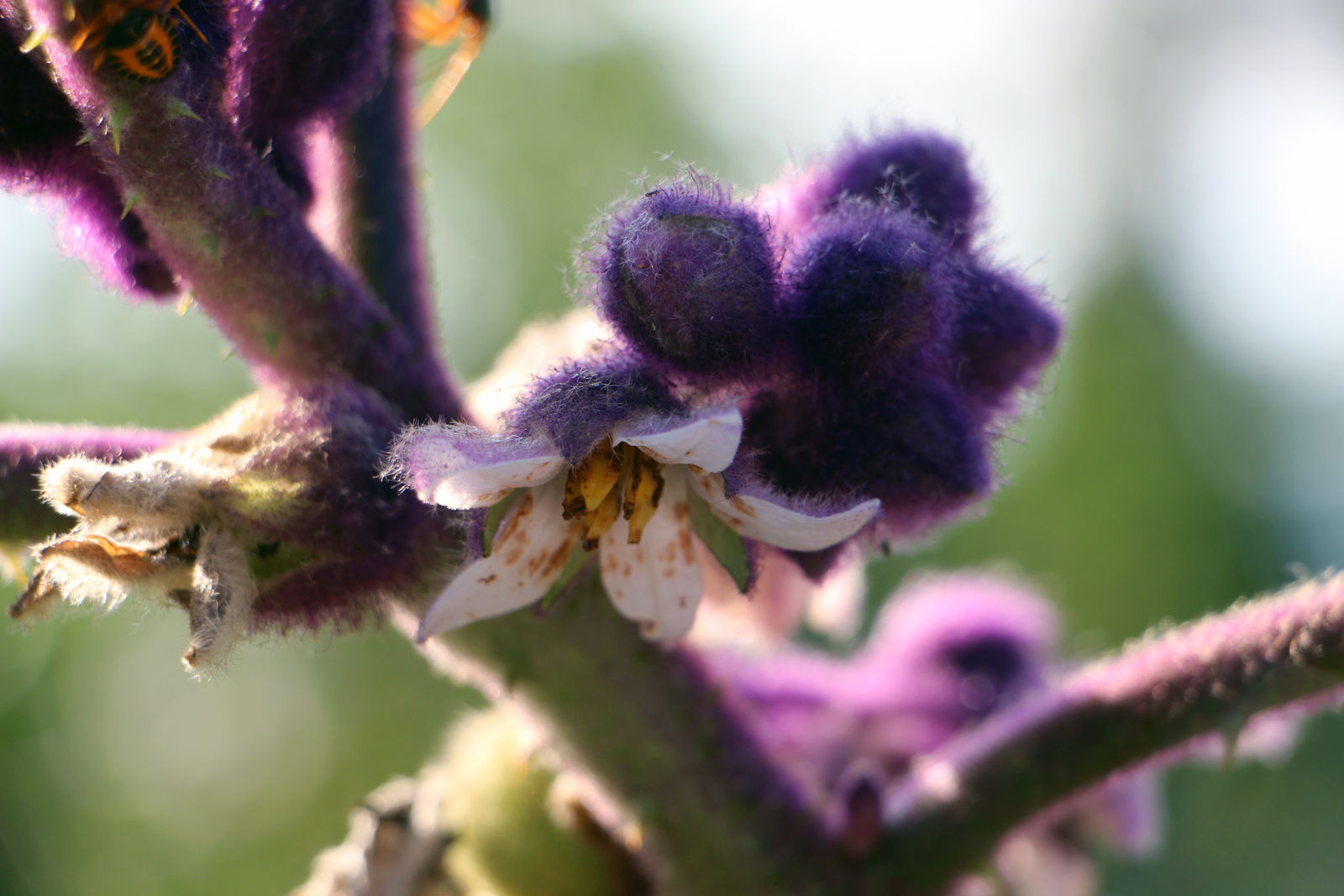
Purple star-shaped hairs cover young shoots, leaf stalks and the undersides of large oval leaves, 30–60 cm (12–24 in) long, just as they cover unripe fruits. The soft, slightly puckered blades bend more readily in wind than the leathery leaves of temperate species, consistent with sheltered woodland origins. 2
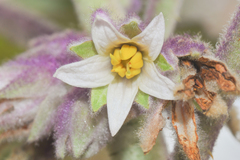
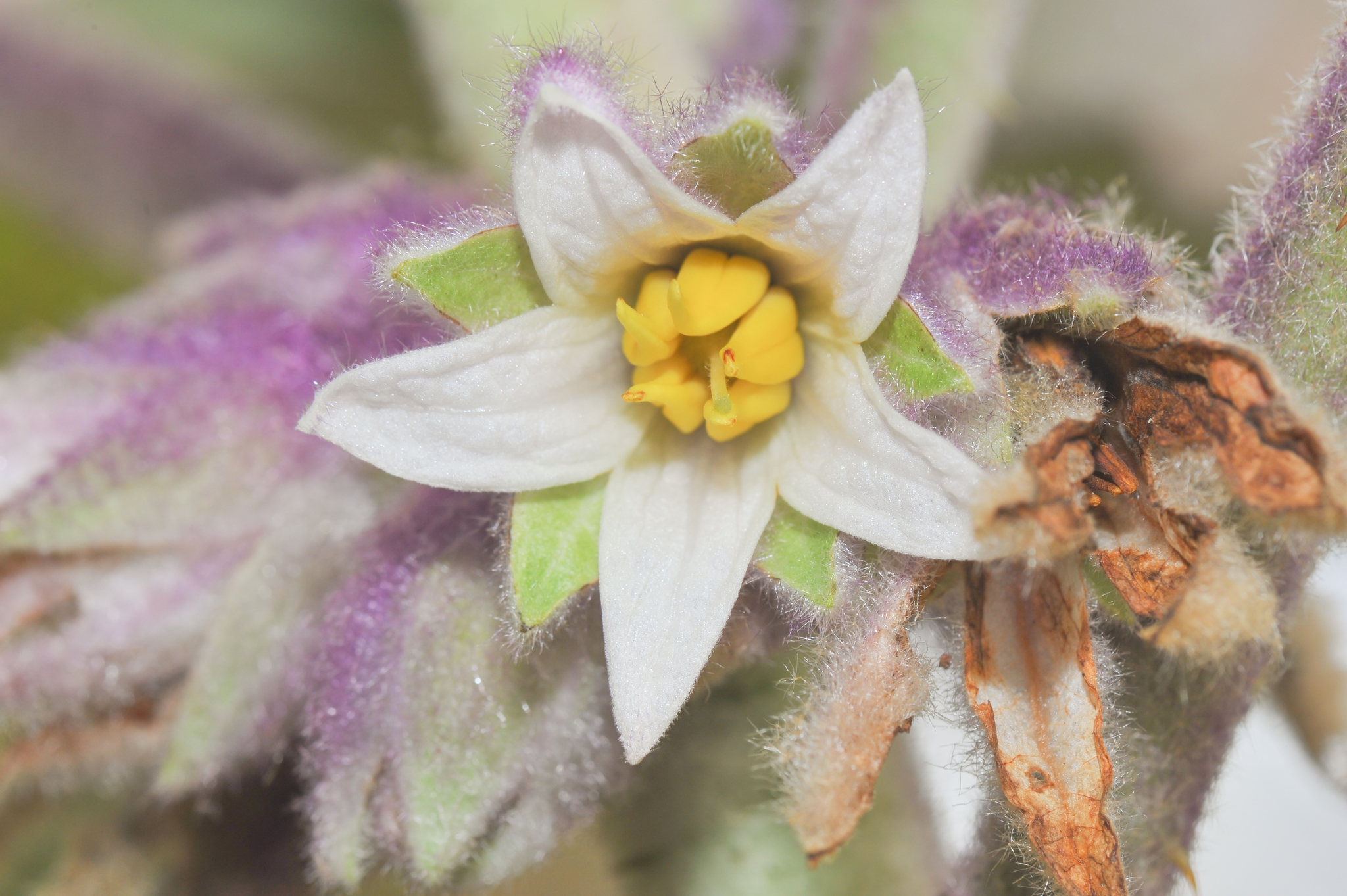
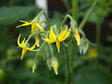
Fragrant flowers about 3 cm (1.2 in) across have five petals, white above and purplish and hairy below, surrounding five bright yellow stamens. Round fruits measure 4–6 cm (1.6–2.4 in) across. Green and covered in purple hairs when unripe, they develop smooth orange skin at maturity. 2 7
Useful taxonomy
POWO/WCVP accepts Solanum quitoense Lam., in subgenus Leptostemonum and section Lasiocarpa, a group containing several related South American species with edible fruits. Recorded synonyms include: 1 6
- Historical synonym: Solanum angulatum Ruiz & Pav.
- Solanum quitense Kunth
- Solanum nollanan Britton
- Solanum quitoense var. septentrionale R.E.Schult. & Cuatrec.
The last variety, described from Colombia and Venezuela, has spines on its stem, branches, leaf stalks and main veins, whereas the typical form has few scattered spines at most. International taxonomic databases, including ITIS in the United States, use the same accepted name as POWO, helping resolve inconsistent sales labels. 2 8
Habitat and range
Northwestern South America is the center of origin, chiefly Peru, Ecuador and southern Colombia. Cultivation extends beyond that native range to Costa Rica, Panama and Venezuela. 2 4
Humid mountain forests at 1,200–2,400 m (3,900–7,900 ft) elevation provide its habitat, with 1,500–3,000 mm (59–118 in) of annual rain. The best Ecuadorian plantations lie at 1,500–1,800 m (4,900–5,900 ft), where mean temperatures remain around 17–19 °C (63–66 °F). 2 7
Sheltered partial shade suits the plant better than full sun. It tolerates neither frost nor prolonged temperatures above 29 °C (84 °F), restricting cultivation to highland tropical climates or heated greenhouses elsewhere. These narrow climatic needs help explain why attempts in Florida and California since the early twentieth century remained limited despite commercial interest. 2
Life cycle and reproduction
Nursery seeds are sown using methods similar to those for tomatoes, and seedlings are transplanted after two to three months. Flowering begins four to five months after transplanting, with the first harvest ten to twelve months after sowing. 2
Established plants crop continuously for about three years before production declines. Fruits need picking every seven to ten days. For sale, they are harvested partly colored, because fully ripe fruit bruises easily and ferments quickly. 2
Commercial propagation mainly uses grafting onto Solanum macranthum to protect against root-knot nematodes, a major crop pest. Air layering and mature-wood cuttings are other possible methods. 2
Uses and risks
Ripe fruit can be eaten fresh, halved and squeezed into the mouth, or made into juice, sorbet, jam and desserts. About twelve fruits yield 227 g (8 oz) of juice, with a flavor often compared to pineapple and lemon. The translucent, tart, greenish pulp is a useful distinguishing feature among related Andean fruits. 2
Steroidal alkaloids of the solanidine type occur in the unripe parts and foliage of Solanum quitoense, as in many nightshades. Only fully ripe fruit is recommended for eating. 7 3
Star-shaped purple hairs on green fruit and young stems can irritate sensitive skin. Rub or rinse them off before handling fruit for food preparation. 3
Varieties, look-alikes and related plants
Widely distributed, stable named cultivars are lacking. Horticultural variation mainly involves spines and the degree of fruit hairiness. The variety septentrionale, spiny throughout, and a sweet but not very juicy local strain grown near Baza in Ecuador illustrate regional variation without constituting registered cultivars. 2
Similar fruits occur on several wild relatives: Solanum sessiliflorum, whose hybrids with Quito-orange have yellowish pulp; Solanum candidum, called huevo de gato; and Solanum pectinatum, whose persistent hairs interfere with juice preparation. 6
Ripe skin color and texture offer the most reliable distinction among these close relatives, along with whether purple hairs remain after washing the fruit.
Main sources
- Plants of the World Online / Kew, Solanum quitoense Lam.
- Purdue University NewCROP (Morton, Fruits of Warm Climates), Naranjilla
- Plants For A Future, Solanum quitoense
- USDA GRIN Global Taxonomy, Solanum quitoense
- International Plant Names Index, Solanum quitoense Lam.
- Wikipedia (EN), Solanum quitoense
- Wikipedia (ES), Solanum quitoense
- Integrated Taxonomic Information System (ITIS), Solanum quitoense Lam.
Frequently asked questions
Is Quito-orange the same plant as lulo?
Yes. Lulo and naranjilla are regional names for Solanum quitoense: lulo in Colombia, and naranjilla in Ecuador, Costa Rica, Nicaragua and Panama.
Is Quito-orange fruit poisonous?
Unripe green fruit and the other parts of the plant contain steroidal alkaloids typical of the nightshade family. Only fully ripe fruit with smooth orange skin is recommended for eating.
Why does green Quito-orange fruit irritate the skin?
Unripe fruit is covered with purple star-shaped hairs that can irritate sensitive skin. These hairs mostly fall away as the fruit ripens, leaving smooth orange skin.
Where does Quito-orange grow naturally?
Its native range lies in the Andes of northwestern South America, mainly Peru, Ecuador and southern Colombia, in humid mountain forests at 1,200–2,400 m elevation.
Can you grow Quito-orange outside the tropics?
The plant cannot tolerate frost and needs high atmospheric humidity. Outside highland tropical climates, it mainly survives in a heated greenhouse or sheltered conservatory, rather than outdoors through freezing winters.
Which plants resemble Quito-orange?
Several related Andean nightshades, including Solanum sessiliflorum, Solanum candidum and Solanum pectinatum, bear similar edible fruits. The color and texture of ripe skin provide the most reliable distinction.
Similar plants
If you are unsure about a plant’s toxicity, ask a botanist or veterinarian for advice.