
Yellow trumpet flower (Tecoma stans, )
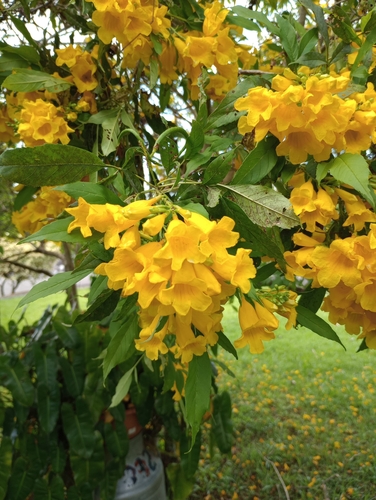

Yellow trumpet flower (Tecoma stans) is a semi-evergreen shrub or small tree in the Bignoniaceae family, native to warm parts of the Americas from the southern United States to northern Argentina. Its bright yellow trumpet-shaped flowers open almost year-round in warm climates and attract bees, butterflies and hummingbirds. Widely grown for ornament, it has also become invasive in several tropical regions, including some French overseas territories.
Read moreYellow trumpet flower, Yellow trumpetbush, Yellow bells, Yellow elder and Esperanza




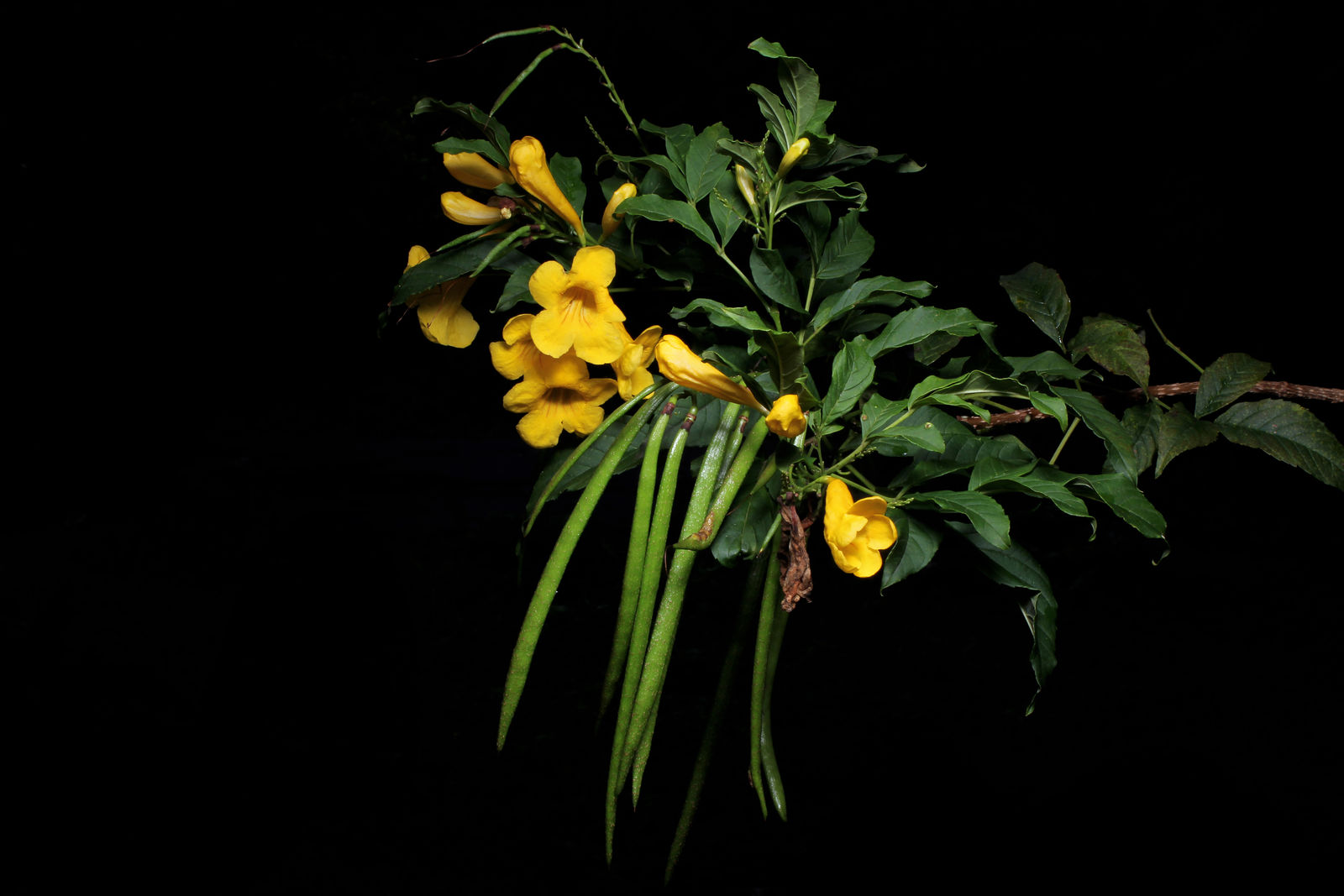
© photo
(c) lyndahicklin_05, some rights reserved (CC BY-NC), uploaded by lyndahicklin_05 · cc-by-nc
Robert Taylor · cc-by
Luc Wyn · cc-by
Taken Nov 16, 2022 by M. Hedayat (cc-by-sa)
Taken Jun 1, 2011 by Krol AS (cc-by-sa)
Taken Aug 28, 2017 by Tela Botanica − Sylvain PIRY (cc-by-sa)
Taken Dec 1, 2020 by N Z Víctor (cc-by-sa)
Taken Jan 21, 2020 by Espinoza-Zevallos Marco Elías (cc-by-sa)
© copyright of the Board of Trustees of the Royal Botanic Gardens, Kew.




Global distribution
Tecoma stans is native from the southern United States through Mexico, Central America and the Caribbean to northern Argentina. Widely cultivated beyond this range, it has naturalized in many tropical and subtropical regions, sometimes becoming invasive, including in several French overseas territories.
- Native4
- Introduced2
- Invasive4
- Mexico
- United States
- Argentina
- Bahamas
- Guadeloupe and Martinique
- Réunion
- South Africa
- India
- Australia
- New Caledonia
Hexagons: regions where the plant occurs. Green dots: native range.1
Identity
Yellow trumpet flower (Tecoma stans (L.) Juss. ex Kunth, 1819), also known as Yellow bells, Yellow elder, Yellow trumpetbush and Esperanza, is a semi-evergreen shrub or small tree in the genus Tecoma, family Bignoniaceae. On Réunion it is called bois pissenlit. Linnaeus first described it as Bignonia stans in 1753; Antoine Laurent de Jussieu and Carl Sigismund Kunth placed it in Tecoma in 1819, the combination accepted by POWO today. 1 7
In Texas and Mexico, esperanza, Spanish for “hope,” is a familiar name for this shrub. Its nearly continuous flowering in warm climates makes it a common feature of gardens, traffic circles and roadside slopes. 3
Recognition
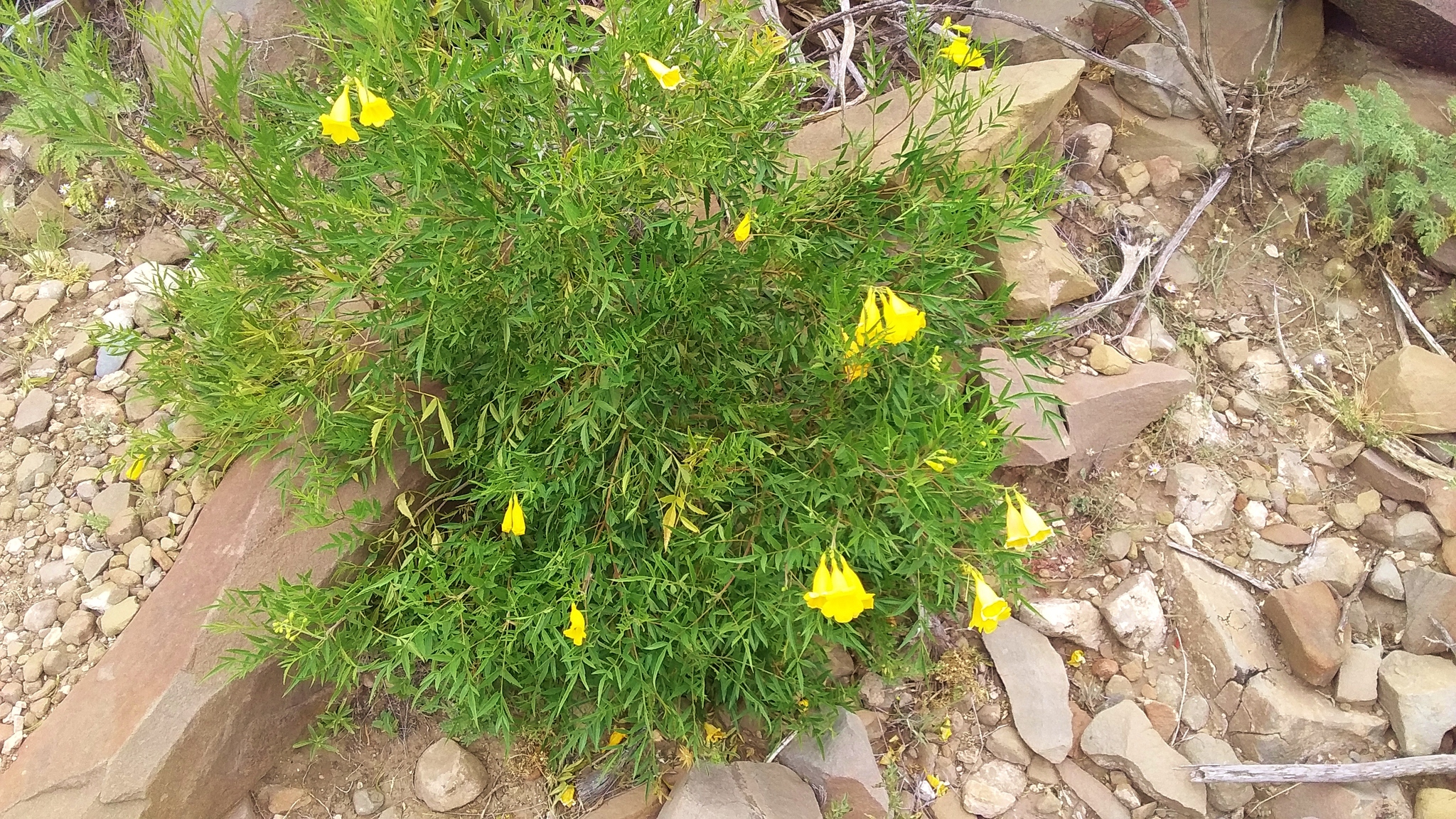
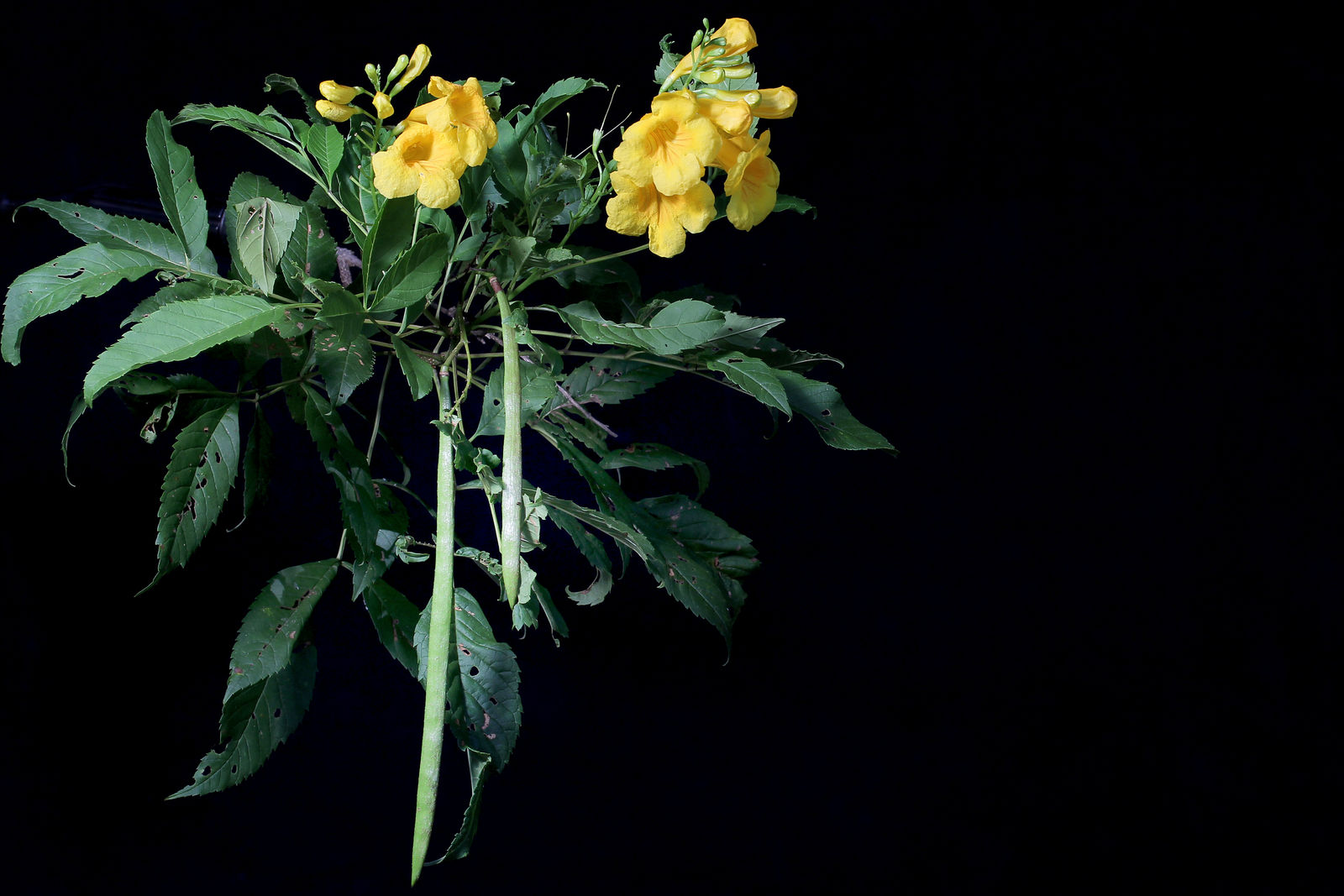
At a typical cultivated height of 2–6 m (7–20 ft) in temperate conditions, Tecoma stans can reach 10 m (33 ft) in tropical climates where frost does not check its growth. Opposite, odd-pinnate leaves carry 3–13 leaflets, varying between plants. These toothed, ovate-lanceolate leaflets measure 8–10 cm (3–4 in) long. 5 7
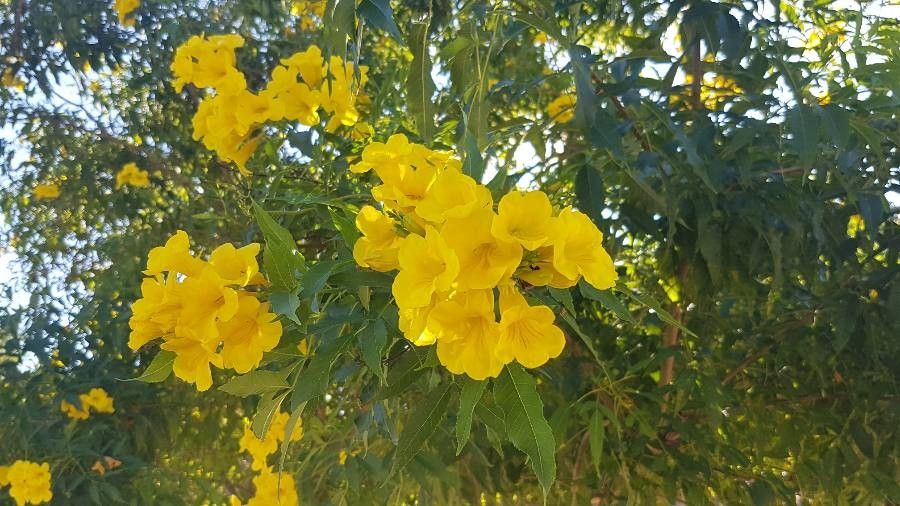
Bright yellow trumpets open in dense clusters at branch tips. Each corolla is 3.5–8.5 cm (1.4–3.3 in) long, with a light fragrance on some plants. Flowering continues almost year-round in tropical conditions but runs from late spring to the first frosts in temperate climates. 4 7
Long, narrow capsules hang from the branches and reach 20–25 cm (8–10 in). At maturity they release flat seeds with membranous wings. Wind dispersal helps the shrub colonize disturbed ground quickly. 4 7
Useful taxonomy
For this shrub, POWO/WCVP accepts the name Tecoma stans (L.) Juss. ex Kunth. Several botanical varieties and historical synonyms remain in use, often interchangeably in horticultural trade:
- Tecoma stans var. angustata Rehder, a desert variety from southern Arizona to northern Mexico
- Tecoma stans var. velutina DC., a hairy variety from Mexico to northwestern Argentina
- Bignonia stans L., the original published name
- Stenolobium stans (L.) Seem.
- Tecoma mollis Kunth
Names such as esperanza, yellow bells and yellow elder all refer to Tecoma stans, without implying separate botanical taxa. The accepted scientific name is the reliable reference when comparing nursery labels. 1 2
Habitat and range
Across its American native range, this shrub grows from Texas and Arizona in the southern United States through Mexico, Central America and the Caribbean to northern Argentina. It colonizes dry scrub, rocky or sandy ground and disturbed sites as a ruderal pioneer. 5 7
Established plants tolerate drought and poor soil well. These qualities make Tecoma stans useful on slopes, along roads and in screening hedges in dry regions. 6
Widespread ornamental introductions have made the species invasive in southern Africa, India, Australia and several Pacific islands. Dense, almost single-species thickets displace local vegetation in tropical and subtropical habitats. 7
New Caledonia received the shrub as early as 1904. There it occupies both disturbed sites and relatively intact natural areas, including around Boulouparis and Walpole Island. Local deer do not browse it, leaving its spread unchecked; invasive-species regulations there prohibit possession, transport and sale. 8
Life cycle and reproduction
Bees, butterflies and hummingbirds visit the yellow flowers and act as the main pollinators. Caterpillars of several hawkmoth species also use the foliage as a host plant. 7 5
Following pollination, capsules take several weeks to ripen before splitting and releasing their winged seeds over long distances. Seed-grown plants may flower at just 2 years old, helping explain rapid colonization where the species is invasive. 4
Spring-sown seed germinates in 1–3 weeks in a warm growing medium. Semi-ripe stem cuttings taken in summer can root just as quickly in warm conditions. 3 4
Uses and risks
Flowering hedges, specimen shrubs and nectar-rich beds are its main ornamental uses in warm climates. In temperate regions, containers can overwinter in a conservatory or cool greenhouse. The dense wood also serves for small joinery projects and rustic construction in the native range. 7 3
No toxicity is known for cats, dogs or people, while information for horses remains limited. Honey made from its nectar is sometimes reported as toxic, a distinction from the toxicity of the plant itself. 7
Mexican and Central American folk traditions record root or bark decoctions for diabetes and digestive disorders. These are traditional medicinal uses and do not replace medical advice. 7
Varieties, look-alikes and related plants
Among nursery selections, 'Gold Star' is widely sold for its compact habit and heavier flowering than the typical species. The accepted botanical varieties var. angustata and var. velutina represent regional forms, distinguished mainly by hairiness and leaflet shape. 2
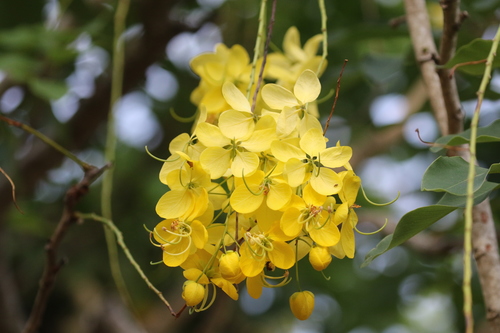
Two similar flowering plants cause frequent confusion. Tecoma capensis has orange to red flowers and a more climbing habit; it belongs to the same family but is a distinct species. Handroanthus chrysotrichus, also sold as yellow trumpet tree, has palmately compound leaves with five leaflets and a concentrated flowering flush before leaf emergence. Tecoma stans retains its pinnate foliage throughout flowering. 7
Main sources
- Plants of the World Online / Kew, Tecoma stans (L.) Juss. ex Kunth
- International Plant Names Index, Tecoma stans
- Royal Horticultural Society, Tecoma stans (Shrubby Trumpet Flower)
- Missouri Botanical Garden Plant Finder, Tecoma stans
- NC State Extension Gardener Plant Toolbox, Tecoma stans
- Plants For A Future, Tecoma stans
- English Wikipedia, Tecoma stans
- French Wikipedia, Tecoma stans (invasive status in New Caledonia)
Frequently asked questions
Is Yellow trumpet flower toxic to cats and dogs?
No. Available information does not consider Tecoma stans toxic to cats, dogs or people; its status in horses remains poorly documented. Honey made from its nectar is sometimes reported to be toxic.
Why is Tecoma stans banned in New Caledonia?
Introduced as an ornamental in 1904, the species has naturalized extensively and forms dense thickets that smother local vegetation. New Caledonian invasive-species rules prohibit its possession, transport and sale.
How does Tecoma stans differ from Tecoma capensis?
Tecoma stans has bright yellow flowers and odd-pinnate compound leaves, while Tecoma capensis has orange to red flowers and a more climbing habit. Both belong to Bignoniaceae but are distinct species.
When does Tecoma stans flower?
In tropical climates, flowering is almost continuous throughout the year. In temperate climates, plants grown in containers or sheltered ground flower from spring until the first frosts.
Can Tecoma stans survive frost?
Aboveground growth is damaged below 0 °C (32 °F), but plants often regrow in spring if the roots have not frozen deeply. This behavior has been observed as far as USDA zone 9b.
Can Tecoma stans be mistaken for a yellow tabebuia?
Yes. Both may be called yellow trumpet tree. Handroanthus chrysotrichus, often sold under that name, has palmately compound leaves with five leaflets and flowers in a concentrated flush before leafing out; Tecoma stans retains its pinnate leaves throughout flowering.
Why is Tecoma stans called esperanza?
Esperanza means hope in Spanish. The horticultural name became established in Texas and Mexico, where the shrub is widely grown for its continuous flowering and drought tolerance.
Similar plants
If you are unsure about a plant’s toxicity, ask a botanist or veterinarian for advice.