
Black-eyed Susan vine (Thunbergia alata, )
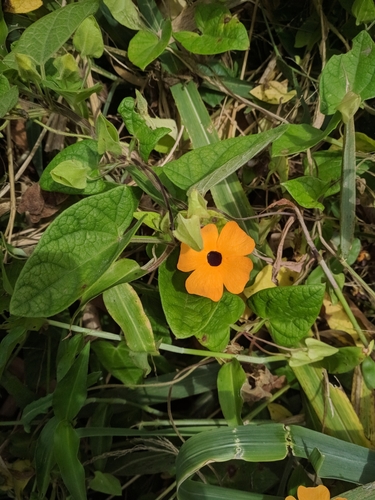


Black-eyed Susan vine (Thunbergia alata) is a herbaceous twining climber in the Acanthaceae family, native to eastern and southern Africa and Madagascar. Its Latin epithet alata, meaning winged, refers to the thin leafy extensions along the leaf stalks and stems. Five spreading lobes open from a flower tube, usually orange around an almost black throat. Widely grown as an annual climber, it has also naturalized, sometimes invasively, far beyond its native range.
Read moreBlack-eyed Susan vine, Black-eyed Susan, Susanita and Schwarzäugige Susanne
Thunbergia albiflora, Thunbergia aurantiaca, Thunbergia alata var. alba and Endomelas alata
Allow a few hours of direct sun per day, preferably morning or evening.
Full sun; tolerates light partial shade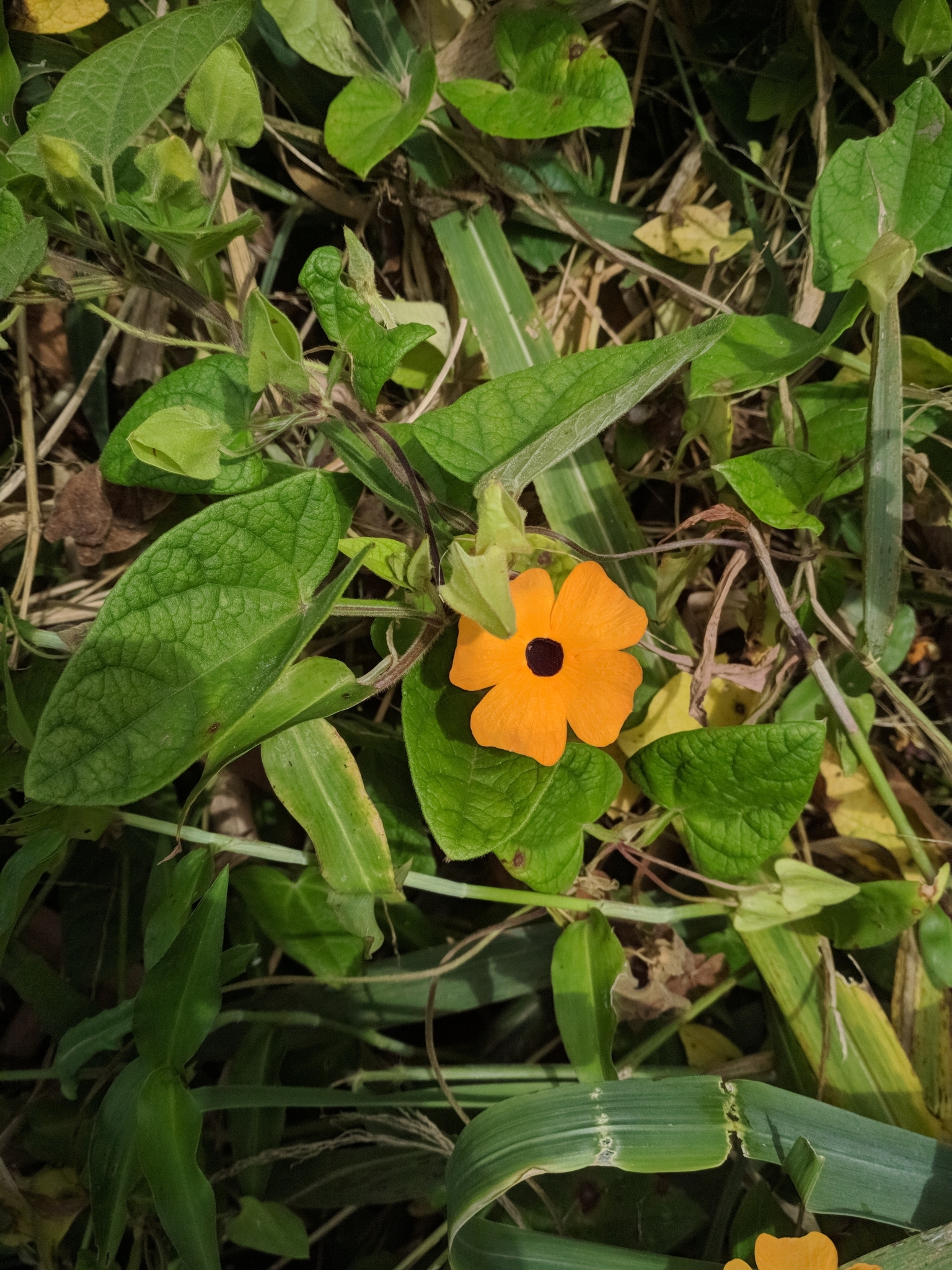


© photo
Macelo Costa · cc-by
iNaturalist User · cc-by
Ricard Busquets Reverte · cc-by
Taken May 27, 2021 by nbx (cc-by-sa)
Taken Jun 9, 2022 by Fabrice Rubio (cc-by-sa)
Taken Aug 20, 2021 by Jorge Cugat Herrero (cc-by-sa)
Taken Mar 3, 2016 by James Tomlinson (cc-by-sa)
© copyright of the Board of Trustees of the Royal Botanic Gardens, Kew.





Global distribution
Thunbergia alata is native to eastern and southern Africa, from Kenya and Tanzania to Limpopo, Mpumalanga, KwaZulu-Natal and the Eastern Cape, and to Madagascar. Horticultural introductions have naturalized far beyond this range, becoming invasive in several tropical and overseas territories.
- Native5
- Introduced1
- Invasive4
- Kenya
- Tanzania
- Mozambique
- South Africa
- Madagascar
- Florida and Texas
- Hawaii
- Australia
- Brazil
- Mayotte
Hexagons: regions where the plant occurs. Green dots: native range.1
Identity
Black-eyed Susan vine (Thunbergia alata Bojer ex Sims, 1825) is a herbaceous twining climber in the Acanthaceae family, native to eastern and southern Africa and Madagascar. Its scientific name describes a precise identification feature: alata, Latin for winged, refers to the thin leafy extensions along the leaf stalks and stems, visible even outside the flowering season. 1 2
The genus commemorates Swedish naturalist Carl Peter Thunberg (1743–1828), a student of Linnaeus and a pioneer of botany in southern Africa and Japan. The common name describes the nearly black throat contrasting with the orange corolla of wild plants. Black-eyed Susan also names Rudbeckia hirta, an upright member of the Asteraceae family unrelated to this vine. The international names Susanita and Schwarzäugige Susanne refer to the climber. 9
Recognition
Slender, angular, slightly hairy stems twine around supports without tendrils or clinging roots. In temperate cultivation, Thunbergia alata commonly grows 1–2.5 m (3–8 ft) in one season. In frost-free tropical climates it can exceed 5 m (16 ft), growing as a perennial rather than an annual. 3 7
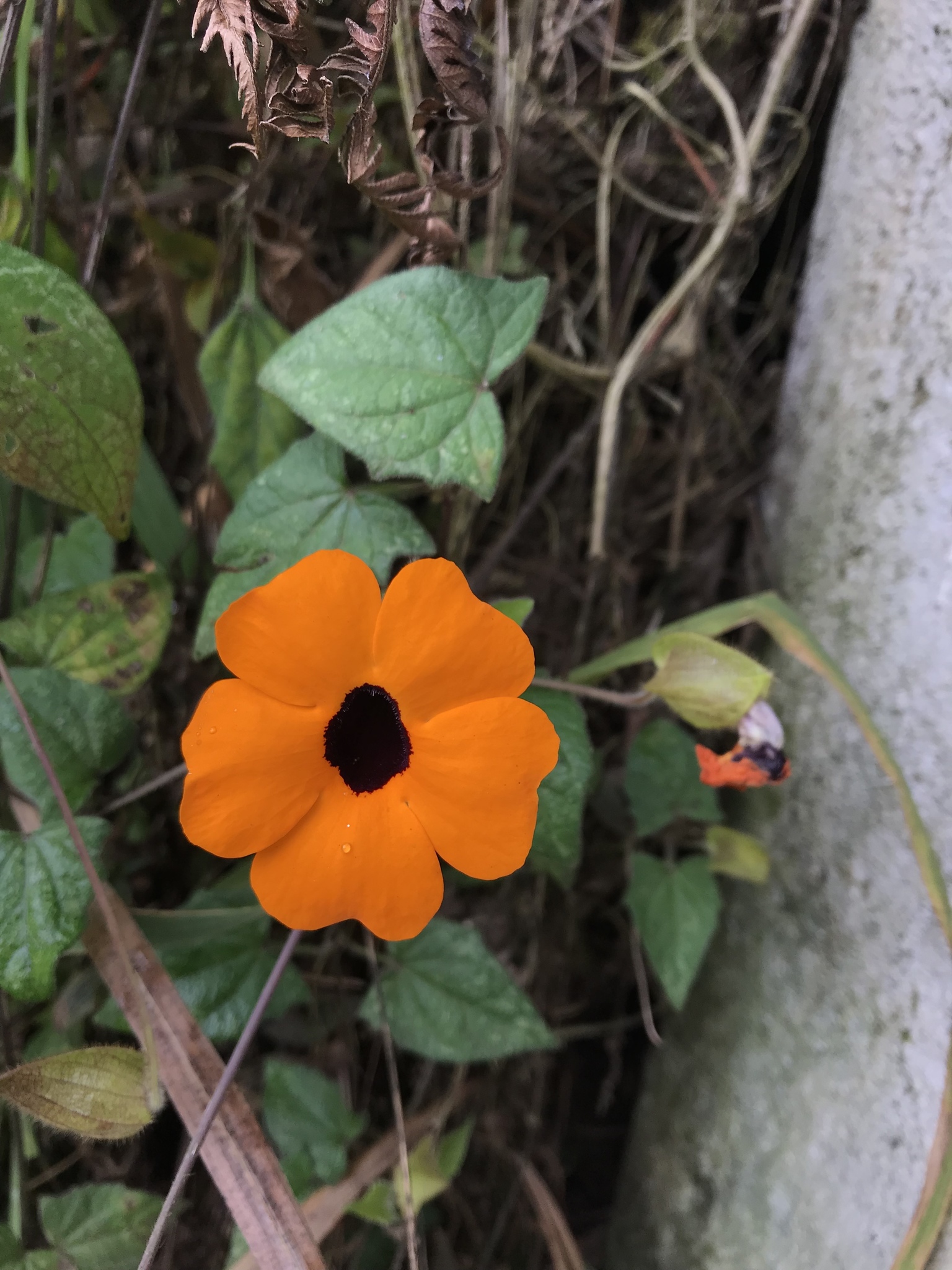
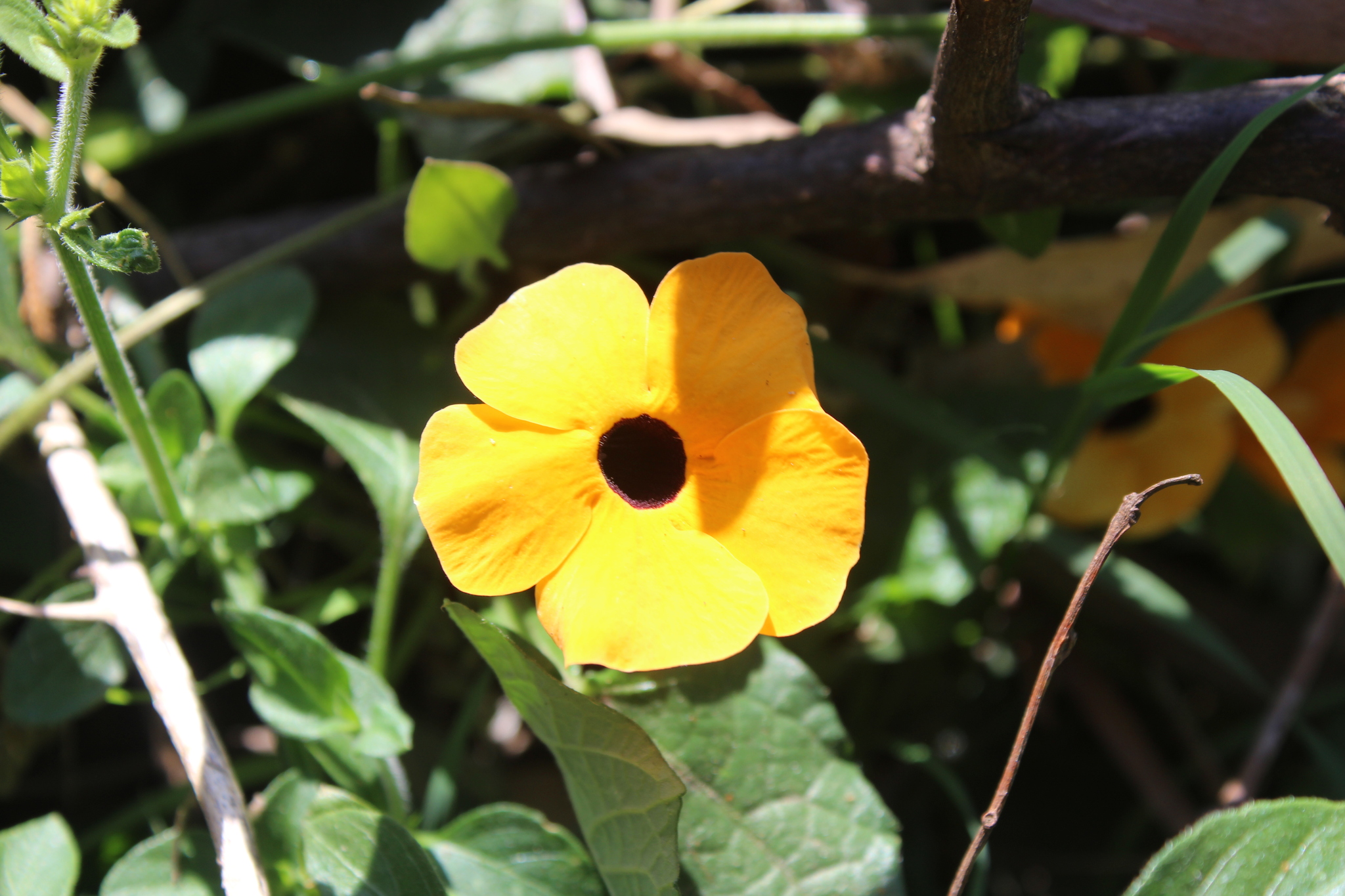
Opposite leaves are triangular to heart-shaped, finely hairy on both surfaces and slightly toothed at the edges. The oblique flower tube opens into five spreading lobes, 3–5 cm (1.2–2 in) across. Wild flowers have a dark brown to almost black throat inside an orange corolla; white, cream or red horticultural forms often lack this contrast. 4 5
Once flowers fade, the dry fruit resembles a bird's head, with a spherical base extended into a narrow beak. It releases seeds when mature. This distinctive shape helps identify the plant after its corolla has fallen, during the seed-dispersal season. 7
Useful taxonomy
Kew recognizes Thunbergia alata Bojer ex Sims as an accepted Acanthaceae species. The 1825 description came from plants sent by naturalist Wenceslas Bojer, whose name accompanies the description published by John Sims. Around thirty synonyms circulate, mostly reflecting color forms once described as separate species, such as Thunbergia albiflora Gordon and Thunbergia aurantiaca Paxton. 1 2
Two relatives can cause confusion: Thunbergia gregorii bears orange flowers without a dark throat, while Thunbergia grandiflora is woodier, with large blue flowers. A label giving only “orange Thunbergia” or “black-eyed Susan” does not settle the identification. The full binomial distinguishes these three climbers. 1
Habitat and range
Eastern and southern Africa and Madagascar make up the native range. It extends from Kenya and Tanzania to Limpopo, Mpumalanga, KwaZulu-Natal and the Eastern Cape, where the vine grows along forest edges and in sunny open habitats. 1 7
Horticultural planting has spread the species far beyond that range. Naturalized populations occur in Brazil, Australia, Hawaii, Mexico and the southern United States. On disturbed ground, fast growth smothers low vegetation and limits regeneration of local species. French overseas inventories record it as invasive in disturbed habitats on Mayotte; this is a local status rather than a universal regulatory classification. 8 9
Life cycle and flowering
Cool-climate gardeners raise the vine as an annual, sowing under cover six to eight weeks before the last frost. Flowers continue from midsummer until the first frosts, peaking late in the season. In frost-free climates, the plant lives as a perennial and may flower almost year-round. 5 6
Bees provide most pollination, guided by an ultraviolet pattern around the dark throat that human eyes cannot see. The butterfly Junonia oenone also lays eggs on the vine; its caterpillars then feed on the leaves. 7
Seeds can be soaked overnight in lukewarm water to speed germination before sowing. Alternatively, stem cuttings taken in late summer allow plants to be kept under frost-free shelter through winter. Both methods provide a way to start the following season's climbers. 6
Uses and risks
A trellis, fence, arch or hanging basket can be covered within a single growing season, making ornamental planting the vine's main use. It also temporarily covers a sunny bed while slower-growing perennials establish. Its twining stems need something suitable to wrap around when grown upward. 4
Fine hairs on stems and leaves may cause mild skin irritation in sensitive people during pruning. The ASPCA lists Thunbergia alata as non-toxic to cats and dogs. The contact irritation described here is therefore distinct from poisoning by the plant. 5
In eastern Africa, leaves and roots have traditional uses for skin inflammation. Locally, the foliage also supplements livestock feed. These uses belong to the plant's regional history alongside its much wider modern role as an ornamental climber. 7
Varieties, look-alikes and related plants
Commercial flower colors extend well beyond wild orange with a black throat. Susie Mix includes orange, yellow and white seedlings with or without a dark center. Volmary's Sunny Susy series ranges from deep red to bright orange around a brown throat. White-flowered Alba, without a dark throat, reuses a name applied in the 19th century to the botanical variety Thunbergia alata var. alba Paxton. 3 1
For comparison, Thunbergia gregorii has orange flowers without a dark throat, and Thunbergia grandiflora is a woodier vine with much larger blue flowers. The name black-eyed Susan also refers to Rudbeckia hirta, an upright Asteraceae plant with no close botanical relationship to Thunbergia alata. Growth habit and the full scientific name resolve that shared-name confusion. 9
Main sources
- Plants of the World Online / Kew, Thunbergia alata Bojer ex Sims
- International Plant Names Index, Thunbergia alata
- Royal Horticultural Society, Thunbergia alata - black-eyed Susan
- Missouri Botanical Garden Plant Finder, Thunbergia alata
- NC State Extension Gardener Plant Toolbox, Thunbergia alata
- University of Wisconsin Horticulture Extension, Black-eyed Susan Vine, Thunbergia alata
- South African National Biodiversity Institute (PlantZAfrica), Thunbergia alata
- Espèces Envahissantes Outre-mer, Thunbergia alata profile (Mayotte)
- Wikipedia (French), Thunbergia alata
Frequently asked questions
Is Black-eyed Susan vine poisonous?
No. The ASPCA does not classify Thunbergia alata as toxic to cats or dogs. The documented risk is mechanical: fine hairs on the stems and leaves may irritate sensitive skin.
Why do some flowers lack a dark center?
Horticultural forms such as Alba and some Susie Mix plants have been selected for solid-colored flowers without the dark throat typical of wild plants. This does not rule out identification as Thunbergia alata.
How does it differ from Thunbergia grandiflora?
Thunbergia grandiflora is a woodier climber with large blue flowers. Thunbergia alata remains herbaceous, with much smaller orange to yellow flowers and a characteristic dark throat.
Is Black-eyed Susan vine invasive?
Yes, in several tropical regions beyond its native range, including Hawaii, Australia, Brazil and Mayotte, where it is recorded as an invasive species of disturbed habitats.
Can Thunbergia alata live permanently outdoors where winters freeze?
No. It does not withstand frost. In climates such as metropolitan France, it is usually grown as an annual climber sown each spring, or kept in a container and brought under shelter for winter.
How can I identify Thunbergia alata without flowers?
The thin wing along the leaf stalk and stem remains visible throughout the season and gives the species its name. It is the most reliable feature before flowering.
Where does the name Black-eyed Susan vine come from?
It describes the dark throat of the flower. Black-eyed Susan also refers to Rudbeckia hirta, an upright member of the Asteraceae family unrelated to Thunbergia alata.
Similar plants
If you are unsure about a plant’s toxicity, ask a botanist or veterinarian for advice.