
Cupuaçu (Theobroma grandiflorum, )
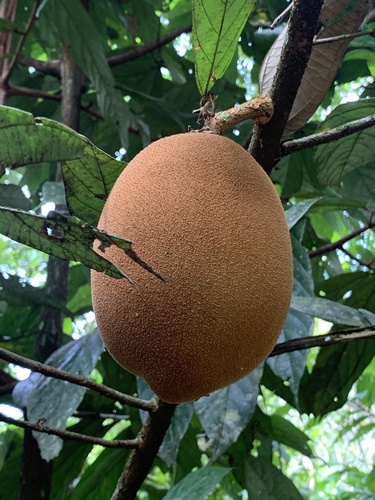

Cupuaçu (Theobroma grandiflorum) is a fruit tree in the Malvaceae family, related to cacao and native to the Amazon basin from southern Venezuela to northern Bolivia. It grows beneath taller trees in humid tropical forests and bears large brown fruits with fragrant white pulp used in juices and ice cream, while its seeds yield cupuaçu butter.
Read moreCupuaçu, Cupuacu, Cupuassu, Cupuazú, Copoazu and Cupu assu
Place in indirect light or in a shaded room.
Partial shade to light shade; no direct full sun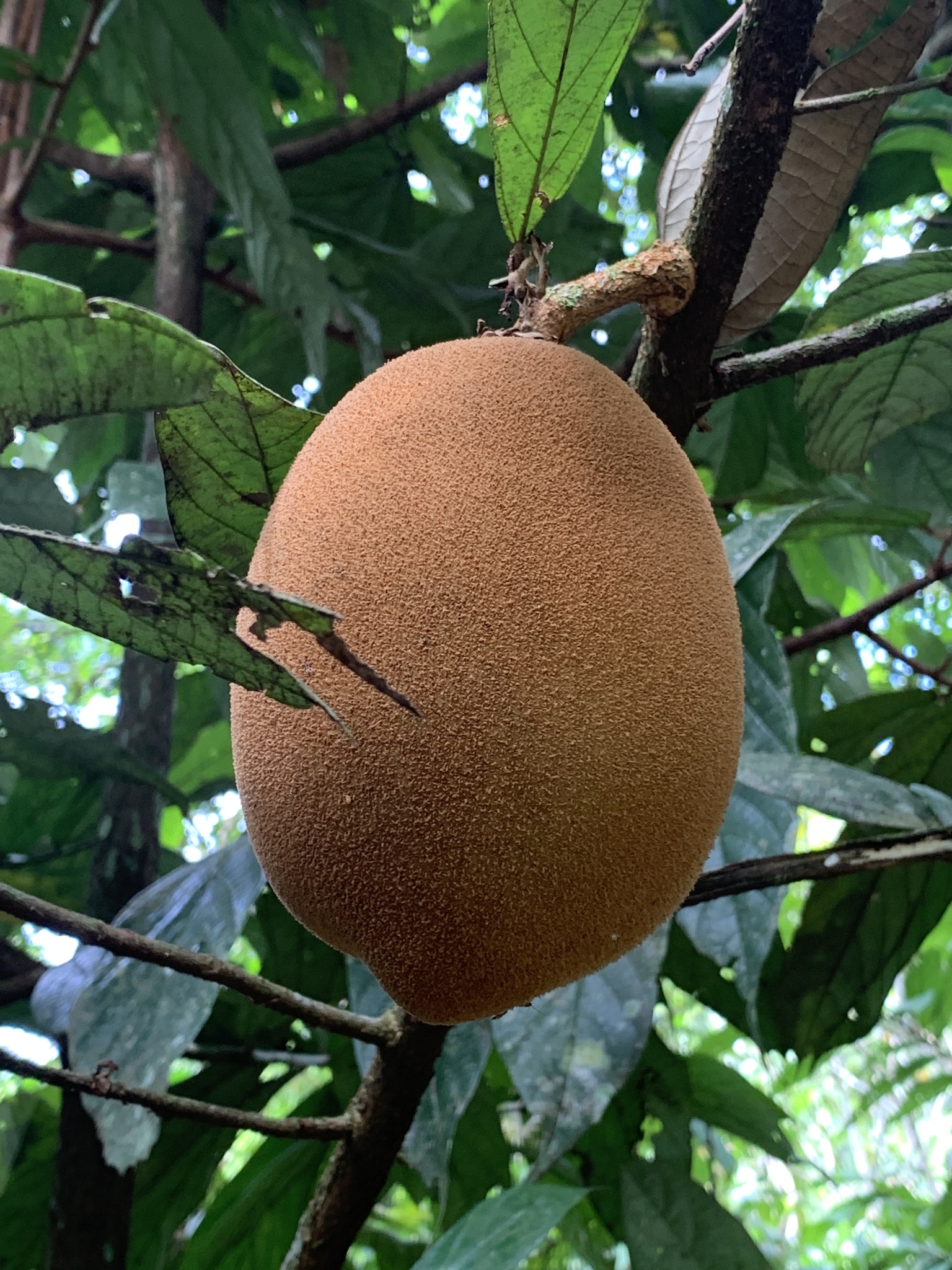


© photo
(c) Sergio Mendez-Cardona, some rights reserved (CC BY-NC), uploaded by Sergio Mendez-Cardona · cc-by-nc
Wikimedia Commons · CC BY-SA or Public Domain
Wikipedia · CC BY-SA
© copyright of the Board of Trustees of the Royal Botanic Gardens, Kew.


Global distribution
The native range of Theobroma grandiflorum extends from southern Venezuela to northern Bolivia through Guyana, Suriname, Colombia, Ecuador and Peru, with a center of diversity in the eastern Brazilian Amazon. Introductions elsewhere have mainly been for crop production. In temperate climates it remains uncommon outside botanical collections and heated greenhouses.
- Native8
- Introduced1
- Brazil
- Venezuela
- Guyana
- Suriname
- Colombia
- Ecuador
- Peru
- Bolivia
- Costa Rica
Hexagons: regions where the plant occurs. Green dots: native range.1
Identity
Cupuaçu (Theobroma grandiflorum (Willd. ex Spreng.) K.Schum., 1886), also spelled Cupuacu, Cupuassu, Cupuazú, Copoazu or Cupu assu, is a Malvaceae fruit tree closely related to cacao (Theobroma cacao). The genus name joins Greek theos (god) and broma (food); grandiflorum describes flowers much larger than cacao’s, borne directly on the trunk. 1 2
Wild populations occur across the Amazon basin, from southern Venezuela to northern Bolivia. Its present distribution owes much to ancient Indigenous domestication. Genomic analyses place the start of this process 5,000–8,000 years ago, from cupuí (Theobroma subincanum), the wild species from which Cupuaçu directly descends. 6
Recognition
Wild Cupuaçu trees commonly reach 5–15 m (16–49 ft), sometimes 20 m (66 ft). Orchard training keeps them around 8–10 m (26–33 ft) instead of the 20 m possible without intervention. The short trunk, rarely over 30 cm (12 in) thick, soon divides into large branches beneath a pyramidal to spreading crown. 9 4
Simple, leathery leaves measure 20–35 cm (8–14 in) long and 6–11 cm (2–4 in) wide. They emerge pink before becoming dark green, with about ten pairs of secondary veins visible underneath. Flowers grow directly on the trunk and larger branches, a cauliflorous habit typical of understory Malvaceae that brings petals within reach of insects active near the ground. Each cream flower, with a purplish-red base, opens for just one day. 4 9
A large brown berry, oval to almost round, measures 20–24 cm (8–9 in) long and can weigh over 1.5 kg (3.3 lb). Its thick, fuzzy shell encloses 25–50 seeds surrounded by creamy white pulp whose fragrance combines chocolate and pineapple. 9 4
Useful taxonomy
Karl Schumann published the currently accepted combination, Theobroma grandiflorum (Willd. ex Spreng.) K.Schum., in 1886. The German botanist based it on an earlier basionym attributed to Willdenow and validated by Sprengel. The main recorded synonyms are:
- Bubroma grandiflorum Willd., historical synonym
- Guazuma grandiflora (Willd. ex Spreng.) G.Don, historical synonym
- Theobroma macranthum Bernoulli, historical synonym
- Theobroma speciosum Willd. ex Mart., historical synonym
Recent genomic analyses identify cupuí (Theobroma subincanum) as Cupuaçu’s wild ancestor. Its fruit and seeds are smaller than those of Theobroma grandiflorum. 2 6
Habitat and range
From southern Venezuela to northern Bolivia, the native range passes through Guyana, Suriname, Colombia, Ecuador and Peru. Eastern Brazilian Amazonia is a center of diversity, and Pará is a major production area. The tree inhabits lowland tropical rainforest understory on terraces that do not flood. 1 4
Within that native range, growth requires annual rainfall of 1,900–3,000 mm (75–118 in), mean temperatures of 20–30 °C (68–86 °F) and drained soil at pH 5–6.5. Introductions elsewhere have mainly served crop production; in temperate regions the tree remains uncommon outside botanical collections and heated greenhouses. 9 3
Life cycle and reproduction
Small insects, including weevils, flies and stingless bees, provide pollination; wind plays only a minor role. Heavy rain interrupts their activity and reduces fertilization. Most trees are self-incompatible, greatly limiting fruit set: barely 5% of open flowers produce a fruit. 4
Fallen fruit shows no external color change to signal ripeness, making harvest timing difficult. Growers collect freshly fallen fruits without a dependable visual cue. The hard shell takes months to decay naturally; rodents typically gnaw an opening to reach the pulp, releasing still-viable seeds in the process. 4 9
Following the initial domestication, a second phase of selection accompanied the geographical expansion of cultivation over the past two centuries. 6
Uses and risks
White pulp makes up roughly a third of the fruit’s weight and is eaten raw or made into juices, ice cream, preserves and pastries throughout Amazonia. Cupuaçu butter, extracted from roasted seeds, melts at about 30 °C (86 °F), lower than cocoa butter. This helps explain its cosmetic use as an emollient. 4 3
No toxicity is documented for humans or domestic animals. Raw seeds contain theobromine and caffeine, like cacao seeds, but in substantially smaller quantities. This explains why Cupuaçu is not routinely mentioned alongside chocolate in veterinary alerts. 3
Witches’ broom remains the main crop threat. The fungus Moniliophthora perniciosa deforms young shoots into dense clusters and can kill the tree without regular sanitary pruning. 8
Varieties, look-alikes and related plants
To address witches’ broom, Embrapa selected resistant clones grouped in its Cupuaçu 5.0 kit: BRS Careca, BRS Fartura, BRS Duquesa, BRS Curinga and BRS Golias. They are planted together to enable cross-pollination. 8
Two close relatives can cause confusion. Cupuí (Theobroma subincanum) bears smaller fruits and seeds and has hairier foliage. Cacao (Theobroma cacao) has a similar general outline, but its elongated fruits contain seeds destined for conventional chocolate rather than an edible pulp crop.
Using the scientific name distinguishes these three Theobroma species, which may be sold locally under interchangeable trade names.
Main sources
- Plants of the World Online / Kew, Theobroma grandiflorum (Willd. ex Spreng.) K.Schum.
- GBIF Backbone Taxonomy, Theobroma grandiflorum, synonymy
- Plants For A Future, Theobroma grandiflorum - Cupuassu, Cupuacu
- Purdue University NewCrop, Cupuaçu (Theobroma grandiflorum) factsheet
- IUCN Red List, Theobroma grandiflorum assessment 2021
- Colli-Silva et al. 2023, Communications Earth & Environment, domestication of cupuaçu
- INPN / MNHN, Theobroma grandiflorum, French reference record
- Embrapa, Cupuaçu 5.0 - kit of witches’ broom-resistant cultivars
- BOTANY.cz, Kakaovník velkokvětý (Theobroma grandiflorum)
Frequently asked questions
Is Cupuaçu the same as cacao?
No. Theobroma grandiflorum and Theobroma cacao share a genus and family, the Malvaceae, but are distinct species. Cupuaçu is grown for its fragrant pulp, cacao for seeds used to make chocolate.
Is Cupuaçu toxic to cats and dogs?
No toxicity is documented for the plant or ripe fruit. Raw seeds contain theobromine and caffeine, like cacao seeds, but in much smaller amounts; they are not eaten as they are.
How does Cupuaçu differ from cupuí?
Cupuí (Theobroma subincanum) is the closest wild relative and is considered the ancestor from which Cupuaçu was domesticated. It has smaller fruits and seeds and hairier leaves.
Can Cupuaçu grow in mainland France?
Only in a heated greenhouse. The species requires mean temperatures of 20–30 °C and high humidity; growth stops below 16 °C, and frost kills the tree.
What is cupuaçu butter used for?
Extracted from roasted seeds, the butter melts at about 30 °C, lower than cocoa butter. It is mainly used in cosmetics as an emollient in creams and balms.
Why do so few flowers produce fruit?
Most trees are self-incompatible: a flower needs pollen from another individual to set seed. Combined with pollinators sensitive to heavy rain, this explains why barely 5% of open flowers produce fruit.
What is witches’ broom in Cupuaçu?
This fungal disease, caused by Moniliophthora perniciosa, deforms young shoots into dense clusters and can weaken or kill the tree. Embrapa cultivars such as BRS Careca and BRS Golias were selected for resistance.
Similar plants
If you are unsure about a plant’s toxicity, ask a botanist or veterinarian for advice.