
Common bilberry (Vaccinium myrtillus, )
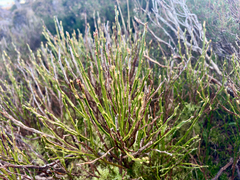
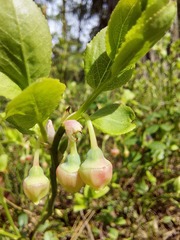
Common bilberry (Vaccinium myrtillus) is a deciduous subshrub in the Ericaceae family, widespread in acidic woodland across Europe and temperate Asia. Its angular green stems and blue-black fruit with deeply colored flesh distinguish it from the American highbush blueberry commonly sold in stores, a different species often confused with it.
Read moreCommon bilberry, Bilberry and Whortleberry
Allow a few hours of direct sun per day, preferably morning or evening.
Full sun to partial shade; fruiting is better in a sunny position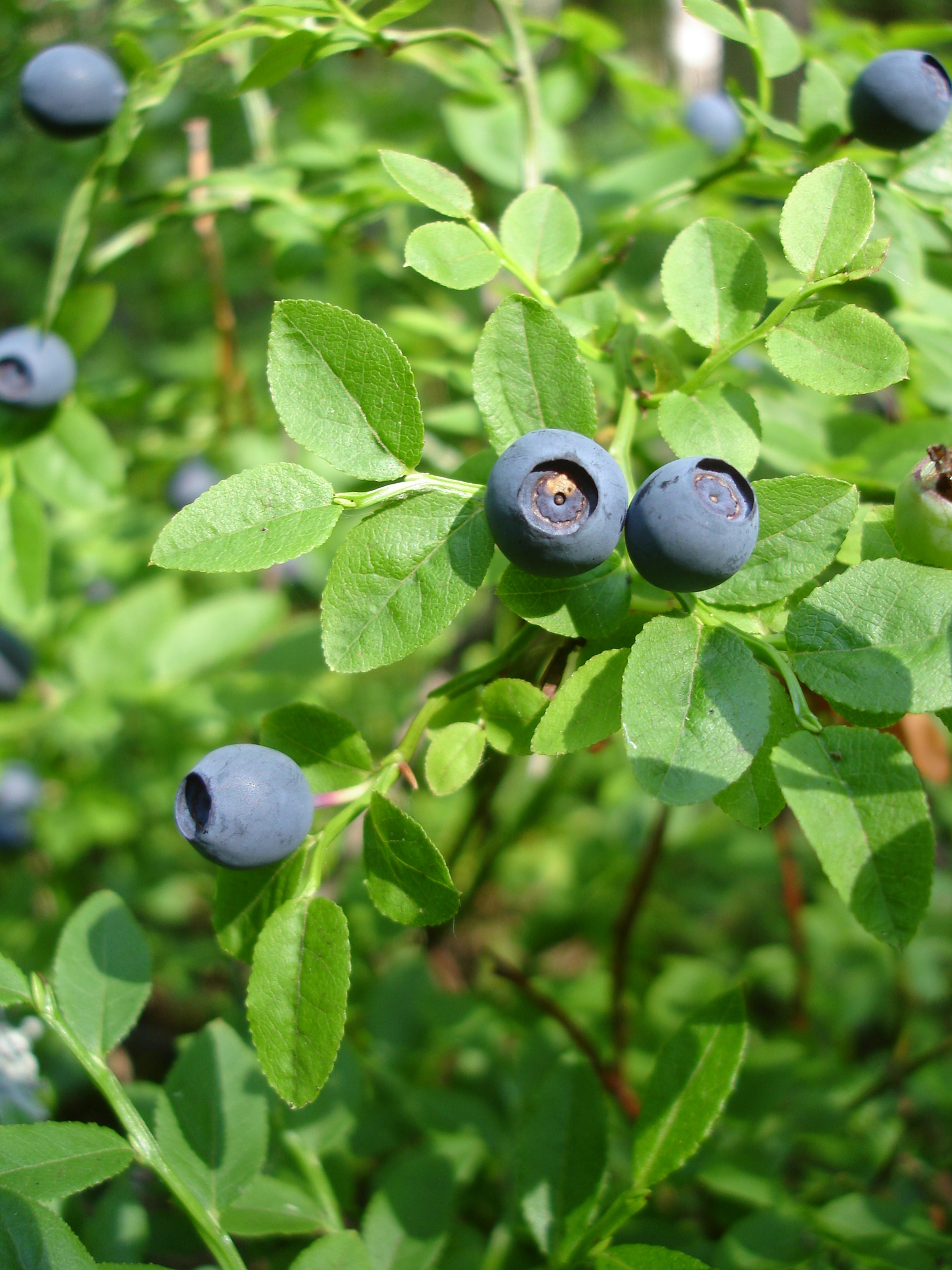
© photo
(c) Дмитрий Власов, some rights reserved (CC BY-NC), uploaded by Дмитрий Власов · cc-by-nc
Kieran Roy Powell · cc0
Katerina Grishina · cc0
(c) Илья Руденко, some rights reserved (CC BY) · cc-by
(c) Kieran Roy Powell, some rights reserved (CC BY) · cc-by
Global distribution
The native range of Vaccinium myrtillus covers much of temperate and boreal Europe, from Greenland to Spain and the Caucasus, extending through northern Asia to Japan. Two isolated populations also occur in western Canada and the northwestern United States. In France, the species is restricted to mountain regions and absent from limestone plains.
- Native9
- France
- Norway
- Poland
- United Kingdom
- Germany
- Greenland
- Japan
- Canada
- United States
Hexagons: regions where the plant occurs. Green dots: native range.1
Identity
Common bilberry (Vaccinium myrtillus L., 1753), also known as bilberry or whortleberry, is a deciduous subshrub in the Ericaceae family. In acidic woodland across Europe and temperate Asia, its underground rhizomes create carpets that can persist for decades in the same woodland patch. 1 5
The epithet myrtillus comes from the Latin myrtus, referring to foliage that resembles common myrtle. That Mediterranean plant has no close botanical relationship to bilberry; the resemblance concerns the leaves rather than shared ancestry. 5
Regional French names include brimbelle, gueule noire and raisin des bois. These nicknames reflect the same conspicuous feature: ripe fruit leaves an intense stain on fingers and tongues. They describe this European berry rather than the pale-fleshed blueberries commonly sold in stores. 6
Recognition
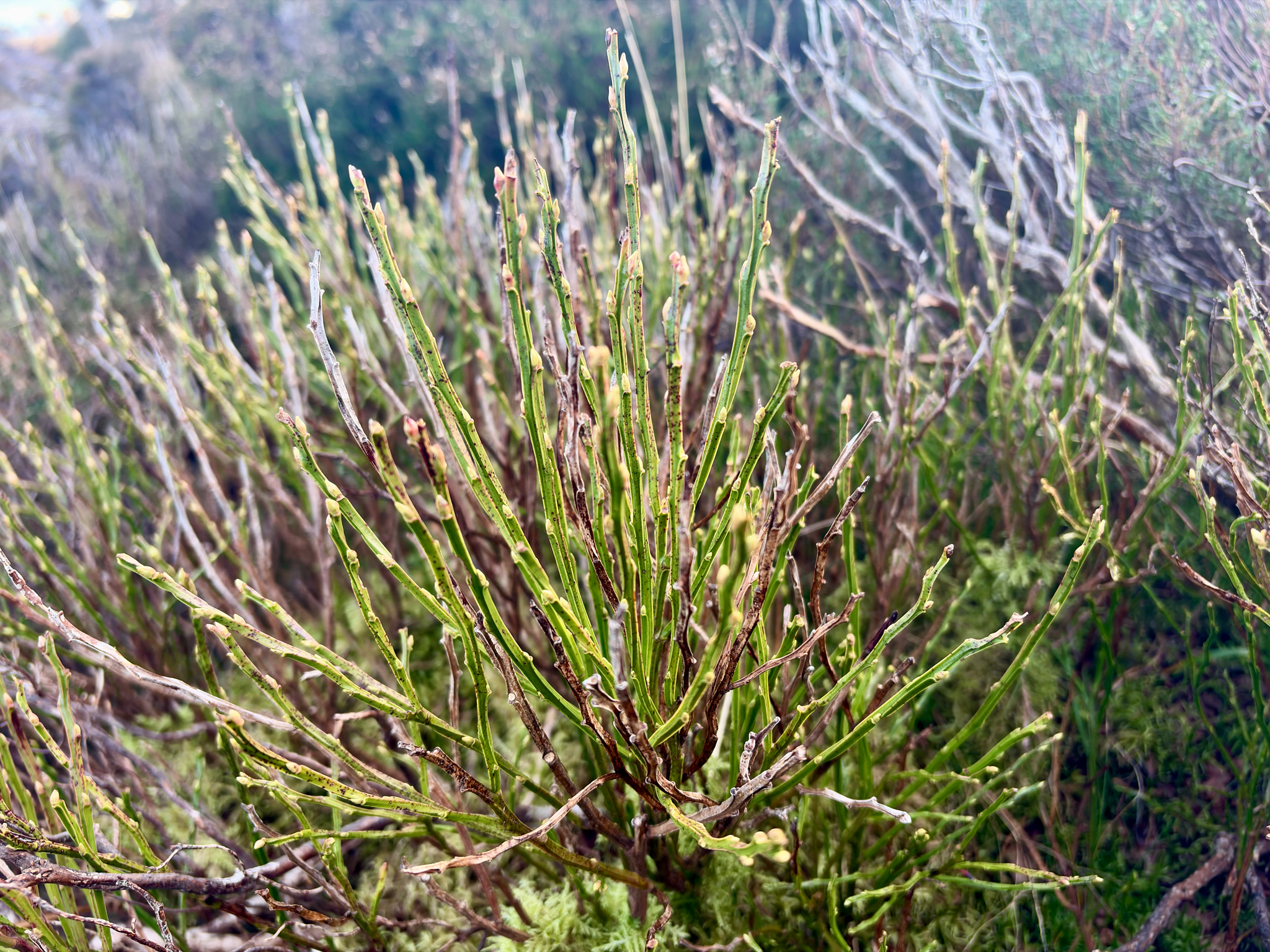
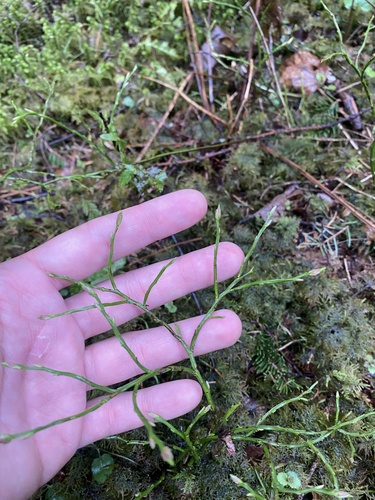
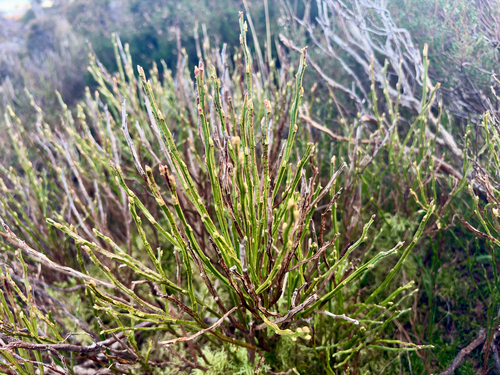
Angular stems offer the first useful clue to Vaccinium myrtillus. Its young shoots are bright green, angled and winged, unlike those of most shrubs. They can continue photosynthesizing in winter after the leaves have fallen, leaving a distinctive green framework in the otherwise bare patch. 2 5
An established bilberry patch usually stands 10–50 cm (4–20 in) tall, depending on the age of the colony. The low, densely spreading growth can survive for several decades once its rhizome network has become established. 5 7
Oval, finely toothed leaves measure 1–3 cm (0.4–1.2 in) long. In fall they turn bright red before dropping, providing a useful seasonal check on identification alongside the angular green stems. 5
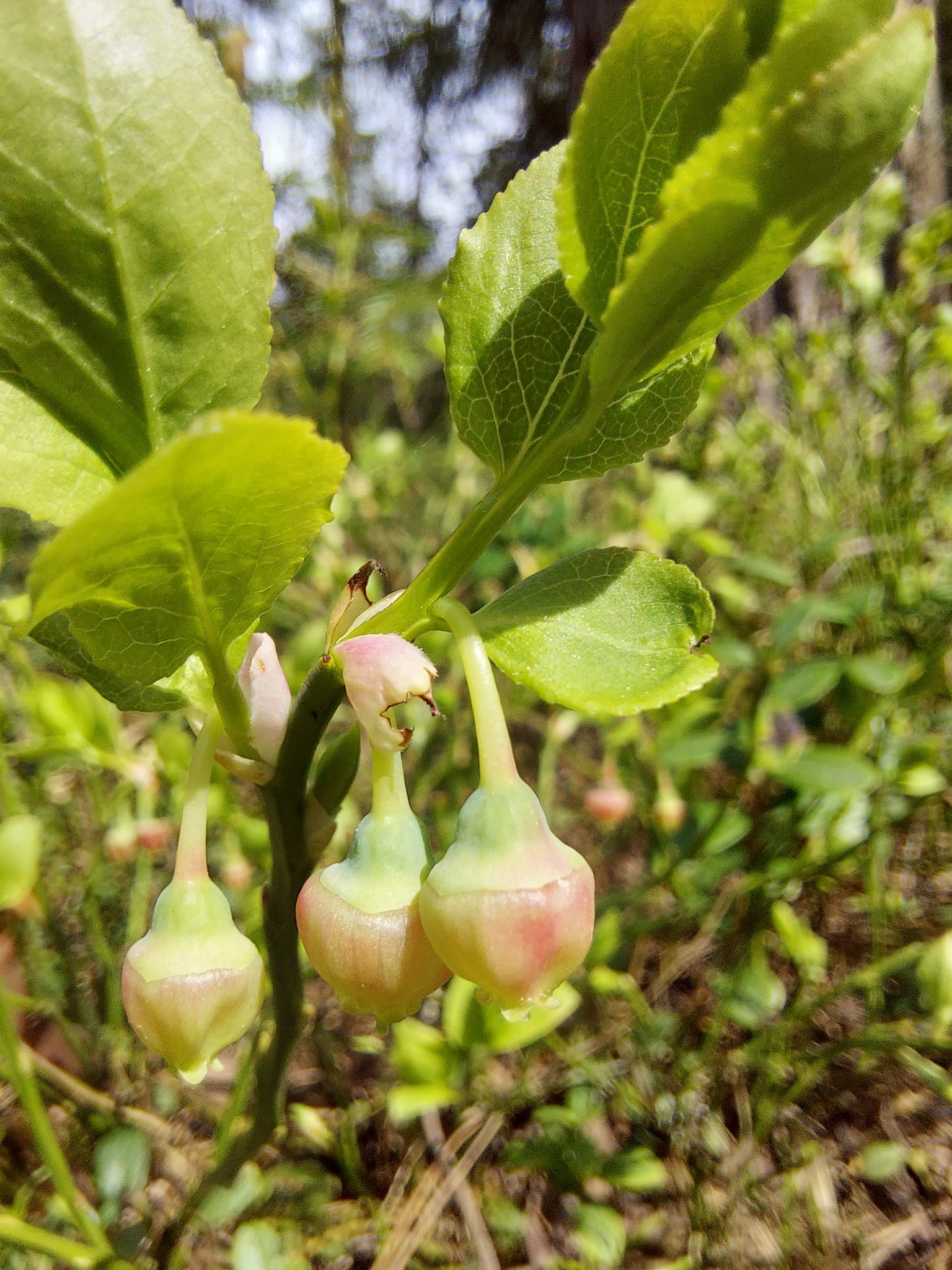
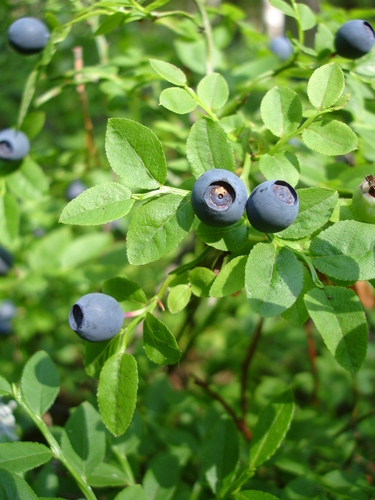
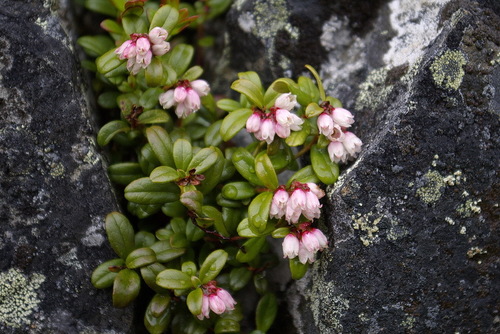
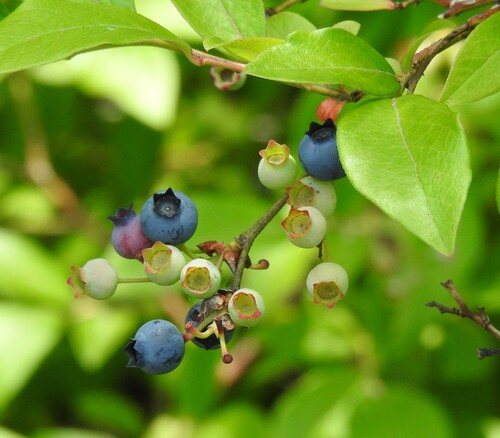
Each nodding flower is a pinkish-white urn 4–6 mm (0.16–0.24 in) long, borne singly or in pairs in the leaf axils in spring. Depending on exposure, it develops into a round blue-black berry with a fine waxy bloom. The red-purple flesh immediately stains fingers and tongues. 2 5
Useful taxonomy
Kew and POWO retain Vaccinium myrtillus L. as the accepted name. Within the genus, this is the species that corresponds specifically to the wild European bilberry, a distinction worth keeping when comparing plants sold under broader berry names. 1
Described varieties and forms include Vaccinium myrtillus var. microphyllum Hook., a smaller-leaved North American population now included in synonymy with the typical species, and Vaccinium myrtillus f. leucocarpum (Dumort.) Busch, a rare form with white rather than blue-black fruit. 1
French use of the name myrtille sometimes extends loosely to other members of the genus. Fruit sold under that name in supermarkets generally comes from Vaccinium corymbosum, the cultivated American highbush blueberry. Its pale flesh barely stains fingers, in contrast to the deeply colored flesh of European wild bilberry. 8
Habitat and range
Across temperate and boreal Europe, the native range of Vaccinium myrtillus runs from Greenland to Spain and the Caucasus, then through northern Asia to Japan. Two isolated populations also occur in western Canada and the northwestern United States. Seasonal tolerance of −30 to 32 °C (−22 to 90 °F) helps explain its presence in widely separated climates. 1 5
French populations occupy mountain regions: the Vosges, Jura, Alps, Massif Central and Pyrenees. There they grow beneath conifers or deciduous trees, on heaths and in bogs, consistently on acidic soil rather than limestone. 8
Wild harvesting supplies nearly all commercially significant bilberry production. The plant is scarcely cultivated, yet it supports an important harvest economy in several Nordic countries. Research into its domestication remains limited compared with the scale of its established use as a wild fruit. 7
Mountain populations reach about 2,350 m (7,700 ft) in acidic upland grassland, along heather moorland margins, and beneath mountain pine and spruce forests. Clear-cutting and intensive mechanical preparation of forest soils are the main local threats, although the overall population remains stable. 5 7
Life cycle and reproduction
Spring flowering produces insect-pollinated blossoms visited by bumblebees and wild bees. Fruits develop slowly and ripen from summer into early fall, with the timing shifting according to elevation; the northern native-range calendar is roughly April–May for flowers and July–September for berries. 2 5
Underground rhizomes provide the main means of natural spread, extending the colony into a continuous carpet. Seed reproduction contributes less and establishes new plants more slowly in woodland already occupied by a mature bilberry patch. 5 7
For garden propagation, rhizome division or semi-ripe cuttings taken in late summer generally work better than sowing. Seeds require cold stratification before germination, adding time and a further condition to successful establishment. 3
Uses and risks
Bilberry fruit is eaten raw or cooked in jam, pies and syrup. It is not toxic to people or the main domestic animals, making the ripe berry a food plant distinct from the caution associated with prolonged use of its leaves. 4
European traditions have used the leaves in herbal tea for about 1,000 years, including for diabetes and eyesight complaints that have not been scientifically validated. Their tannin content is a reason to avoid prolonged consumption or high doses. 4 3
Supplements made from bilberry are generally well tolerated at ordinary food-level doses. Anyone taking anticoagulant medication should seek medical advice, since the circumstances of supplement use matter as well as the plant involved. 4
Color in both skin and flesh comes from anthocyanins, which contribute to the nutritional interest of the fruit alongside pectin, chlorogenic acid and vitamin C. Leaves instead concentrate tannins, catechins and arbutin, compounds traditionally sought for external skin preparations. 5
Varieties, look-alikes and related plants
Pale flesh separates the usual supermarket blueberry from wild European bilberry. Vaccinium corymbosum has light-colored flesh that does not stain, whereas Vaccinium myrtillus colors the mouth intensely because anthocyanins occur throughout its pulp as well as in its skin. 6 8
Nearby heath-family relatives can also cause confusion in the field. Vaccinium vitis-idaea, lingonberry, has leathery evergreen foliage and clustered red fruit. Vaccinium uliginosum, bog bilberry, has round stems and smooth-edged, blue-green leaves rather than the characteristic green angles of Vaccinium myrtillus. 2
Limestone or poorly drained soil, especially above pH 6, can quickly bring on chlorosis through iron or manganese deficiency. This is a useful warning that a plant has been placed outside the soil conditions of its native habitat. 2
Main sources
- Plants of the World Online / Kew, Vaccinium myrtillus L.
- Royal Horticultural Society, Vaccinium myrtillus - common bilberry
- Plants For A Future, Vaccinium myrtillus
- National Center for Complementary and Integrative Health (NIH), Bilberry
- Wikipedia EN, Vaccinium myrtillus
- Wikipedia FR, Myrtille
- NordGen, Bilberry or European blueberry - Vaccinium myrtillus L.
- INPN MNHN, Vaccinium myrtillus L., 1753
Frequently asked questions
Are store-bought blueberries the same as wild bilberries?
Usually not. Commercial blueberries are generally Vaccinium corymbosum, the cultivated American highbush blueberry, with pale flesh that barely stains. Vaccinium myrtillus is the European wild bilberry with red-purple flesh.
Is common bilberry poisonous to cats and dogs?
No. The fruit is not toxic to people or the main domestic animals. Only excessive, prolonged consumption of the tannin-rich leaves is discouraged.
Why will common bilberry not grow in limestone soil?
Vaccinium myrtillus needs acidic soil with a pH of 4.5–6. On limestone it develops chlorosis from iron and manganese deficiency and declines within a few seasons.
How can I tell common bilberry from lingonberry?
Lingonberry, Vaccinium vitis-idaea, keeps its leathery evergreen leaves all year. Common bilberry loses its deciduous leaves each fall, revealing its angular green stems through winter.
How long does a newly planted common bilberry take to fruit?
Allow two to three years after planting for the first fruit, followed by regular production once the rhizomatous colony is well established.
Is wild common bilberry threatened?
The species remains widespread and broadly stable, but clear-cutting and intensive forest soil preparation weaken some local populations in managed areas.
Is bilberry leaf tea safe to drink?
Occasional use is acceptable, but prolonged use or high doses are discouraged because the leaves contain tannins. Medical advice is useful for anyone taking anticoagulant medication.
Similar plants
If you are unsure about a plant’s toxicity, ask a botanist or veterinarian for advice.