
Common vervain (Verbena officinalis, )
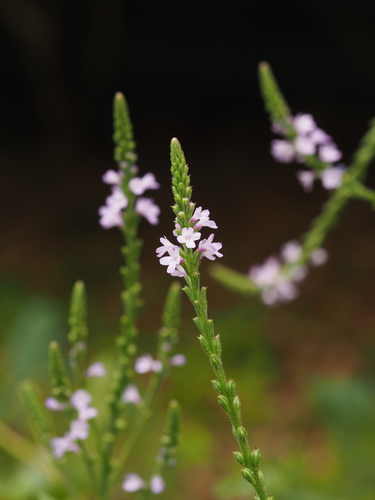
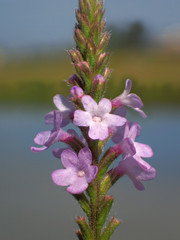
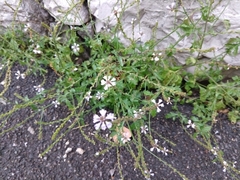
Common vervain (Verbena officinalis) is an herbaceous perennial in the Verbenaceae family, found across Europe, North Africa and temperate Asia as far as the Himalayas. Slender, square stems carry loose spikes of tiny mauve flowers from summer into fall in temperate northern climates. Sacred to the Gauls and Romans, it remains a traditional medicinal herb, distinct from lemon verbena and ornamental garden verbenas.
Read moreCommon vervain and Vervain


© photo
(c) 小铖/Smalltown, some rights reserved (CC BY-NC), uploaded by 小铖/Smalltown · cc-by-nc
葉子 · cc0
Quentin Groom · cc0
Taken Dec 16, 2016 by René Bernt (cc-by-sa)
Taken Dec 30, 2019 by García Ana (cc-by-sa)
Taken Feb 21, 2017 by Yoan MARTIN (cc-by-sa)
© copyright of the Board of Trustees of the Royal Botanic Gardens, Kew.




Global distribution
The native range of Verbena officinalis covers Europe, North Africa and temperate Asia as far as the Himalayas. It has naturalized well beyond this range, notably in North America and Australia, where it grows as an introduced rather than a native plant.
- Native6
- Introduced2
- France
- United Kingdom
- Spain
- Morocco
- China
- South Africa
- United States
- Australia
Hexagons: regions where the plant occurs. Green dots: native range.1
Identity
Common vervain (Verbena officinalis L., 1753), also known as vervain, is an herbaceous perennial in the genus Verbena, family Verbenaceae. The epithet officinalis reflects its long history as an apothecary's plant, grown and gathered for traditional medicine. 1 2
Roman tradition gave this herb a specific diplomatic role. According to Pliny the Elder, ambassadors sent to negotiate with an enemy carried a sprig of vervain as part of purification rituals before a peace mission. The Gauls attributed divinatory powers to it, reflected in the French name meaning “witches' herb.” Another French name, literally “vein of Venus,” belongs to a separate tradition of love potions rather than its documented medicinal use today. 5
Recognition
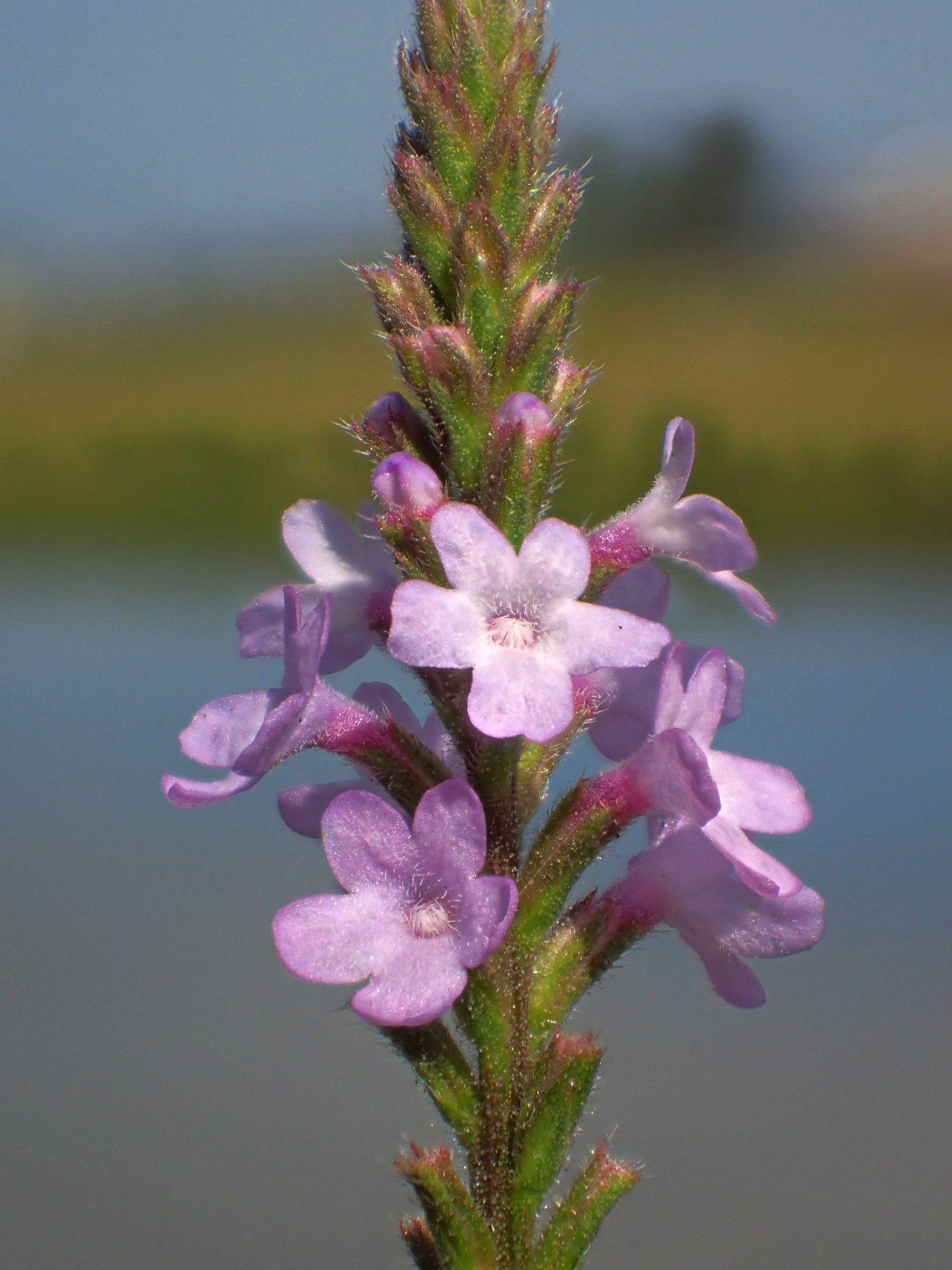
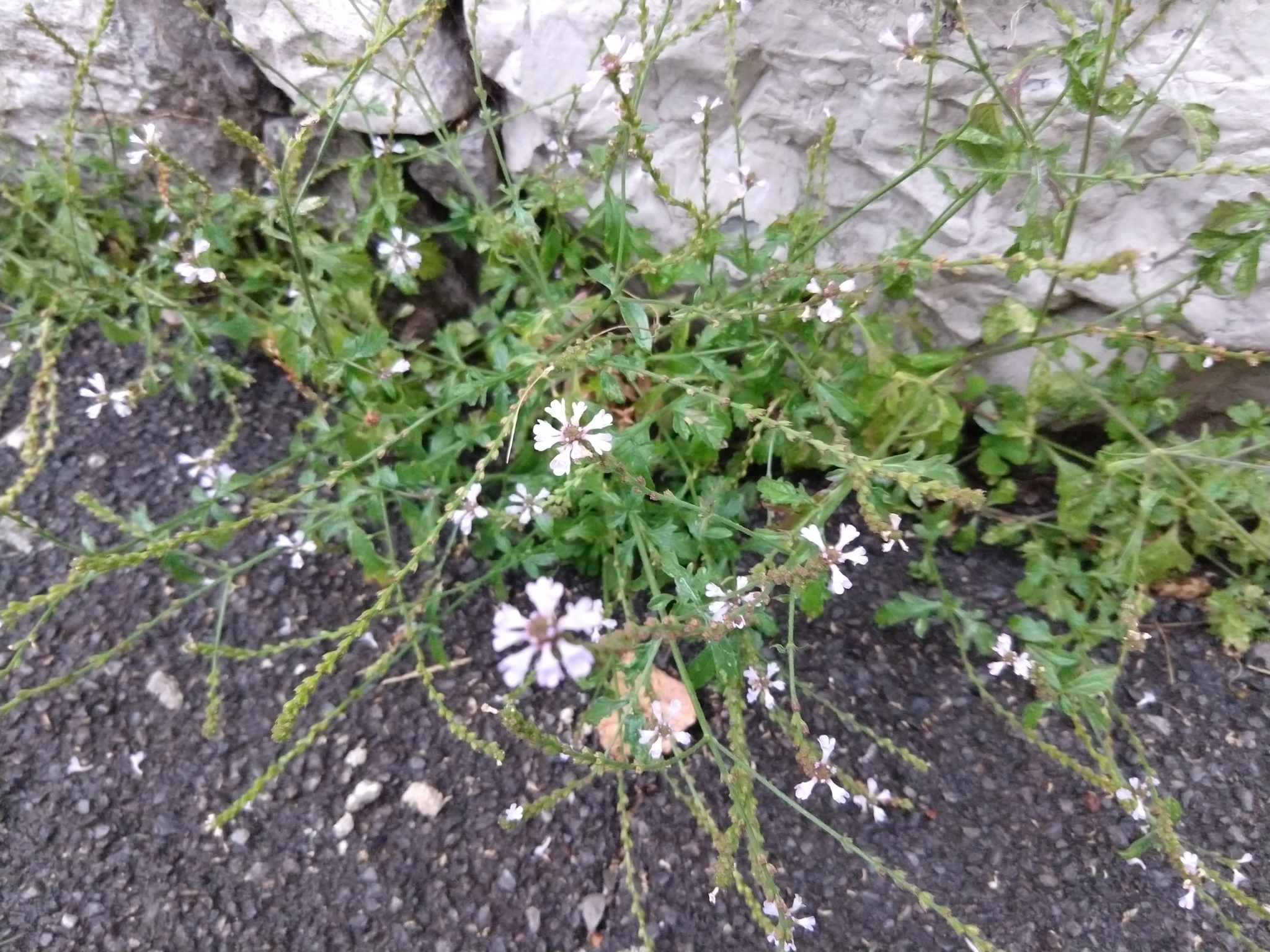
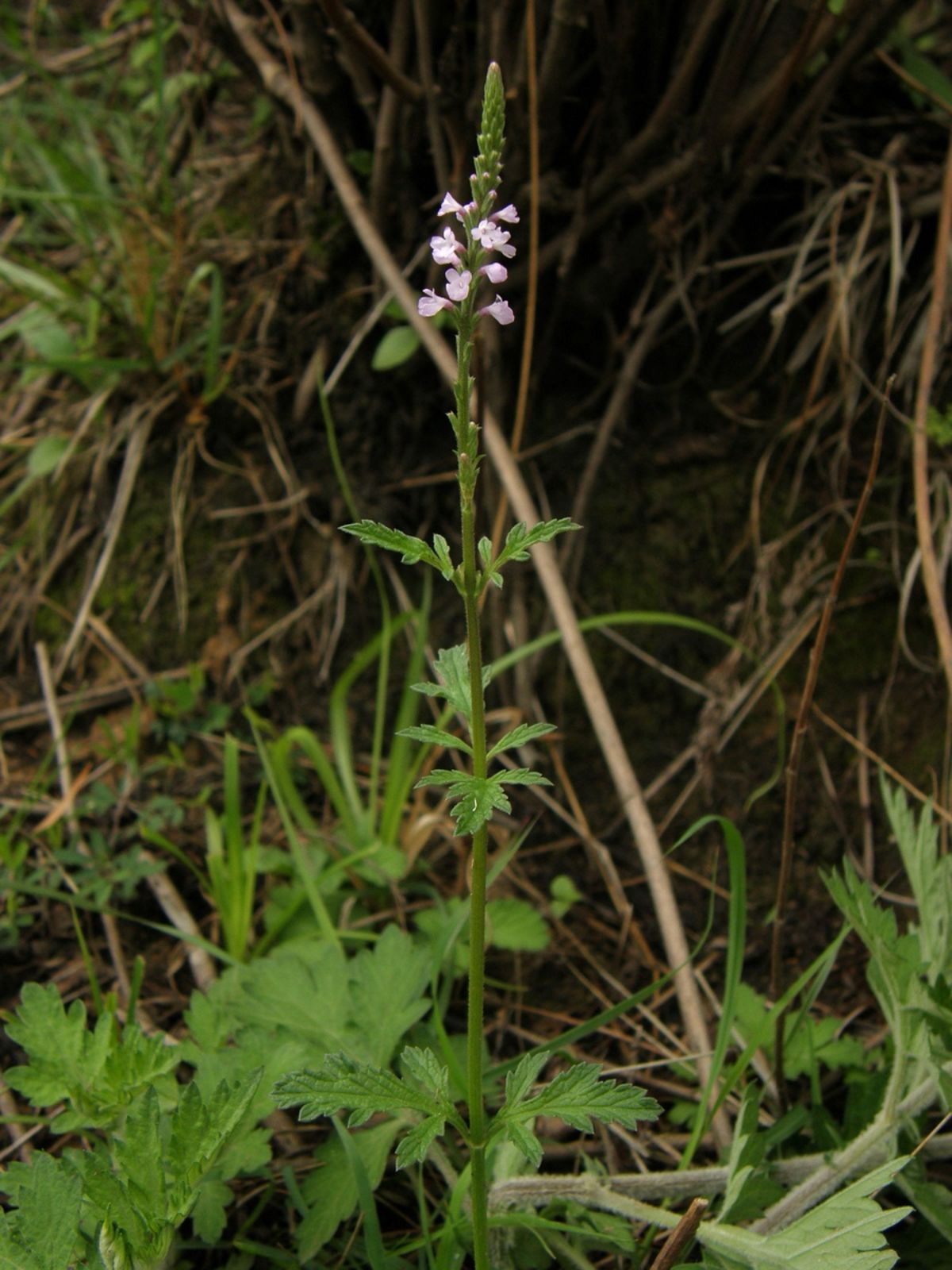
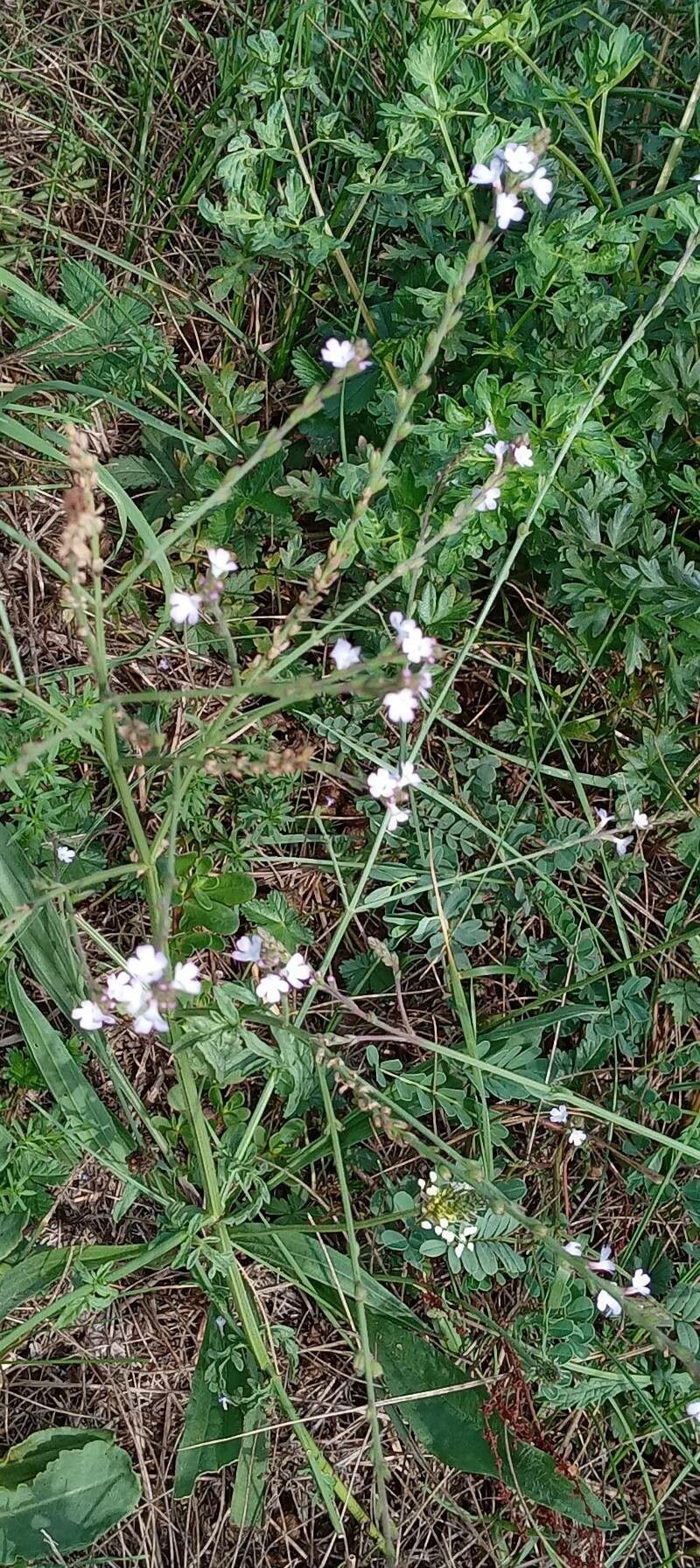
Verbena officinalis makes an upright clump 20–90 cm (8–35 in) tall, with finely hairy, grooved, square stems. Opposite leaves range from oval to wedge-shaped; those near the base are toothed or deeply lobed, while upper leaves are simpler. 5 4
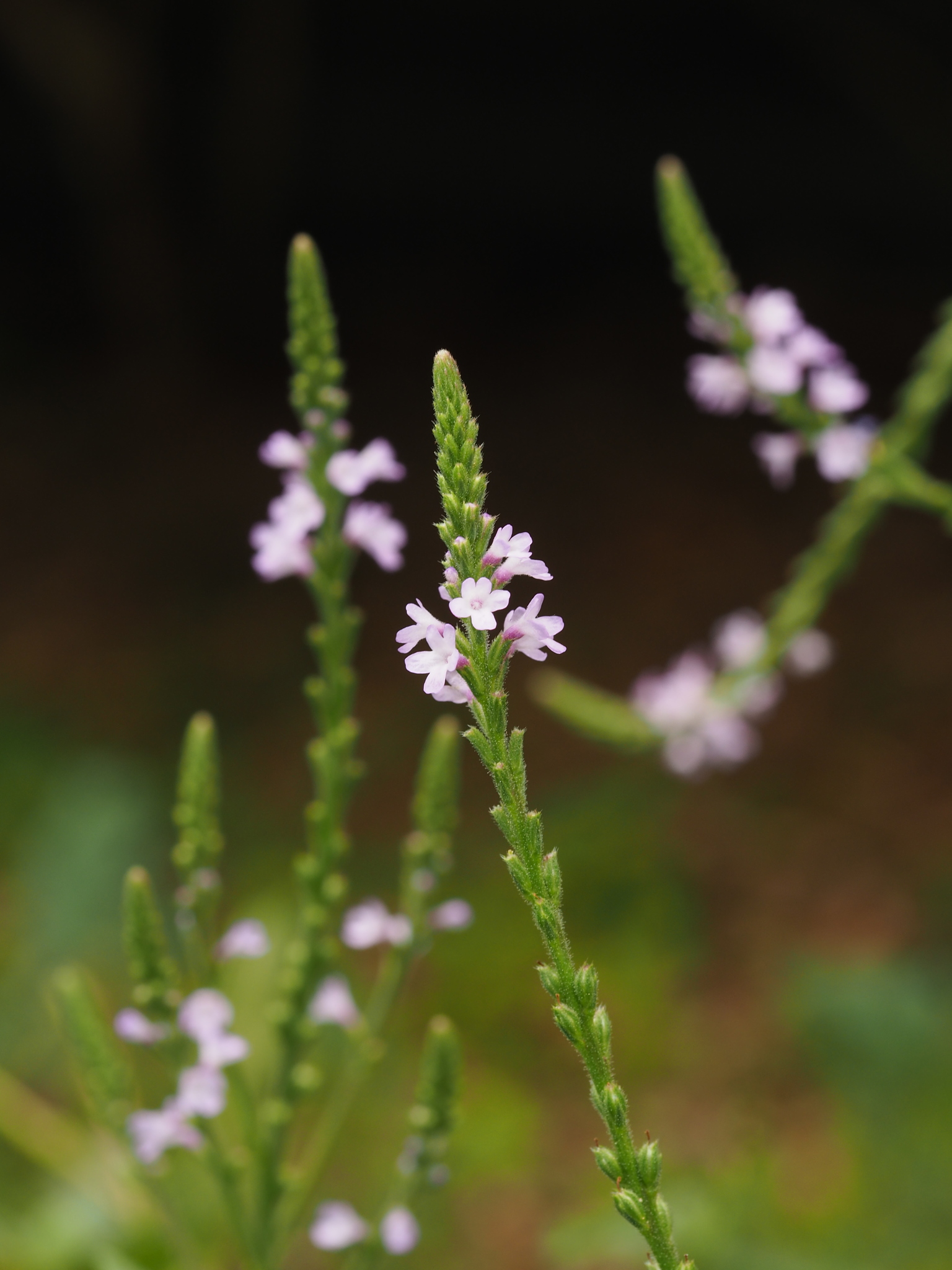
Tiny mauve to violet flowers provide a further identification clue. Barely noticeable individually, they form loose, threadlike spikes that extend into a terminal panicle. Flowering lasts about five months, from summer into fall in temperate northern climates, an unusually long continuous display for a perennial of waste ground. 4 5
Each flower develops into a dry fruit that splits at maturity into four small nutlets. Below ground lies a yellowish, spindle-shaped taproot, hidden until the plant is pulled up. 5
Useful taxonomy
Carl Linnaeus described Verbena officinalis L. in 1753, and the name remains accepted. POWO recognizes two varieties: the typical var. officinalis, found across the Eurasian and North African range, and var. africana (R.Fern. & Verdc.) Munir, restricted to southern Africa and Australia. 1 3
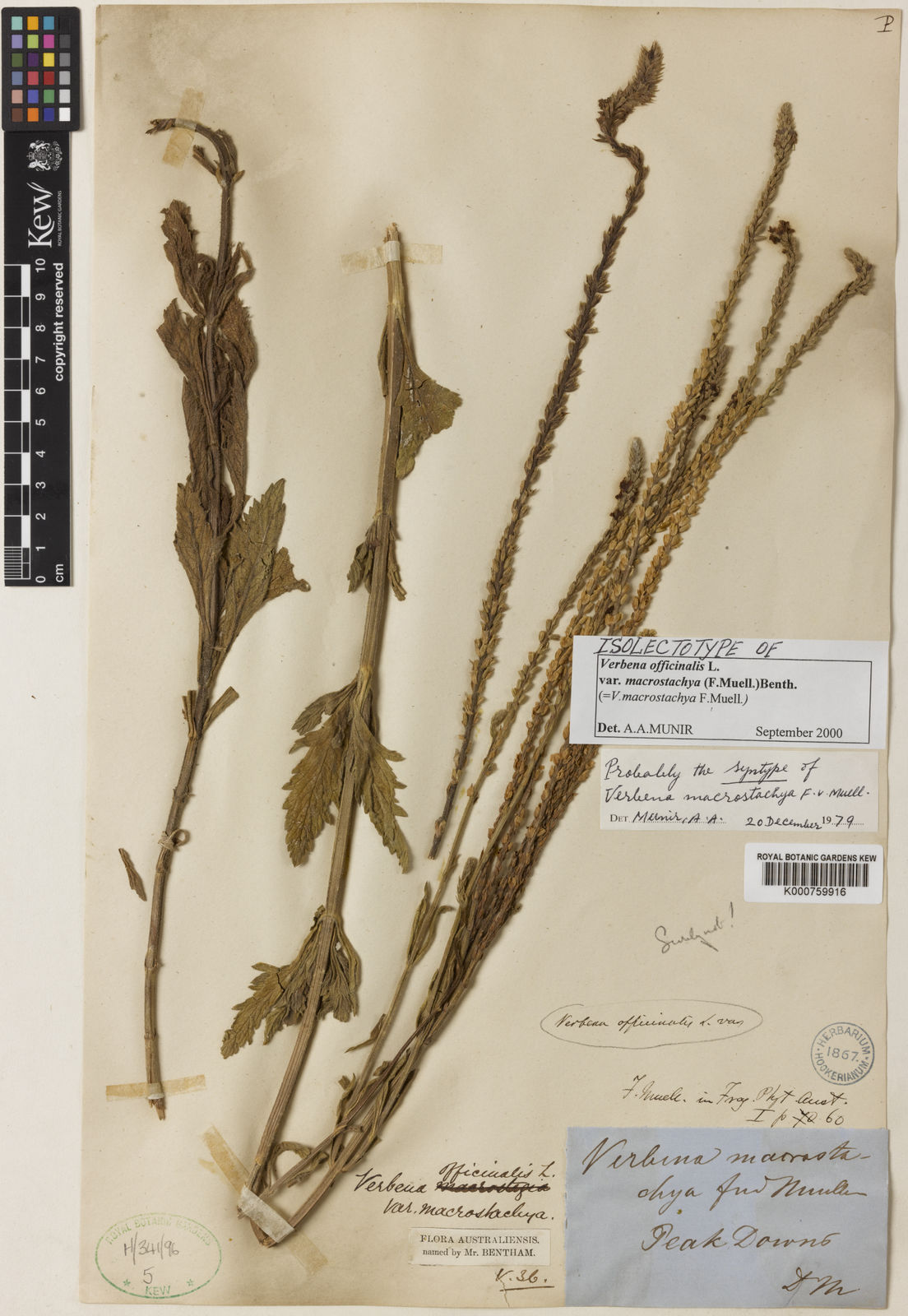
Older floras sometimes treated Texas vervain as a subspecies, Verbena officinalis subsp. halei. POWO now recognizes it as a separate species, Verbena halei Small, restricted to the central and southern United States and Mexico. Other varieties mentioned in older literature, including Verbena officinalis var. macrostachya Benth. and var. gracilescens Cham., remain synonyms of the accepted name rather than distinct taxa recognized by POWO. 1 2
Habitat and range
Across its native range in Europe, North Africa and temperate Asia as far as the Himalayas, common vervain favors sunny waste ground, roadsides and rubble. Acidic soil and shade hinder establishment, helping explain its scarcity in woodland understories and acid heathland. 4 5
Beyond that native range, vervain has become widely naturalized. Australia records it as introduced in Western Australia and Victoria; in the United States it grows wild as far as Florida. These Australian and Floridian populations are introduced, distinct from its native populations in Europe, North Africa and temperate Asia. 6 7 8
Life cycle and reproduction
Winter removes the aboveground growth of this perennial, which returns from its taproot each spring. Surface-sown seeds germinate in 2–4 weeks, and established plants self-seed readily where conditions suit them. 4 5
Herb gardeners can also propagate it by division of an established clump in spring or by basal cuttings in early summer. A shoot 8–10 cm (3–4 in) long with a piece of the crown generally roots without particular difficulty. 4 1
Uses and risks
Traditional use of common vervain is chiefly medicinal. Herbal teas have been described as diuretic, fever-reducing and astringent; external lotions have traditionally been used for minor wounds, skin irritation and gum problems. More recent work has also discussed effects on estrogenic and thyroid hormones, helping explain its historical reputation in connection with childbirth. 4 5
Hormonal effects also underlie its main precaution: high doses of verbenalin can cause neurological disorders, and the plant's uterotonic action makes it unsuitable during pregnancy or breastfeeding. No notable toxin is reported for pets; the ASPCA generally lists garden verbenas, genus Verbena, as non-toxic to cats, dogs and horses. 4 9
Varieties, look-alikes and related plants
Confusion often starts with lemon verbena (Aloysia citrodora), a shrub with lemon-scented leaves sold for herbal tea. It has no close botanical relationship to Verbena officinalis, a small perennial with unscented leaves and tiny flowers. The scientific name is the most reliable way to distinguish them. 4
Within Verbena, useful comparisons include:
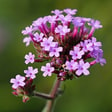
- Verbena bonariensis, purpletop vervain, much taller at up to 2 m (6.6 ft), with almost leafless angular stems;
- Verbena halei, Texas vervain, long treated as a subspecies of V. officinalis before recognition as a separate species;
- ornamental garden hybrids (Verbena x hybrida), sold for beds and containers, with much larger, more colorful flowers.
A relatively small stature, basal lobed leaves and very fine mauve flower spikes usually distinguish Verbena officinalis found growing on waste ground. 5 1
Main sources
- Plants of the World Online / Kew, Verbena officinalis L.
- International Plant Names Index, Verbena officinalis L.
- GBIF Backbone Taxonomy, Verbena officinalis L.
- Plants For A Future, Verbena officinalis
- Wikipedia (French), Common vervain
- FloraBase, Western Australian Herbarium, Verbena officinalis
- VicFlora, Royal Botanic Gardens Victoria, Verbena officinalis
- Atlas of Florida Plants, Verbena officinalis
- ASPCA, Garden verbena (Verbena) non-toxic plant entry
Frequently asked questions
Is common vervain toxic?
No notable toxin is reported for pets, and the genus Verbena is generally listed as non-toxic to cats, dogs and horses. The main precaution concerns pregnancy, because a uterotonic effect has been described at high doses.
Can common vervain be confused with lemon verbena?
Yes, the common names often cause confusion. Lemon verbena (Aloysia citrodora) is a shrub with lemon-scented leaves grown for herbal tea. Verbena officinalis is a small herbaceous perennial with unscented leaves and tiny mauve flowers, without a close botanical relationship to it.
Where does common vervain grow wild?
It colonizes sunny waste ground, roadsides and rubble, often on poor soil. Native to Europe, North Africa and temperate Asia, it has also naturalized in North America and Australia.
How do you propagate common vervain?
Surface sowing in spring is the simplest method, with slow germination taking two to four weeks. Dividing an established clump or taking basal cuttings in early summer also works well.
Why is my common vervain flowering poorly?
Too little sun or overly rich, shaded soil are the most common causes. The plant needs full sun and fairly poor soil to flower freely from summer into fall in temperate northern climates.
How does it differ from Verbena bonariensis?
Verbena bonariensis is a tall, almost leafless perennial reaching 2 m, with mauve flower clusters at the top of angular stems. Verbena officinalis stays below 90 cm, with well-developed lobed leaves and finer, looser flower spikes.
Similar plants
If you are unsure about a plant’s toxicity, ask a botanist or veterinarian for advice.