
Desert rose (Adenium obesum, )


Desert rose (Adenium obesum) is a thick-stemmed succulent shrub in the Apocynaceae, native to the Sahel, eastern and southern Africa and the Arabian Peninsula. Its swollen trunk, called a caudex, stores water beneath tubular pink to red flowers. Milky sap containing cardiac glycosides makes it one of the most toxic ornamental plants commonly grown indoors.
Read moreDesert rose, Sabi star, Impala lily, Mock azalea and Kudu


© photo
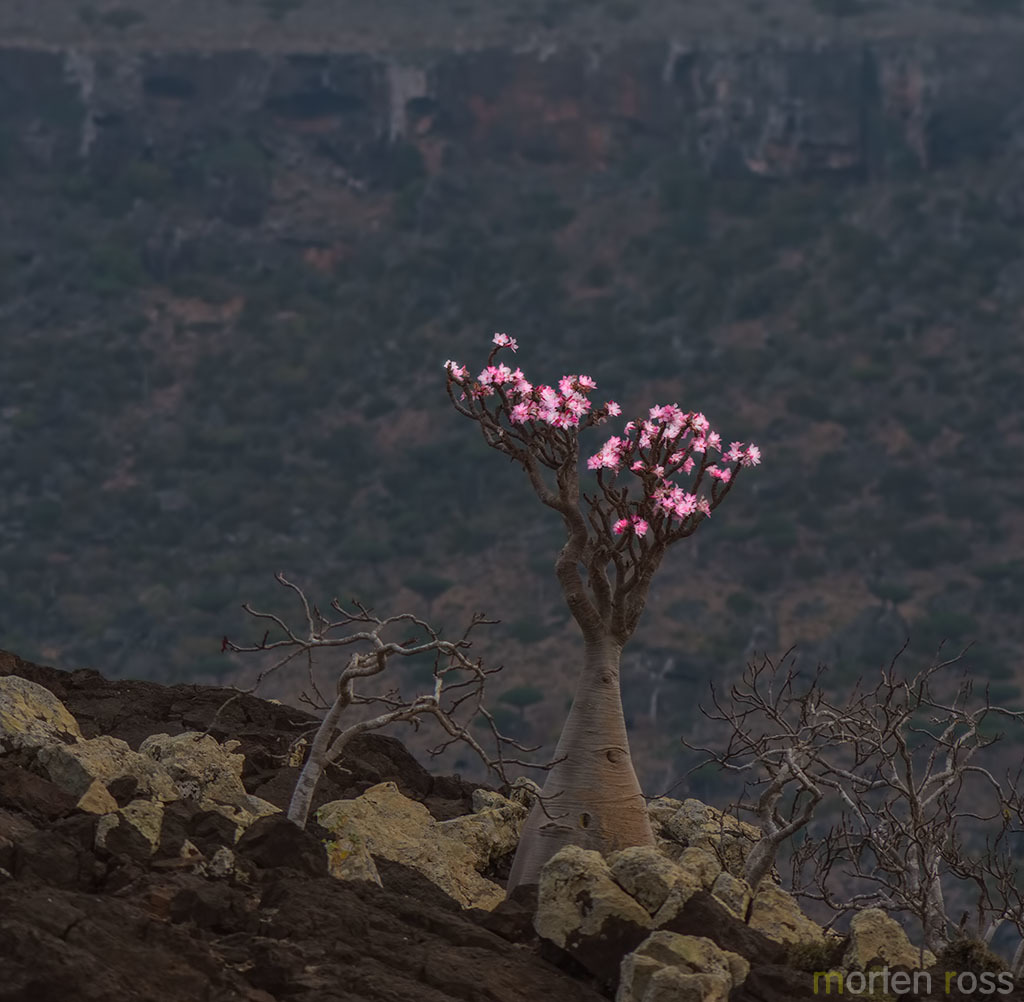
Morten Ross · cc-by
(c) James Bailey, some rights reserved (CC BY-NC), uploaded by James Bailey · cc-by-nc
iNaturalist User · cc-by-sa
Taken Mar 7, 2013 by Daniel Barthelemy (cc-by-nc)
Taken Aug 9, 2019 by Citra Endra (cc-by-sa)
Taken Jul 20, 2012 by Tela Botanica − Liliane Roubaudi (cc-by-sa)
Taken Aug 27, 2019 by Peres Pedro Lucas (cc-by-sa)
Taken Mar 1, 2022 by vega medina (cc-by-sa)
© copyright of the Board of Trustees of the Royal Botanic Gardens, Kew.




Global distribution
Adenium obesum is native from the Sahel south of the Sahara through tropical eastern and southern Africa, extending to the Arabian Peninsula and Socotra. It is widely introduced and cultivated as an ornamental in the tropics and grown in containers under frost-free protection in temperate regions.
- Native6
- Senegal
- Sudan
- Kenya
- Tanzania
- Saudi Arabia
- Yemen
Hexagons: regions where the plant occurs. Green dots: native range.1
Identity
Desert rose (Adenium obesum (Forssk.) Roem. & Schult., 1819) is a succulent shrub with a swollen trunk or caudex. It belongs to the Apocynaceae, the same family as oleander. Peter Forsskål first described the species as Nerium obesum; Roemer and Schultes transferred it to Adenium in 1819. 1 6
A resemblance to the swollen trunk of Adansonia explains the nickname jackal baobab, although the two genera are not close botanical relatives. Baobabs belong to the Malvaceae, while desert rose belongs to the Apocynaceae. Sabi star, impala lily, mock azalea and kudu are other names used for the same plants, without implying a taxonomic distinction. 1
Recognition
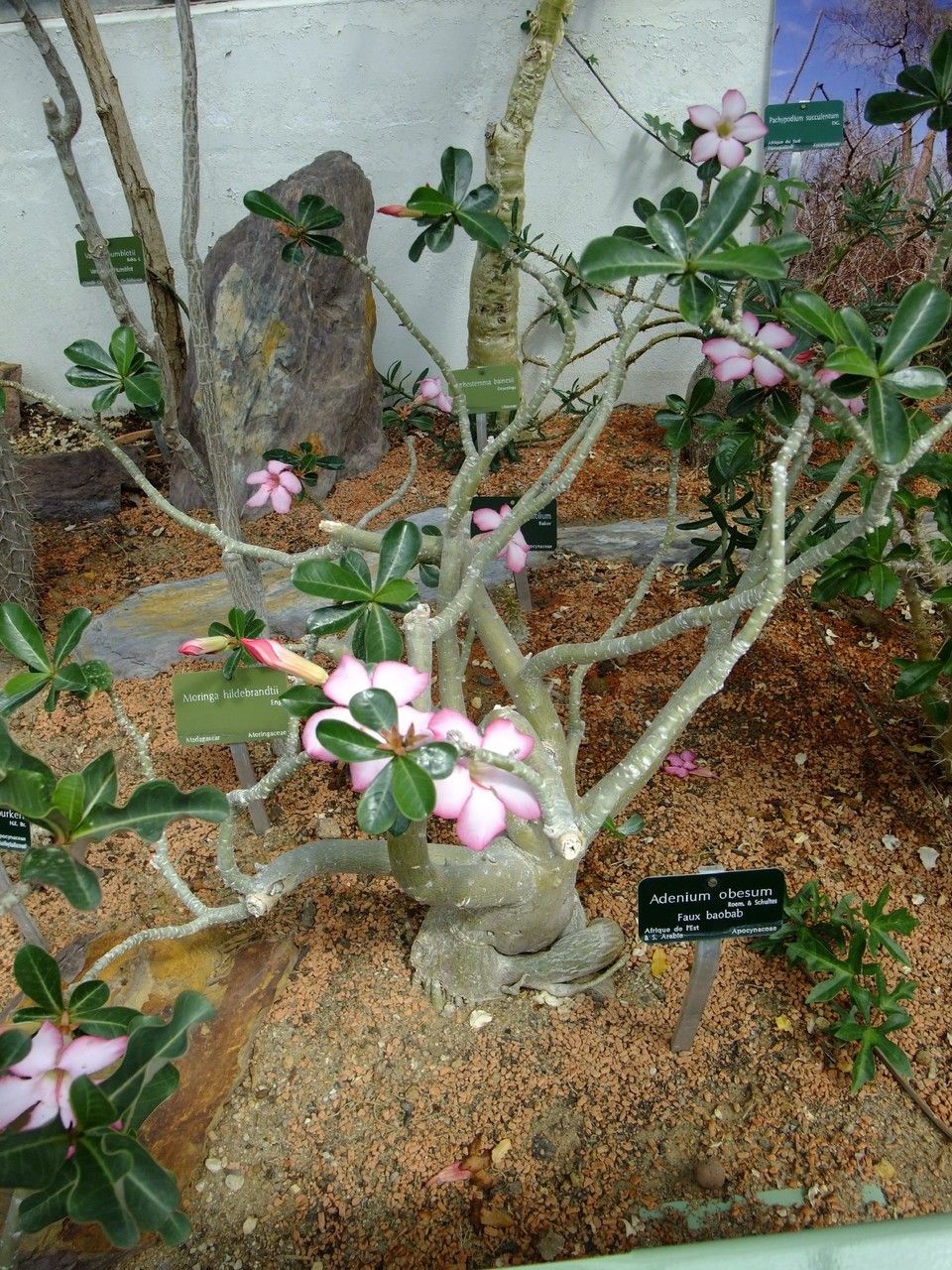
The caudex is the clearest identifying feature of Adenium obesum. This swollen, gray-green to brown stem base stores water and gives the plant its squat silhouette and appeal for bonsai. Container plants generally reach 1–1.5 m (3–5 ft) tall; older specimens growing in the ground can exceed 2.5 m (8 ft). 2 3
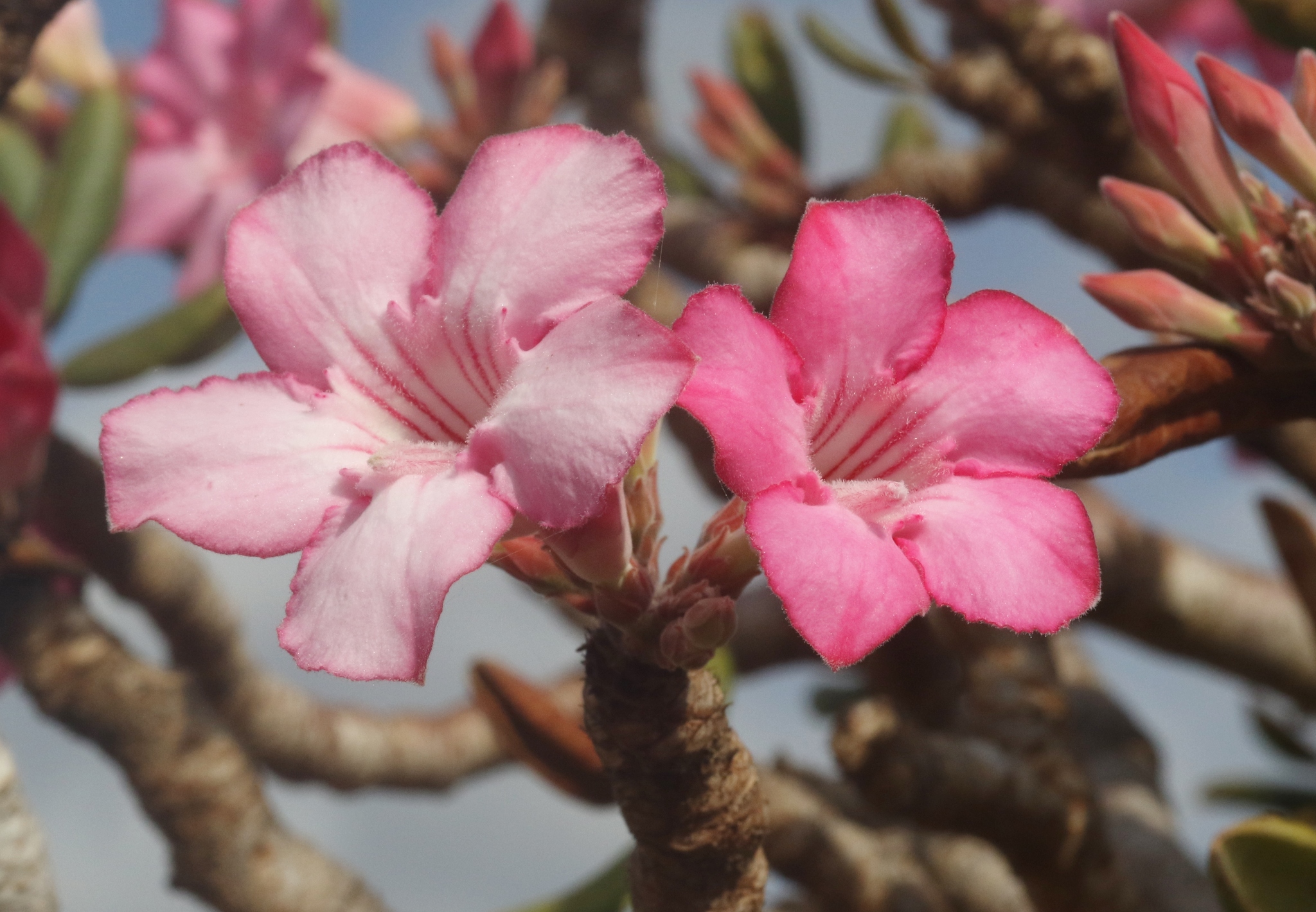
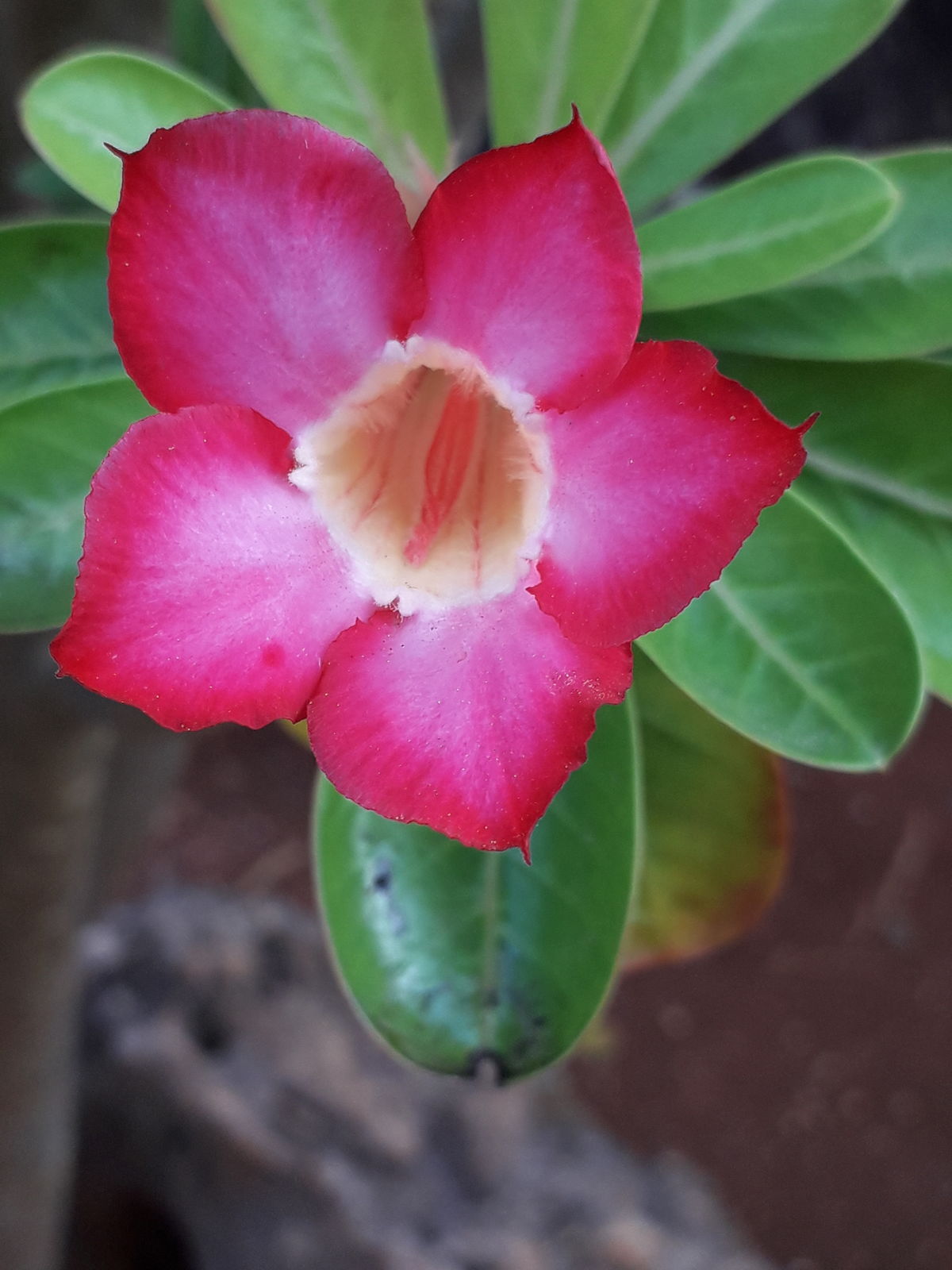
Fleshy, glossy leaves cluster in spirals at the shoot tips and have entire, unlobed margins. Tubular flowers with five petals measure 2–5 cm (¾–2 in) long. Their red to pink coloring often fades toward a white or pale yellow throat, recalling Plumeria. A cut stem releases sticky, whitish sap, a visible warning of the plant's toxicity. 3 2
Useful taxonomy
Buyers encounter several names in the genus Adenium that are sold as separate species but are treated botanically as synonyms of Adenium obesum. The main names to recognize are:
- Nerium obesum Forssk. (basionym)
- Adenium arabicum Balf.f.
- Adenium coetaneum Stapf
- Adenium honghel A.DC.
Arabicum is especially liable to mislead buyers. In trade it denotes a form with a particularly massive caudex, sold as a distinct species with a strong bonsai character, while Kew places it in synonymy with Adenium obesum. The reverse also occurs: Adenium boehmianum, Adenium multiflorum, Adenium oleifolium and Adenium swazicum are sometimes reduced to subspecies in horticultural accounts, yet Kew recognizes them as distinct species of Adenium, each with its own range. 1
Habitat and range
Across the Sahel south of the Sahara, tropical eastern and southern Africa and the Arabian Peninsula, Adenium obesum occupies semiarid habitats. It grows in well-drained sandy or stony soils. 1 3
The IUCN assesses the species as Least Concern. Its broad distribution and tolerance of disturbed habitats reduce the risk of extinction, despite localized collection pressure for horticulture. 4
Beyond its original range, desert rose is grown as an ornamental in the tropics and in containers protected from frost in temperate regions. Cold winter conditions, such as those in metropolitan France, prevent it from becoming established outdoors in the ground. 2
Life cycle and reproduction
Collectors favor seed propagation because it produces a better-developed caudex at a young age than other methods. Fresh seeds germinate in 1–2 weeks in a light, warm growing medium. Seedlings begin forming their swollen bases within the first few months of growth. 8
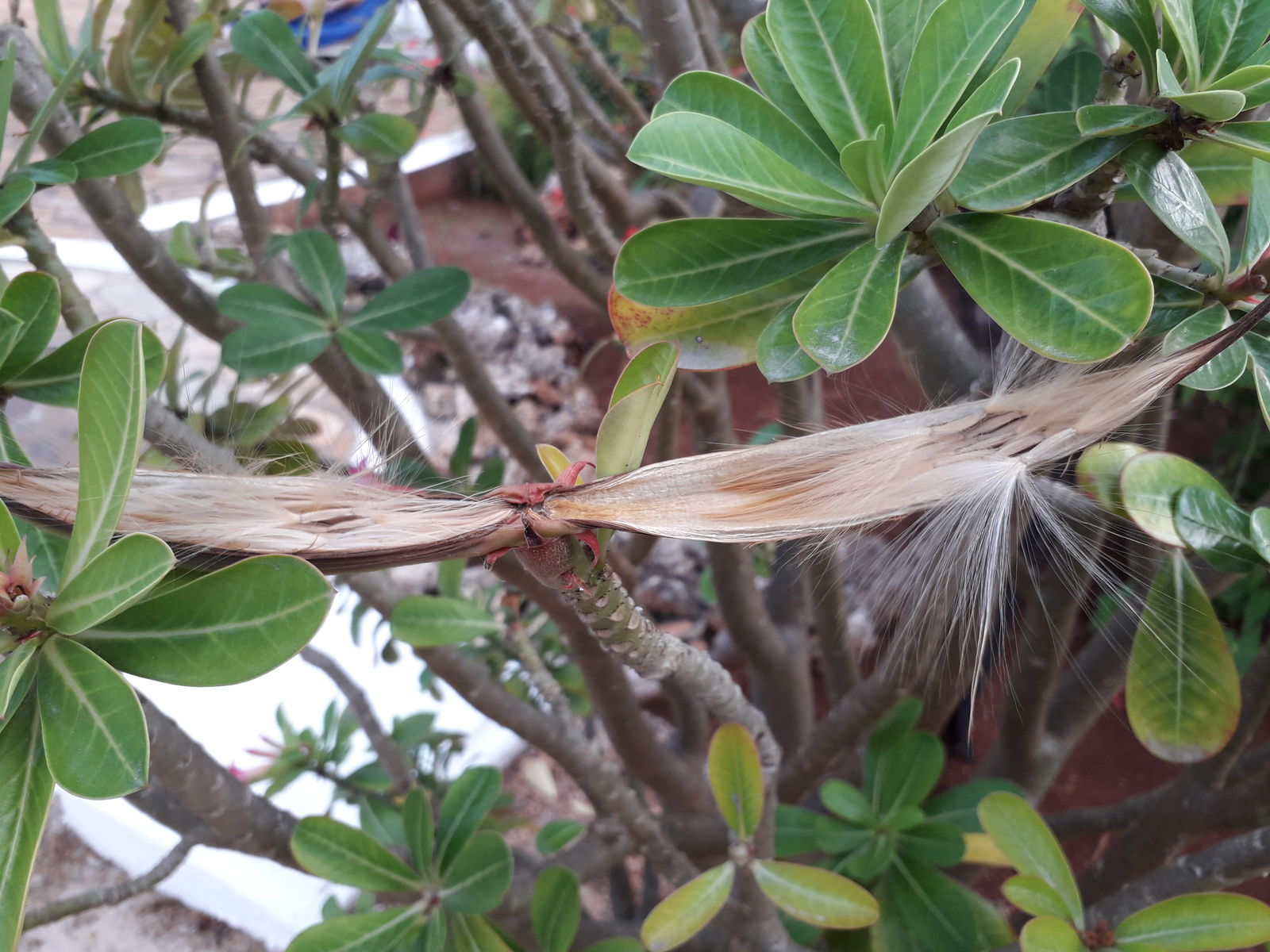
Mature, well-lit plants flower in spring and autumn. After pollination, a pair of slender follicles develops; these fruits split lengthwise to release seeds with two tufts of hairs that aid wind dispersal. 3
Stem cuttings and grafting onto vigorous rootstocks reproduce double-flowered or variegated cultivars faithfully. The resulting plants usually retain a less swollen base than plants grown from seed. 8
Cultivation and toxicity
A sunny container suits desert rose as a houseplant or bonsai in temperate climates. The Royal Horticultural Society recommends protection under glass above 15 °C (59 °F) throughout the year. Growth stops below this threshold, and prolonged cold damages the caudex. Use a very freely draining medium, such as a cactus mix, with thorough watering in summer and almost none in winter. 2
Sap rich in cardiac glycosides has long been used in parts of Africa as arrow poison for hunting large game and as fish poison. This same toxicity calls for care at home. The ASPCA lists the plant as toxic to cats, dogs and horses; exposure or ingestion can cause skin and mouth irritation, vomiting, diarrhea and abnormal heart rhythms. 8 5
Outdoors in warm climates, desert rose shares a pest with oleander. The oleander caterpillar (Syntomeida epilais) feeds on both plants and can rapidly strip the leaves from an unattended specimen. 7
Varieties, look-alikes and related plants
Established commercial cultivar names include Harry Potter and Tao, although their botanical parentage is not always documented. The scientific name Adenium obesum remains the reliable reference for identifying the species. 1
Plants most often confused with desert rose include:
- Adenium arabicum, a commercial form with a massive caudex, botanically treated as a synonym of Adenium obesum;
- Pachypodium, another caudex-forming genus in the Apocynaceae, with spiny stems and often white flowers;
- young Plumeria, whose five-petaled flowers can look similar before the typical desert rose caudex develops.
When buying a plant, examine the caudex base for firmness and a dry surface, and check for healthy roots beneath the pot. These checks matter more than a species label promising rarity. A full scientific name helps guard against misleading claims on nursery labels.
Main sources
- Plants of the World Online / Kew, Adenium obesum (Forssk.) Roem. & Schult.
- Royal Horticultural Society, Adenium obesum - Desert rose
- Missouri Botanical Garden PlantFinder, Adenium obesum
- IUCN Red List, Adenium obesum assessment (2019)
- ASPCA, Desert azalea (Adenium obesum) toxicity entry
- INPN / MNHN, Adenium obesum (Forssk.) Roem. & Schult., 1819
- University of Florida IFAS, Oleander caterpillar (Syntomeida epilais)
- Schmelzer & Gurib-Fakim (PROTA), Medicinal Plants, entry on Adenium obesum arrow poison use
Frequently asked questions
Is desert rose really poisonous?
Yes. Its sap contains cardiac glycosides, concentrated mainly in the roots and stems, that have long been used as arrow poison for hunting in Africa. The ASPCA lists the plant as toxic to cats, dogs and horses, with digestive and cardiac effects possible after ingestion.
Why does my desert rose lose its leaves in winter?
Many forms of Adenium obesum naturally become dormant as temperatures and light levels fall. Watering must be greatly reduced during this winter rest; otherwise, the caudex may rot instead of the plant simply shedding its leaves.
Should I grow desert rose from seeds or cuttings?
Seedlings develop a better-formed caudex at a young age, a feature prized by bonsai enthusiasts. Cuttings and grafting are useful for reproducing a double-flowered or variegated cultivar faithfully, but often produce a less swollen base.
Is desert rose related to the baobab?
No. Its nickname jackal baobab refers to the resemblance between its swollen caudex and an Adansonia trunk. The genera belong to separate botanical families: Apocynaceae for Adenium and Malvaceae for baobabs.
What is the lowest temperature desert rose can tolerate?
In temperate climates, the Royal Horticultural Society recommends growing it under glass above 15 °C (59 °F) throughout the year. Below this threshold growth stops, and prolonged cold quickly damages the caudex and roots.
Why isn't my desert rose flowering?
Insufficient direct light is the most common reason, followed by excess nitrogen in the growing medium or a plant that is still too young. Full sun and low-nitrogen fertilizer encourage flowering from the second or third year.
Is Adenium arabicum a different species from Adenium obesum?
In the nursery trade, Adenium arabicum denotes a form with a particularly massive caudex, often sold as a separate species. Plants of the World Online, the Kew reference, nevertheless treats it as a synonym of Adenium obesum.
Similar plants


If you are unsure about a plant’s toxicity, ask a botanist or veterinarian for advice.