
Konjac (Amorphophallus konjac, )


Konjac (Amorphophallus konjac) is a corm-forming perennial in the Araceae family, native to Yunnan and widely cultivated in East Asia for its corm, processed into konjac flour and konnyaku. Each spring, a mature corm produces either a single highly divided leaf or a carrion-scented inflorescence that attracts pollinating flies.
Read moreKonjac, Devil’s tongue, Voodoo lily, Snake palm and Elephant yam
Place in indirect light or in a shaded room.
Bright partial shade


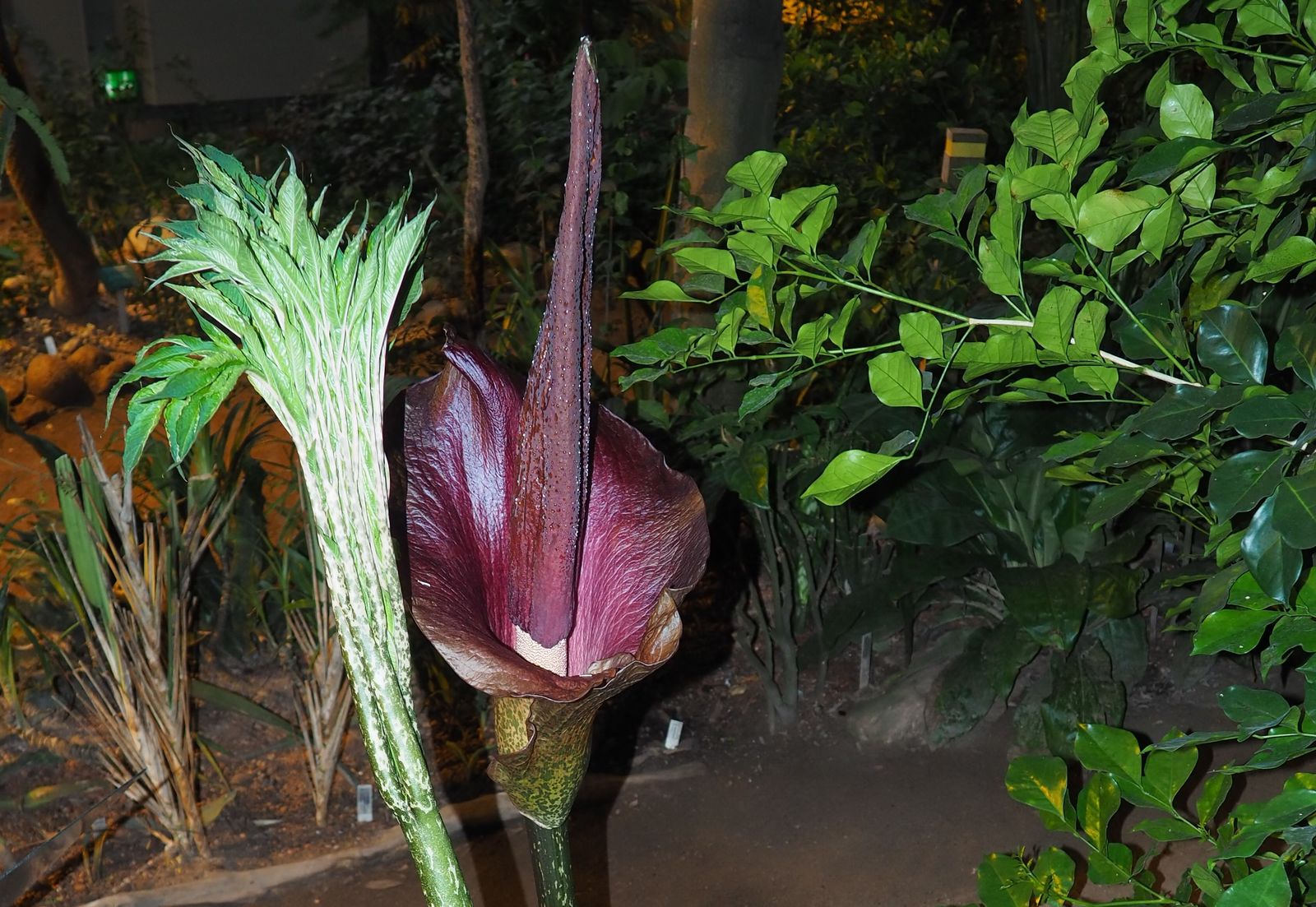
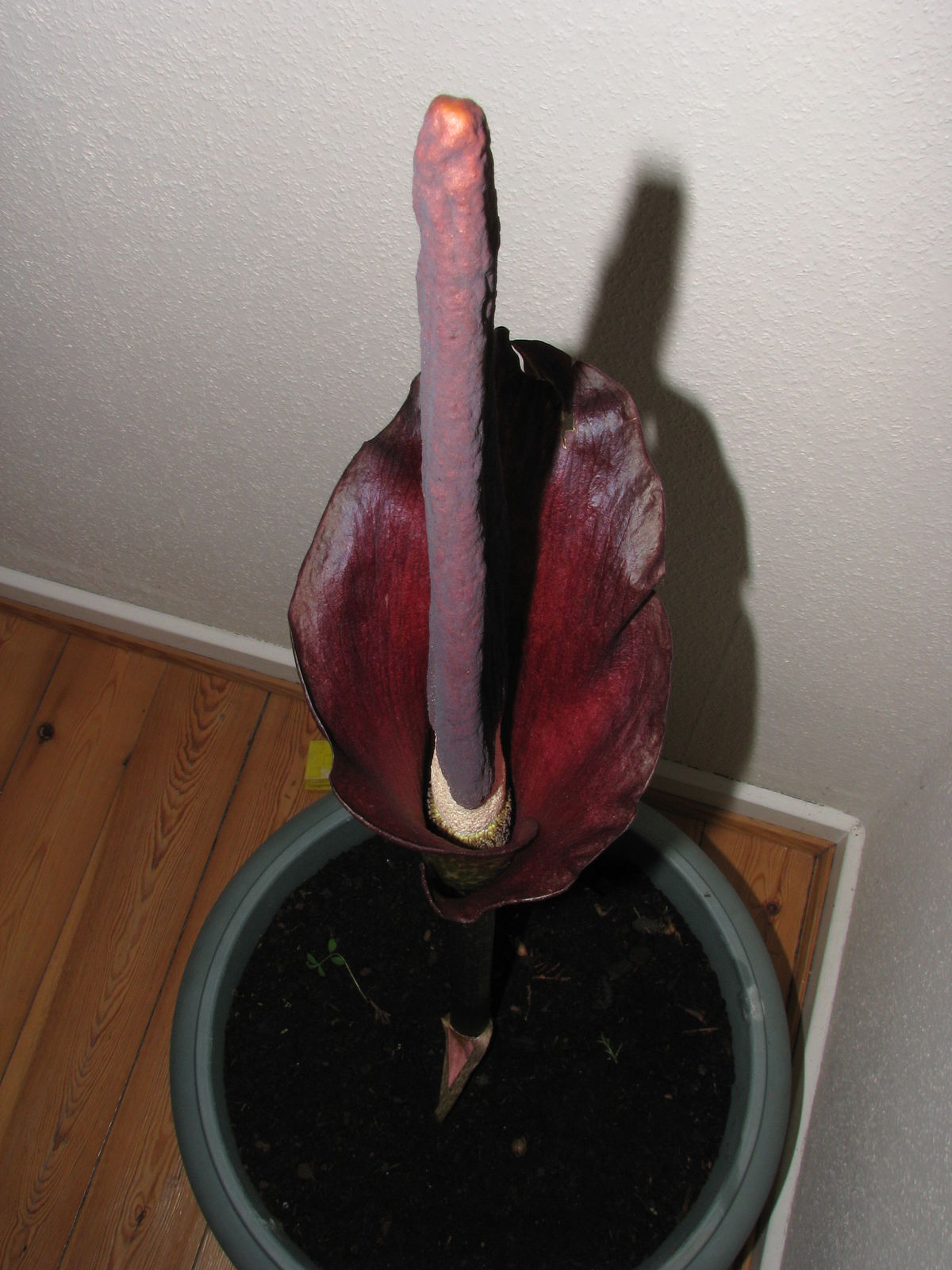
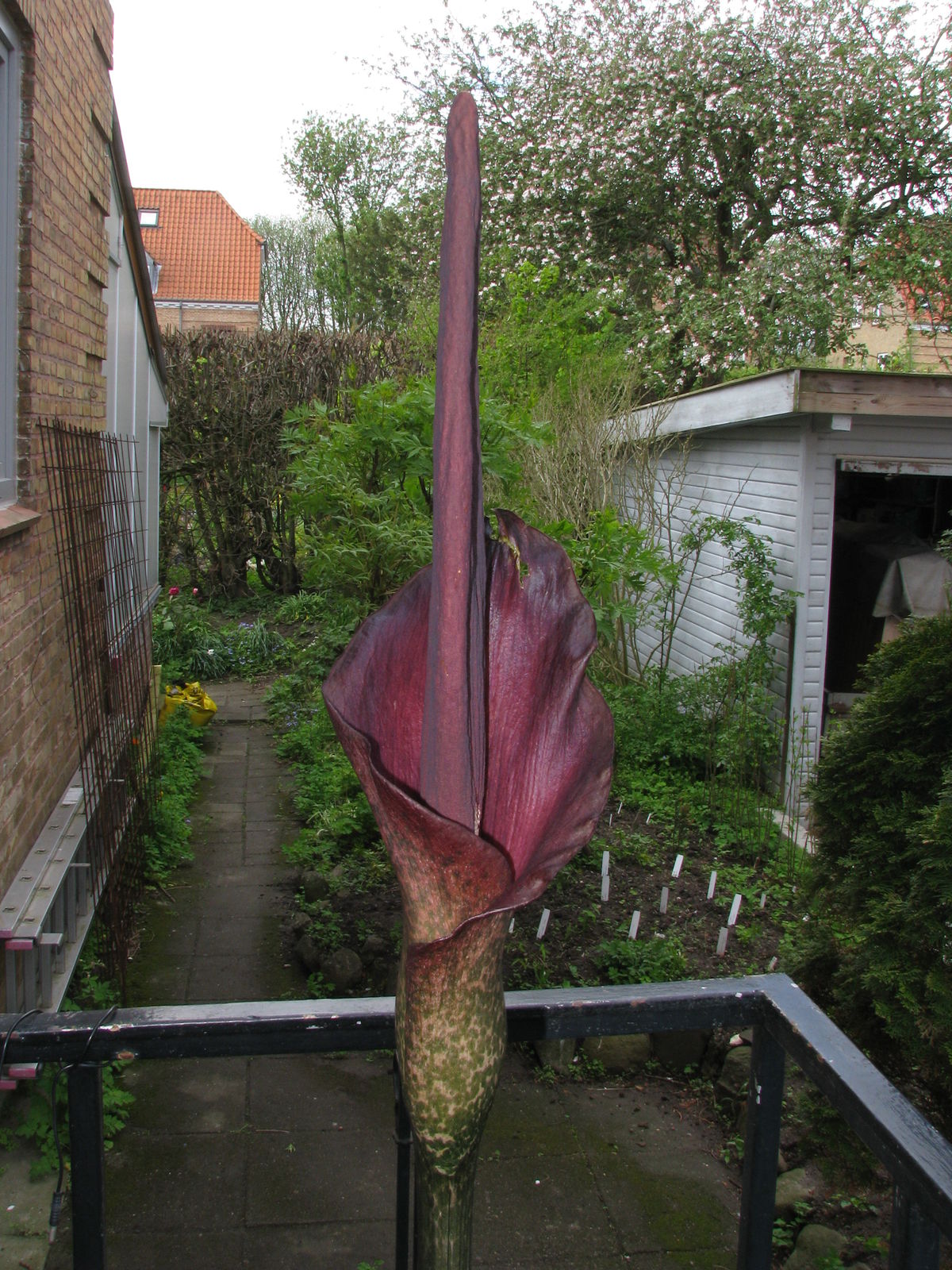
© photo
no rights reserved, uploaded by Adam Kranz · cc0
Wikimedia Commons · CC BY-SA or Public Domain
Wikipedia · CC BY-SA
Taken Aug 11, 2019 by manu kasa (cc-by-sa)
© copyright of the Board of Trustees of the Royal Botanic Gardens, Kew.




Global distribution
POWO/WCVP restricts the native range of Amorphophallus konjac to western Yunnan, China. It has been cultivated for centuries far beyond this area, particularly in Japan, Vietnam and Korea, for konjac food production. Missouri Botanical Garden describes a wider range extending to the eastern Himalayas and Southeast Asia, a horticultural account broader than the strict native range recognized by POWO.
- Native1
- Introduced1
- China (Yunnan)
- Indonesia
Hexagons: regions where the plant occurs. Green dots: native range.1
Identity
Konjac (Amorphophallus konjac K.Koch, 1858), also called devil’s tongue or voodoo lily, is a corm-forming perennial in the genus Amorphophallus, within the Araceae family. Its common name comes from Japanese konnyaku, the flour and food jelly made from its underground storage organ. The name of the food also became a familiar name for the living plant. 1 4
Seasonal dormancy separates Konjac from many large evergreen aroids grown as houseplants. A corm-forming geophyte, it loses its aboveground parts every year and starts again from a renewed underground reserve. That resting period, together with a flower that smells of carrion, distinguishes it from relatives such as Monstera and Alocasia. 2 3
Recognition
One highly divided leaf rises from the corm each growing season. Three main divisions give it an umbrella-like outline. Its fleshy, pale pink leaf stalk is mottled olive-green and carries a blade up to 1.3 m (4.3 ft) across, while the whole plant reaches 1–1.5 m (3.3–5 ft) tall. 3 2
A mature, flattened spherical corm can exceed 25 cm (10 in) in diameter; exceptional specimens approach 50 cm (20 in). The annual growth pattern is a useful identification clue: the corm never produces two leaves in the same season, unlike clump-forming perennials such as Colocasia esculenta. 5 4
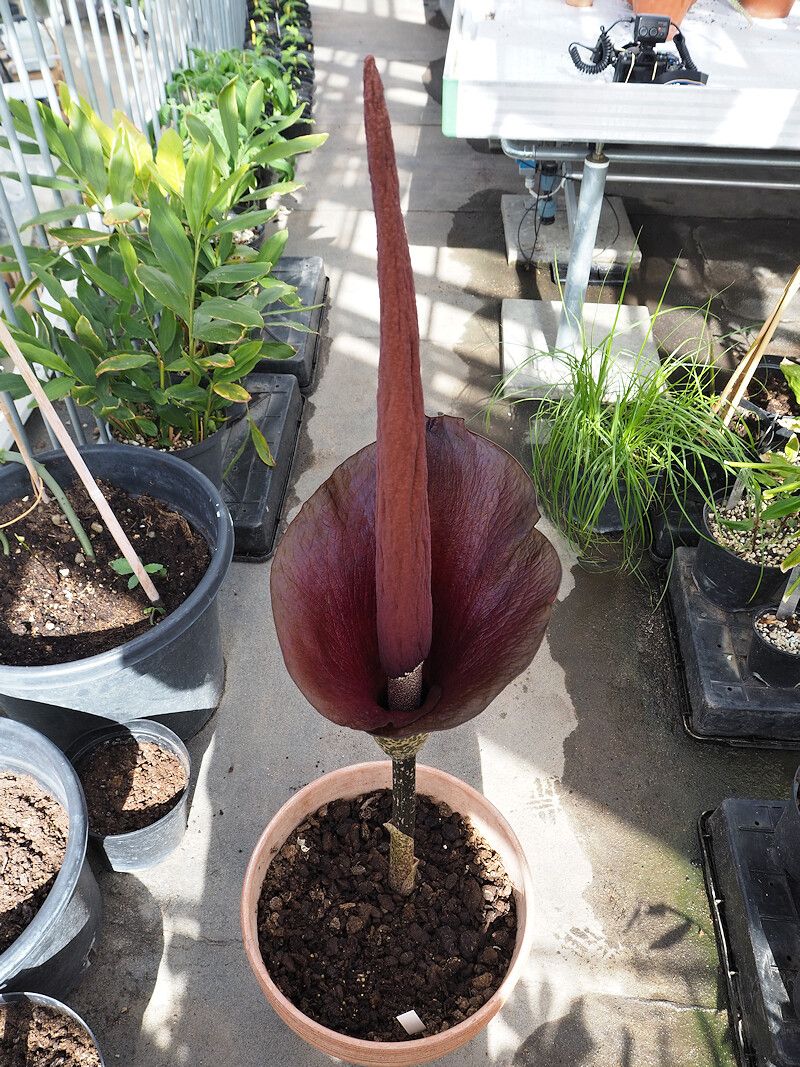
A sufficiently mature corm produces its inflorescence before a leaf would appear, in place of that leaf. A dark purple to chestnut-brown spathe with wavy margins surrounds a spadix that can exceed 50 cm (20 in). Smaller corms produce only foliage. On a mature corm, absence of a spring leaf can therefore indicate approaching flowering rather than a cultivation failure. 4 2
Useful taxonomy
Published in 1858, Amorphophallus konjac K.Koch is the accepted name in POWO, which identifies western Yunnan in China as its place of origin. Five synonyms remain relevant in horticultural trade or botanical literature. 1
Names worth recognizing on labels and seed packets include:
- Amorphophallus rivieri Durieu ex Carrière, still common in nurseries and on seed packets;
- Amorphophallus rivierei var. konjac (K.Koch) Engl., a combination within the same genus as the accepted name;
- Conophallus konjak Schott and Brachyspatha konjac (K.Koch) K.Koch, two older generic names now included within Amorphophallus;
- Amorphophallus konjac var. kiusianus Makino, described in Kyushu, Japan, in 1911.
Nursery use of Amorphophallus rivieri can imply that it is a separate species, although POWO treats it as a direct synonym of konjac. Using the accepted binomial provides a stable reference when comparing plants offered under different labels. 1
Habitat and range
Western Yunnan, China, constitutes the strict native range recognized by POWO/WCVP. There, Konjac grows along forest edges and in scrub, on loose organic litter in shade, at elevations of 830–1,200 m (2,700–3,900 ft). 1 5
Horticultural accounts describe a much wider East and Southeast Asian distribution. Missouri Botanical Garden includes the eastern Himalayas, Nansei-shoto islands, Philippines, Thailand and Vietnam. This broader picture mainly reflects centuries of food cultivation rather than an equally extensive strict native range. 3
In cool-climate cultivation, Konjac tolerates exposure from deep shade to full sun but performs best in partial shade. The underground corm can survive cold winters in the ground if kept dry, whereas the foliage is sensitive to even slight frost. Conditions around the resting corm and those around the growing leaf therefore need separate consideration. 4
Life cycle and reproduction
Winter rest governs the annual rhythm. In spring, the dormant corm develops a pink point that becomes either a leaf or an inflorescence, rather than both in the same year. The leaf lasts one season; by autumn it yellows and collapses, while a larger replacement corm has already formed underground. 2 4
At flowering, the spathe and spadix mimic the odor of a decomposing body. Carrion flies respond to that scent and carry out pollination instead of the more familiar flower-visiting insects. After fertilization, a compact cluster of fruits develops, changing from green to orange and then red as it ripens. 3
Cultivated plants are propagated by dividing daughter corms, the offsets forming around the main corm. Fresh seed can also be used, but seedlings take longer to develop than plants raised by division. 5
Uses and risks
Food production is Konjac's principal use. Domesticated about two thousand years ago in southwestern China, it has been eaten in Japan since at least the 6th century. Its glucomannan-rich corm is cooked and processed into flour used for konnyaku and shirataki noodles. 4
Raw corm is strongly irritating. Calcium oxalate crystals cause burning and swelling of the tongue and throat when tissue is chewed or swallowed. A clinical report records vomiting and mouth redness in two young children who accidentally ate Konjac seeds, with complete recovery within 24 hours. Thorough cooking or extensive drying into flour is the processing described for neutralizing these calcium oxalate crystals; raw plant tissue remains unsuitable for eating. 6 7
Konjac-jelly candies present a separate physical hazard. Their very firm texture and poor dissolution in the mouth caused fatal choking incidents in Japan during the 1990s and 2000s. American, European and Australian health authorities subsequently issued warnings or restricted sales of these products. This historical food-texture concern is distinct from the irritation caused by eating raw plant material. 8
Varieties, look-alikes and related plants
Konjac diversity mainly reflects local agricultural selections in China and Japan. It does not have the broad range of ornamental cultivars familiar in Monstera or Philodendron, particularly variegated forms sold in garden centers. Nursery labels often retain the name rivieri, adding confusion even though it denotes the same plant. 1
Several other carrion-scented aroids can be mistaken for it:
- Amorphophallus titanum, the corpse flower, much larger and rarely grown outside botanical glasshouses;
- Sauromatum venosum, another plant called voodoo lily, with a much smaller corm and inflorescence;
- Dracunculus vulgaris, a Mediterranean aroid with a similar carrion smell but belonging to a different genus.
These three plants share carrion mimicry. Comparing the corm, inflorescence size and geographic origin helps distinguish them despite the similar odor and overlapping common names.
Main sources
- Plants of the World Online / Kew, Amorphophallus konjac K.Koch
- Royal Horticultural Society, Amorphophallus konjac (konjaku)
- Missouri Botanical Garden Plant Finder, Amorphophallus konjac
- University of Wisconsin Extension, Konjac, Amorphophallus konjac
- Plants For A Future, Amorphophallus konjac database entry
- Little Known Dangers of an Exotic Poisonous Fruit, Lessons From Two Cases of Konjac Ingestion (PMC)
- Merck Veterinary Manual, houseplants with insoluble calcium oxalates
- FDA, warning on candies containing konjac (archived, 2001)
Frequently asked questions
Is Konjac poisonous?
Yes, when raw. All parts, including the corm, contain calcium oxalate crystals that strongly irritate the mouth and throat. Thorough cooking or extensive drying neutralizes this toxicity, allowing the corm to be eaten as flour or jelly.
Why does my Konjac sometimes produce no leaf?
A sufficiently large, mature corm produces an inflorescence in place of its annual leaf, before returning to an ordinary leaf cycle the following year. A missing leaf therefore often signals flowering rather than a cultivation problem.
Why does the flower smell rotten?
The spathe and spadix mimic decomposing flesh to attract carrion flies that pollinate the flowers. The strong smell lasts only a few days during flowering.
Can the Konjac corm be eaten raw?
No. Raw corm causes intense mouth irritation because of its calcium oxalates. It must undergo prolonged cooking or processing into dried flour before consumption, as in Japanese konnyaku preparation.
Is Konjac dangerous to children or pets?
Yes, if eaten raw. A clinical report describes vomiting and mouth irritation in young children after accidental ingestion of Konjac seeds, with full recovery within 24 hours.
How is Konjac different from the corpse flower?
The corpse flower is Amorphophallus titanum, a separate species with a much larger inflorescence. Konjac shares its carrion smell and pollination strategy but has a much smaller corm and flower.
How should Konjac corms be stored in winter?
In nontropical climates, lift the corm before frost, let it dry and store it dry at 10–15 °C (50–59 °F). Keep it away from moisture, which encourages soft rot.
Similar plants
If you are unsure about a plant’s toxicity, ask a botanist or veterinarian for advice.