
Giant taro (Alocasia macrorrhizos, )
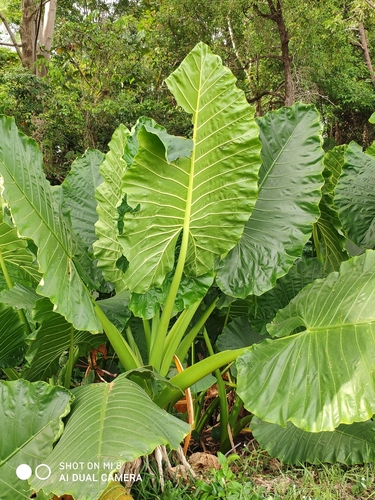
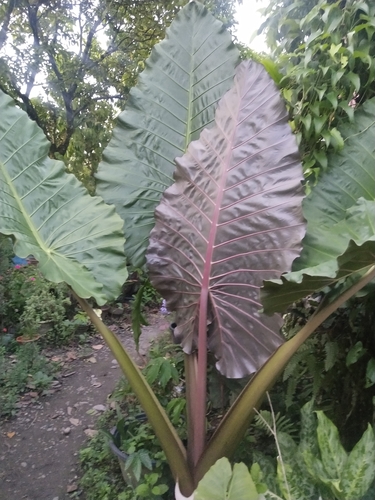
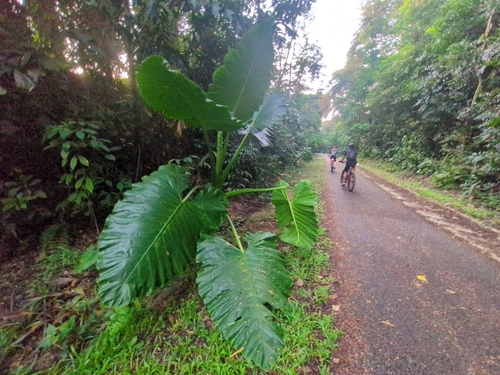
The giant taro (Alocasia macrorrhizos) is a rhizomatous perennial in the arum family, Araceae, native to central Malesia, the Philippines, New Guinea and Queensland. Its upright, arrow-shaped leaves, among the largest of any potted plant, rise from a pseudotrunk built up from stacked leaf-stalk bases.
Read moreGiant alocasia and Elephant ear
Give plenty of ambient light without direct sun on the leaves.
Global distribution
The native range of Alocasia macrorrhizos runs from central Malesia (Borneo, Sulawesi, the Moluccas) to the Philippines, New Guinea and Queensland, in the Murray Islands group of the Torres Strait. Long cultivated for its edible corm, the species was later spread far beyond that range, into the Pacific and the Indian subcontinent.
- Native5
- Introduced1
- Invasive1
- Indonesia
- Philippines
- Papua New Guinea
- Australia (Queensland)
- Solomon Islands
- Hawaii
- United States (Florida, Gulf Coast)
Hexagons: sourced regions. Green dots: native range. Statuses according to POWO (Kew).
Identity
The giant taro (Alocasia macrorrhizos (L.) G.Don, 1839), also called giant alocasia or elephant ear, is a perennial in the genus Alocasia, part of the arum family, Araceae. POWO accepts this name and keeps the species in Alocasia; the Missouri Botanical Garden places its native range in Australia, Malesia and Papuasia. 1 2
The botanical name refers to a bulky rhizome (macro- + rhiza), not to the leaves. In a container the plant commonly tops 1.5–2.5 m (5–8 ft), and it reaches 3–4 m (10–13 ft) in the tropics. 3 The scientific name is a safer guide than any common one: in the nursery trade, "elephant ear" and "giant taro" are generic tags for several large alocasias, which makes buying the right plant harder than it should be. 4
Recognition
On adult plants, the arrow- to heart-shaped leaves often exceed 1 m (3.3 ft) in length, held on thick leaf stalks that rank among the longest in the genus Alocasia. 3 4
To tell Alocasia macrorrhizos from true taro (Colocasia esculenta), look at where the leaf stalk joins the blade rather than at leaf size. In Alocasia, it meets the blade at the notch and the leaves point upward; in Colocasia, the attachment sits closer to the center and the blade hangs toward the ground. With age, the stacked leaf-stalk bases form a fibrous pseudotrunk that can reach 1 m (3.3 ft) tall without ever turning woody. 5 2
Early morning offers another clue: a row of droplets beads along the leaf margin. This guttation, driven by root pressure in humid air, is not a disease; it shows the potting mix is well supplied with water. 6
Useful taxonomy
The name accepted by POWO keeps the authority (L.) G.Don: Carl Linnaeus published the basionym Arum macrorrhizon in 1753, and George Don moved the species into Alocasia in 1839. The synonyms you are most likely to meet are: 1 7
- Colocasia macrorrhizos (L.) Schott
- Caladium macrorrhizon (L.) R.Br.
- Arum macrorrhizon L.
- Alocasia rapiformis (Roxb.) Schott
Alocasia macrorrhizos var. brisbanensis is a trap: that name actually belongs in the synonymy of a separate species, Alocasia brisbanensis, not in that of Alocasia macrorrhizos. Mixing the two up leads to misidentified plants at the garden center. The stable reference remains the name accepted by POWO, kept apart from look-alike varieties and trade names. 1
Habitat and range
Central Malesia (Borneo, Sulawesi, the Moluccas) marks one end of the native range, which continues through the Philippines and New Guinea to Queensland, in the Murray Islands group of the Torres Strait. 1 2
There the species grows along forest edges and riverbanks, in lowlands up to about 500 m (1,640 ft), on moist soils rich in organic matter. That liking for saturated ground explains why Alocasia macrorrhizos tolerates periodic flooding in cultivation. 6 4
Grown for centuries for its edible corm, the species has been carried well beyond its native range, into the Pacific and the Indian subcontinent. In the United States, several alocasias have naturalized in Florida and around the Gulf Coast, where their status shifts from ornamental to potentially invasive depending on the area. 4
Life cycle and reproduction
Growth is fast in warm, humid conditions: during the growing season a new leaf regularly outsizes the previous one within a few weeks, then growth slows sharply below 18 °C (64 °F). 6 3
Flowers follow the aroid pattern, a spadix wrapped in a pale green to cream spathe about 20–25 cm (8–10 in) tall. Indoors they appear only now and then; mature plants in a favorable climate bloom more often. 2
In cultivation, propagation is mostly by dividing rooted basal offsets, less often by sowing fresh seed kept at about 24 °C (75 °F). An offset separated without roots of its own establishes slowly and stays fragile for the first few weeks; cold, soggy mix encourages it to rot. 6
Uses and risks
As food, the corm and stem bases are eaten cooked in several Southeast Asian and Pacific cuisines, provided they are cooked long enough to break down the calcium oxalate crystals. Raw, the plant stays irritating and unfit to eat. 6
All fresh parts contain insoluble calcium oxalate raphides. When the plant is chewed or swallowed, the ASPCA reports oral irritation, excessive drooling, vomiting and difficulty swallowing in cats, dogs and horses; contact with the sap can also cause dermatitis. 8
Indoors or in a conservatory, the plant is grown mainly for ornament, for the sheer volume and texture of its foliage. In frost-free climates, roughly USDA zones 10 to 12, it can also fill a shady bed or edge a pond, thanks to its tolerance of waterlogged soil. 4 3
Varieties, look-alikes and related plants
Not every nursery label points to a stable cultivar. Variegata refers to leaves marbled with creamy white, often unstable depending on light; Stingray has a blade narrowed to a point that suggests a stingray; Borneo Giant is sold for a form with noticeably broader foliage, which does not always match the species itself. 5 4
Common look-alikes include:
- true taro (Colocasia esculenta), with drooping leaves and a more central, peltate attachment
- Alocasia brisbanensis, a distinct species despite a similar synonym
- Xanthosoma sagittifolium, another large aroid with an edible corm, whose main veins are less prominent
Since the trade name "elephant ear" covers plants from several different genera, the scientific name is a more reliable way than the label to pin down the exact species.
Main sources
- Plants of the World Online / Kew, Alocasia macrorrhizos (L.) G.Don
- GBIF Backbone Taxonomy, Alocasia macrorrhizos
- Royal Horticultural Society, Alocasia macrorrhizos
- Missouri Botanical Garden Plant Finder, Alocasia macrorrhizos
- NC State Extension Gardener Plant Toolbox, Alocasia, Giant Taro
- Plants For A Future, Alocasia macrorrhizos
- ASPCA, Alocasia toxicity entry
- University of Wisconsin Extension, Elephant Ears: Colocasia, Alocasia and Xanthosoma
Frequently asked questions
Is giant taro the same plant as edible taro?
No. The taro grown as an everyday staple is mainly Colocasia esculenta. Alocasia macrorrhizos also has a corm that is edible once cooked, but its upright habit and the way its leaves attach set it clearly apart from true taro.
Can you eat Alocasia macrorrhizos?
The corm and stem bases are eaten cooked in some Southeast Asian and Pacific cuisines, after long cooking that breaks down the calcium oxalate crystals. Raw, the plant remains irritating.
Is Alocasia macrorrhizos toxic to cats and dogs?
Yes. The ASPCA lists it as toxic to cats, dogs and horses because of the calcium oxalate raphides found in all fresh parts, which cause oral irritation and drooling.
Why is my Alocasia macrorrhizos growing a trunk?
It is not a true woody trunk but leaf-stalk bases stacked up over the years. The rhizome beneath this sheath is the only structure that persists from one season to the next in cooler climates.
Which plants are mistaken for Alocasia macrorrhizos?
The most frequent mix-ups involve Colocasia esculenta, Alocasia brisbanensis and Xanthosoma sagittifolium, often lumped together under the trade name elephant ear.
Why do drops form on the leaves?
That is guttation, a normal effect of root pressure when the air is humid. It is not a sign of disease or overwatering.
Can Alocasia macrorrhizos live outdoors in a temperate climate?
Only in summer, away from frost. The species does not tolerate temperatures below 15 °C (59 °F) for long and should come indoors or into a heated conservatory once autumn arrives.
Similar plants
Botanical data compiled from reference sources (RHS, Kew Gardens, POWO). This profile is for guidance only and is not a substitute for advice from a botanist or veterinarian if you have concerns about toxicity.