
Common silverweed (Argentina anserina, )
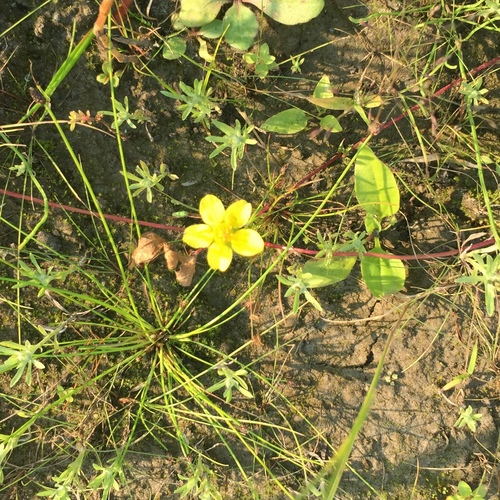
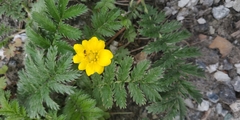
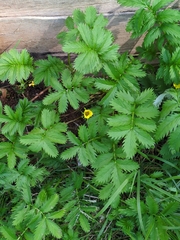
Common silverweed (Argentina anserina (L.) Rydb., 1898) is a perennial in the Rosaceae family that spreads by runners across the temperate Northern Hemisphere, from riverbanks to roadsides. Its pinnate leaves have silky silver undersides, while reddish runners rapidly colonize bare ground. Long classified in Potentilla, it was transferred to the revived genus Argentina, a treatment some botanists still dispute.
Read moreCommon silverweed, Silverweed and Silver cinquefoil
Allow a few hours of direct sun per day, preferably morning or evening.
Full sun; tolerates light partial shade


© photo
Mary Krieger · cc-by
Yurii Basov · cc-by
iNaturalist User · cc-by
(c) Sarah Johnson, some rights reserved (CC BY) · cc-by
Global distribution
Argentina anserina is native throughout the temperate Northern Hemisphere, from Europe through temperate Asia to North America, where its range reaches from Alaska to northern Mexico. It is common and widespread within this native range. Records outside the Northern Hemisphere represent localized introduction rather than general naturalization.
- Native4
- Introduced2
- Metropolitan France
- Temperate Europe
- North America
- Temperate Asia
- New Zealand
- Temperate Australia
Hexagons: regions where the plant occurs. Green dots: native range.1
Identity
Common silverweed (Argentina anserina (L.) Rydb., 1898), also called silverweed or silver cinquefoil, is a runner-forming perennial in the Rosaceae family. It grows throughout the temperate Northern Hemisphere, from riverbanks to roadsides. Rydberg transferred Potentilla anserina, published by Linnaeus in 1753, to Argentina in 1898, although the historical name remains common in references. 1 2
The epithet anserina comes from the Latin anser, goose. It refers either to the plant's former use as feed for domestic geese or to its divided leaves, thought to resemble a webbed footprint. The French name argentine describes the silky silver undersides of the leaves, rather than a connection with the country of Argentina. In English, the same conspicuous leaf color is reflected in the name silverweed. 4
Recognition
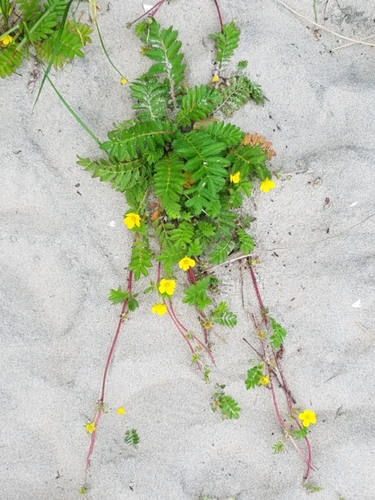
Low rosettes without branched flowering stems send out reddish runners up to 80 cm (31 in) long. Each runner node that contacts the soil can root and produce another rosette. An isolated plant can consequently cover 30 cm to 1 m (12 in to 3.3 ft) across in a single growing season, gradually filling the spaces between its original leaves. 3 4
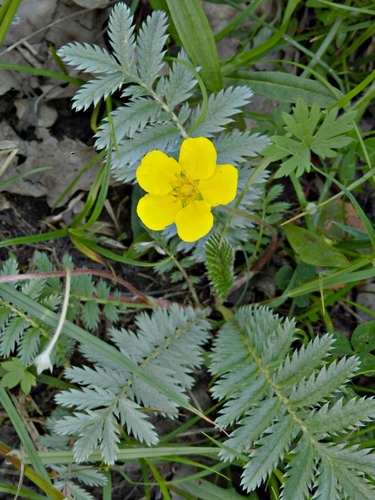
Pinnate leaves measure 10–20 cm (4–8 in) long and carry numerous toothed leaflets, each 2–5 cm (0.8–2 in) long and matte green above. Dense silky silver-white hairs cover the underside of every leaflet. This feature supplies the common name and distinguishes it at a glance from cinquefoils whose leaves are green on both surfaces. 4 5
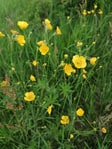
Solitary bright yellow flowers have five petals, rarely seven, and measure 1.5–2.5 cm (0.6–1 in) across. In the Northern Hemisphere flowering extends from June to September. Seed reproduction follows flowering, with the fruit consisting of a cluster of dry, kidney-shaped achenes grouped in the center of the rosette. 3 4
Useful taxonomy
A disputed generic placement explains the two scientific names found in botanical references. Linnaeus published the plant as Potentilla anserina in 1753, and Per Axel Rydberg transferred it to Argentina in 1898. That transfer gained wider acceptance following molecular phylogenetic work in the 1990s. ITIS nevertheless retains Potentilla anserina as the valid species name, differing from the reclassification accepted by POWO. 1 7
Frequently encountered synonyms and associated names include:
- Potentilla anserina L., the original combination
- Potentilla anserina subsp. anserina, the nominal subspecies
- Argentina anserina subsp. pacifica (Howell) Ertter & N.M.House, the Pacific coastal form
- Argentina anserina subsp. egedii (Wormsk. ex Oeder) Á.Löve & Ritchie, the northern coastal form
- Potentilla yukonensis Hultén, an associated name
Coastal pacifica and egedii populations occur around the northern Pacific and Arctic. Their leaves are fleshier than those of the typical inland riverbank and meadow plant, and some are adapted to salt marshes. Habitat therefore provides a useful clue when separating the typical species from these coastal subspecies: inland sites favor the former, while the named coastal forms occupy shore habitats. 1
Habitat and range
Temperate regions across the Northern Hemisphere form the native range, from Europe through temperate Asia to North America. There it extends from Alaska and Newfoundland south to California, New Mexico and the Great Lakes. Hardy in USDA zones 3–8, the plant tolerates −30 to 35 °C (−22 to 95 °F) and favors neutral to slightly alkaline soil with a pH of 6–7.5. 6 4
Moisture-retentive sandy or gravelly ground, often disturbed by passing feet, is characteristic habitat. Riverbanks, moist to wet meadows, ditches, roadsides and pond margins all support it. Tolerance of occasional trampling helps explain its frequency along well-used paths and in pastures, where runners can colonize gaps in the vegetation. 5 3
Outside the native range, localized naturalization occurs in New Zealand and parts of temperate Australia. In these settings the plant is sometimes regarded as a pasture weed rather than an introduced ornamental. These scattered populations should be distinguished from its widespread native occurrence across northern temperate regions. 4
Life cycle and reproduction
Runner growth supplies the main means of reproduction, greatly outweighing sexual reproduction. A runner fragment already rooted at a node can establish an independent new rosette within 2–3 weeks. This quick transition from connected offshoot to separate plant explains how dense colonies develop so readily on bare, damp ground. 3
Summer flowers, opening from June to September according to the local Northern Hemisphere climate, are followed by dry achenes. Seed can establish new plants, but it is slower than spread by runners. On disturbed soil, rooted fragments already have a direct means of anchoring and expanding, so vegetative colonization usually takes the lead. 4 5
Prolonged drought without supplementary water stops the production of new runners. The colony consequently ceases expanding until moist soil conditions return. Its rapid spread depends on continuing access to moisture, rather than an ability to grow equally well through extended dry periods. 4
Uses and risks
Starchy roots have a parsnip-like flavor when cooked and have been cultivated as a root vegetable in Scotland and North America. In Tibet, the roots are known locally as droma and are traditionally served cooked with butter and sugar during New Year celebrations. Young shoots can be eaten raw, and dried leaves are steeped as tea. 5
Astringent tannins in the roots account for their use in traditional preparations for digestive complaints and inflammation in the mouth. No toxicity is listed for domestic animals. Excessive internal use, however, can irritate the stomach in people and animals alike; an edible root is not an invitation to consume unlimited quantities. 5
Garden use centers on ground cover for damp sites, particularly banks and pond edges. Rapid colonization of bare soil through runners can help hold a bank, but the same habit becomes troublesome in a maintained border. Its value therefore depends on placing it where spreading growth is wanted and keeping runners within that area. 5
Varieties, look-alikes and related plants
Only a small selection of horticultural forms is available compared with many other garden perennials. The Royal Horticultural Society lists the compact selection Wolley Dod. By contrast, the coastal forms pacifica and egedii represent botanical subspecies rather than nursery cultivars, and should not be confused with named ornamental selections. 3 1
The following plants are frequent sources of confusion:
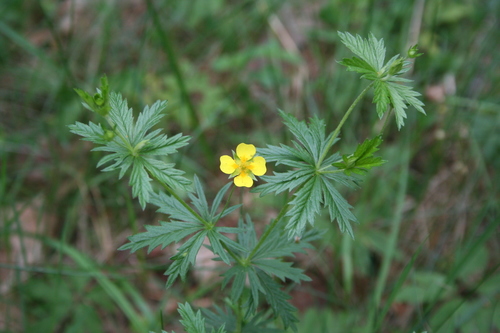
- Potentilla reptans has palmate leaves divided into five leaflets, rather than the pinnate leaves of common silverweed;
- Potentilla erecta lacks developed runners and has four-petaled flowers;
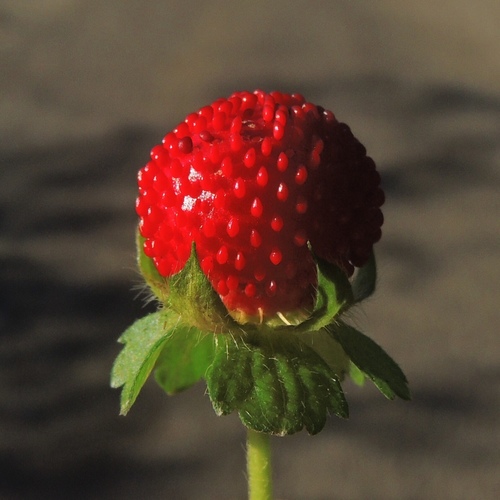
- Fragaria vesca has three-parted leaves and readily distinguishable red fruits once they develop.
Silky silver leaf undersides separate common silverweed from these three relatives, which lack the same dense covering of hairs. Long reddish runners provide a second useful feature: they are absent in Potentilla erecta and less developed in Fragaria vesca. Combining leaf structure and runner growth is more useful than relying on flower color alone.
Main sources
- Plants of the World Online / Kew, Argentina anserina (L.) Rydb.
- International Plant Names Index, Argentina anserina Rydb.
- Royal Horticultural Society, Argentina anserina — Silverweed
- Missouri Botanical Garden PlantFinder, Potentilla anserina
- Plants For A Future, Potentilla anserina
- USDA PLANTS Database, Argentina anserina (L.) Rydb. (ARAN7)
- Integrated Taxonomic Information System, Potentilla anserina subsp. anserina (TSN 184598)
Frequently asked questions
Are Argentina anserina and Potentilla anserina the same plant?
Yes. They are two scientific names for the same taxon. Long known as Potentilla anserina, the species was placed in the revived genus Argentina in the 1990s; some databases, including ITIS, still use Potentilla as their reference name.
Are common silverweed roots edible?
Yes, when cooked. They taste similar to parsnip and have been cultivated as a root vegetable in Scotland and Tibet, where they are served with butter and sugar at New Year. The immature fruit is not eaten.
Is common silverweed toxic to animals?
No toxicity is listed for cats, dogs or horses. The root contains astringent tannins that can irritate digestion if eaten excessively, in humans and animals alike.
Why do the leaves look silver?
Dense silky white hairs cover the undersides of the leaflets, creating a silver flash when wind turns the leaves. The upper surfaces remain matte green.
Can common silverweed take over a garden?
It rapidly colonizes bare, moist soil through runners, making it useful on banks but sometimes troublesome in maintained beds. Removing runners outside the intended area usually keeps it contained.
Which plants look like common silverweed?
Frequent look-alikes include Potentilla reptans, with palmate rather than pinnate leaves, Potentilla erecta, without well-developed runners, and Fragaria vesca, whose red fruits become distinctive once formed.
Why is the genus Argentina disputed?
Molecular phylogenetic work in the 1990s revived Argentina for species previously classified in Potentilla. Some taxonomic authorities continue to prefer the historical name Potentilla anserina.
Similar plants
If you are unsure about a plant’s toxicity, ask a botanist or veterinarian for advice.