
Peacock plant (Calathea, )
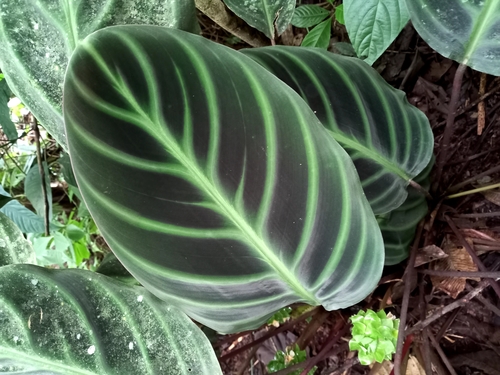
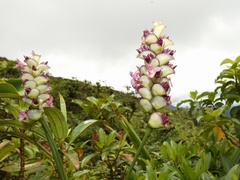
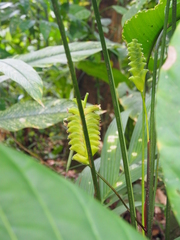
Calathea (Calathea), often called peacock plant, is a genus in the Marantaceae family native to tropical America and grown indoors for its patterned foliage. Its leaves rise in the evening and flatten during the day, a movement shared with prayer plants. Since 2012, most species formerly placed here have belonged to Goeppertia.
Read morePeacock plant and Prayer plant


© photo
Frank Dietze · cc-by
Kai Squires · cc-by
Lena Struwe · cc-by-nc


Global distribution
Calathea is native to tropical America, from southern Mexico through Central America and the Caribbean to South America, with the exact range varying by species. Widely grown as foliage plants, calatheas are cultivated in pots and greenhouses far beyond this range; cultivated regions should be distinguished from their American native range.
- Native4
- Brazil
- Colombia
- Peru
- Costa Rica
Hexagons: regions where the plant occurs. Green dots: native range.1
Identity
Calathea (Calathea G.Mey., 1818), often sold as peacock plant, is a genus of herbaceous plants in the Marantaceae family native to tropical America. In garden centers, the name covers around thirty houseplants grown chiefly for bold leaf patterns, including eye-shaped markings reminiscent of a peacock feather. 1 4
Evening brings a visible change in the foliage: the leaves lift, then flatten again during the day. This nyctinastic movement is shared with Maranta and other members of the family known as prayer plants. It helps make calatheas recognizable, although their need for humidity can make them demanding houseplants. 4 5
Recognition
Upright clusters of leaves give Calathea its characteristic shape. Long leaf stalks emerge from a rhizome, forming a clump generally 30–90 cm (1–3 ft) tall, depending on the species. Broad oval to lance-shaped leaves dominate the plant, with smooth margins and a surface that is often velvety. 2 3
Regular patterns on either side of the midrib provide the clearest visual clue. Light green, dark green, silver or purple markings decorate the blade, while the underside is frequently purple. The contrast becomes especially noticeable when a leaf rises in the evening and exposes its lower surface. 2 3
Daily leaf movement is another useful feature that can be observed without equipment. Flowering, by comparison, is inconspicuous and uncommon in pots: small white, yellow or orange flowers appear in spikes and generally contribute less ornamental interest than the foliage. 4 5
Useful taxonomy
Georg Friedrich Wilhelm Meyer described Calathea in 1818, placing the name within the Marantaceae, the family that also includes Maranta. A much later revision explains many modern labels: a phylogenetic study in 2012 showed that most species formerly included in Calathea belonged to a distinct group. 1 4
That revision transferred about 200 species to Goeppertia, leaving around 60 species in Calathea in its strict botanical sense. Plants still sold under the familiar horticultural name Calathea may therefore have an accepted botanical name beginning with Goeppertia. 1 2
Several familiar houseplants illustrate the change. C. orbifolia is now Goeppertia orbifolia, C. roseopicta is Goeppertia roseopicta, and the rattlesnake plant, C. lancifolia, has also moved to Goeppertia. Continued use of Calathea in horticulture explains the frequent difference between a nursery label and a botanical reference. 1 3
Habitat and range
Humid American forests provide the native setting for calatheas, from southern Mexico through Central America and the Caribbean into South America, with ranges differing by species. These understory herbs grow at ground level on moist, covered substrates sheltered from direct sunlight. 1 4
Life beneath the forest canopy explains their preference for steady warmth, high humidity and filtered light. In some species, young leaves and bracts hold little pools of rainwater called phytotelmata. These small water-filled pockets provide habitat for numerous invertebrates. 4 3
Horticulture has carried these plants well beyond their native forests. They are grown in pots and greenhouses in Europe, including the Netherlands, and in East Asia. Such regions of cultivation are distinct from the American range where the species occur naturally. 3 5
Life cycle and reproduction
Indoor flowering is an occasional event rather than the main attraction. When flowers appear in spring or summer, they form small spikes of white, yellow or orange, depending on the species. Cultivation focuses primarily on the foliage, which remains the dominant feature even when the plant blooms. 3 2
Leaf movement follows the daily light-dark cycle. A swelling at the base of the leaf stalk, called the pulvinus, changes its turgor as lighting conditions change. The leaves rise at night and return toward a horizontal position during the day; sufficient light supports this daily rhythm. 4 3
Propagation in cultivation relies mainly on division during repotting. Each separated section must retain both roots and leaves. For these clump-forming herbs, division is considerably more reliable than stem cuttings with a node, although cuttings can work in species with a distinct stem. Growing from seed is uncommon among home growers. 2 5
Uses and risks
Patterned foliage and nighttime leaf movement make Calathea chiefly an ornamental houseplant. In humid tropical climates it can also serve as ground cover in shade. Where winters are cold, it is grown as a full clump in a pot, protected from low temperatures. 5 3
The ASPCA lists Calathea as non-toxic to cats, dogs and horses, with no signs of poisoning described. This makes it a suitable foliage plant for homes with pets or young children. Keeping the foliage attractive is usually the greater challenge: dry air, hard water and cold drafts quickly brown leaf edges and often frustrate beginners. 6 3
Varieties, look-alikes and related plants
Plants sold as calatheas represent species and selections rather than a single uniform cultivar group. C. orbifolia has large round leaves striped with silver; C. makoyana, the peacock plant, has finely marked green and purple foliage; C. lancifolia, the rattlesnake plant, has long wavy leaves. C. roseopicta has rounded leaves edged in pink, while C. zebrina has velvety leaves striped dark green. 2 3
Other members of the Marantaceae account for most identification difficulties:
- Goeppertia is the genus to which most former calatheas have been reassigned;
- Maranta, the prayer plant, has a lower, more spreading habit;
- Ctenanthe has more elongated leaves, often variegated;
- Stromanthe has distinctly purple leaf undersides.
An upright clump, eye-like leaf markings and daily leaf movement together provide the most useful clues for placing a plant sold as Calathea within this group of Marantaceae. The trade name alone cannot resolve the botanical distinction between Calathea and its reclassified relatives. 3 1
Main sources
- Plants of the World Online / Kew, Calathea G.Mey.
- North Carolina Extension Gardener Plant Toolbox, Calathea makoyana
- Missouri Botanical Garden, Calathea search results
- Encyclopaedia Britannica, Marantaceae (arrowroot family)
- Royal Horticultural Society, Calathea search results
- ASPCA, Calathea non-toxic plant entry
Frequently asked questions
Is Calathea toxic to cats and dogs?
No. The ASPCA lists Calathea as non-toxic to cats, dogs and horses. It is among the larger foliage houseplants suitable for homes with pets.
Why do Calathea leaves rise at night?
This nyctinastic movement is controlled by a swelling at the base of the leaf stalk, the pulvinus, which responds to the light-dark cycle. The leaves rise at night and flatten during the day, as in Maranta.
Why are the leaf edges turning brown?
Brown tips and edges mainly result from dry air or hard water. Raising humidity above 60% and using soft water helps limit this common problem in heated rooms.
What is the difference between Calathea and Goeppertia?
Since 2012, about 200 species formerly placed in Calathea have been transferred to Goeppertia. Calathea now contains around 60 species, but the name remains common in garden centers.
What light does Calathea need?
Bright indirect light brings out the strongest leaf patterns. Direct sun fades and scorches the leaf blade, while too little light dulls the markings and disrupts nighttime movement.
How do you propagate Calathea?
The simplest method is to divide the clump when repotting, keeping roots and leaves on each section. This is the most reliable method for these clump-forming, rhizomatous herbs.
Why is Calathea hard to keep healthy?
Calathea needs high humidity, soft water and steady warmth. Dry heated air, hard tap water and cold drafts are the most frequent causes of damaged foliage.
Does Calathea flower indoors?
Rarely. Grown for its foliage, it sometimes produces small white, yellow or orange flowers grouped in spikes, but flowering remains inconspicuous and secondary in a pot.
Similar plants




If you are unsure about a plant’s toxicity, ask a botanist or veterinarian for advice.