
Bengal currant (Carissa carandas, )
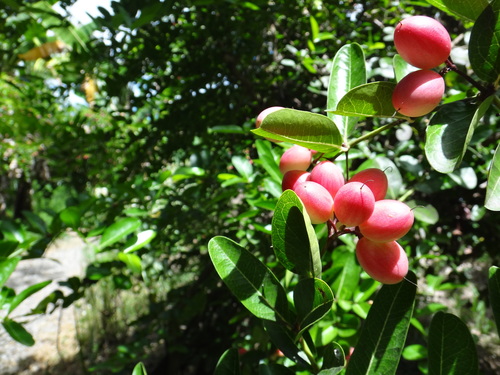

Bengal currant (Carissa carandas) is a thorny evergreen shrub in Apocynaceae, native to the Indian subcontinent, where it grows in dry scrub and poor soils. Injured parts release white latex. Its fruit changes from green to dark purple or black. Long cultivated in India for tart fruits made into pickles, chutneys and preserves, it also forms defensive hedges with paired thorns.
Read moreBengal currant, Karonda, Carandas, Karaunda and Christ’s thorn


© photo
Greg III Espera · cc-by
Wikimedia Commons · CC BY-SA or Public Domain
Wikipedia · CC BY-SA
© copyright of the Board of Trustees of the Royal Botanic Gardens, Kew.




Global distribution
POWO places the native range in India and southeastern Bangladesh; GRIN also lists India and Bangladesh as native. POWO lists Nepal, Pakistan and Sri Lanka as introduced; GRIN records cultivation in Nepal and Sri Lanka. The species has been widely introduced or cultivated elsewhere for fruit and thorny hedges, separately from its native range.
- Native6
- Introduced4
- India
- Nepal
- Sri Lanka
- Pakistan
- Bangladesh
- Afghanistan
- Philippines
- Malaysia
- Thailand
- United States
Hexagons: regions where the plant occurs. Green dots: native range.1
Identity
Bengal currant (Carissa carandas L., 1767), also known as karanda, karonda, carandas, Karaunda or Christ’s thorn, is a thorny evergreen Carissa shrub in Apocynaceae. Stems, leaves and unripe fruits all release white latex when injured, as in most members of this family. 2 4
Linnaeus described the species in 1767 in Mantissa Plantarum. Its fruit resembles a small tart plum, explaining the English name carandas plum; karonda is the widely used international transcription of its Hindi name. 2 3
Recognition
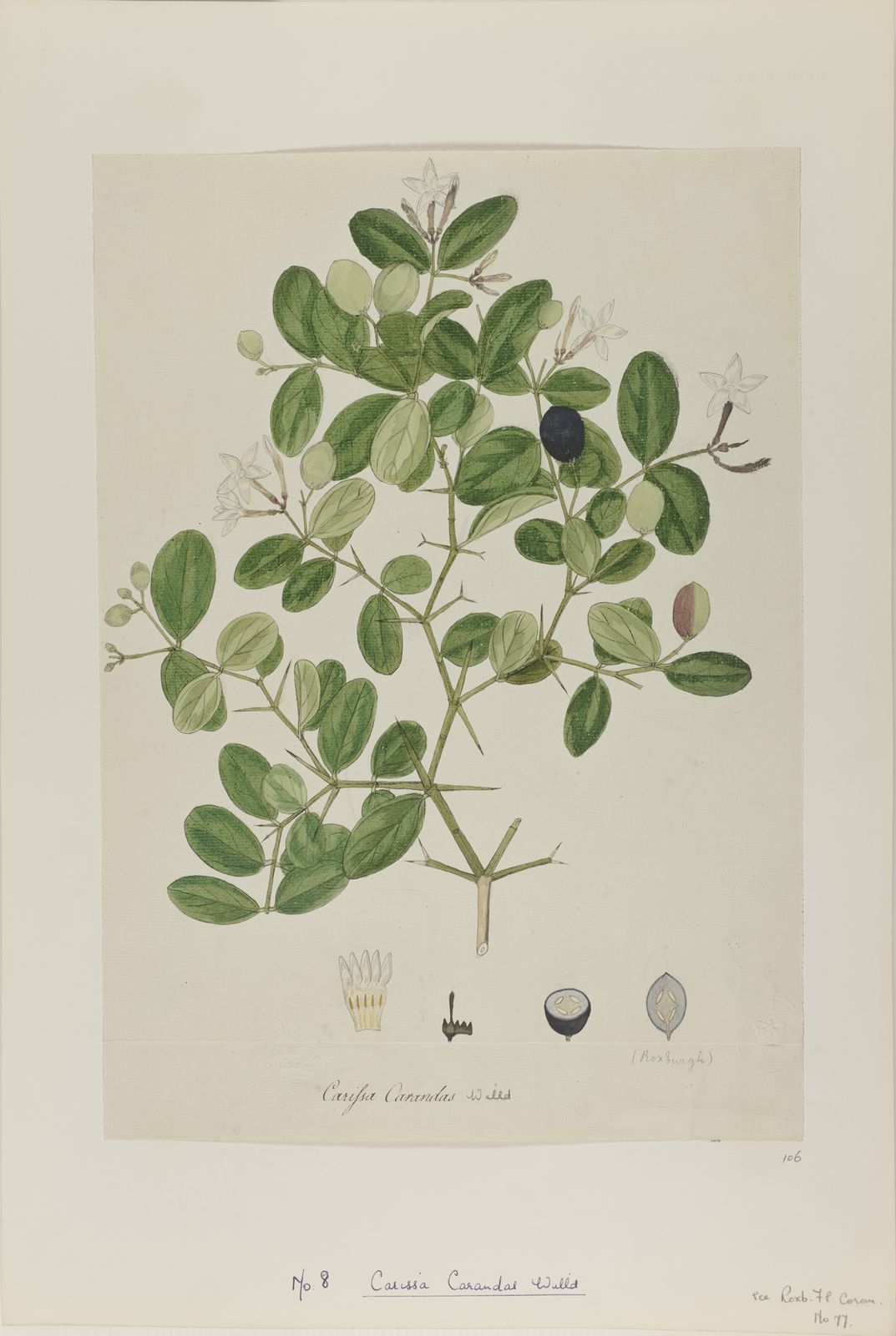
Bushy stems form a shrub or small tree commonly 3–5 m (10–16 ft) tall, climbing higher if supported by neighboring branches or a tree crown. Straight, paired thorns, sometimes 5 cm (2 in) long, make an established hedge impenetrable. 3
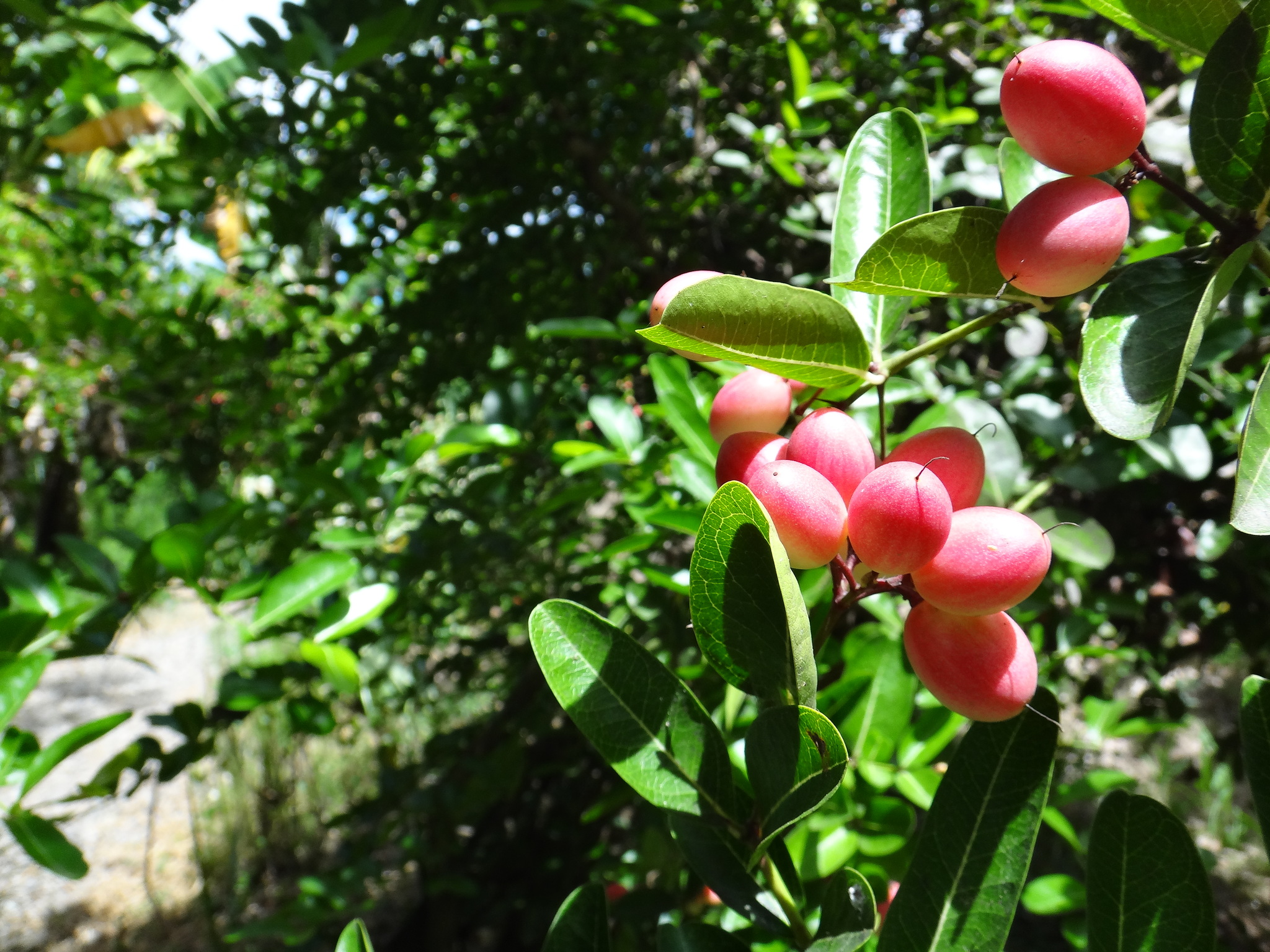
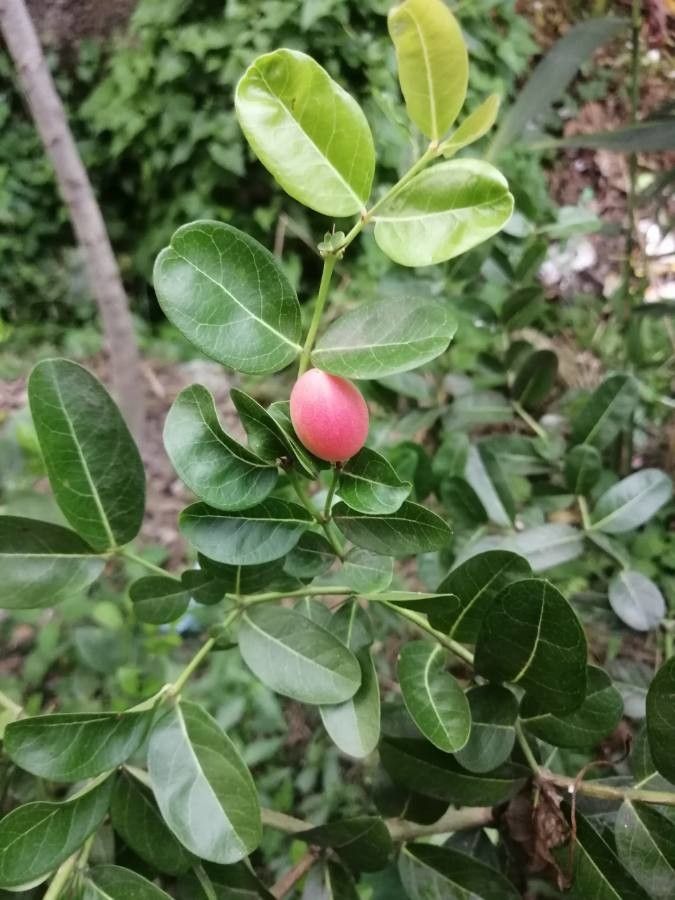
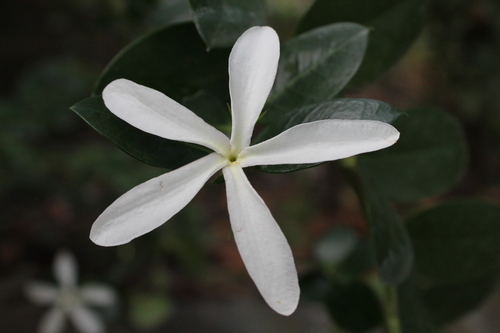
Opposite, oval to elliptical leaves are leathery and glossy, measuring 2.5–7.5 cm (1–3 in) long. White flowers, often pink-tinged on the reverse, open in small terminal cymes and give off a strong fragrance, especially late in the day. 3
Egg-shaped to nearly round fruits measure about 1.25–2.5 cm (0.5–1 in). Green and latex-rich when immature, they become dark purple, then black when fully ripe, revealing sweet-tart red flesh. A green fruit, or one that does not bleed latex when cut, is simply not ripe yet. 3
Useful taxonomy
POWO/WCVP accepts Carissa carandas L., distinguishing it from several plants sold under the same common name, karonda. Recognized homotypic and heterotypic synonyms include:
- Arduina carandas (L.) Baill., a botanical synonym;
- Jasminonerium carandas (L.) Kuntze
- Capparis carandas (L.) Burm.f.
- Carissa salicina Lam.
- Echites spinosus Burm.f.
Particular care is needed with Carissa congesta Wight, widely used for karanda in older English-language horticultural literature. POWO now places that name under a different species, Carissa spinarum. An old account of “Carissa congesta” therefore need not describe Carissa carandas. Morton’s 1987 chapter “Karanda” uses Carissa congesta Wight and Carissa carandas Auct.; its historical horticultural observations must be distinguished from the modern accepted taxon. 1
Tropicos at the Missouri Botanical Garden and the official USDA profile also confirm the accepted name, the latter under code CACA74. This provides a stable reference across English- and French-language botanical databases. 7 8
Habitat and range
For Bengal currant, POWO identifies India and southeastern Bangladesh as the native range; GRIN also lists these two countries as native. Records of cultivation and introduction elsewhere must be distinguished from that native range. Karanda grows in dry scrub, edges and poor soils, both sandy and calcareous, and is reported from lowlands to Himalayan foothills around 300–1,800 m (980–5,900 ft). 4 3
Official US collections introduced Carissa carandas in 1912. It spread through tropical and subtropical regions, including Florida, where it thrives on both sand and limestone in full sun. The Philippines and Malaysia adopted it earlier in the 20th century. 3
The official USDA profile records its introduced presence in the United States separately from its Indian native range. There it is listed only as a cultivated plant, without a status indicating extensive naturalized populations. 8
Life cycle and reproduction
In the documented northern Indian cycle, flowering begins in March, with fruit ripening from July to September. Seed-grown plants first bear at about two years, and ripe fruits become dark purple or black. 4
Propagation is chiefly by seed, since stem cuttings root poorly and inconsistently in the historical trials reported by Morton. Grafting and air layering provide more reliable alternatives for reproducing a particular plant faithfully. 3
Uses and risks
Immature fruits, rich in pectin and latex, are traditionally made into pickles, chutneys and preserves. Fully ripe fruits are eaten raw or made into jelly, with natural pectin helping it set. In traditional Indian medicine, green fruit serves as an astringent and ripe fruit as a vitamin-C-rich restorative. 3 A 2011 study reported a blood-glucose-lowering effect from an immature-fruit extract in rats. 6
No ASPCA data specifically cover Carissa carandas. The related Natal plum, Carissa macrocarpa, is listed as non-toxic to dogs, cats and horses. That classification does not establish veterinary safety for Carissa carandas. Sticky latex and marked astringency nevertheless give good reason to avoid eating karanda fruit before it is fully ripe. 5
Varieties, look-alikes and related plants
No stable cultivar of Carissa carandas is widely documented internationally. Variation in Indian orchards chiefly reflects local selections rather than horticultural names registered on a broad scale.
Three names regularly cause confusion:
- Carissa spinarum, with smaller fruits and thorns, occurs from Africa to Indochina and is often confused with karanda through the old name Carissa congesta;
- Carissa macrocarpa, Natal plum, comes from southern Africa, has larger flowers and is listed as non-toxic by the ASPCA;
- Capparis carandas is a historical synonym whose name does not connect this plant to the modern caper genus Capparis.
Geographic origin together with the accepted scientific name distinguishes the two species more reliably than a common name such as karonda. Plants sold under that name outside South Asia often prove to be Carissa macrocarpa. Check the botanical label before buying to avoid a surprise when the first fruit ripens. 1
Main sources
- Plants of the World Online / Kew, Carissa carandas L.
- International Plant Names Index, Carissa carandas record
- Purdue University NewCROP, Julia Morton, Karanda
- USDA GRIN Global, Taxonomy detail, Carissa carandas
- ASPCA, Natal Plum toxicity entry
- Journal of Ethnopharmacology, 2011, antidiabetic potential of unripe Carissa carandas fruit extract
- Tropicos / Missouri Botanical Garden, Carissa carandas record
- USDA PLANTS Database, Carissa carandas plant profile (CACA74)
Frequently asked questions
Is karanda fruit edible?
Yes, when fully ripe and dark purple or black. Green fruit is astringent and full of sticky latex; it is chiefly cooked in pickles or preserves.
Are karonda and carandas the same plant?
Yes. Karonda transcribes the Hindi name and remains widely used internationally; carandas comes directly from the scientific epithet Linnaeus published in 1767.
Is Carissa carandas toxic to cats and dogs?
The cited ASPCA entry concerns Carissa macrocarpa, not Carissa carandas. It does not establish safety for cats and dogs for this species. Latex in unripe fruit may cause local irritation.
How does the fruit change as it ripens?
Green, latex-rich fruit turns dark purple or black at full maturity.
How does it differ from Natal plum?
Carissa macrocarpa comes from southern Africa, has larger flowers and red fruit, and is listed as non-toxic by the ASPCA. Carissa carandas is Asian, with smaller fruits that turn black.
How is karanda propagated?
Seed remains the most reliable method because stem cuttings root poorly. Grafting and air layering are better suited to reproducing a particular plant faithfully.
Where does karanda come from?
POWO places its native range in India and southeastern Bangladesh, and GRIN also lists India and Bangladesh as native. It has subsequently been introduced or cultivated in several tropical regions, including Florida.
Similar plants
If you are unsure about a plant’s toxicity, ask a botanist or veterinarian for advice.