
Butterfly pea (Clitoria ternatea, )


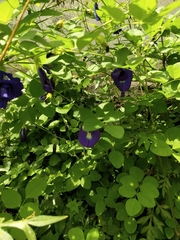
Butterfly pea (Clitoria ternatea) is a herbaceous climbing vine in the Fabaceae family, grown for cobalt-blue flowers with a white center and the natural color they give many Southeast Asian drinks and dishes. Although ternatea refers to the Indonesian island of Ternate, long considered its home by Linnaeus, Kew places its native range in tropical and southern Africa and the Arabian Peninsula. Nontoxic to people and the main domestic animals, this strictly tropical plant is grown as an annual in temperate climates.
Read moreButterfly pea, Blue pea, Asian pigeonwings, Bluebellvine, Darwin pea and Cordofan pea
Place in full sun, with intense direct light all day long.
Full sun; tolerates light shade in very hot climates




© photo
no rights reserved, uploaded by 葉子 · cc0
Ricard Busquets Reverte · cc-by
Greg III Espera · cc-by
Taken Dec 28, 2019 by susan brown (cc-by-sa)
Taken May 18, 2019 by Prakash Rudraraju (cc-by-sa)
Taken Sep 4, 2022 by Sana Ansari (cc-by-sa)
Taken Nov 14, 2013 by Tela Botanica − Liliane ROUBAUDI (cc-by-sa)
Taken Feb 25, 2022 by Soares Lopes Eduiges (cc-by-sa)
© copyright of the Board of Trustees of the Royal Botanic Gardens, Kew.


Global distribution
The native range recognized by POWO covers Cape Verde, tropical and southern Africa and the Arabian Peninsula. The epithet ternatea, referring to the Indonesian island of Ternate, long suggested an Asian origin. The species was introduced there later, before naturalizing throughout the tropics.
- Native3
- Introduced1
- Invasive2
- Cape Verde
- Kenya
- Saudi Arabia
- India
- Hawaii
- Australia
Hexagons: regions where the plant occurs. Green dots: native range.1
Identity
Butterfly pea (Clitoria ternatea L., 1753), also called blue pea, is a herbaceous climbing vine in the Fabaceae family, cultivated worldwide for its deep cobalt-blue flower with a white or yellow center. Other established English names include Asian pigeonwings, bluebellvine, Darwin pea and Cordofan pea. 1 2
The genus name Clitoria comes directly from “clitoris.” Polish naturalist Jakób Breyne thought the flower resembled a human vulva and described it in 1678 as Flos clitoridis ternatensibus, “Ternate flower of the clitoris.” Several 19th-century botanists openly objected to the name as indecent, including James Edward Smith in 1807. 7
The epithet ternatea refers to Ternate, in the Indonesian Moluccas, which Linnaeus believed was the species’ birthplace. This geographical clue is misleading: POWO places the native range in tropical and southern Africa, Cape Verde and the Arabian Peninsula, rather than Southeast Asia. 1
Recognition
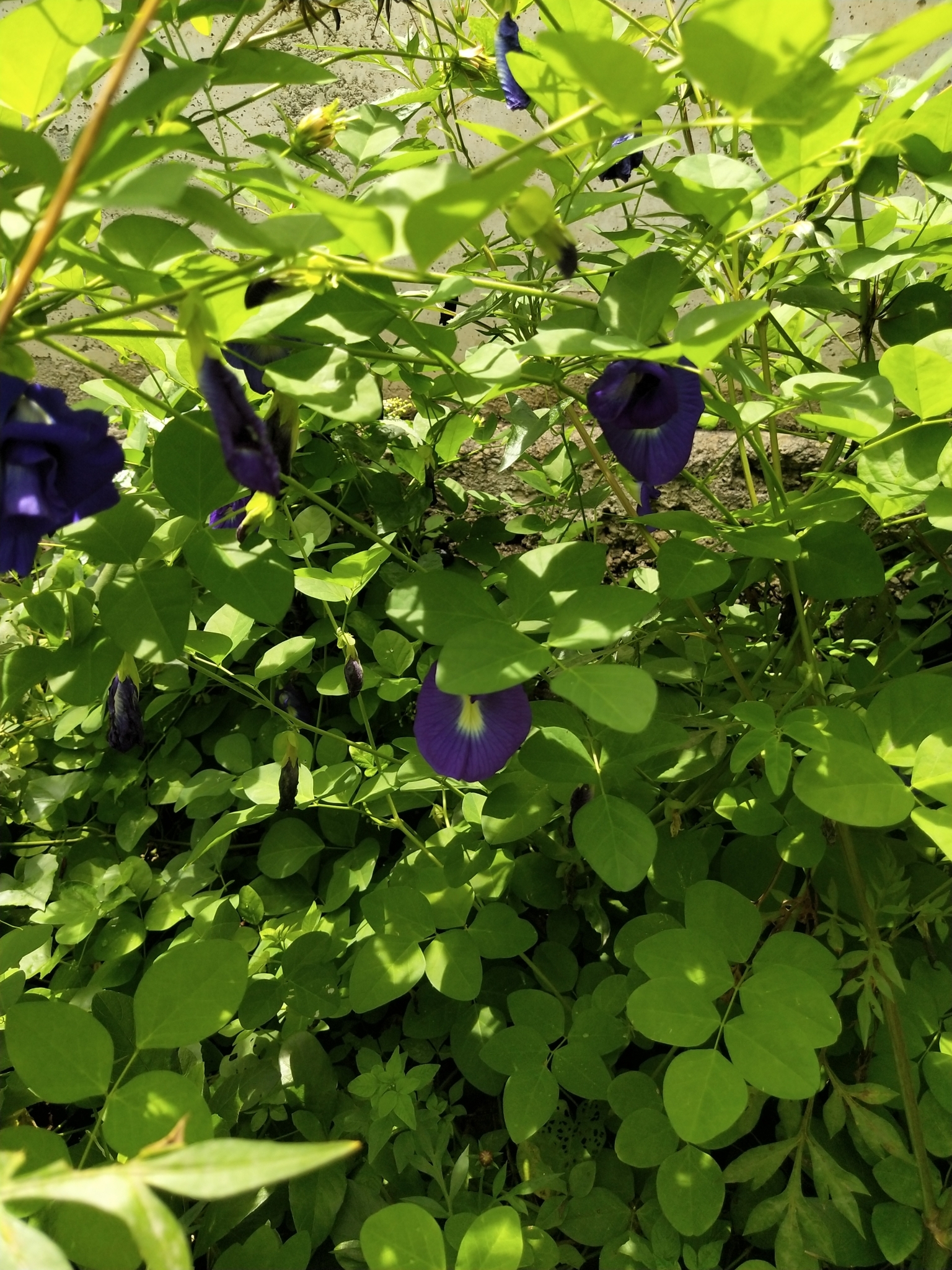
A slender, twining stem climbs or trails for 3 to 6 m (10 to 20 ft), growing fast enough to cover a trellis in one season. Alternate compound leaves have 5 to 9 leaflets, elliptic to oval and each a few centimeters wide. 3 4
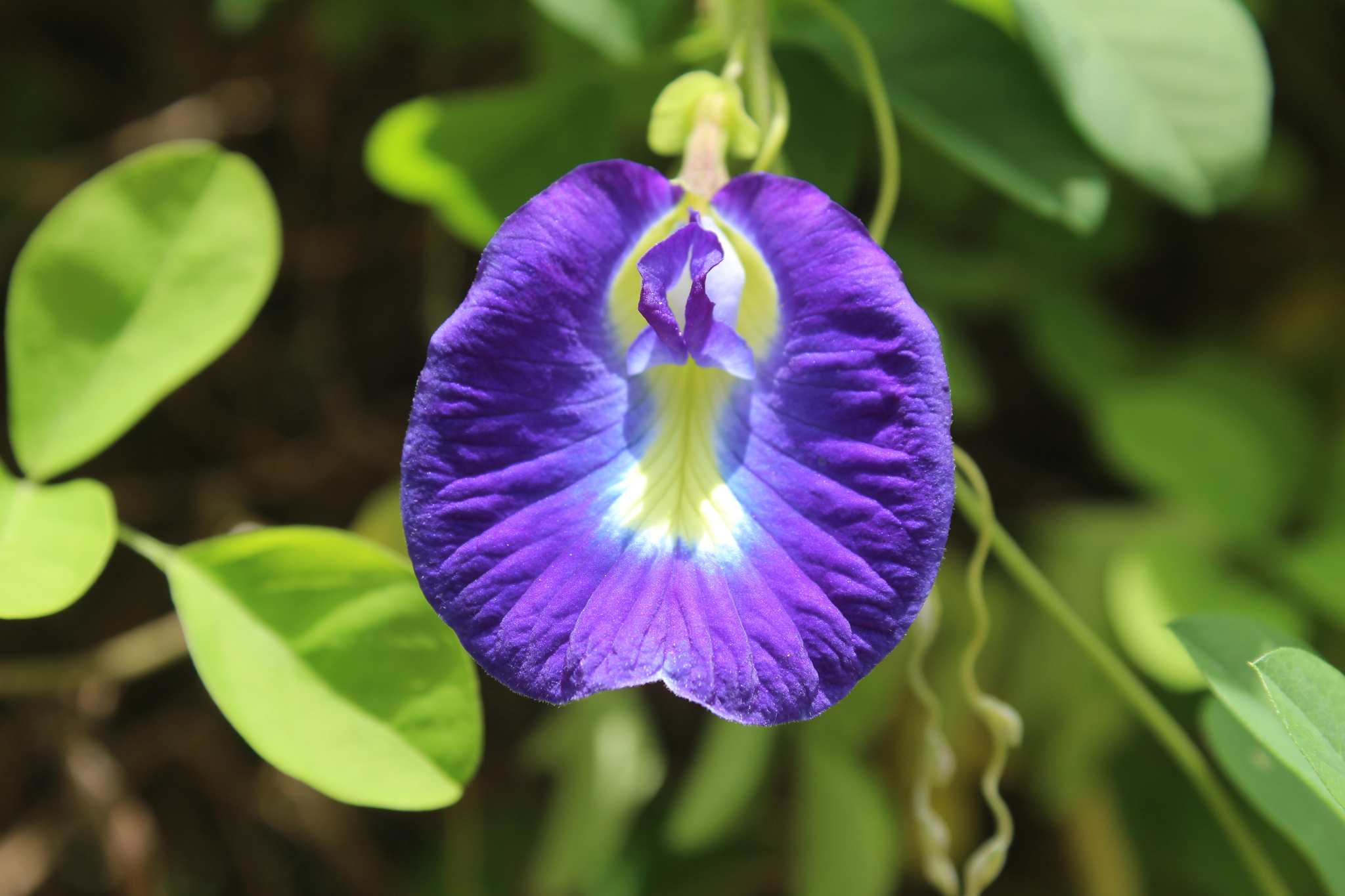
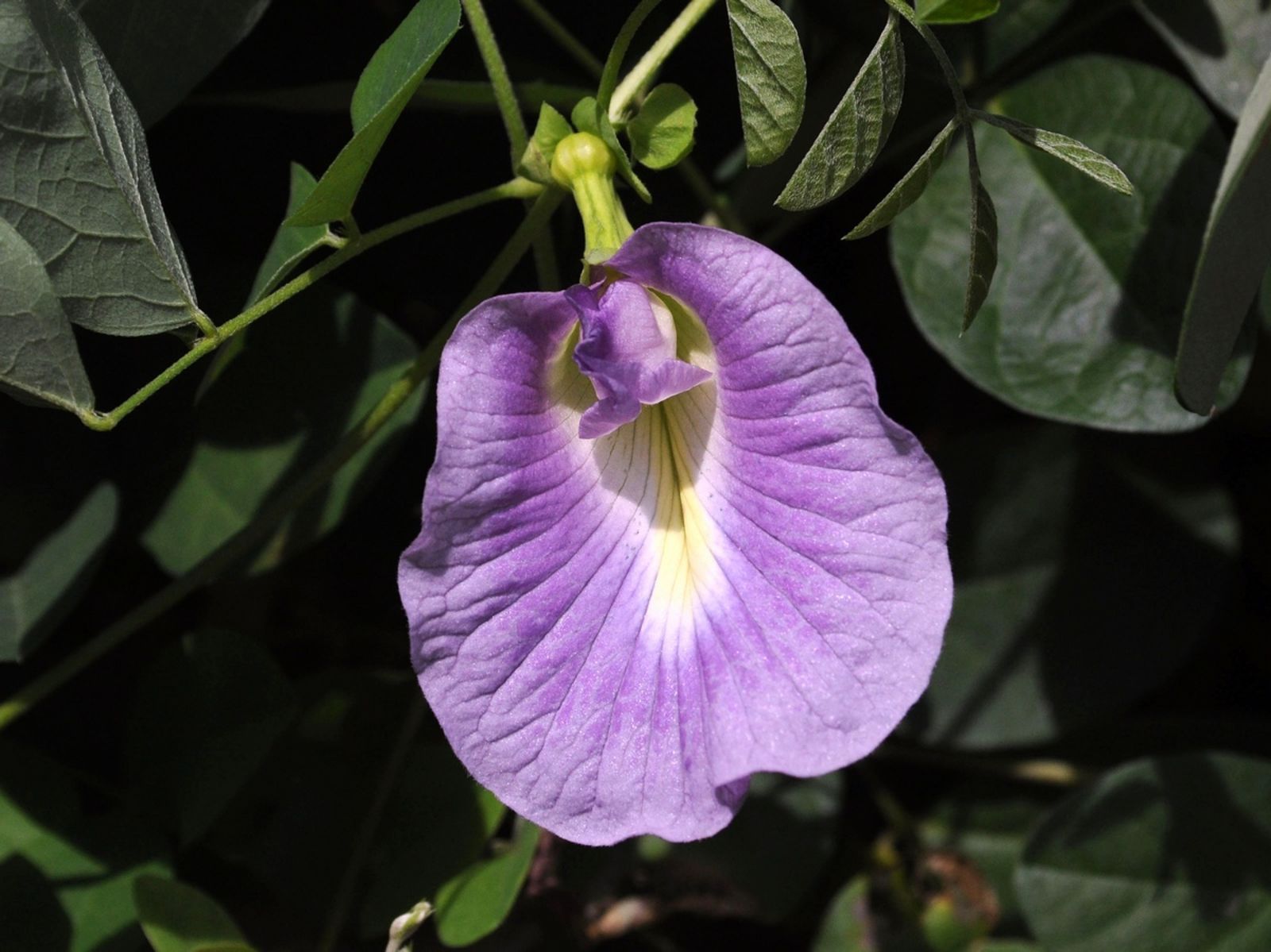
Flowers appear singly or in pairs in the leaf axils and measure 4 to 5 cm (1.6 to 2 in) across. The deep blue standard petal, sometimes white or pink in horticultural selections, bears a distinctive white or yellow center. 2 4
As in the related genus Centrosema, butterfly pea flowers are resupinate: twisting of the flower stalk turns them over. The standard, the largest floral part, thus sits low rather than upright at the top, unlike most Fabaceae. This detail alone helps rule out an ordinary pea flower seen from a distance. 7
After flowering, the flat pod develops over 8 to 10 weeks and bursts open at maturity, flinging out its seeds. This mechanism helps explain how quickly the plant can naturalize beyond cultivation. 3
Useful taxonomy
Within a genus of several dozen climbing or upright Fabaceae, POWO accepts the name Clitoria ternatea L. Several forms have been described under this accepted species: variety alba Berhaut has white flowers, form flaviflora Chiov. bears yellowish flowers, and variety angustifolia Hochst. ex Baker f. has narrower leaves than the typical form. 1
All of these forms remain attached to a single botanical species. The accepted name Clitoria ternatea is a more reliable reference than flower color, which varies freely among horticultural selections. 1
Habitat and range
Cape Verde, tropical and southern Africa and the Arabian Peninsula make up the native range recognized by POWO. Habitats include grassland, open woodland edges, scrub and riverside vegetation. 1 3
Long ago introduced to Southeast Asia, then spread throughout the tropics, the species had naturalized in Hawaii by 1871. It now grows in India, Thailand, Malaysia, Australia and much of tropical America, with status ranging from cultivated to invasive depending on the region. 5
This spread carries ecological risks. The PIER assessment for Pacific islands gives it a risk score of 9 out of 10, reflecting its ability to invade riverbanks, pond margins and disturbed ground at the expense of local vegetation. 5
Life cycle and reproduction
Breaking the hard seed coat by scarification allows germination in 3 to 6 days, helping grouped sowings emerge evenly beneath a trellis. Flowering follows 7 to 11 weeks after sowing, fast enough for the plant to be grown as a seasonal annual in temperate climates. 3
A perennial in tropical conditions, Clitoria ternatea is killed by frost when temperatures fall below 0 °C (32 °F), requiring annual culture in colder climates. As a legume, it fixes atmospheric nitrogen through root symbiosis with soil bacteria. This supports growth in poor substrates and explains its widespread use as a green manure and forage plant. 4 3
Pollination depends on sufficiently heavy insects, particularly bees, whose weight triggers the opening of the resupinate flower. Later, the ripe flat pod bursts open and scatters seeds some distance away, encouraging rapid naturalization outside the original range. 3
Uses and risks
Blue flowers provide a natural food coloring: their anthocyanins color Southeast Asian rice dishes, drinks and pastries, including Malaysian blue rice, nasi kerabu. The pigments shift to purple or pink according to the liquid’s acidity. 8 In 2025, the US FDA expanded permitted uses of the flower extract as a color additive, including in cereals, crackers and chips. 6
Plant tissues also contain cyclotides, tiny cyclic peptides with documented insecticidal activity that naturally defend butterfly pea against certain pests. In traditional Ayurvedic medicine, the flower is associated with memory and mental clarity under the Sanskrit name aparajita. The purgative, diuretic root remains reserved for supervised traditional use. 8 3
The plant is nontoxic to cats, dogs and people, while its status in horses remains uncertain because published data are lacking. In cultivation, it is susceptible to spider mites, whiteflies, anthracnose and bacterial soft rot. 9 4
Varieties, look-alikes and related plants
Flower color and shape drive most horticultural selection. Double Blue, with extra petals, and white- or pink-flowered forms circulate in the seed trade without representing distinct botanical varieties. 2
The common name butterfly pea is shared with Centrosema virginianum, a North American legume with equally resupinate flowers. Its standard is flat rather than concave, and a long, spur-shaped sepal gives it the name “spurred butterfly pea.” 7
Another look-alike is Clitoria mariana, a North American member of the same genus whose flower hangs with the standard downward, whereas that of Clitoria ternatea remains upright. With these two look-alikes, the complete scientific name distinguishes the three vines more reliably than the shared common name butterfly pea. 7
Main sources
- Plants of the World Online / Kew, Clitoria ternatea L.
- Missouri Botanical Garden Plant Finder, Clitoria ternatea
- Plants For A Future, Clitoria ternatea
- NC State Extension Gardener Plant Toolbox, Clitoria ternatea
- Pacific Island Ecosystems at Risk (PIER), Clitoria ternatea risk assessment
- Federal Register, Listing of Color Additives Exempt From Certification — Butterfly Pea Flower Extract
- Wikipedia EN, Clitoria ternatea
- PMC, Butterfly Pea (Clitoria ternatea), a Cyclotide-Bearing Plant With Applications in Agriculture and Medicine
- Perenual Plant Database, Clitoria ternatea toxicity entry
Frequently asked questions
Is butterfly pea native to Asia?
No, despite the epithet ternatea referring to the Indonesian island of Ternate. POWO recognizes a native range in tropical and southern Africa and the Arabian Peninsula. Southeast Asia is an area of long-standing introduction and naturalization.
Is butterfly pea toxic to cats and dogs?
No. It is not listed as toxic to cats, dogs or people. Its status in horses remains uncertain because published data are lacking.
Why do butterfly pea flowers turn purple in a drink?
The anthocyanins responsible for the blue color react to the liquid’s pH. Adding acidic juice such as lemon shifts the color from blue to purple and then pink, an effect used in many Southeast Asian drinks.
Can butterfly pea stay outdoors in temperate climates?
No, frost kills it in temperate conditions, including metropolitan France. Grow it as an annual sown each spring, or in a pot brought into a conservatory or heated greenhouse for winter.
Which plants are confused with butterfly pea?
Centrosema virginianum, with a flat standard petal and a spur, and Clitoria mariana, whose flower hangs with the standard downward rather than upright, are the two most frequent look-alikes.
Why is the genus called Clitoria?
In 1678, naturalist Jakób Breyne described the flower as Flos clitoridis ternatensibus because of its resemblance to a human vulva. Several 19th-century botanists criticized the name as indecent.
Similar plants
If you are unsure about a plant’s toxicity, ask a botanist or veterinarian for advice.