
Great willowherb (Epilobium hirsutum, )
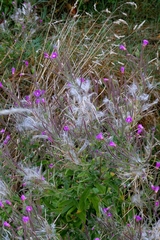
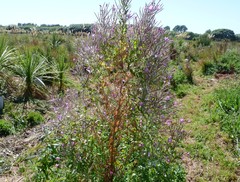
Great willowherb (Epilobium hirsutum) is an herbaceous perennial in the Onagraceae, native to temperate Europe, North Africa and western Asia. It forms dense colonies through creeping rhizomes along riverbanks, ditches and nitrogen-rich wet meadows. Large bright pink flowers with four notched petals appear in summer, followed by long capsules releasing silky-haired seeds into the wind.
Read moreGreat willowherb, Great hairy willowherb, Hairy willowherb and Codlins and cream
Allow a few hours of direct sun per day, preferably morning or evening.
Full sun to light partial shade


© photo
(c) Sergey Mayorov, some rights reserved (CC BY-NC), uploaded by Sergey Mayorov · cc-by-nc
Patrick Le Mao · cc0
Colin Meurk · cc-by
(c) Colin Meurk, some rights reserved (CC BY-SA) · cc-by-sa
(c) Matteo Marcandella, some rights reserved (CC BY) · cc-by
Global distribution
The native range covers temperate Europe north to southern Sweden, North Africa and western Asia. Widely naturalized in North America and Australia, it is locally regarded as a vigorous weed in wet soil.
- Native5
- Introduced1
- Invasive1
- France
- United Kingdom
- Spain
- Sweden
- Morocco
- Australia
- United States
Hexagons: regions where the plant occurs. Green dots: native range.1
Identity
Great willowherb (Epilobium hirsutum L., 1753) colonizes wet banks in temperate Europe, where hairy stems often exceed 2 m (6.5 ft) in nitrogen-rich soil. This rhizomatous perennial belongs to the Onagraceae. The genus name combines Greek epi, upon, and lobos, pod: the flower appears to sit on a long inferior ovary that later becomes the elongated capsule. The epithet hirsutum describes the dense glandular hair on stems and leaves, a useful feature even before flowers appear. 1 6
Linnaeus described this species in 1753. Its established English names include great hairy willowherb and hairy willowherb. The name great willowherb distinguishes it from fireweed (Chamerion angustifolium), long included in the same genus. Another traditional name is codlins and cream. 6 2
Recognition
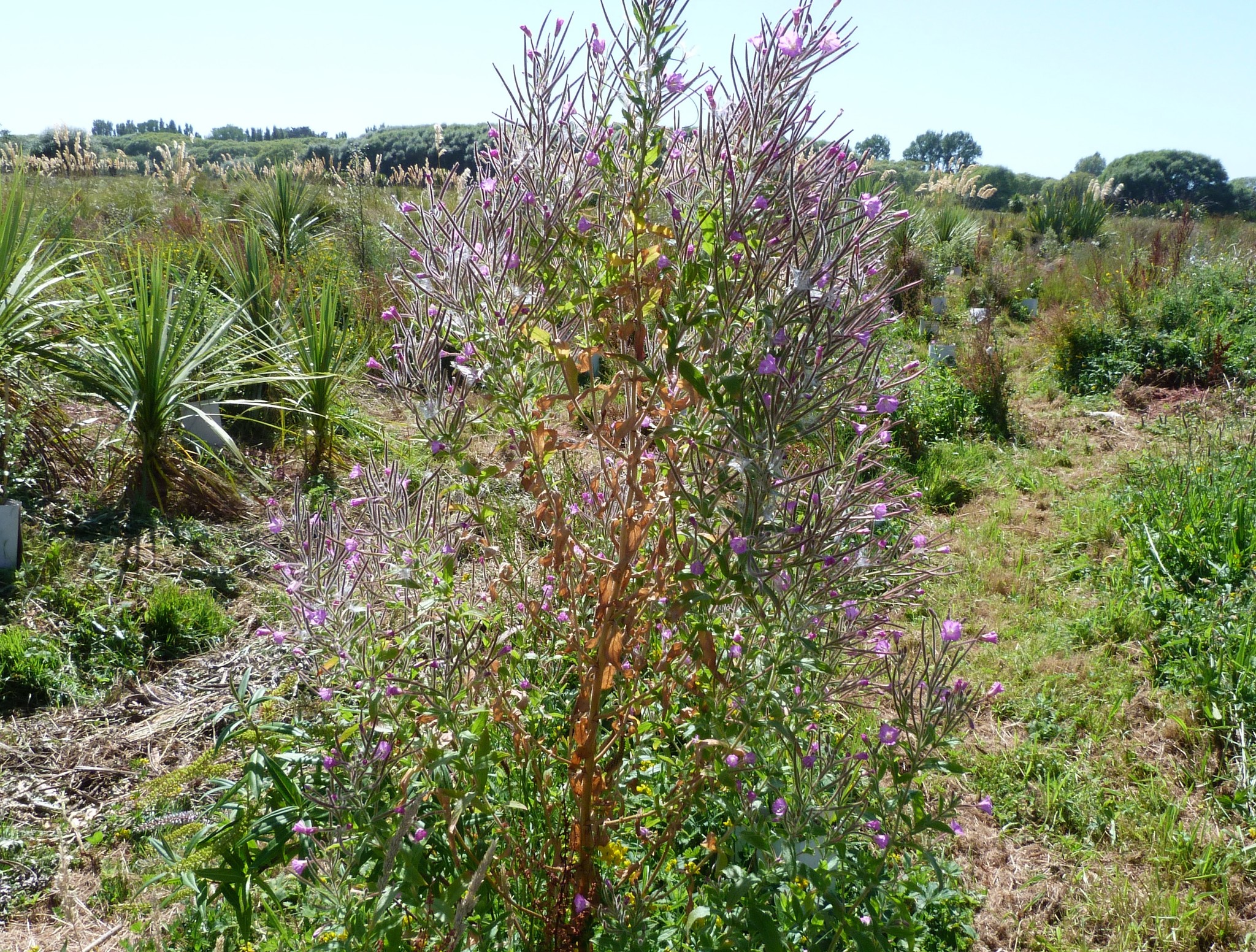
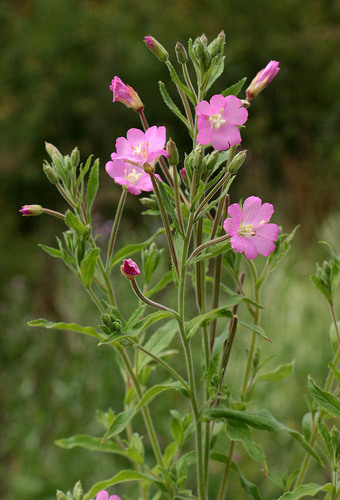
Upright, sturdy stems branch freely near the top and usually reach 1.5–2.5 m (5–8 ft), with the greatest height confined to very rich soil. Fine hairs mingle with glandular hairs in a dense covering. Their rough feel helps identify the plant when it is not flowering. 2 7
Opposite, lance-shaped, toothed leaves measure 2–12 cm (0.8–4.7 in) long. They lack leafstalks and slightly clasp the stem at their bases. This combination of opposite arrangement and stalkless leaves helps separate great willowherb from other tall waterside herbs with alternate foliage. 2 7
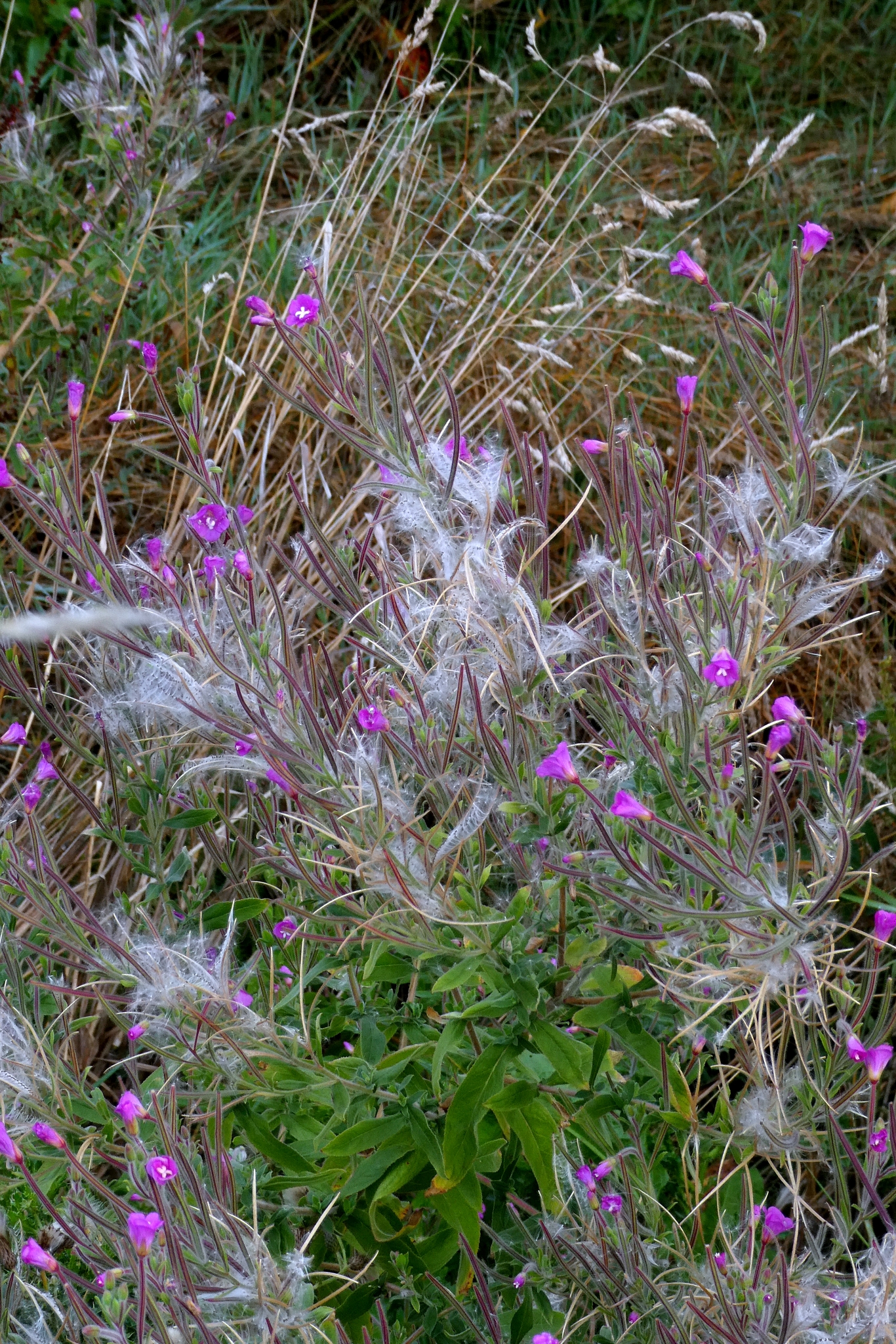
Flowers in the upper leaf axils have four bright pink, notched petals, with darker fine veins and a paler center. Each flower is about 2–3 cm (0.8–1.2 in) across. Eight stamens surround a style ending in a white, four-lobed stigma, a characteristic feature of Epilobium. 7 5
Useful taxonomy
Epilobium hirsutum L. is the accepted name in POWO/WCVP. Numerous varieties and forms described during the 19th and early 20th centuries are now treated as synonyms:
- Epilobium hirsutum var. villosum Mert. & W.D.J.Koch, a synonym listed as a variety
- Epilobium hirsutum subsp. parviflorum Ehrh., a synonym listed as a subspecies
- Epilobium hirsutum var. glabriusculum Mert. & W.D.J.Koch, a synonym listed as a variety
- Epilobium hirsutum f. alboroseum D.C.McClint., a synonym listed as a form
- Epilobium hirsutum var. tomentosum (Vent.) Boiss., a synonym listed as a variety
Several dozen Epilobium species occur in France, and many look very similar from a distance. Flower size and stem hairiness provide more reliable clues than the general outline of the plant alone. 1 6
Habitat and range
Temperate European wetlands, north to southern Sweden, form part of its native range alongside North Africa and western Asia. It inhabits river and canal banks, ditches, marshes and nitrogen-rich meadows, always on wet ground, from sea level to 2,500 m (8,200 ft) in mountains. 5 1
Naturalized populations are widespread beyond this range, notably in North America and Australia. Rapid spread through creeping rhizomes has led to monitoring in some regions. Some northern US states restrict sales of plants or seeds, and effective herbicide control can be difficult once a colony is established. 3
Within France, Epilobium hirsutum is a native wetland plant with no particular invasive status or restriction of this kind. Geographic origin explains this difference in management; the rhizome has the same biological capacity to spread in both settings. 6
Life cycle and reproduction
Summer flowering peaks in midsummer and continues into late summer, with timing varying by local climate. Each pollinated flower develops into a long, narrow capsule. At maturity it splits into four valves, releasing numerous tiny seeds topped with silky hairs that carry them considerable distances on the wind. 5 2
Below ground, creeping rhizomes build dense colonies within 2–3 years. Abundant seed production and vegetative spread work together, explaining how a single established plant can occupy an entire bank. Division and seed both provide ways to propagate it. 3
Hoverflies, bees and other flower-visiting insects pollinate the flowers throughout summer. The leaves also feed caterpillars of the elephant hawkmoth (Deilephila elpenor), a large moth common in Europe. 5
Uses and risks
Waterside planting combines ornamental and ecological uses. On natural banks, great willowherb stabilizes loose soil and feeds pollinators late in the season. In a rain garden or beside a pond, the main management task is to contain its spreading rhizomes. 3 2
Traditional herbal preparations use dried Epilobium leaves, including Russian kaporie tea as a tea substitute. An optimized Epilobium hirsutum extract rich in oenothein B and flavonoids such as myricitrin has shown anti-inflammatory effects and potential as a chemotherapy adjunct in laboratory research. Human clinical trials have not confirmed these findings. 8 5
The ASPCA lists Epilobium, including Epilobium hirsutum, as non-toxic to cats, dogs and horses. An old, isolated report describes convulsions after an inadequately specified medicinal use. Without recent confirmation, this warning calls for caution rather than treatment as an established effect. 4 5
Varieties, look-alikes and related plants
Specialist waterside nurseries occasionally offer roseum, a paler-flowered form, and 'Caerphilly Castle'. Few stable horticultural cultivars exist for this mainly wild species, and these selections have no well-standardized cultivation status. 2
Useful comparisons when identifying a plant include:
- Epilobium parviflorum, also hairy-stemmed, with much smaller flowers, 6–10 mm (0.25–0.4 in) rather than 2–3 cm (0.8–1.2 in);
- Chamerion angustifolium, fireweed, with a dense terminal flower spike and alternate, untoothed leaves;
- smaller willowherbs with pinkish flowers but without the dense hair covering of Epilobium hirsutum.
Flower size and the density of the hairs remain the best field clues for separating these related species. Stem height alone is less dependable because it varies markedly with soil fertility. 9
Main sources
- Plants of the World Online / Kew, Epilobium hirsutum L.
- Royal Horticultural Society, Epilobium hirsutum - great willowherb
- NC State Extension Gardener Plant Toolbox, Epilobium hirsutum
- ASPCA, Willow Herb (Epilobium) toxicity entry
- Plants For A Future, Epilobium hirsutum
- INPN / MNHN, Epilobium hirsutum L., 1753
- First Nature, Epilobium hirsutum - Great Willowherb
- PMC / NCBI, anti-inflammatory and antitumor potential of an Epilobium hirsutum extract
- Florealpes, Epilobium hirsutum - great willowherb
Frequently asked questions
Is great willowherb toxic to cats and dogs?
No. The ASPCA lists Epilobium, the genus that includes Epilobium hirsutum, as non-toxic to cats, dogs and horses.
How does it differ from Epilobium parviflorum?
Both species have hairy stems, but Epilobium parviflorum has much smaller flowers, around 6–10 mm (0.25–0.4 in), compared with 2–3 cm (0.8–1.2 in) in great willowherb.
Why is it called codlins and cream?
This dialect name refers to the cooked-apple scent of crushed leaves and the pale pink and cream flower colors. It does not indicate an established culinary use.
Is great willowherb invasive?
It is a native wetland species in France and is not regarded as invasive there. Outside its native range, notably in the northern United States, its vigorous rhizome growth prompts local monitoring.
Can great willowherb be used for herbal tea?
Dried Epilobium leaves are traditionally used for herbal tea, including kaporie tea in Russia. An old, isolated report mentions convulsions after medicinal use; reasonable caution is warranted without recent confirmation.
Where does great willowherb grow naturally?
Its native range covers temperate Europe north to southern Sweden, North Africa and western Asia. It grows in moist or waterlogged ground from sea level to 2,500 m (8,200 ft).
How does it differ from fireweed, Chamerion angustifolium?
Chamerion angustifolium, formerly placed in Epilobium, has flowers in a long terminal spike and alternate, untoothed leaves. Great willowherb has flowers in the leaf axils and opposite leaves.
Similar plants
If you are unsure about a plant’s toxicity, ask a botanist or veterinarian for advice.