
Iris
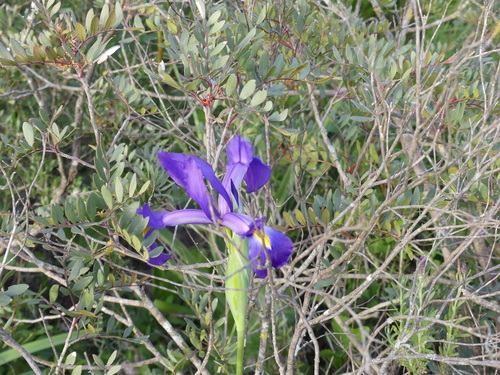
Iris (Iris) is a large genus of perennial plants in the Iridaceae family, distributed across the Northern Hemisphere. Its distinctive flowers have three drooping outer segments and three upright inner segments. Rhizomatous members include bearded and yellow flag irises; bulbous members include reticulated iris. The flowers are also associated with the heraldic fleur-de-lis.
Read more


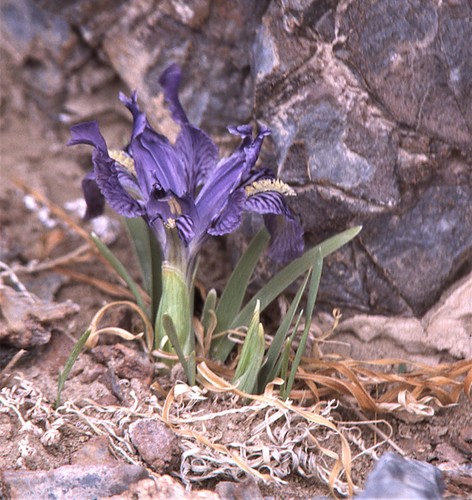
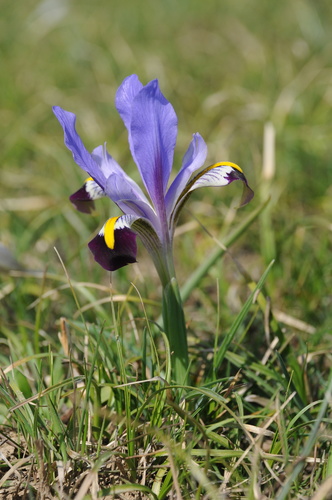
© photo
Gilles San Martin · cc0
Kent P. McFarland · cc0
NoahM · cc-by
(c) Valentin Moser, some rights reserved (CC BY) · cc-by
(c) Peter L Achuff, some rights reserved (CC BY) · cc-by
Global distribution
Iris species occur widely across temperate parts of the Northern Hemisphere, including Europe, Asia, North Africa and North America. Each species has its own range. Plants sold in garden centers are mostly horticultural hybrids, which should be distinguished from the wild species from which they descend.
- Native5
- Metropolitan France
- Italy
- Turkey
- China
- United States
Hexagons: regions where the plant occurs. Green dots: native range.1
Identity
From dry rock gardens to wetland edges, the iris (Iris L., 1753) takes many forms. This large perennial genus belongs to the Iridaceae, alongside gladioli and crocuses. Its name honors Iris, the messenger of the gods and goddess of the rainbow in Greek mythology, reflecting the diversity of its flower colors. 1 4
About 300 species occur across the Northern Hemisphere. In gardens, the name often brings to mind the bearded iris (Iris germanica), with its broad flowers and fleshy rhizome. The genus also includes waterside irises, rock-garden plants and bulbous types grown for cut flowers. Choosing among them starts with identifying which group a plant belongs to. 2 5
Recognition
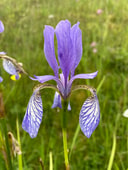
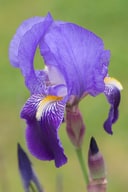
The distinctive flower has three drooping outer segments, traditionally called sepals or falls, and three upright inner segments, called petals or standards. The falls provide a landing platform for pollinators, while the standards stand over the flower’s center. These two whorls of three form a useful first clue to the genus. 4 3
Flat, sword-shaped leaves form fans at the base of the plant, a feature shared with other Iridaceae. Bearded irises have a line of upright hairs along the center of each fall. Beardless types lack this structure, so the beard helps separate major garden groups without relying on flower color. 5 3
The underground storage organ provides another distinction. Bearded, Siberian and yellow flag irises have fleshy, creeping rhizomes, while reticulated and Dutch irises have bulbs. Flowering is chiefly in spring and summer in temperate climates, with colors ranging from blue and purple to white, yellow and orange. Garden plants in this broad group span 15–120 cm (6–47 in) in height, depending on the type. 2 5
Useful taxonomy
Carl Linnaeus established the genus Iris in 1753. Roughly 300 species are accepted, arranged in several subgenera and sections. That diversity has led botanists to organize the genus using broad growth forms and underground storage organs, although horticultural classifications serve a different practical purpose. 1 4
For garden use, two broad groups can be recognized by their storage organs:
- Rhizomatous irises include Iris germanica, the bearded iris; Iris pseudacorus, yellow flag; and Iris sibirica, Siberian iris.
- Bulbous irises include the early-flowering Iris reticulata and Dutch irises of the Iris × hollandica group.
The accepted genus name, Iris, remains the stable botanical reference. Horticultural group and cultivar names describe garden selections rather than formal botanical ranks. A familiar garden label can therefore be useful without representing a distinct species. 1 2
Habitat and distribution
Temperate regions of the Northern Hemisphere hold the broad distribution of the genus: Europe, Asia, North Africa and North America. The precise range varies between species. This geographic spread is matched by striking differences in habitat, so a single set of soil and watering instructions cannot describe every iris. 1 4
Bearded irises favor open, well-drained places such as dry slopes, meadows and sunny rocky ground, where their rhizomes benefit from warmth. Yellow flag (Iris pseudacorus) occupies a contrasting setting: banks, ditches and wetlands with moist to waterlogged soil. 3 5
Outside their native ranges, garden irises are most often encountered in cultivation. Some vigorous species can naturalize, however. Yellow flag may spread along water and become invasive in particular regions where it has been introduced. That behavior belongs to the species and location concerned, rather than to every garden iris. 5 3
Life cycle and reproduction
These perennial geophytes survive unfavorable seasons through their rhizomes or bulbs. In the temperate seasonal cycle described here, a clump produces leaves and flower stems in spring, blooms, then slows toward the end of summer. Bearded iris rhizomes extend and branch each growing season, gradually creating a dense clump. 5 3
The flowers are adapted to bees and bumblebees. An insect landing on a fall passes under a style branch and picks up pollen. After fertilization, capsules release seeds, allowing wild species to reproduce sexually and providing the variation used in breeding. 4 1
For garden bearded irises, division of the rhizomes every 3–4 years after flowering is the simplest propagation method. Healthy sections are replanted at the soil surface. Seed is useful for species and breeding, but seedlings of hybrids vary widely and do not reliably reproduce their parent’s flower color. 2 5
Uses and risks
Ornamental use covers several distinct settings: sunny beds for bearded irises, pond margins for waterside types, rock gardens for small bulbous irises and cut flowers from Dutch irises. Beyond the garden, dried rhizomes of the Florentine iris group, including Iris ×germanica and Iris pallida, provide orris root, a scented fixative valued in perfumery. 2 4
Irises also have a prominent cultural role. The heraldic fleur-de-lis associated with the French monarchy derives from a stylized iris rather than a true lily. The flower is linked with Florence and the Brussels-Capital Region and serves as Quebec’s floral emblem. 4 3
Handle the plants with care. The ASPCA lists irises as toxic to cats, dogs and horses. Rhizomes and bulbs contain the highest concentrations of irritant terpenoids and glycosides and may cause salivation, digestive upset and lethargy after ingestion. Keep these storage organs, as well as accessible plantings, away from animals and young children. 6 5
Varieties, lookalikes and related plants
Garden centers commonly sell irises by broad horticultural group. Bearded iris (Iris germanica) dominates sunny beds; Siberian iris (Iris sibirica) prefers moisture-retentive soil; and yellow flag (Iris pseudacorus) suits wet margins. Reticulated iris and Dutch iris offer early flowers or stems for cutting. When buying, look for firm, healthy rhizomes or weighty, undamaged bulbs. 2 3
Other Iridaceae with blade-like leaves are frequent lookalikes:
- Gladiolus has a one-sided flower spike and a flattened corm.
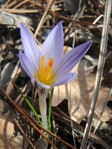
- Crocus has low flowers with no obvious aboveground stem and grows from a corm.
- Crocosmia, or montbretia, carries arching sprays of small orange flowers.
A flower with three drooping falls and three upright standards, together with sword-shaped leaves arranged in fans, remains a useful combination for recognizing the genus. Check the flower and growth form together rather than identifying a plant from its foliage alone. 3 1
Main sources
Frequently asked questions
Are irises toxic to cats and dogs?
Yes. The ASPCA lists Iris as toxic to cats, dogs and horses. Rhizomes and bulbs have the highest concentrations of irritant compounds and may cause salivation, digestive upset and lethargy after ingestion.
What is the difference between rhizomatous and bulbous irises?
Bearded, Siberian and yellow flag irises grow from fleshy, creeping rhizomes; reticulated and Dutch irises grow from bulbs. Bearded iris rhizomes are planted at the soil surface; planting depth for other rhizomatous irises depends on the species. Bulbs are planted a few centimeters (around an inch) deep.
Why has my bearded iris stopped flowering?
A nonflowering clump is often overcrowded, too shaded or planted too deeply. Divide the rhizomes every 3–4 years and replant them in full sun at the soil surface.
Is the fleur-de-lis an iris or a lily?
The heraldic fleur-de-lis, an emblem of the French monarchy, derives from a stylized iris rather than a lily. Irises are also emblems of Florence and the Brussels-Capital Region, and the official floral emblem of Quebec.
What is orris root?
Orris root is the dried, aged rhizome of the Florentine iris group, mainly Iris ×germanica and Iris pallida. Its violet scent makes it a valued fragrance fixative in perfumery and cosmetics.
How can I prevent iris rhizome rot?
For bearded irises, plant the rhizome at the soil surface in full sun and well-drained ground, without burying or mulching it. Avoid excess nitrogen and waterlogged soil, major factors in bacterial rot.
When should I divide bearded irises?
Divide every 3–4 years after flowering, in summer in the local growing season. Replant healthy rhizome sections, each with a shortened fan of leaves, at the surface of sunny, well-drained soil.
Species in this genus
Similar plants
If you are unsure about a plant’s toxicity, ask a botanist or veterinarian for advice.