
Bearded iris (Iris × germanica, )


Bearded iris (Iris × germanica L., 1753) is a perennial iris in the Iridaceae, grown for large flowers with upright standards, drooping falls and a visible beard. It belongs to an ancient hybrid complex. This border plant does best in full sun and well-drained soil with shallow rhizomes, and needs division when clumps become crowded.
Read moreBearded iris, German iris and orris root
Place in full sun, with intense direct light all day long.


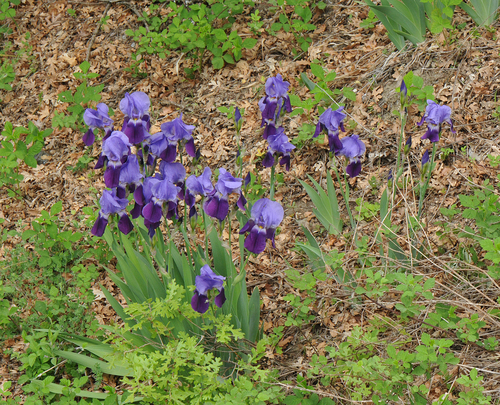
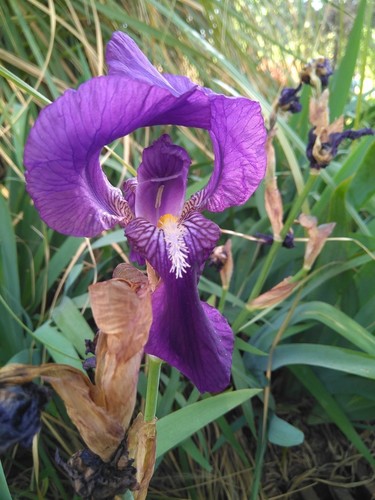
© photo
Wikimedia Commons · CC BY-SA or Public Domain
(c) Todd Boland, some rights reserved (CC BY) · cc-by
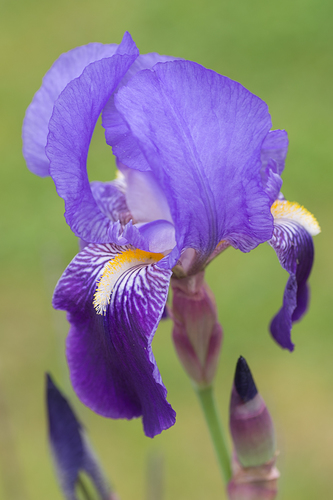
(c) Cristina Villaverde, some rights reserved (CC BY) · cc-by
Global distribution
POWO places the strict hybrid’s native range in the northwestern Balkans and lists many introduced regions, including France and Corsica. French botanical references chiefly describe it as cultivated, locally escaped or naturalized, with no established national invasive status.
- Native1
- Introduced7
- Northwestern Balkans
- Metropolitan France
- Corsica
- Italy
- Spain
- Great Britain
- Switzerland
- United States
Hexagons: regions where the plant occurs. Green dots: native range.1
Identity
A visible line of hairs on each outer flower segment gives the bearded iris its familiar name. The plant treated here is Iris × germanica L., in the Iridaceae. POWO and WFO retain the hybrid sign, while horticultural references often write Iris germanica for garden use. 1 2 5
The distinction matters. EPPO describes Iris x germanica as an ancient sterile hybrid between Iris pallida and Iris variegata, propagated vegetatively. It also notes that many other garden iris hybrids have been sold under the same name. EPPO includes German iris among its English common names. 3
French occurrence and name records use iris des jardins, iris d’Allemagne and flambe. GBIF records the first two, while CBNFC uses the regional name Iris bleu d’Allemagne. These French names describe the same familiar garden plant, rather than establishing separate botanical taxa. 4 14
The beard itself is a row of hairs on the drooping outer tepals. It distinguishes bearded from beardless irises, many of which are more closely associated with moist or wet soils. Flower structure is therefore a practical starting point when identifying a plant and choosing its growing conditions. 10 8
Recognition
A thick rhizome supports this herbaceous perennial. It is not a true bulb: Missouri Botanical Garden emphasizes the distinction and describes creeping rhizomes that gradually build large clumps. The plant expands along the surface rather than renewing itself from a bulb like a tulip. 8
Long, flat, sword-shaped leaves range from green to glaucous gray-green. They commonly rise in fans from the rhizome. RHS describes clumps with gray-green foliage; NC State adds that the strap-like leaves overlap at their bases and lie in a single plane. 5 7
The flower has two clear levels. Three upright segments are the standards and three drooping segments the falls, with a beard along the center of each fall. Cultivar colors extend well beyond violet: white, cream, yellow, orange, pink, red, blue, purple, brown and nearly black are all represented. 10 7
Size varies with the horticultural group. RHS gives a mature height of 0.5–1 m (1.6–3.3 ft) and a spread of 0.1–0.5 m (4–20 in) for Iris germanica. Missouri places the common type around 60–90 cm (2–3 ft) tall and distinguishes cultivars from dwarf to tall bearded classes. 5 8
Taxonomy and names
The accepted name in modern botanical references is Iris × germanica L. POWO attributes the taxon to Linnaeus and lists numerous synonyms, including Iris × alba, Iris × amoena and Iris × barbata, as well as Iris florentina var. alba and var. pallida. 1
EPPO offers a useful distinction for gardeners: in the strict sense, Iris x germanica denotes a particular hybrid, probably connected with I. pallida and I. variegata. In horticultural use, the same name has often served as a broad label for garden bearded irises. 3
RHS continues to use Iris germanica as a horticultural name and marks it correct in its system, whereas POWO/WFO display the hybrid sign. The form Iris × germanica is more precise taxonomically, while the form without the sign remains common on labels and in gardening references. 5 1
Two practical consequences follow. A modern bearded iris is not necessarily the strict botanical taxon, and a cultivar name does not establish a wild species identity. Many tall bearded irises are complex horticultural lines, so read the species or group name alongside the cultivar. 8 7
Distribution and occurrence in France
For the strict hybrid, POWO places the native range in the northwestern Balkan Peninsula. Its wide introduced range includes France, Corsica, Italy, Spain, Great Britain and parts of Asia, North Africa, Oceania and North America. 1
That broad distribution largely reflects a long-cultivated plant whose rhizomes are readily moved between gardens. WFO describes a European cultigen able to persist after cultivation and sometimes spread through wasteland, roadsides and other disturbed places. 2
In France, CBNFC describes Iris germanica as frequently cultivated and naturalized across the country, with a stronger presence around the Mediterranean and in the Massif Central. Its local assessment is alien but noninvasive. French references therefore describe it as noninvasive; this assessment should not be treated as a rule for other regions. 14
SNHF describes the garden setting as sunny, light and well-drained, often with calcareous soil. Persistent winter wetness or standing water is the principal concern. These preferences help explain its association with old walls, banks, rock gardens and long-established gardens. 15 14
Growing: keep the rhizome aerated
Shallow planting is the key step. NC State advises placing rhizomes at soil level or barely covered, without mulch. Missouri recommends only a very light covering and spacing of about 30–60 cm (12–24 in). 7 8
The fleshy rhizome stores reserves but rots when water remains around it. Improve or raise heavy ground before planting. Mounds and slopes are often better positions than hollows in a flower bed, where water collects around the rhizome. 8 15
Choose full sun. RHS specifies a sunny position, and Missouri associates full sun with the best flowering and disease resistance, although light shade can be tolerated. More water is not a substitute for adequate light or suitable drainage. 5 8
Water sparingly. Irrigate at planting or after division to establish roots; afterward, 10–20 mm (0.4–0.8 in) per week during establishment and flowering when rain is lacking is a guide for most well-drained soils. Once established, bearded iris tolerates dry conditions better than persistent wetness. 7 8
Watering, division and maintenance
Divide after flowering, in summer or early fall in the local growing season. Utah State University Extension recommends division when plants become crowded, often 2–5 years after planting. Each division should retain at least one growing point, a healthy section of rhizome and developed roots. 10
Missouri gives a practical sign: when crowding reduces flowering, divide after the blooms finish, often every 3–4 years. Firm outer sections with vigorous leaf fans are better planting material than exhausted, aging centers. 8
Removing spent flower stems keeps the bed tidy and avoids unnecessary seed production on fertile plants. Leave healthy foliage in place to replenish the rhizome. Remove dead, spotted or otherwise suspect leaves promptly instead of cutting back every green leaf after flowering. 8 10
Keep feeding light. SNHF suggests a low-nitrogen application in spring if needed, and Missouri likewise recommends light fertilization. Excess nitrogen produces more foliage and tissues that are more vulnerable to rot, rather than solving poor flowering. 15 8
Diseases and pests
In North America, the iris borer is a serious regional problem. University of Wisconsin describes it as the most damaging iris pest in its setting. Caterpillars tunnel into rhizomes and favor foul-smelling rot, with bearded irises particularly affected. 11
University of Minnesota describes early injury as small holes and water-soaked or brownish streaks in leaves. The caterpillar later moves into the rhizome, creating an entry point for bacterial rot. Sudden yellowing therefore calls for opening and inspecting the clump, rather than assuming it simply needs irrigation. 12
Other familiar problems include bacterial soft rot, fungal rots, leaf spot and occasional viral mosaic. Utah State University emphasizes prevention through spacing, sun, drainage, debris removal and prompt disposal of diseased parts. 10
Missouri identifies deeply buried rhizomes, excess shade, too much fertilizer and overcrowding as common causes of failure to flower. Address those causes before adding water, which may worsen the problem when the rhizome is already too wet. 8
Fragrance uses and toxicity
Garden use is chiefly ornamental: sunny beds, borders, banks, rock gardens and cut flowers. RHS records scented flowers; Missouri describes large, often fragrant blooms and numerous horticultural introductions in different colors and sizes. 5 8
RHS lists orris root among the common names. Missouri Department of Conservation describes an extract from rhizomes of Iris germanica and Iris pallida, known as orris-root tincture, formerly used to imitate violet scent in perfume, cosmetic powders, potpourri and gin. This specialist use does not make a fresh rhizome a garden food. 5 9
For animals, the ASPCA lists Iris species as toxic to dogs, cats and horses. Possible signs include salivation, vomiting, diarrhea and lethargy, and its account places the highest concentration of toxic compounds in the rhizomes. 13
NC State describes low-severity human toxicity after ingestion and possible skin irritation, naming irisin, iridin or irisine among the compounds involved and roots, sap and seeds among the affected parts. The caution remains moderate: the animal risk is clear, while the commonly described human effects are chiefly irritation and digestive upset. 7 13
Cultivars and lookalikes
Cultivars account for much of the garden diversity. NC State lists 'Again, and Again', 'Concertina', 'Harvest of Memories', 'Immortality', 'Passion & Purity', 'Sugar Blues' and 'Tickled Peach'. Missouri notes the thousands of bearded iris cultivars available. 7 8
Horticultural classes chiefly describe height and season: miniature dwarf, standard dwarf, intermediate, miniature tall, border and tall bearded irises. These are garden classification groups rather than separate botanical species. 8
The first important distinction is between rhizomatous and bulbous irises. Iris × germanica has a horizontal rhizome; Dutch irises and several rock-garden irises have true bulbs. Treating them all alike leads to errors in watering and especially planting depth. 8 10
The second concerns wetland irises. Iris pseudacorus, yellow flag iris, grows in wet or aquatic settings and can become problematic outside its native range. Bearded iris instead needs well-drained soil and air around the rhizome. 8 15
Main sources
- Plants of the World Online / Kew, Iris × germanica L.
- World Flora Online, Iris × germanica L.
- EPPO Global Database, Iris x germanica
- GBIF Backbone Taxonomy, Iris ×germanica L.
- Royal Horticultural Society, Iris germanica bearded iris
- Royal Horticultural Society, How to grow border irises
- NC State Extension Gardener Plant Toolbox, Iris x germanica
- Missouri Botanical Garden Plant Finder, Iris germanica
- Missouri Department of Conservation, Irises
- Utah State University Extension, Growing Iris
- University of Wisconsin Horticulture, Iris Borer
- University of Minnesota Extension, Iris borers
- ASPCA, Iris toxicity entry
- CBNFC-ORI, Iris germanica L., 1753
- Société Nationale d'Horticulture de France, Iris des jardins
Frequently asked questions
Is bearded iris a true bulb?
No. Botanically, it is a rhizomatous perennial with a horizontal storage rhizome, rather than a bulb like a tulip. The broad gardening category of bulbs sometimes includes such plants, but it does not describe their actual underground organ.
Should a bearded iris rhizome remain visible?
Yes, at least at soil level or very lightly covered, depending on climate. Deep burial, mulch or persistent moisture reduces flowering and makes rot more likely.
When should I divide bearded iris?
After flowering, in the local summer or early fall. Horticultural references commonly recommend division when clumps become dense, typically after 3–4 years.
Why has my bearded iris stopped flowering?
Common causes include deeply buried rhizomes, too much shade, excess nitrogen, an aging clump or excessive moisture. Full sun, drainage and division address those underlying problems.
Is bearded iris toxic to cats and dogs?
Yes. The ASPCA lists Iris species as toxic to dogs, cats and horses, with a higher concentration of toxic compounds in rhizomes. Watch for salivation, vomiting, diarrhea or lethargy after ingestion.
Is bearded iris invasive in France?
French references describe it as noninvasive. It is cultivated and locally naturalized, but the references used do not establish a national invasive alien species status. This does not determine its status in another country.
How does it differ from Iris pseudacorus?
Iris pseudacorus is yellow flag iris, a wetland plant that can be invasive outside its native range. Bearded iris instead needs well-drained soil and shallow, aerated rhizomes.
Similar plants



If you are unsure about a plant’s toxicity, ask a botanist or veterinarian for advice.