
Lily (Lilium spp., )
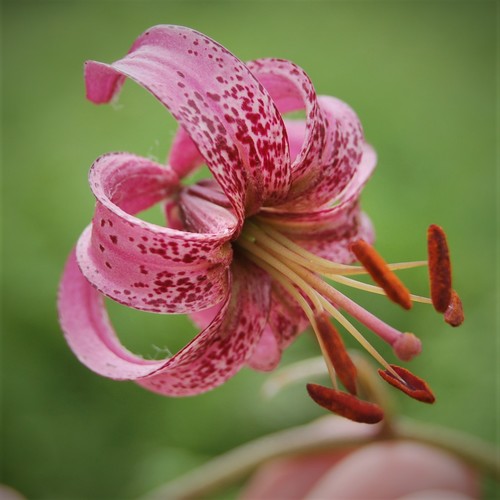
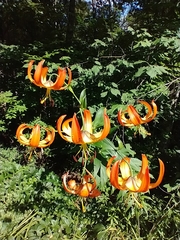

Lily refers here to the genus Lilium Tourn. ex L., rather than a single species. These bulbous perennials in the Liliaceae are chiefly native to the temperate Northern Hemisphere and are grown for their large, often fragrant flowers in borders, pots and bouquets. Toxicity to cats is the main safety concern with true lilies.
Read moreLily and true lily
Allow a few hours of direct sun per day, preferably morning or evening.
Sun or light partial shade, with cool roots


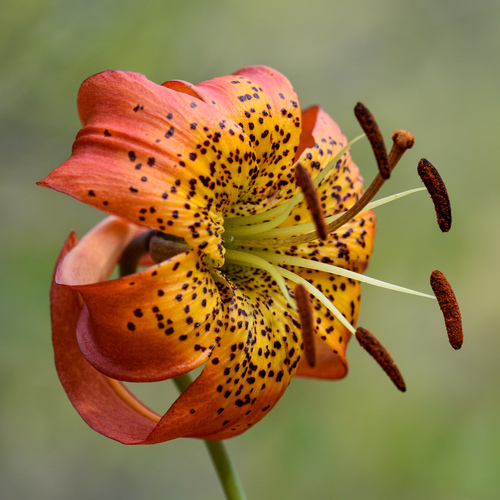
© photo
Alexander Dubynin · cc-by
Tom Norton · cc-by
Jay Horn · cc-by
(c) Alexander Dubynin, some rights reserved (CC BY) · cc-by
(c) Tom Norton, some rights reserved (CC BY) · cc-by
Global distribution
Lilium is described at genus level: POWO recognizes a very broad native range in the temperate Northern Hemisphere, extending to the northern Philippines, and 124 accepted species. Local records from France, Europe, Asia or North America therefore do not apply to every cultivar sold in garden centers.
- Native5
- Temperate Northern Hemisphere
- Europe
- East Asia
- North America
- Northern Philippines
Hexagons: regions where the plant occurs. Green dots: native range.↗
Identity
The name lily, or true lily, refers here to the genus Lilium Tourn. ex L., in the family Liliaceae. It does not identify a single species: Lilium spp. is used here to cover several true lilies, including species, hybrids and garden cultivars. POWO/WCVP accepts Lilium as a genus, published in 1753, and places it in the order Liliales. 1 2
The word lily extends far beyond this genus. A peace lily is a Spathiphyllum, a daylily a Hemerocallis, a Peruvian lily an Alstroemeria, a calla lily a Zantedeschia, and lily of the valley a Convallaria. This is more than a matter of names: care requirements and toxic risks vary greatly between genera. 3 8
In the nursery and flower trade, lilium often means bulbs and cut flowers from horticultural groups: Asiatic, Martagon, Longiflorum, Trumpet, Oriental or OT hybrids. Information about the genus should therefore not be taken as a guarantee for every named cultivar. 3
Recognition
A true lily grows from a scaly bulb made of overlapping fleshy pieces. In spring it produces an upright, often sparsely branched stem with simple green leaves, arranged alternately or in whorls. Horticultural sources describe highly variable garden plants, often about 30 cm–1.8 m (1–6 ft) tall according to group and cultivar. 3 5
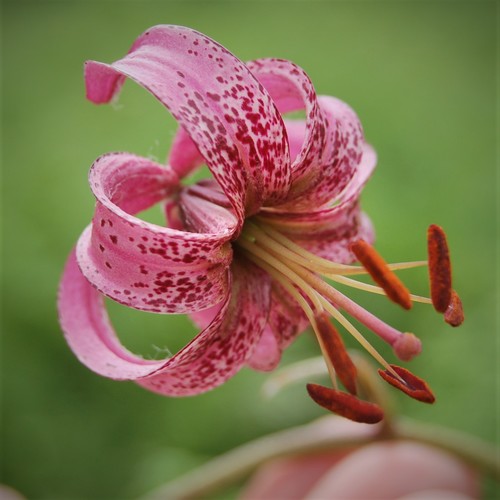
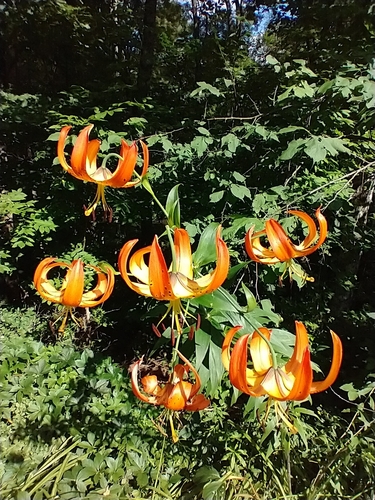
Flowers sit at the top of the stem, singly or in a raceme or umbel. They have six free tepals, six stamens and often abundant pollen. Depending on the group, flowers may be cup-shaped, bowl-shaped, trumpet-shaped, funnel-shaped or recurved into a turban. Colors include white, yellow, orange, red, pink, purple and variegated combinations. 3 4
Two features help prevent confusion: a single flowering stem rising from a scaly bulb, and leaves growing along that stem. Daylilies form clumps of strap-shaped leaves from the base. Alstroemerias have leafy stems but do not belong to Liliaceae. Arums and peace lilies have an inflorescence enclosed by a spathe, rather than six free tepals. 3
Taxonomy and scope
POWO lists Lilium as an accepted genus, with 124 accepted species in the consulted extract. The same account gives it a broad native range, from the temperate Northern Hemisphere to the northern Philippines, and lists horticultural introductions or naturalized populations in other regions. 1
That breadth matters: the dimensions, fragrance, soil needs, flowering season or uses of a single species cannot be applied to all Lilium. For example, Lilium candidum has a Mediterranean history and distinctive white flowers, whereas the Oriental and Asiatic lilies sold in garden centers are horticultural groups. 5 3
Names such as Asiatic hybrids, Martagon, Longiflorum, Trumpet, Oriental and Orienpet are useful horticultural guides. They help anticipate fragrance, height, flower orientation and soil requirements, but do not replace a complete botanical identification. 3
Origin and distribution
As a genus, Lilium belongs mainly to temperate regions of the Northern Hemisphere. POWO records numerous native areas in Europe, Asia and North America, extending to the northern Philippines. A genus-level range does not mean that every potted lily is wild or locally native. 1
In France, true lilies may be native, cultivated, introduced or simply present as garden plants, depending on the taxon. The native or cultivated description for mainland France therefore needs that qualification; no invasive status is reported for France. 1 10
Natural habitats vary between species, including meadows, woodland edges, open woodland, cool slopes and mountain areas. In cultivation, the shared requirements are simpler: fertile, well-drained soil that stays reasonably moist during growth, with light reaching the stem and the roots kept cool. 3 6
Life cycle and cultivation
Lilies are bulbous geophytes: visible growth emerges, flowers and dies back, while the bulb supports the next cycle. Cultivation sources stress planting bulbs promptly, in fall or spring according to local conditions, because prolonged dry storage does not suit them. 6
Reliable drainage is central to successful cultivation. Bulbs dislike standing water, but the soil should not dry out completely during growth. Pots need depth and drainage holes; in the garden, mulch or low-growing plants can keep the root zone cooler. 3 6
Spent flowers can be removed after flowering, but the leaves should remain while green. Cutting an active stem too low weakens the bulb for the following year. Propagation is by offsets, bulb scales or seed; seedlings take longer to reach flowering size. 4 5
Uses and risks
Lilies are grown chiefly for borders, deep pots, cutting gardens and bouquets. Modern groups have been selected for color, size, fragrance, vase life and early flowering. No food use is established for Lilium spp. as a whole. 3 6
Cats face the most serious risk. The ASPCA lists Lilium species as toxic to cats and non-toxic to dogs and horses. The FDA explains that true lilies and daylilies can cause severe kidney damage in cats, even after exposure to small amounts of plant material, pollen or vase water. 7 8 9
For dogs, caution is still warranted without overstating the hazard: the FDA describes possible gastrointestinal upset, rather than the kidney failure typical of cats. For people, lilies are not automatically food plants. Culinary uses involving particular species or traditions need separate treatment, specifying the plant part, preparation and a reliable food source. 8 11
Horticultural groups and similar plants
Asiatic lilies are often colorful, early and lightly scented or unscented. Martagon lilies bear many small, nodding flowers. The Longiflorum group includes trumpet-flowered Easter lilies. Trumpet and Aurelian lilies are often fragrant; Oriental lilies have large, often strongly scented flowers. Orienpet lilies cross Oriental and Trumpet groups. 3
These groups are not species. An Asiatic lily label may mean a garden hybrid, whereas Lilium candidum, Lilium auratum or Lilium martagon identifies a species or a more precise taxon. When buying, look for the genus, group, cultivar, expected height, fragrance, hardiness and toxicity to cats. 4 5
A dangerous mistake works in either direction: assuming that a plant called lily outside Lilium has the same risks as a true lily, or treating a true lily bouquet as harmless. The FDA distinguishes true lilies and daylilies, which are highly dangerous to cats, from calla lilies and peace lilies, which mainly irritate through oxalates, and Peruvian lilies, which mainly cause digestive upset when eaten in large amounts. 8
Main sources
- Plants of the World Online / Kew, Lilium Tourn. ex L.
- WCVP data consulted, Lilium Tourn. ex L.
- NC State Extension Gardener Plant Toolbox, Lilium
- Royal Horticultural Society, Lilium auratum and Lilium genus description
- Royal Horticultural Society, Lilium candidum
- UC Cooperative Extension Master Gardeners, Growing Lilies
- ASPCA, Lily toxicity entry
- U.S. FDA, Lovely Lilies and Curious Cats
- ASPCA, dog, cat and horse toxicity data for Lilium
- Trefle data consulted, Lilium candidum
- Iowa State University Extension and Outreach, Aaron Steil and Cynthia Haynes, Growing Lilies in Iowa — Lilium genus; Edible or Toxic? (reviewed June 2026)
Frequently asked questions
Is Lilium spp. a species?
No. Lilium is the genus, and spp. means that the discussion covers several species or hybrids of true lilies. For an individual plant, read its full label: species, group and cultivar.
Are all true lilies dangerous to cats?
True lilies in the genus Lilium should be treated as dangerous to cats. The FDA and ASPCA identify leaves, flowers, pollen and vase water as possible sources of exposure.
Are lilies toxic to dogs?
The ASPCA lists Lilium species as non-toxic to dogs, while the FDA mainly describes possible gastrointestinal upset. Avoiding ingestion is still sensible, without claiming canine kidney toxicity.
Why use the term true lilies?
Many plants called lilies do not belong to Lilium. Peace lilies, calla lilies, Peruvian lilies, lily of the valley and daylilies belong to other genera and families and carry different risks.
When should lily bulbs be planted?
Cultivation sources allow planting in fall or spring, with well-drained soil and prompt planting of the bulbs. Depth varies with the group and bulb size.
Why do my lilies have gray or brown spots?
Leaf spots may result from botrytis or other lily diseases, encouraged by stagnant humidity and overhead watering. Water at the base and improve air movement around the stems.
Can lily flowers or bulbs be eaten?
No food use is established for Lilium spp. as a whole. Traditions and particular edible species need separate treatment, with a precise food source, plant part, preparation and context.
Similar plants

If you are unsure about a plant’s toxicity, ask a botanist or veterinarian for advice.