
Persian walnut (Juglans regia, )
Persian walnut (Juglans regia) is a large deciduous tree in the Juglandaceae family, native to southwestern and central Asia, from the Caucasus and eastern Turkey to the western Himalayas. Cultivated since antiquity for its nuts and valuable cabinetmaking timber, it has aromatic compound leaves and roots that release a substance toxic to many neighboring plants.
Read morePersian walnut, Common walnut, English walnut, Walnut and Madeira walnut




© photo
(c) Ed Alverson, some rights reserved (CC BY), uploaded by Ed Alverson · cc-by
iNaturalist User · cc0
Taken Jun 3, 2021 by José Teso (cc-by-sa)
Taken Jul 19, 2021 by Barry Mcclelland (cc-by-sa)
Taken Jun 3, 2020 by Alain Bigou (cc-by-sa)
Taken Aug 13, 2019 by nhfc (cc-by-sa)
Taken Jun 28, 2021 by Alain Bigou (cc-by-sa)
© copyright of the Board of Trustees of the Royal Botanic Gardens, Kew.




Global distribution
The native range of Juglans regia extends from the Caucasus and eastern Turkey to Lebanon and the western Himalayas, through central Asia and Iran. Spread westward in antiquity, first to Greece and then throughout the Mediterranean basin, it is now cultivated across the temperate continents.
- Native5
- Turkey
- Iran
- Kyrgyzstan
- Lebanon
- India (western Himalayas)
Hexagons: regions where the plant occurs. Green dots: native range.1
Identity
Persian walnut (Juglans regia L., 1753), also known as common walnut, English walnut, Madeira walnut, or simply walnut, is a large deciduous tree in the genus Juglans and family Juglandaceae. Its genus name comes from Latin Jovis glans, “Jupiter’s acorn”: Romans considered the fruit worthy of the gods. The epithet regia, “royal,” refers to the tree’s imposing size and the long-standing value of its timber. 1 2
Southwestern and central Asia, from the Caucasus to the western Himalayas, is the homeland of Juglans regia. It has been cultivated since antiquity for nuts and dense, fine-grained cabinetmaking timber. The English word walnut comes from Old English wealhnutu, “foreign nut,” distinguishing this imported fruit from the hazelnut native to the British Isles.
Recognition
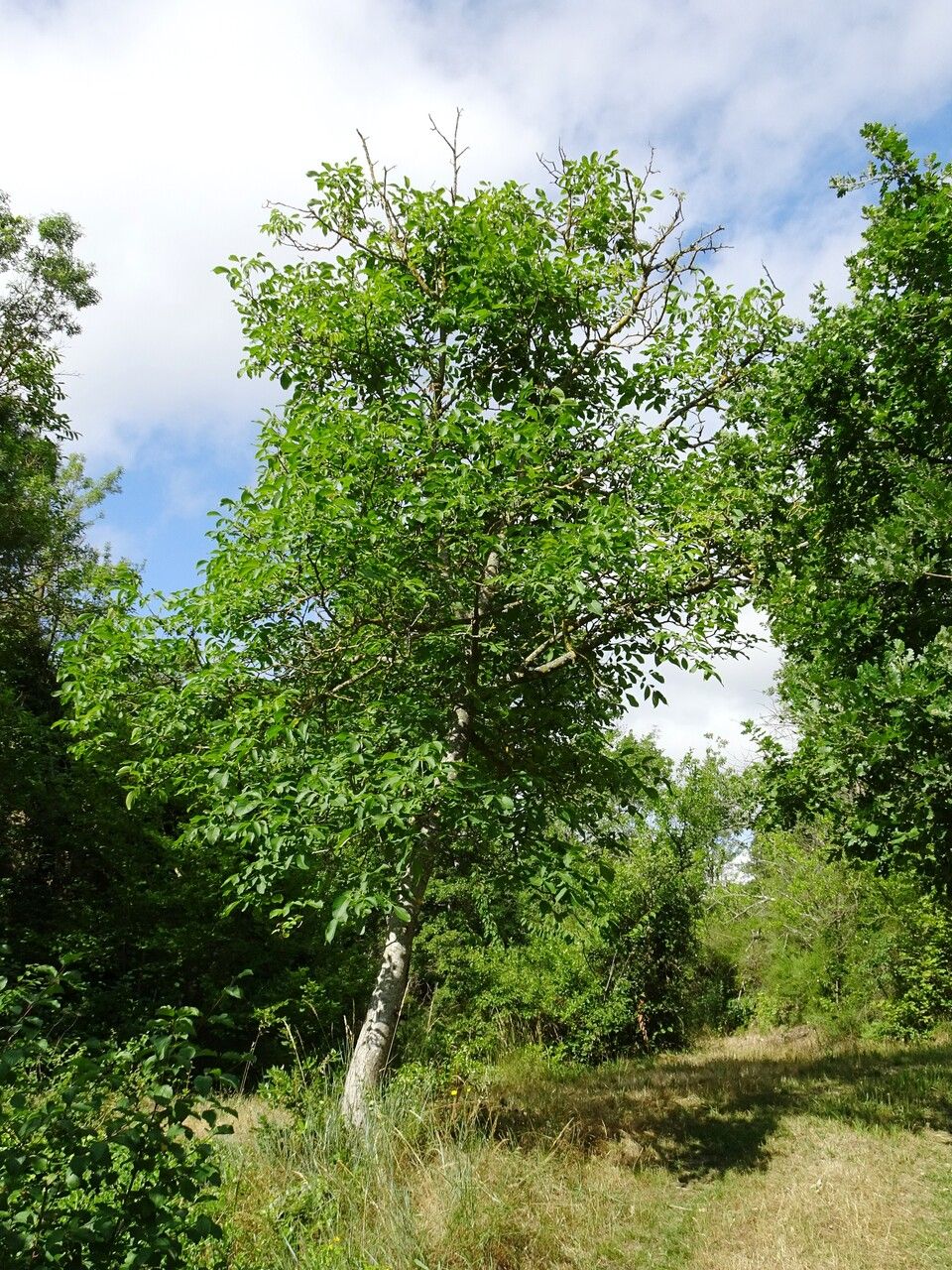
Mature Persian walnut trees commonly reach 10 to 25 m (33 to 82 ft) in height with a spread of 8 to 20 m (26 to 66 ft), and the oldest trunks may exceed 2 m (6.6 ft) in diameter. A broad, rounded crown with dense branching makes this an imposing specimen tree rather than a typical avenue tree. 4 2
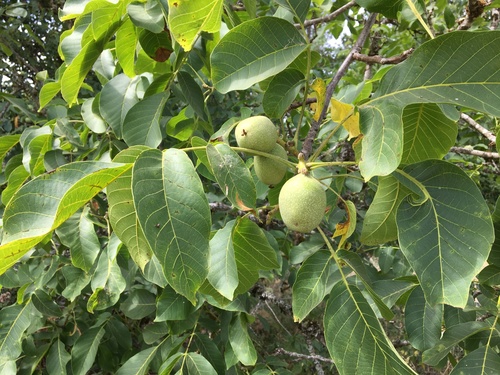
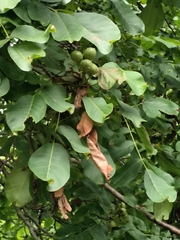
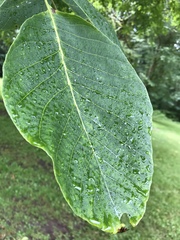
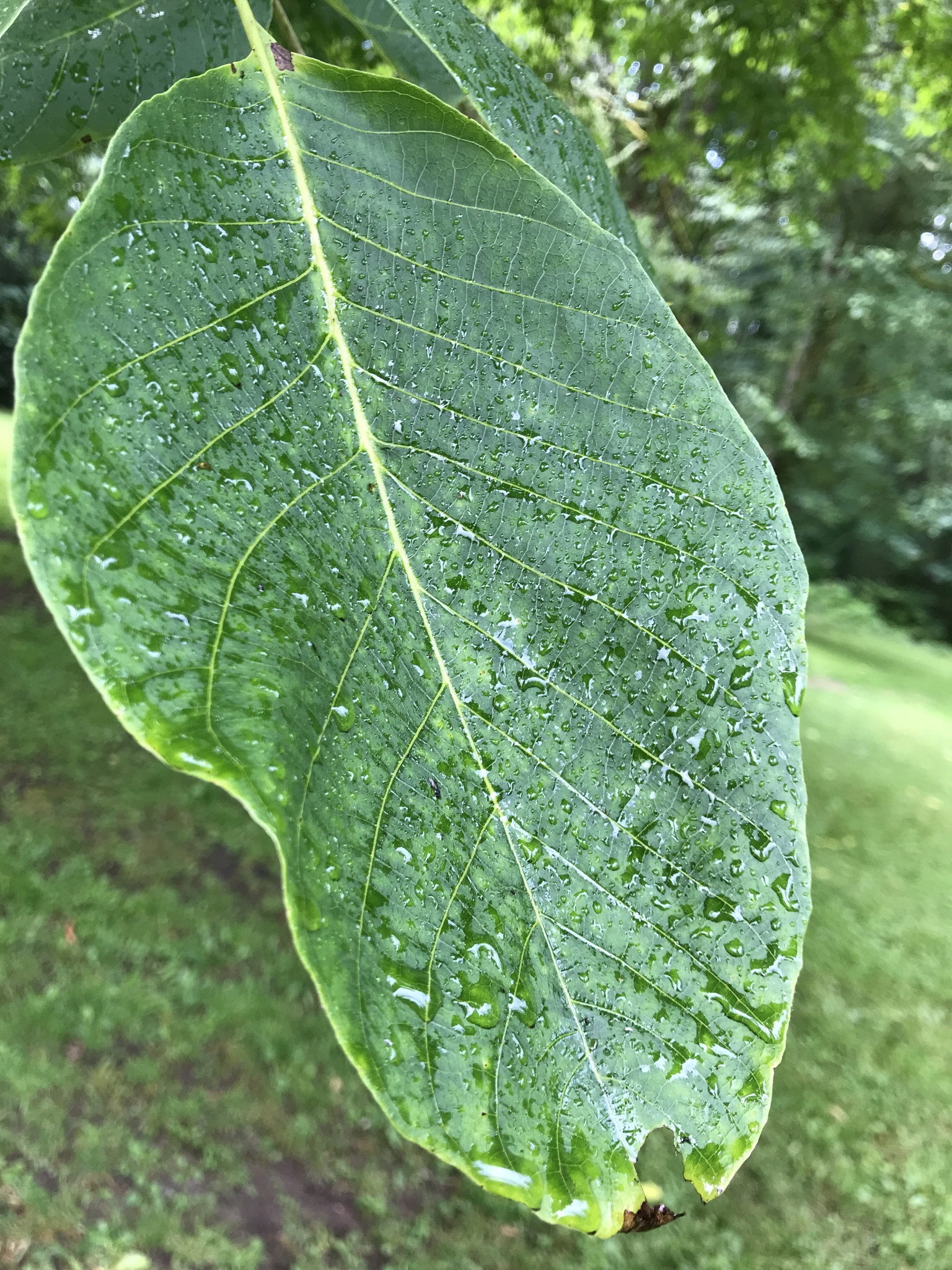
Compound, odd-pinnate leaves measure 20 to 45 cm (8 to 18 in) long and bear 5 to 9 oval leaflets, smooth and glossy. Crushing a Juglans regia leaf releases a distinct aromatic scent, helping distinguish it from other large trees with compound foliage. 4
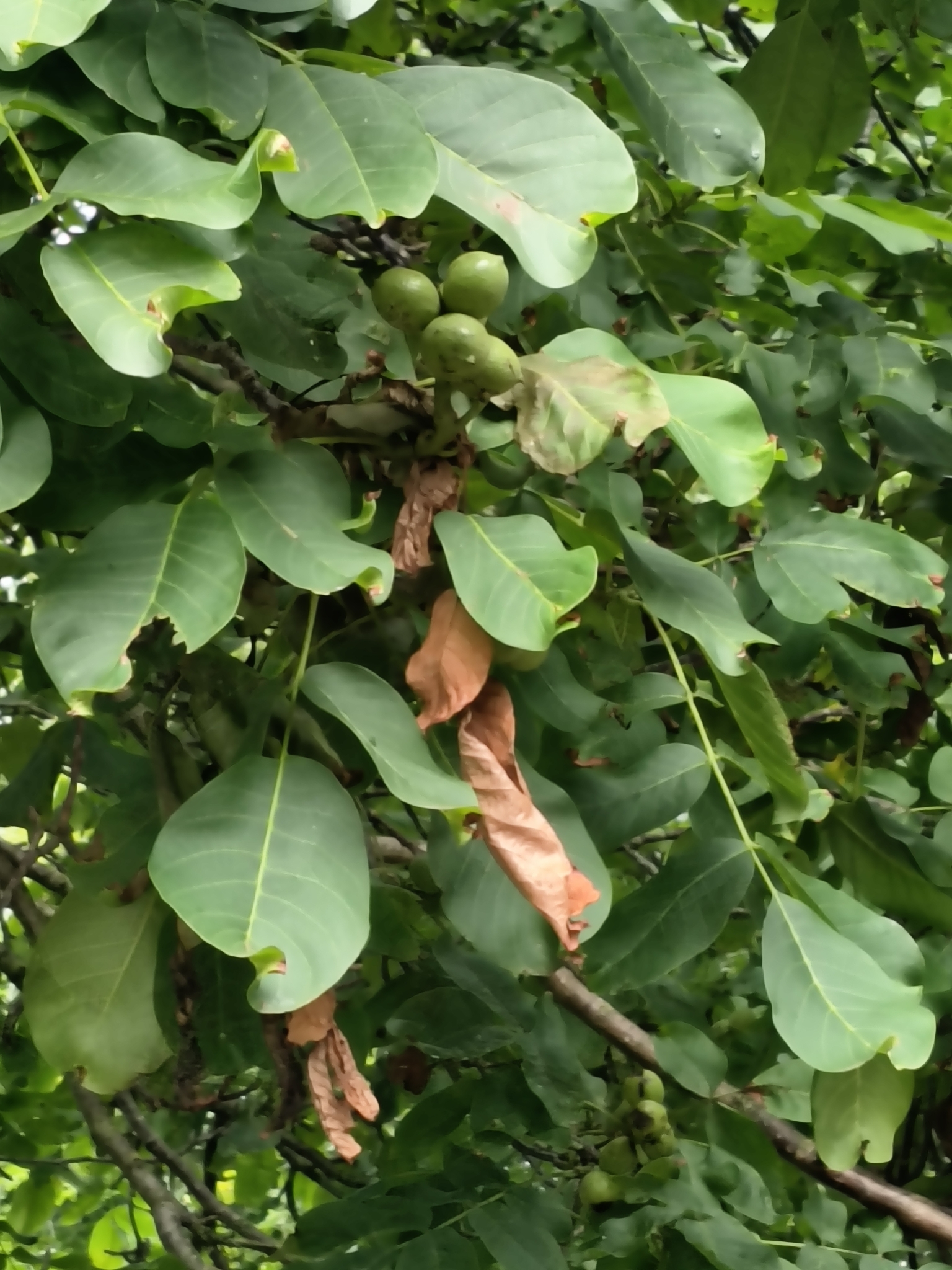
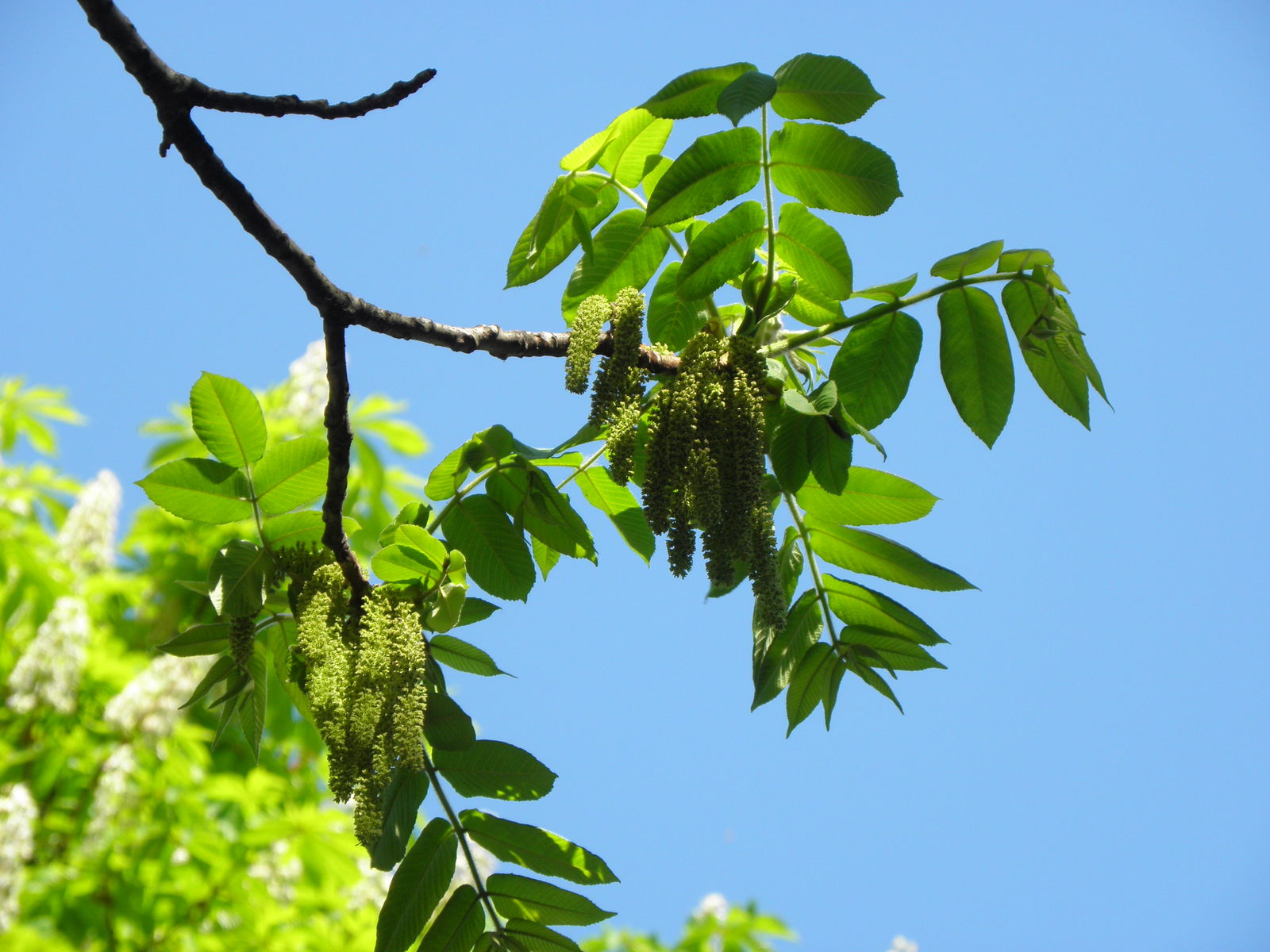
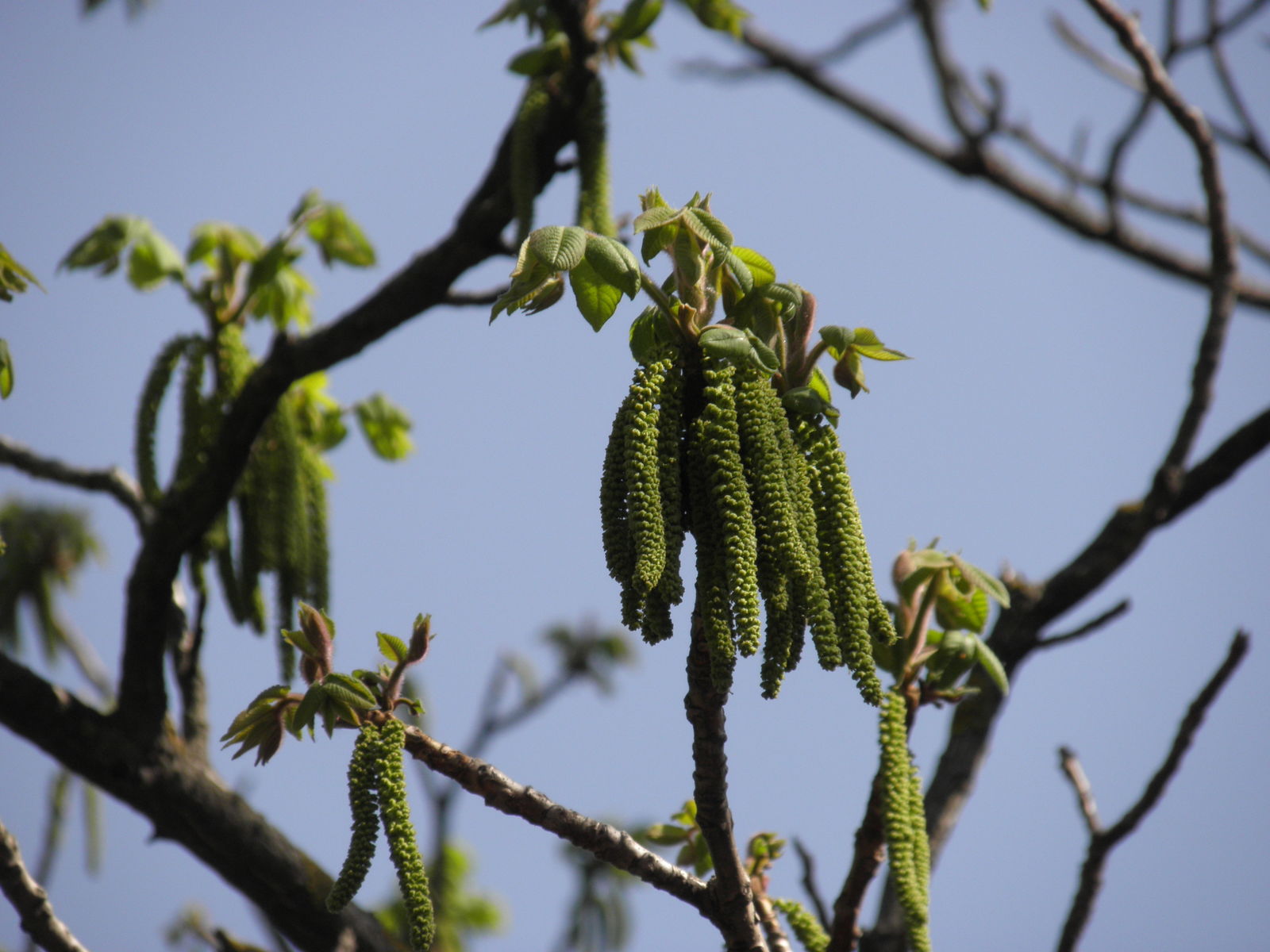
Both sexes of flowers occur on one tree, making the species monoecious. Male flowers form hanging catkins 5 to 10 cm (2 to 4 in) long in spring, while inconspicuous female flowers appear in small terminal groups on the same shoots. Following wind pollination, the nut develops inside a smooth green husk. In fall, the husk blackens and splits, releasing a wrinkled shell that encloses the edible kernel. 3 3 4
Useful taxonomy
POWO/WCVP accepts the name Juglans regia L., the only member of its genus widely distributed beyond its native range. Numerous historical varieties and forms have been described, most now treated as botanical synonyms:
- Juglans regia var. sinensis C.DC., a historical variety;
- Juglans regia var. kamaonia C.DC., another varietal name;
- Juglans regia subsp. fallax (Dode) Popov, a subspecific name;
- Juglans regia f. pendula (Pépin) C.K.Schneid., a named form;
- Juglans regia f. monophylla (Dochnahl) C.K.Schneid., another named form.
Around twenty species belong to Juglans, distributed in the Americas, Europe, and Asia. Its closest relative is the North American black walnut, Juglans nigra, often confused with J. regia in gardens and mixed orchards. 1
Habitat and range
Across its native range, Persian walnut grows from the Caucasus and eastern Turkey to Lebanon and the western Himalayas, through Iran and central Asia. It occupies mixed mountain forests and cool valleys with deep soil, from lowlands to mid-elevation mountains depending on the region. 5 8
Westward cultivation began in antiquity, first in Greece and then throughout the Mediterranean basin with the Roman legions. Persian walnut is now cultivated across the temperate continents. INPN records its naturalized presence in France, where it notably supplies the Grenoble walnut appellation. 9
Full sun and deep, moist, well-drained soil are essential; this tree tolerates neither shade nor compacted soil or winter waterlogging. Its taproot grows deep from an early age, greatly reducing the chances of successful establishment when older trees are transplanted. 4
Life cycle and reproduction
Spring brings flowering, generally in May in the Northern Hemisphere, depending on climate. Wind carries pollen from male catkins to female flowers on the same or a nearby tree, since most cultivars are partly self-sterile. Nuts ripen in September and October in this seasonal setting, when the green husk cracks and blackens. 3 4
Seed-grown trees produce their first nuts at around 4 to 6 years, but full production arrives only at 15 to 20 years, depending on the cultivar and rootstock. Sowing a cold-stratified walnut does not reproduce a named variety faithfully: grafting onto seedling rootstock remains the standard method for reliable, consistent nuts. 5
Uses and risks
Two major products come from Persian walnut: nuts rich in fats and protein, eaten fresh, dried, or pressed for oil, and dense, fine-grained timber prized across Europe for cabinetmaking, veneer, and gunstocks. 5
Roots of Juglans regia release juglone, an allelopathic substance that inhibits many neighboring plants within 15 to 20 m (49 to 66 ft), including tomatoes, potatoes, azaleas, and rhododendrons. This toxicity explains the often bare ground beneath a mature walnut canopy and argues against planting it immediately beside a vegetable garden. 4
Fresh walnuts are not classed as toxic to dogs or cats, but moldy nuts left on the ground can be dangerous. They may contain tremorgenic mycotoxins, notably penitrem A, which cause tremors, loss of coordination, and seizures in dogs. 6 7
Varieties, look-alikes and related plants
Fruit cultivars differ in harvest timing and yield. Franquette is a traditional French selection whose late budbreak limits frost damage; Chandler is an early, productive American cultivar; and Lara bears on lateral buds from its early years. Deeply cut foliage makes Laciniata primarily an ornamental choice.
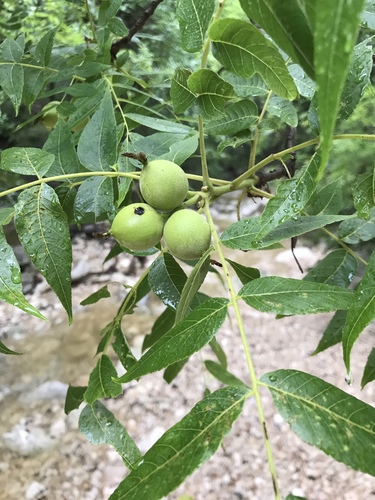
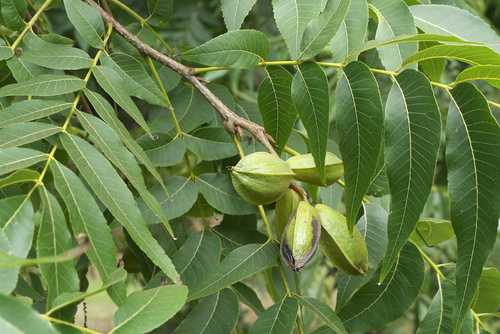
Black walnut, Juglans nigra, is the most frequent source of confusion. This North American species has more leaflets, a markedly harder shell, and a stickier, more staining husk than Juglans regia. Both species share juglone-producing roots, so that trait does not distinguish them.
Main sources
- Plants of the World Online / Kew, Juglans regia L.
- Royal Horticultural Society, Juglans regia - common walnut
- Missouri Botanical Garden Plant Finder, Juglans regia
- NC State Extension Gardener Plant Toolbox, Juglans regia
- Plants For A Future, Juglans regia
- Merck Veterinary Manual, Tremorgenic Neuromycotoxicosis in Dogs
- Munday et al., 2008, presumptive tremorgenic mycotoxicosis in a dog after eating mouldy walnuts, New Zealand Veterinary Journal
- Tela Botanica eFlore (BDTFX), Juglans regia
- INPN / MNHN, Juglans regia L., 1753
Frequently asked questions
Are Persian walnuts toxic to dogs and cats?
Fresh walnuts are not classed as toxic, but large quantities can cause weight gain and digestive problems. Moldy fallen nuts are dangerous because they may contain tremorgenic mycotoxins that cause tremors and seizures in dogs.
Why does little grow beneath a walnut tree?
Juglans regia roots release juglone, a substance that inhibits the growth of many nearby plants, including tomatoes, potatoes, and azaleas. The often bare area beneath its crown is a familiar identification clue.
How long does a walnut tree take to produce nuts?
The first nuts often appear at 4 to 6 years, but full production is reached only at 15 to 20 years, depending on the cultivar and rootstock.
How does Persian walnut differ from black walnut?
Juglans regia has 5 to 9 leaflets and a relatively thin shell that is easy to crack by hand. The North American black walnut, Juglans nigra, has more leaflets and a much harder, thicker shell.
Can you prune a walnut tree in winter?
No. Pruning in winter or early spring while sap is rising causes heavy bleeding that weakens the tree. Prune in late summer, outside the period of rising sap.
Where does Persian walnut come from?
Its native range extends from the Caucasus and eastern Turkey to Lebanon and the western Himalayas. It reached the Mediterranean basin in antiquity before being cultivated across the temperate continents.
Is walnut wood valuable?
Yes. The dense, fine-grained timber of Juglans regia is prized for cabinetmaking, veneer, and gunstocks, making it one of the most valued European timbers.
Similar plants
If you are unsure about a plant’s toxicity, ask a botanist or veterinarian for advice.