
Coral jasmine (Nyctanthes arbor-tristis, )
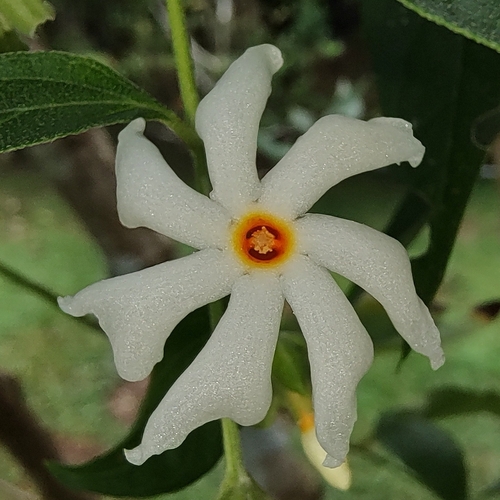


Coral jasmine (Nyctanthes arbor-tristis) is a shrub or small tree in the Oleaceae family, native to the Himalaya, the Indian subcontinent and mainland Southeast Asia. Its white flowers with orange tubes open at dusk, release their fragrance at night and fall at daybreak, earning the species its Latin epithet arbor-tristis, meaning sad tree. Widely cultivated in the tropics for its flowers and dye, it remains rare in temperate horticulture.
Read moreCoral jasmine, Night-flowering jasmine, Parijat, Tree of sorrow, Night-blooming jasmine and Harsingar
Allow a few hours of direct sun per day, preferably morning or evening.
Full sun to light partial shade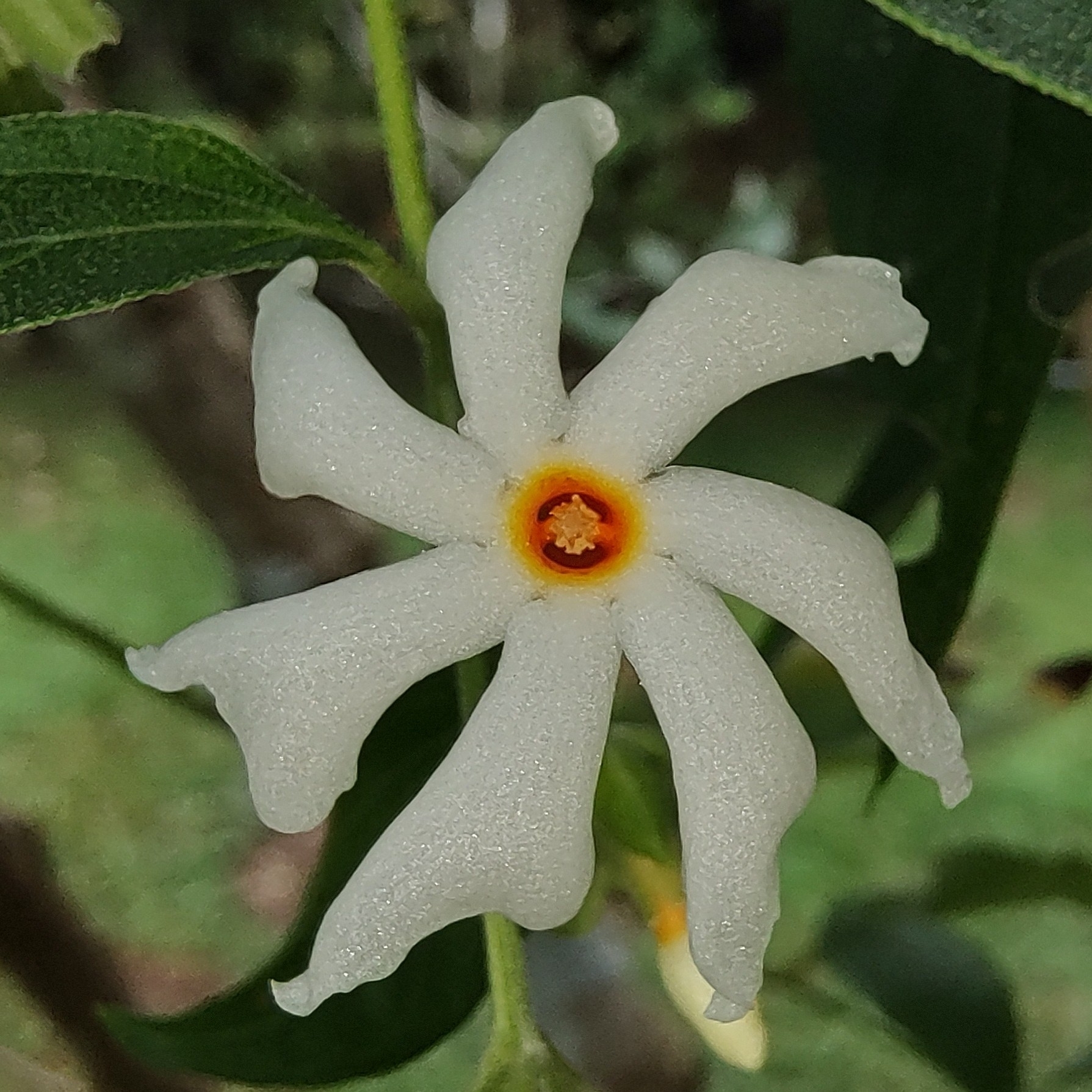



© photo
(c) tangming, some rights reserved (CC BY-NC), uploaded by tangming · cc-by-nc
Wikimedia Commons · CC BY-SA or Public Domain
Taken Nov 26, 2020 by Luis Oscar Herrera Valdez (cc-by-sa)
© copyright of the Board of Trustees of the Royal Botanic Gardens, Kew.




Global distribution
Nyctanthes arbor-tristis is native from the eastern Himalaya and the Indian subcontinent to mainland Southeast Asia, Sumatra and Java. It is widely introduced and cultivated in the tropics for its fragrant flowers and dye, including the Caribbean and French overseas territories such as Réunion.
- Native5
- Introduced3
- India
- Nepal
- Thailand
- Cambodia
- Indonesia
- Malaysia
- Réunion
- Trinidad and Tobago
Hexagons: regions where the plant occurs. Green dots: native range.1
Identity
Coral jasmine (Nyctanthes arbor-tristis L., 1753), also called night-flowering jasmine or parijat, is a shrub or small tree in the Oleaceae family, the only widely cultivated species of Nyctanthes. It usually reaches 2 to 6 m (6.5 to 20 ft) in cultivation, occasionally 10 m (33 ft) when allowed to grow freely. Its orange-red corolla tube is immediately recognizable, a detail absent from jasmines of the genus Jasminum. The Latin epithet arbor-tristis literally means “sad tree,” describing fleeting flowers that open at dusk and fall before daybreak. 1 2
Metropolitan France rarely sees this species outside greenhouses, although its national inventory records it under the French names nyctanthe arbre-triste and jasmin de nuit. It is also established on Réunion, whose tropical climate suits it much better. 5
Recognition
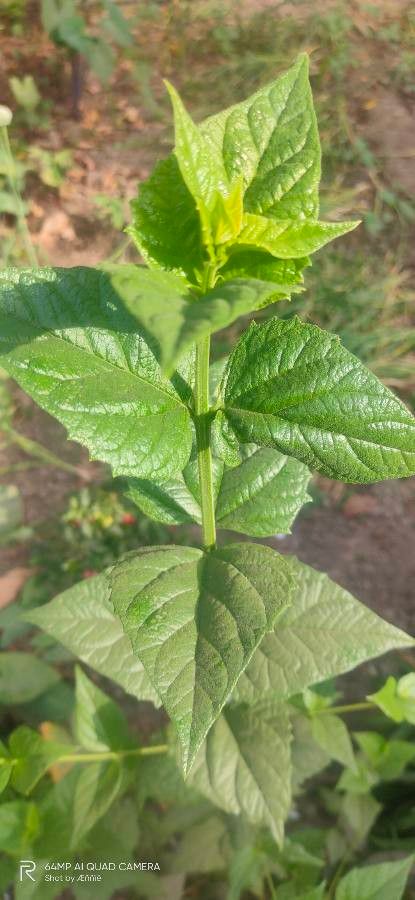
Cultivated specimens commonly stand 2 to 6 m (6.5 to 20 ft) tall, while unrestrained trees can approach 10 m (33 ft) in favorable climates. Rough, flaky gray bark contrasts clearly with the smooth wood of many nearby jasmines. 4 3
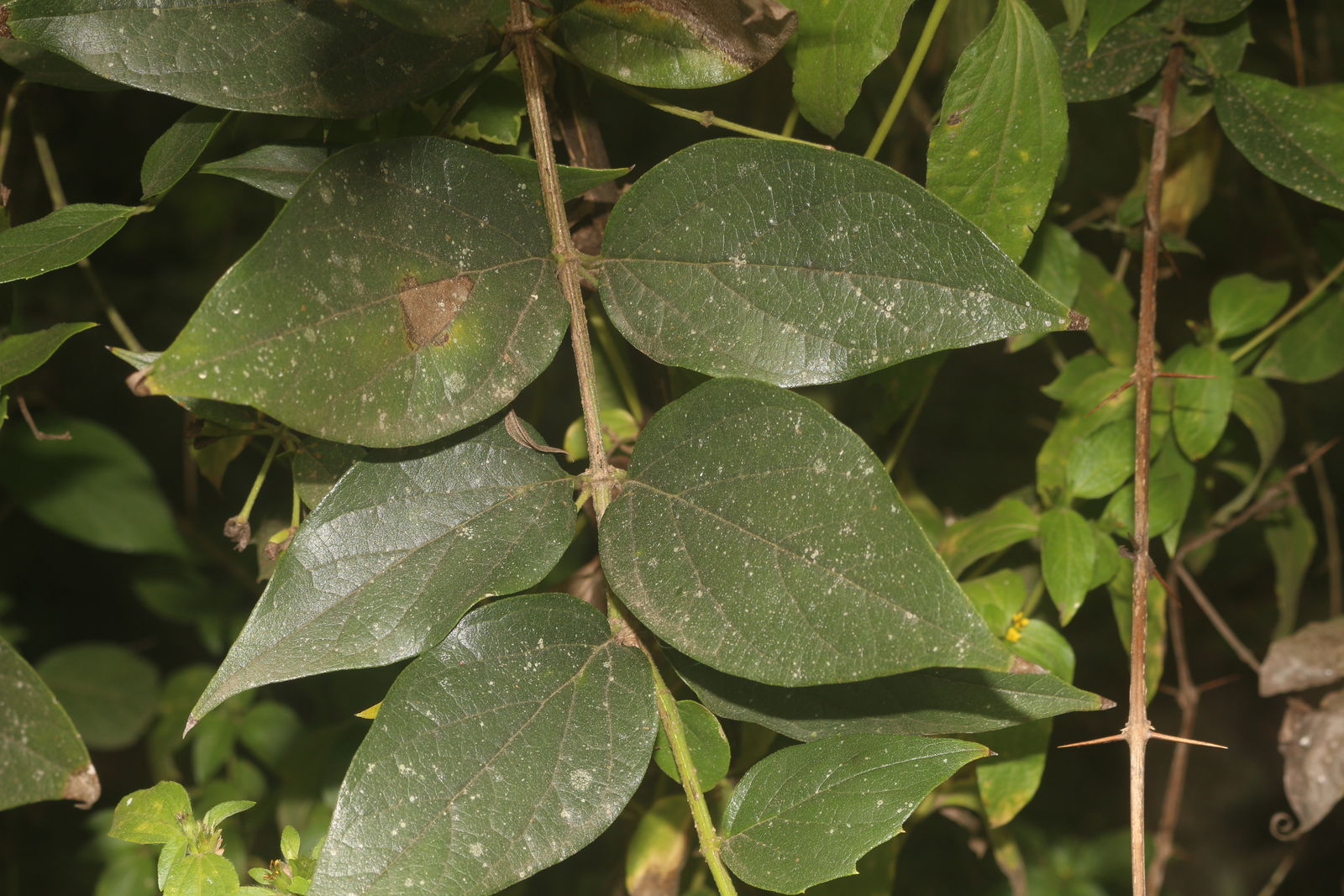
Opposite, simple leaves measure 6 to 12 cm (2.4 to 4.7 in) long and 2 to 6.5 cm (0.8 to 2.6 in) wide. Their rough upper surface helps identify the species even without flowers. White flowers with 5 to 8 lobes have a distinctive orange-red corolla tube and appear in clusters of 2 to 7. 3 4
Each flower lasts just one night: it opens at dusk, scents the air for several hours, then falls faded at dawn, carpeting the ground in white and orange. The fruit is a flat, brown, heart-shaped capsule about 2 cm (0.8 in) across, divided into two chambers, each containing a single seed. 3
Useful taxonomy
Published in 1753, Nyctanthes arbor-tristis L. is the name accepted by POWO/WCVP. Botanical revisions have left it with several synonyms:
- Parilium arbor-tristis (L.) Gaertn., a historical synonym
- Nyctanthes dentata Blume, a historical synonym
- Bruschia macrocarpa Bertol., a historical synonym
- Scabrita scabra L., a historical synonym
- Scabrita triflora L., a historical synonym
Older classifications placed the species in Verbenaceae for many years. Modern taxonomy assigns it to Oleaceae, the family of olives, privets and jasmines of the genus Jasminum. The genus Nyctanthes itself contains only a handful of tropical Asian species, none with a comparable horticultural use. 1 8
Habitat and range
From the eastern Himalaya and the Indian subcontinent (Nepal and India), the native range reaches mainland Southeast Asia (Myanmar, Thailand, Cambodia, Laos and Vietnam), with populations as far as Sumatra and Java. The species grows in dry deciduous forests and on rocky hillsides, from sea level to 1500 m (4920 ft). 4 1
Introductions for flowers and dye have established the plant widely in tropical regions, including island Southeast Asia, the Caribbean and French overseas territories such as Réunion. Outside its native range it remains mainly ornamental and associated with religious practice, with no documented invasive status. 4 5
Life cycle and reproduction
Late summer through fall is the flowering season, depending on climate, with peak flowering often linked to the South Asian rainy season. In West Bengal, where it is the state flower, mass flowering traditionally heralds Durga Puja. 4 6
Semi-ripe stem cuttings root within a few weeks, much faster and more reliably than seeds, whose germination remains irregular. The shrub also readily reshoots after hard cutting, a useful trait when maintaining an informal hedge. 4
Its intense nighttime fragrance suggests pollination by insects active at dusk and after dark, a trait shared with other strongly scented white flowers such as jasmine. Seeds, one per capsule chamber, remain the slower option: irregular germination explains growers' preference for cuttings. 4
Uses and risks
Nyctanthin in the orange corolla tube is a pigment related to saffron crocetin. It dyes silk and cotton saffron yellow; in Southeast Asia, the same dye has long colored Buddhist monastic robes. 4
Bitter leaves feature in traditional treatments for fever, rheumatism and intestinal worms, while recent research associates them with antimalarial and anti-inflammatory properties. An acute toxicity study in mice gives a median lethal dose of 977 mg/kg by intraperitoneal injection, indicating generally low toxicity, but no specific data have been published for cats, dogs or humans. 7 4
Seeds yield a pale yellow oil rich in sterol compounds, and the bark contains glycosides still little studied outside regional laboratories. No Western health authority has validated a therapeutic human dose of Nyctanthes arbor-tristis, calling for caution outside medical supervision. 4
Varieties, look-alikes and related plants
Indian horticultural literature mentions two ornamental cultivars, 'Karna-phool' and 'Seeya Shrinagar', with no verified international botanical standard to date. 4
Jasmines of the genus Jasminum are the likeliest source of confusion: they too are fragrant and sometimes flower at night, but lack the orange-red corolla tube and rough opposite leaves characteristic of Nyctanthes arbor-tristis. Highly toxic oleander (Nerium oleander) shares only its use as a tropical ornamental, without a close botanical relationship.
Main sources
- Plants of the World Online / Kew, Nyctanthes arbor-tristis L.
- International Plant Names Index, Nyctanthes arbor-tristis L.
- NParks Singapore FloraFaunaWeb, Nyctanthes arbor-tristis
- PROSEA / Pl@ntUse, Nyctanthes arbor-tristis
- INPN / MNHN, Nyctanthes arbor-tristis L., 1753
- Top Tropicals Plant Encyclopedia, Nyctanthes arbor-tristis (Parijat)
- PMC, In vivo antimalarial property and acute toxicity of Nyctanthes arbor-tristis leaves
- GBIF Backbone Taxonomy, Nyctanthes arbor-tristis L.
Frequently asked questions
Is coral jasmine a true jasmine?
No. Nyctanthes arbor-tristis belongs to Oleaceae, the same family as jasmines of the genus Jasminum, but forms its own genus. Its orange-red corolla tube and rough, opposite leaves distinguish it from true jasmines.
Why do the flowers fall every morning?
The flowers of Nyctanthes arbor-tristis open at dusk and naturally fade at daybreak, completing a one-night floral cycle. This behavior, known since the time of Linnaeus, explains the epithet arbor-tristis.
Is coral jasmine toxic to cats and dogs?
No formal toxicity profile exists for domestic animals. An acute toxicity study in mice gives a median lethal dose of 977 mg/kg by intraperitoneal injection, indicating generally low toxicity, with no specific cat or dog data.
What is the dye extracted from the flower used for?
The orange corolla tube contains nyctanthin, a pigment related to saffron crocetin, used to dye silk and cotton saffron yellow, as well as some Buddhist monastic robes.
Where does the name Parijat come from?
Parijat is the Sanskrit name, linked to a Hindu legend in which Krishna steals the celestial tree from the garden of Indra. The name remains widely used in India, notably for the state flower of West Bengal.
What light and watering does coral jasmine need?
The shrub prefers full sun to light partial shade and moderate watering. Allowing the substrate to dry between waterings helps prevent root rot, its main weakness in cultivation.
Can Nyctanthes arbor-tristis be confused with another species in its genus?
Nyctanthes includes several related species from South and Southeast Asia, but Nyctanthes arbor-tristis is by far the most widely cultivated and the only one extensively described in horticulture. Its full scientific name remains the most reliable reference.
Similar plants
If you are unsure about a plant’s toxicity, ask a botanist or veterinarian for advice.