
Lima bean (Phaseolus lunatus, )
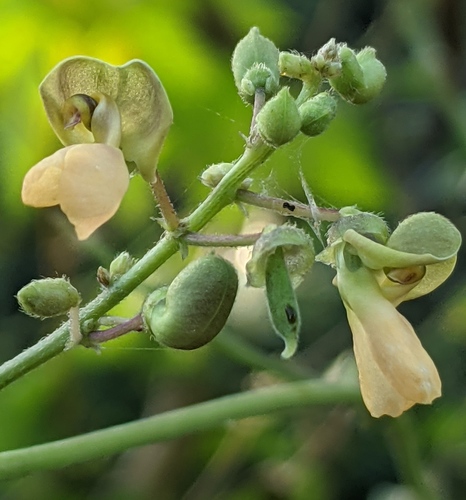


Lima bean (Phaseolus lunatus) is an herbaceous climbing vine in the Fabaceae family, native to tropical America from Mexico to Peru. Perennial in warm climates, it is grown as an annual in temperate regions. Its flattened pods contain large, kidney-shaped seeds that may be white, green or red-marbled and are eaten as a vegetable, like common beans. Raw seeds, particularly colored forms, contain a cyanogenic glycoside and require thorough cooking before consumption.
Read moreLima bean, Butter bean, Sieva bean and Madagascar bean


© photo
(c) Lyrae, some rights reserved (CC BY), uploaded by Lyrae · cc-by
Wikimedia Commons · CC BY-SA or Public Domain
Taken Feb 15, 2017 by Photoflora - Benoit BOCK (©)
© copyright of the Board of Trustees of the Royal Botanic Gardens, Kew.


Global distribution
Phaseolus lunatus is native to tropical America, from Mexico to Peru, with two independent domestication centers: one in the Andes around 2000 BCE, the other in Mesoamerica around 800 CE. It is now widely grown in the tropics and warm temperate climates; outside its native range its presence represents deliberate cultivation.
- Native5
- Mexico
- Guatemala
- Peru
- Colombia
- Venezuela
Hexagons: regions where the plant occurs. Green dots: native range.1
Identity
Lima bean (Phaseolus lunatus L., 1753), also known as butter bean, is a legume in the Fabaceae family and the genus Phaseolus. Unlike common bean (Phaseolus vulgaris), it behaves as a perennial vine in warm climates: swollen roots allow it to regrow from one season to the next. In temperate climates it is grown as an annual. 1 2
The epithet lunatus, meaning crescent-shaped, describes the seed’s flattened, curved outline, quite different from the oval seed of common bean. French usage includes haricot de Madagascar and tsidimy, while pois du Cap is used in Réunion and Mauritius. Those regional names reflect historical Indian Ocean trading routes rather than a different botanical species. 4 3
Recognition
Twining stems, either smooth or hairy, can reach 4–5 m (13–16 ft) in well-established climbing forms. A root system reaching nearly 2 m (6.5 ft) deep helps explain the drought tolerance of established plants. Its growth can therefore differ markedly from the compact outline of a bush bean. 5 3
Trifoliate leaves have oval to lance-shaped leaflets 3–15 cm (1–6 in) long on a leaf stalk that may exceed 15 cm (6 in). A notable character in Phaseolus lunatus is epigeal germination: the cotyledons emerge above ground, rather than remaining buried as in most other beans. 2 3
Small whitish to pink flowers have the pea-flower form, with a keel twisted through one and a half turns. Oblong, often curved pods measure 5–11 cm (2–4.5 in) long and 1.2–2.5 cm (0.5–1 in) wide. Each contains two to four seeds, flattened and kidney-shaped, ranging from white through green and red-marbled to black, depending on the variety. 3 2 A stem over 3 m (10 ft), combined with cotyledons emerging at germination, already helps rule out related dwarf beans before flowers or mature seeds appear.
Useful taxonomy
In 1753, Carl Linnaeus described Phaseolus lunatus, in the same year as Phaseolus vulgaris, the other major cultivated bean species. Seed catalogs and botanical literature still include obsolete synonyms: Phaseolus limensis Macfad., Phaseolus lunatus var. macrocarpus (Moench) Benth., Phaseolus inamoenus L., Phaseolus puberulus Kunth and Phaseolus xuaresii Zuccagni. These names refer to the same kidney-seeded species under older labels.
The name limensis, referring to Peru’s capital Lima, illustrates how the common name can be confused with the plant’s actual range, which is much wider than the Lima region. The accepted name Phaseolus lunatus remains the reliable identification reference; synonyms mainly help interpret old catalogs and commercial labels. 1 4
Habitat and range
From Mexico to Peru, lima bean has native populations across Central America and several South American countries, including Colombia and Venezuela. In natural habitats it grows at humid tropical forest edges and along streambanks, climbing over shrubs and young trees. 1 3
Its history includes two independent domestications. The first, in the Peruvian Andes around 2000 BCE, produced a large-seeded group found at archaeological sites associated with the Nazca and Mochica civilizations. The second, in Mesoamerica around 800 CE, produced a small-seeded group often called sieva bean. 6 7
Now widely grown in tropical and warm temperate regions, the plant remains primarily a deliberately cultivated crop. It naturalizes only locally and is not counted among the major invasive species. 2
Life cycle and reproduction
In tropical regions, a lima bean may persist as a perennial for several years. In temperate climates it is grown as an annual and sown after the last frost. Seedlings emerge in about ten days after a 12-hour soak in lukewarm water, a practice that speeds and evens out germination. 3 5
Clusters of flowers develop in the leaf axils, carried on a long stalk often exceeding 15 cm (6 in). Each fertilized pod contains several seeds. Full maturity, indicated by a dry, brittle seed coat, separates the dry-bean harvest from the immature-pod stage used fresh. 3 2
Cultivated plants are propagated only by seed, sown into warmed soil. Seed set declines markedly above 30 °C (86 °F), so the crop suits warm seasons without excessive heat better than periods of peak heat-wave temperatures. 3
Uses and risks
Food is the principal use: immature pods are boiled, dried seeds are soaked and cooked, and sprouted shoots enter certain preparations. Under the name garrofó, the seed is a traditional ingredient of Valencian paella. In Réunion and Mauritius, pois du Cap accompanies curry and forms a staple ingredient of bonbon piment fritters. 3 2
The main danger lies in raw seeds, particularly colored-seeded varieties. They contain phaseolunatin, a cyanogenic glycoside that releases hydrogen cyanide through enzyme action. Prolonged soaking followed by thorough cooking in plenty of water, discarding the water after each stage, destroys phaseolunatin and makes the seeds safe to eat. White-seeded varieties contain considerably less than colored forms. 8 2
Ornamental forms with variegated seeds, grown for foliage or flowers rather than food, remain toxic after partial cooking and should never be eaten. 2
Varieties, look-alikes and related plants
Two broad cultivated groups reflect the independent domestications: large-seeded Andean lima types and small-seeded Mesoamerican sieva or butter bean types. Modern cultivars combine bush or climbing habit, seed color and earliness to suit different uses. 6 5
Other vegetable-garden legumes are the main sources of confusion:
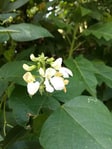
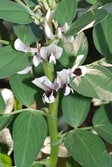
- Phaseolus vulgaris, common bean, with smaller, less flattened seeds;
- Phaseolus coccineus, runner bean, with large red flowers;
- Vicia faba, fava bean, belonging to a different lineage but with a similar pod outline.
A flattened, kidney-shaped seed together with a curved pod 5–11 cm (2–4.5 in) long distinguishes Phaseolus lunatus more reliably than seed-coat color alone. That color ranges from white to black among varieties. 2 1
Main sources
- Plants of the World Online / Kew, Phaseolus lunatus L.
- North Carolina State Extension, Phaseolus lunatus
- Plants For A Future, Phaseolus lunatus
- INPN / MNHN, Phaseolus lunatus L., 1753
- Purdue University, NewCROP, Phaseolus lunatus
- Motta-Aldana et al., 2010, Multiple Origins of Lima Bean Landraces in the Americas, Crop Science
- Serrano-Serrano et al., 2012, Evolution and Domestication of Lima Bean in Mexico, Crop Science
- Adeparusi, 2001, Effect of processing on nutrients and anti-nutrients of lima bean flour, Food/Nahrung
Frequently asked questions
Are lima beans toxic?
Raw seeds, especially colored varieties, contain phaseolunatin, a cyanogenic glycoside that releases hydrogen cyanide. Soaking followed by thorough cooking, discarding the water at each stage, destroys this toxin. White seeds contain much less than colored forms.
How do lima beans differ from common beans?
Lima bean (Phaseolus lunatus) has a larger, flatter, curved seed, whereas common bean (Phaseolus vulgaris) has smaller, more rounded seeds. The two species are grown similarly but do not hybridize naturally.
Why are some lima bean varieties more dangerous than others?
Colored-seeded varieties contain more cyanogenic glycoside than white-seeded ones. Variegated ornamental forms grown for flowers rather than food remain toxic even after partial cooking.
Where do lima beans come from?
Their native range extends from Mexico to Peru. The species was domesticated independently in the Andes around 2000 BCE and in Mesoamerica around 800 CE, explaining the range of seed sizes among cultivars.
Can lima beans grow in temperate climates?
Yes, as annuals sown after the last frost. They do, however, need a longer warm season than common beans to ripen their seeds fully.
Are lima beans perennial?
In their native tropical range, plants can be perennial, regrowing from season to season from swollen roots. In temperate climates with frost, they are grown as annuals.
How can I identify lima beans in the garden?
Look for twining climbing stems, slightly curved oblong pods and, especially, flattened kidney-shaped seeds. These are more reliable than seed color alone, which varies greatly among varieties.
Similar plants
If you are unsure about a plant’s toxicity, ask a botanist or veterinarian for advice.