
Ponderosa pine (Pinus ponderosa, )

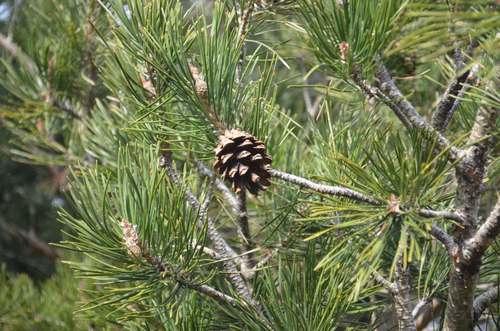
Ponderosa pine (Pinus ponderosa) is a large conifer in the Pinaceae family, native to western North American mountains from southwestern Canada through the western United States. Broad orange bark plates separated by dark fissures, bright green needles in threes and marked tolerance of fire and drought help identify it.
Read morePonderosa pine, Western yellow pine, Bull pine and Blackjack pine


© photo
no rights reserved, uploaded by Julia Carr · cc0
Torsten Watkins · cc0
Jim Morefield · cc-by
Taken May 24, 2018 by Daniel Barthelemy (cc-by-nc)
Taken May 25, 2018 by Daniel Barthelemy (cc-by-nc)
Taken Jun 9, 2019 by Tela Botanica − Jean-Claude Bouzat (cc-by-sa)
Taken Feb 4, 2022 by William Coville (cc-by-sa)
© copyright of the Board of Trustees of the Royal Botanic Gardens, Kew.




Global distribution
Ponderosa pine is native from southwestern Canada, in British Columbia, through the western United States, spanning sixteen states from Washington to Texas. It has also been introduced to temperate Europe and New Zealand, where it locally behaves as an invasive wilding pine.
- Native2
- Introduced1
- Invasive1
- United States
- Canada
- Australia
- New Zealand
Hexagons: regions where the plant occurs. Green dots: native range.1
Identity
Ponderosa pine (Pinus ponderosa Douglas ex C.Lawson, 1836), also called western yellow pine or bull pine, is a large conifer in the Pinaceae family, commonly reaching 20–45 m (66–148 ft) at maturity. Among North America's three-needle pines, it has the widest distribution, ranging through western mountains from southwestern Canada to the western United States. 1 2
Scottish naturalist David Douglas collected it in 1826 near present-day Spokane, Washington, initially mistaking it for eastern red pine. In 1829 he concluded that it was a new species and coined ponderosa, Latin for “heavy,” referring to the wood's weight. Scottish nurseryman Charles Lawson published the formal description in 1836. 3
The fictional Ponderosa Ranch in the television series Bonanza also took its name from this tree. The series was filmed around Lake Tahoe, where ponderosa pine dominates mountain forests. 4
Recognition
Bark offers a more reliable identification clue than needle length or trunk size, changing dramatically as the tree ages. Young trees have dark brown to nearly black bark, giving rise to the early western loggers' name blackjack pine. Older bark becomes orange to yellow-brown, breaking into broad, puzzle-like plates separated by dark fissures. 4 3
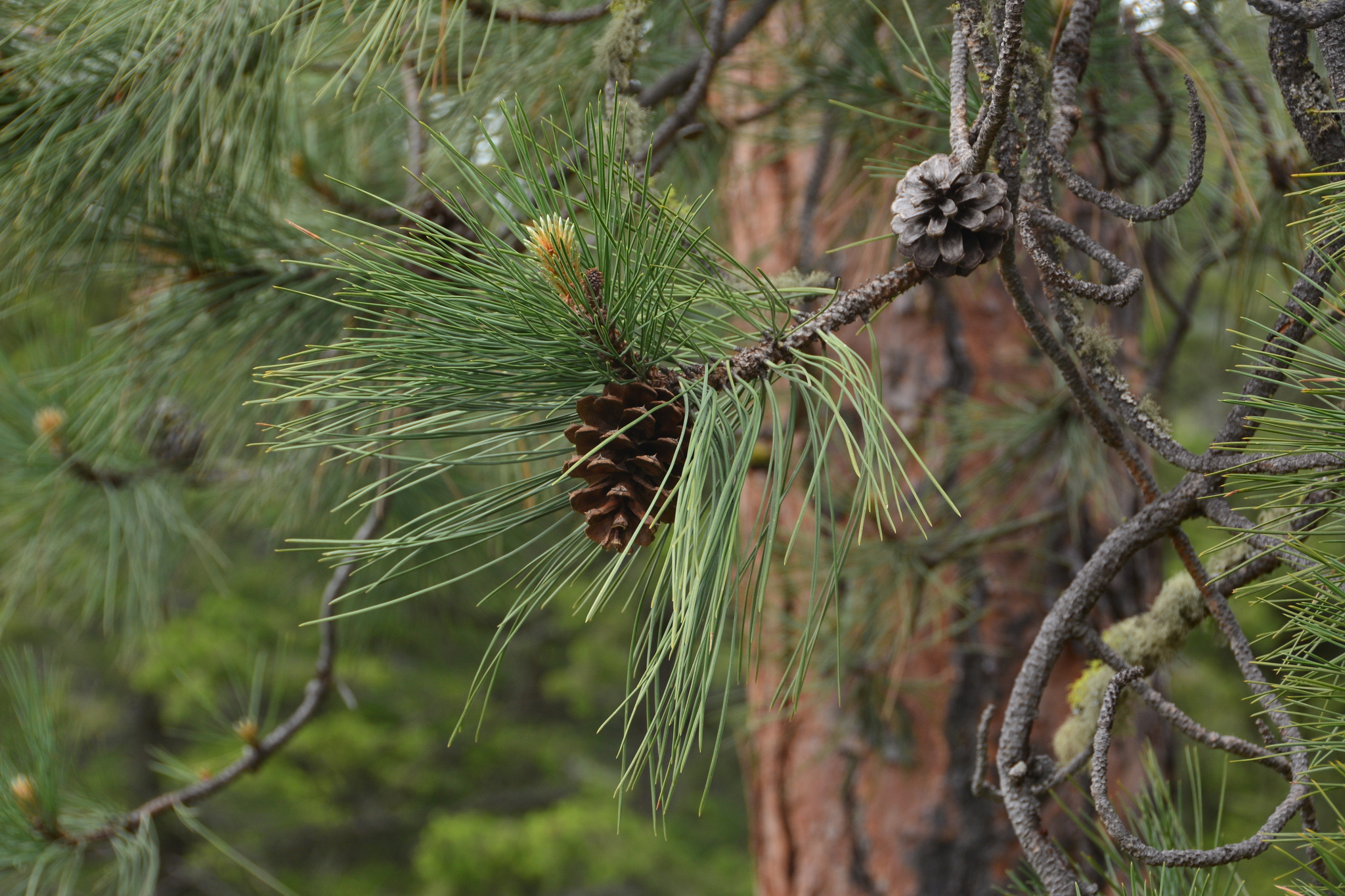
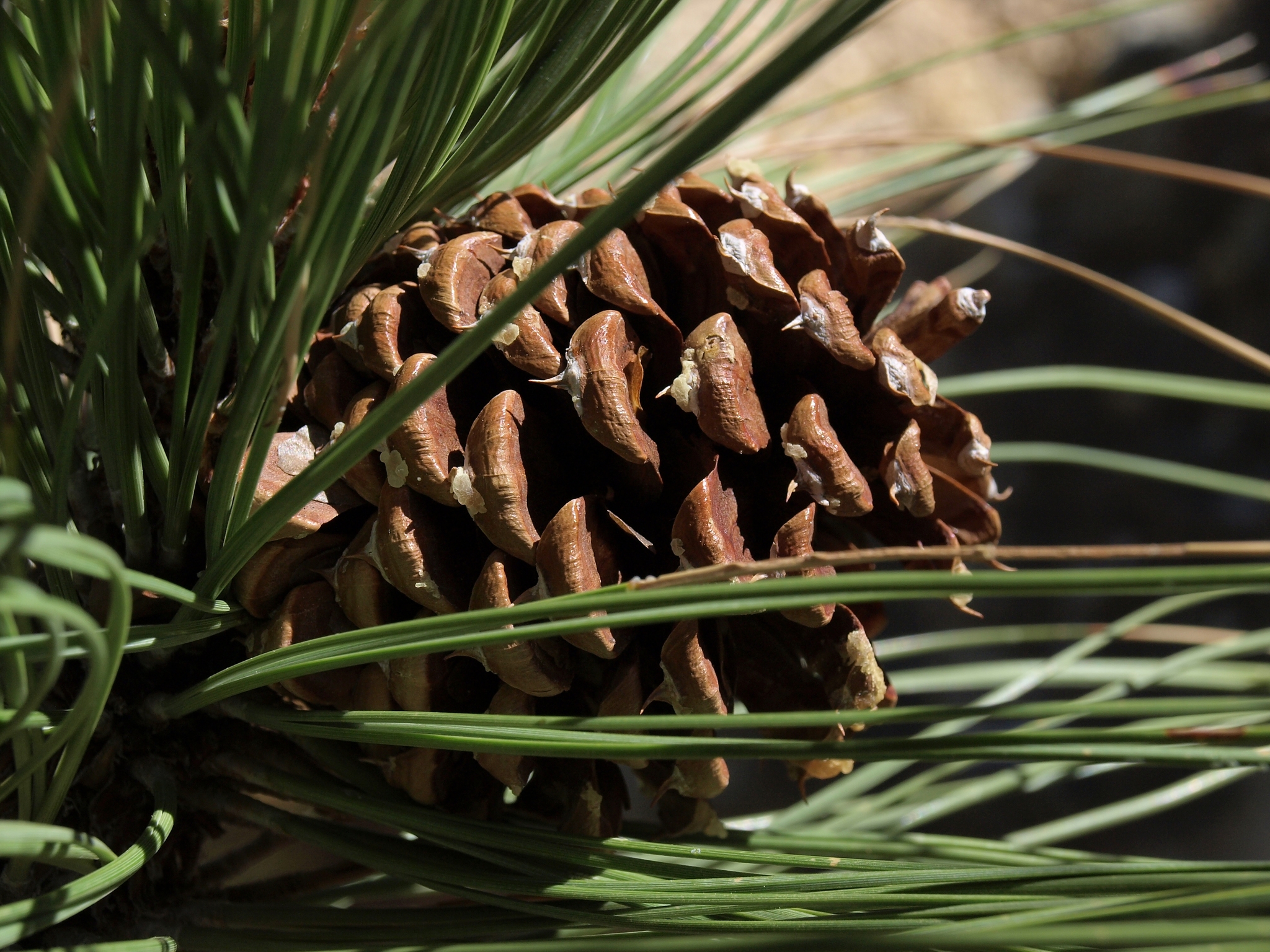
Bright green to yellow-green needles measure 13–25 cm (5–10 in), depending on the variety. Most grow in bundles of three, although some Rocky Mountain populations have only two. Egg-shaped cones measure 8–13 cm (3–5 in) and carry scales tipped with a sharp point usually directed outward. 6 4
A sniff inside a bark fissure mainly reveals turpentine, sometimes lemon peel, but rarely sweet vanilla according to the Gymnosperm Database. The vanilla scent often attributed to ponderosa pine actually comes from its relative Jeffrey pine, which has a much stronger fragrance. 6
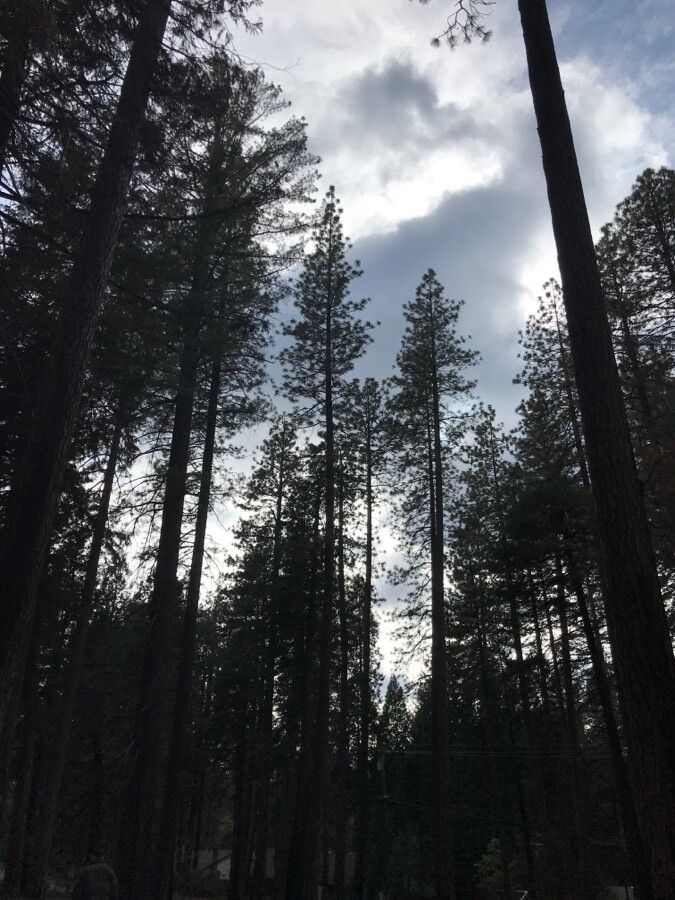
Older trees shed branches from more than half the trunk's total height, making their outline recognizable at a distance. The five tallest measured specimens, located after 2010 through LIDAR surveys in southwestern Oregon, reach 81–83 m (266–272 ft), more than 35 m (115 ft) above the usual mature height. 6
Useful taxonomy
Botanists disagree on ponderosa pine's internal classification. Depending on the author, it comprises two to five infraspecific taxa, treated as varieties, subspecies or even distinct species. Useful names include:
- Pinus ponderosa var. scopulorum Engelm., Rocky Mountain ponderosa pine, with shorter, stouter needles;
- Pinus ponderosa var. benthamiana (Hartw.) Vasey, Pacific ponderosa pine, with long, flexible needles;
- Pinus washoensis H.Mason & Stockw., first described as a separate species before several authors reduced it to varietal rank;
- Pinus ponderosa var. brachyptera (Engelm.) Lemmon, southwestern ponderosa pine, closely related to Arizona pine.
Arizona pine (Pinus arizonica), long treated as a variety of Pinus ponderosa, is now recognized as distinct in most recent classifications. While varietal names change with revisions, the accepted scientific name Pinus ponderosa provides a more stable reference. 1 6
Habitat and range
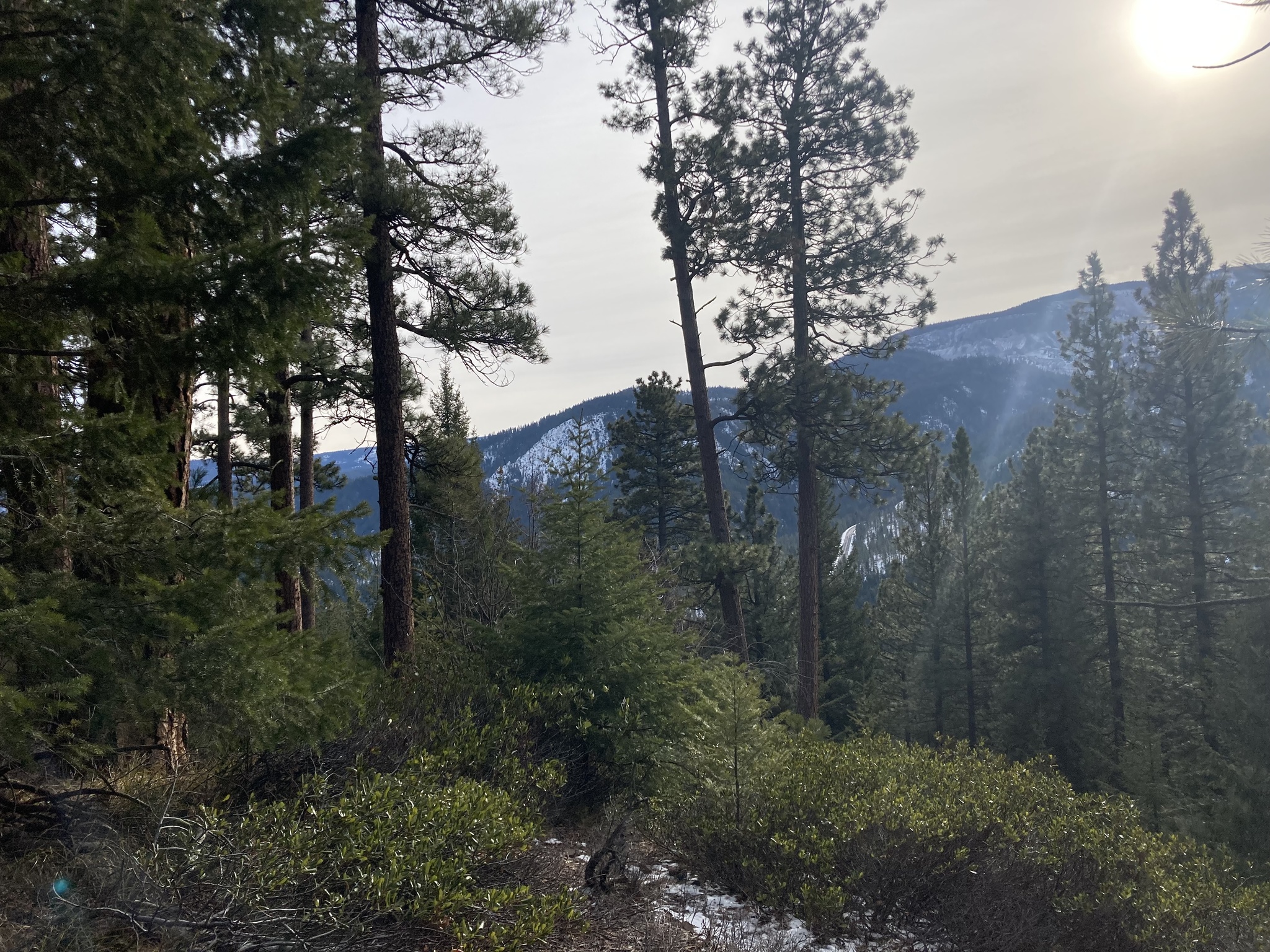
From British Columbia in southwestern Canada, ponderosa pine extends through the western United States across sixteen states, from Washington to Texas. It dominates semiarid mountain forests, generally below 2,700 m (8,860 ft), but also occupies some lowland valleys, including the Niobrara River banks in Nebraska. 2 3
In South Dakota's Black Hills, ponderosa pine accounts for nearly 80% of forested land. Introduced to temperate Europe and New Zealand for ornamental planting and forestry, it can locally behave as an invasive wilding pine, colonizing open ground at the expense of native vegetation. 3 8
Shade is poorly tolerated by this sun-loving species, which struggles to establish under a dense canopy. Its broad distribution and abundant populations support its Least Concern status on the IUCN Red List. 8
Life cycle and reproduction
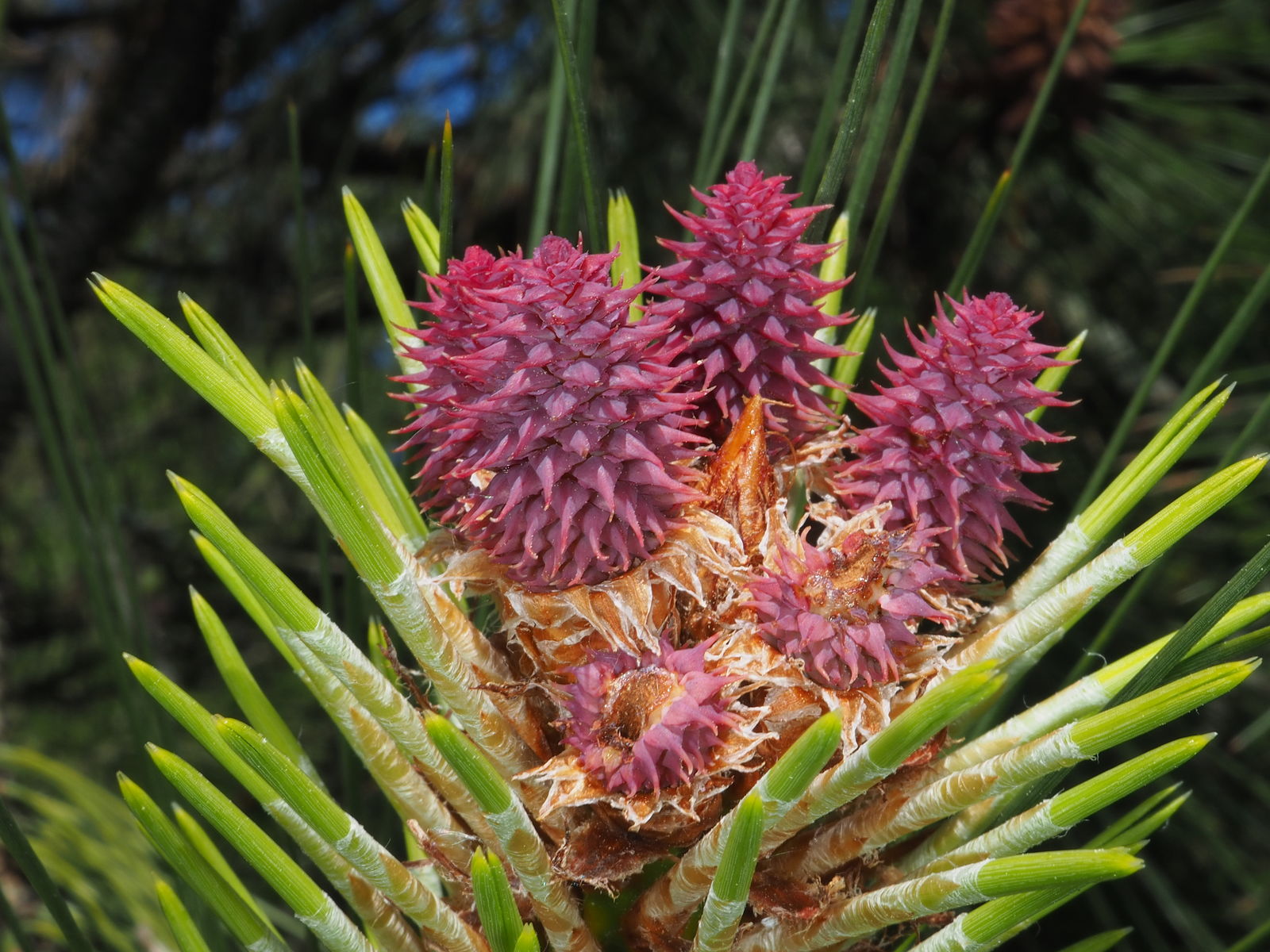
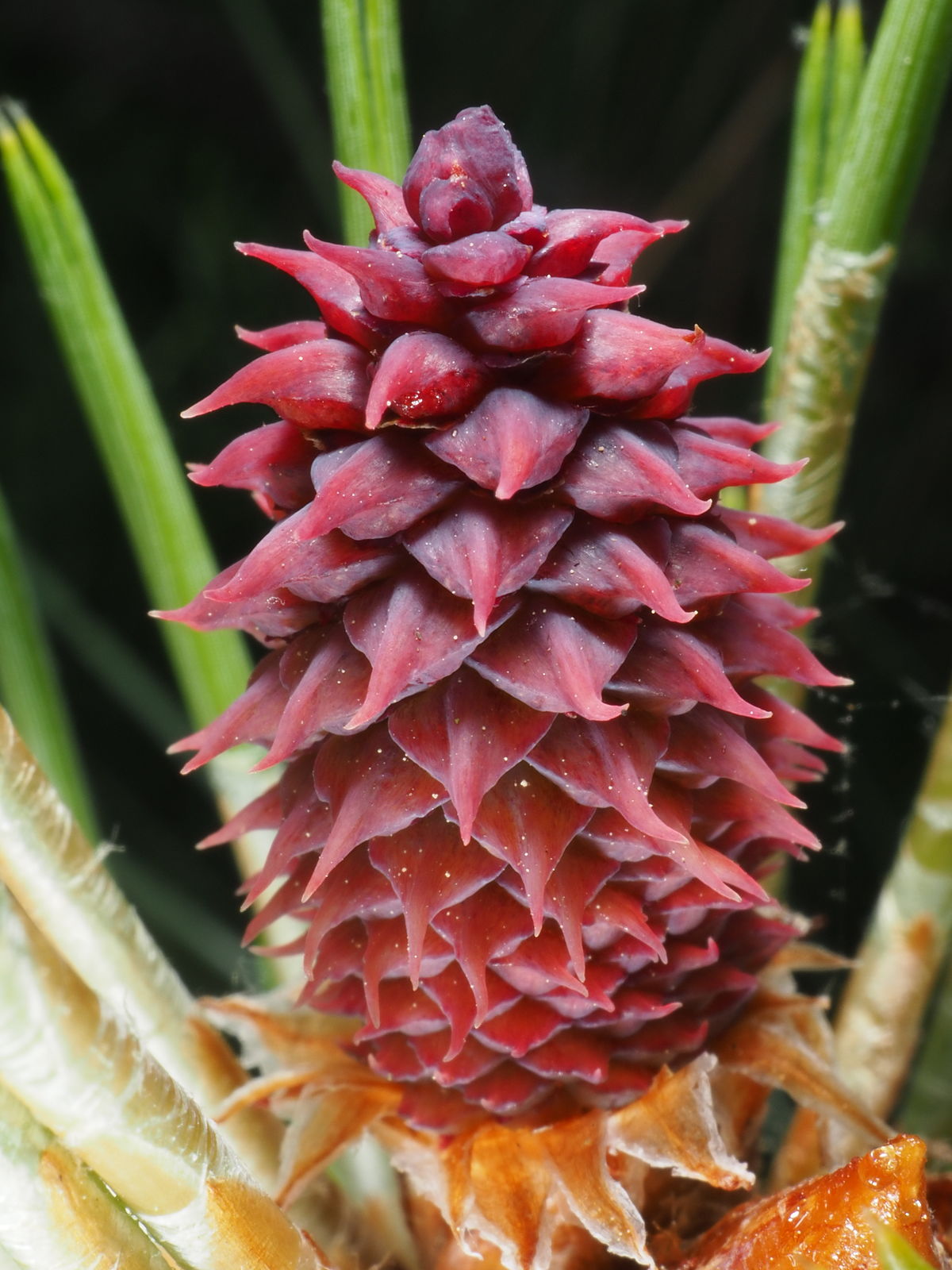
A ponderosa pine bears both male and female cones, making it monoecious. Pollination takes place in spring. Female cones take about two years to mature, changing from apple green to reddish brown before releasing their winged seeds in fall. 6
Fire adaptation helps this pine survive low-intensity burns that naturally recur every five to ten years. Thick bark insulates the trunk, and clusters of needles protect its buds. This regular fire regime long maintained open stands of old trees, some exceeding 500 years. 3
Seeds germinate on the ground without a strict requirement for stratification. During their first few years, however, seedlings remain vulnerable to shade and drought until their deep taproot becomes established. 4 5
Uses and risks
Pale, straight-grained timber has made ponderosa pine one of the most heavily harvested construction woods of the American West since the 19th century. Uses include light framing, plywood, particleboard and poles. 3
Several Indigenous peoples of North America ate its seeds and sweet inner bark. They also used needles in basketry and in infusions traditionally taken for coughs. 4 5
Cats and dogs are not poisoned by ponderosa pine. The needles do, however, contain isocupressic acid, which causes abortion or premature birth in pregnant mares and cows after prolonged ingestion, particularly in late winter when forage is scarce. 7
Varieties, look-alikes and related plants
Jeffrey pine (Pinus jeffreyi) is the main look-alike in the same western mountains. Ponderosa pine cones prick the hand when squeezed because their sharp tips point outward; Jeffrey pine cones have inward-curved tips and do not prick. The mnemonic “gentle Jeffrey, prickly ponderosa” captures that difference. 4 6
Regional varieties such as benthamiana, scopulorum and washoensis differ chiefly in needle length and the number of needles per bundle. Both features vary continuously with elevation and local climate, helping explain why their taxonomic status remains disputed. 1
Main sources
- Plants of the World Online / Kew, Pinus ponderosa Douglas ex C.Lawson
- USDA PLANTS Database, Pinus ponderosa (ponderosa pine)
- USDA Forest Service, Silvics of North America, Volume 1: Conifers (1990), Ponderosa Pine (Pinus ponderosa); archived original chapter 2026-02-14
- NC State Extension, Pinus ponderosa (Ponderosa Pine)
- Plants For A Future, Pinus ponderosa
- The Gymnosperm Database, Pinus ponderosa
- ASPCA, Ponderosa Pine toxicity entry
- IUCN Red List of Threatened Species, Pinus ponderosa assessment
Frequently asked questions
Is ponderosa pine poisonous?
Not to cats and dogs, according to the ASPCA. Its needles contain isocupressic acid, however, which is toxic to pregnant mares and cows and can cause abortion after prolonged ingestion.
How can I distinguish ponderosa pine from Jeffrey pine?
Ponderosa pine cones prick the hand when squeezed because their scale tips point outward. Jeffrey pine cones have inward-curved tips and can be squeezed without pricking.
Why does ponderosa pine bark change color with age?
Young trees have dark, almost black bark, known as blackjack. With age it thickens and splits into broad orange plates separated by black fissures, providing a useful indication of a tree’s age.
Can ponderosa pine become invasive?
It is not invasive in its native North American range. Introduced to New Zealand and parts of Australia, it can behave as an invasive wilding pine, colonizing open habitats at the expense of native vegetation.
How long does ponderosa pine live?
Several centuries in good conditions; some trees exceed 500 years. Its longevity partly reflects adaptation to fire, which limits competition from less resistant trees.
Does ponderosa pine depend on fire?
Thick bark and buds protected by needle clusters help it survive low-intensity fires returning every five to ten years. This adaptation long maintained open stands of old trees.
Can ponderosa pine be grown in France?
Yes, in well-drained soil and full sun, especially in collections and arboretums. It remains a minor horticultural tree in Europe compared with its dominant forestry role in North America.
Similar plants
If you are unsure about a plant’s toxicity, ask a botanist or veterinarian for advice.