
Tanner's sumac (Rhus coriaria, )

Tanner's sumac (Rhus coriaria) is a deciduous shrub or small tree in the Anacardiaceae family, native to the Mediterranean basin and Middle East, with a range extending from Macaronesia to Afghanistan. Its dried fruits produce sumac spice, while its tannin-rich leaves have long been used in leather tanning.
Read moreTanner's sumac, Sicilian sumac and Elm-leaved sumac
Allow a few hours of direct sun per day, preferably morning or evening.



© photo
(c) bobasil, some rights reserved (CC BY-NC), uploaded by bobasil · cc-by-nc
zebedeugalinha · cc-by
Wikimedia Commons · CC BY-SA or Public Domain
Taken Oct 12, 2011 by Tela Botanica − daniel BARTHELEMY (cc-by-sa)
© copyright of the Board of Trustees of the Royal Botanic Gardens, Kew.




Global distribution
Rhus coriaria is native to the Mediterranean basin and Middle East, from Macaronesia to Afghanistan. In France it remains scattered; local status varies between naturalized, self-sown outside cultivation and rare protected populations, with no invasive behavior reported.
- Native9
- France
- Spain
- Italy
- Greece
- Turkey
- Morocco
- Iran
- Afghanistan
- Canary Islands
Hexagons: regions where the plant occurs. Green dots: native range.1
Identity
Tanner's sumac (Rhus coriaria L., 1753), also known as Sicilian sumac, is a deciduous shrub or small tree in the Anacardiaceae family. Its fuzzy reddish-brown drupes distinguish it from poisonous Toxicodendron species with smooth white or cream fruits that must never be eaten. The epithet coriaria comes from Latin corium, meaning leather. Tannin-rich leaves and bark were historically used in preparing and tanning hides, explaining the plant's leatherworking name. 2 3
Dried drupes have an acidic, astringent taste reminiscent of vinegar, reflected in the French name vinaigrier. Once ground and sifted, they yield the dark red sumac spice used throughout Levantine and Mediterranean cooking. It is often combined with thyme in za'atar. The fruit's culinary role is distinct from the historical tanning use of the leaves and bark. 8 7
Recognition
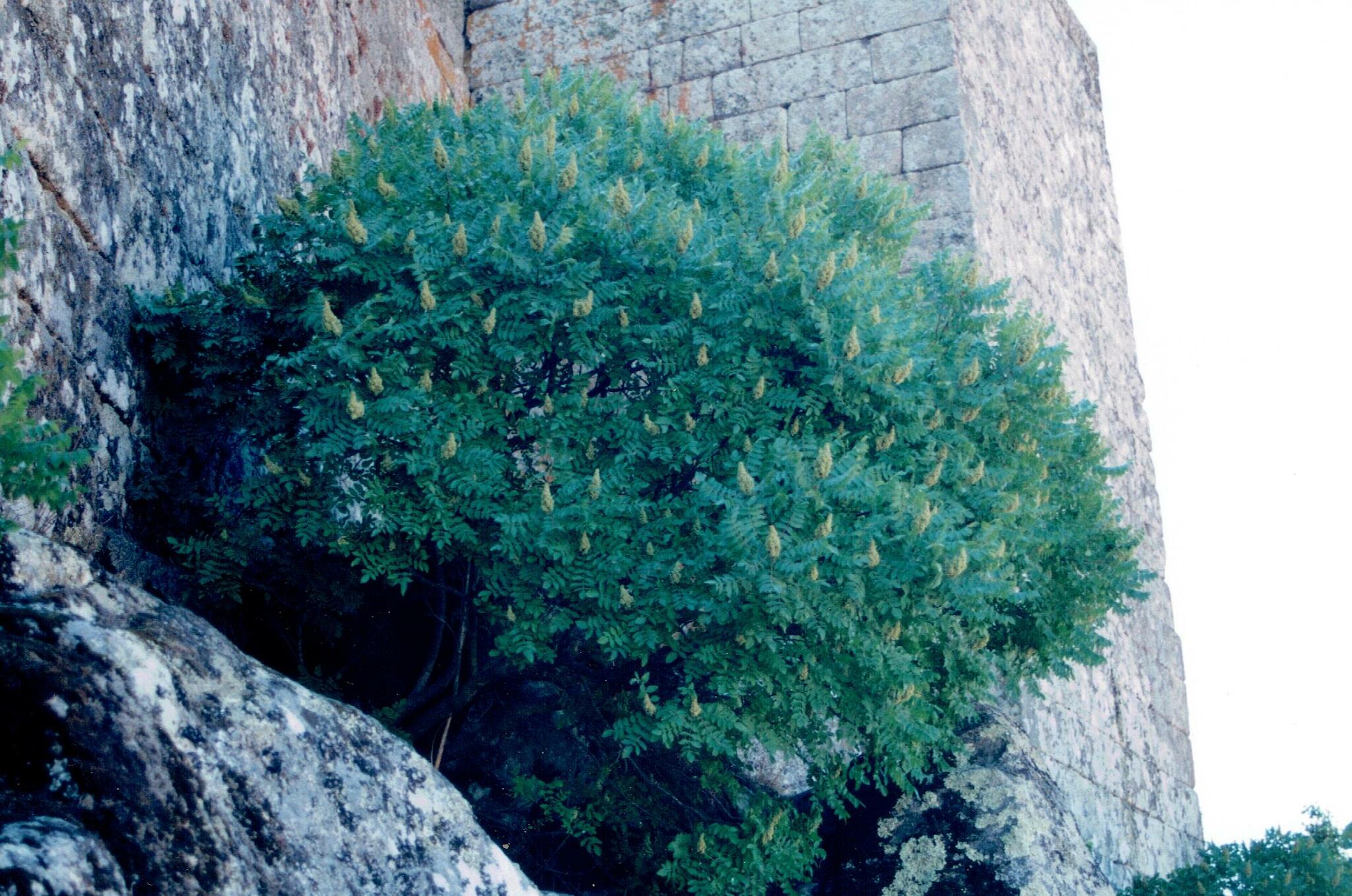
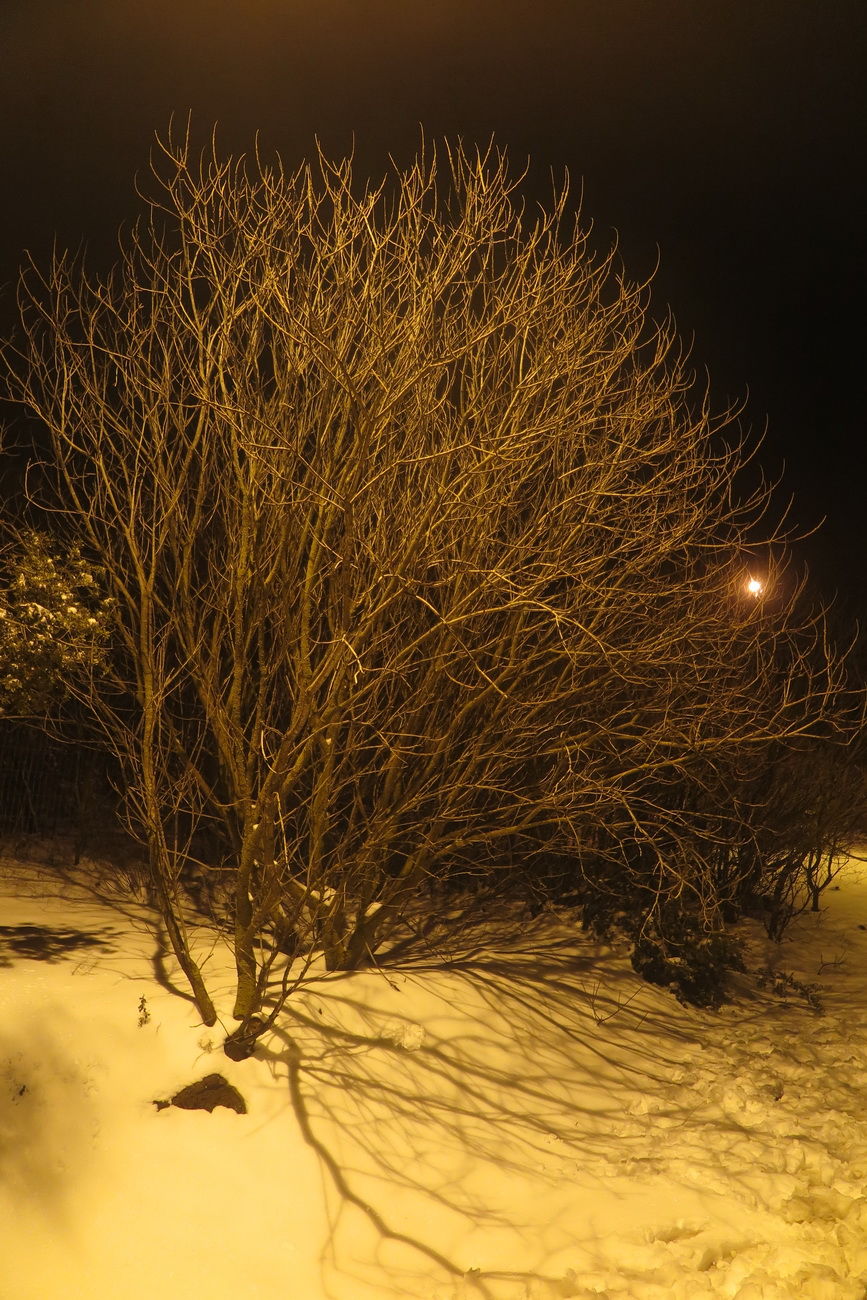
Bushy stems develop into a shrub or small tree commonly 1–3 m (3–10 ft) tall. Well-established specimens sometimes exceed 4 m (13 ft). Young shoots carry fine down, while the wood is brittle and can snap in a strong gust. Exposed planting sites therefore need particular attention to wind, even when the soil and sunlight otherwise suit this Mediterranean species. 2 1
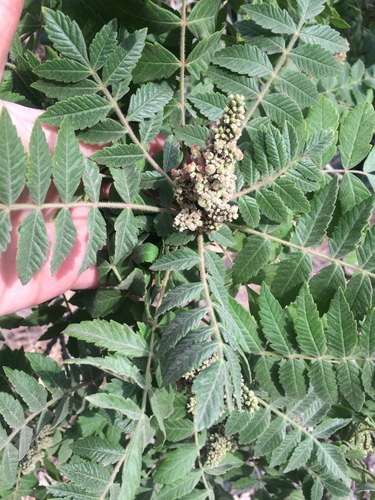
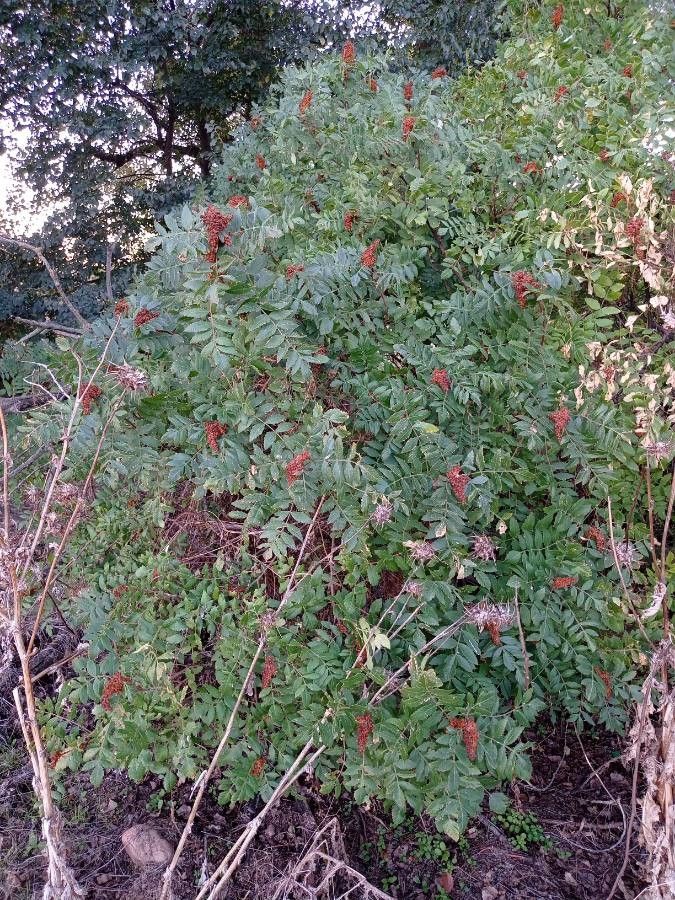
Compound leaves are odd-pinnate, bearing 7–15 toothed leaflets that are bright green above and paler, almost grayish beneath. The hairy central axis is often tinged vivid pink. Autumn color shifts through pink and yellow before the plant sheds all its foliage, leaving a seasonal contrast with the persistent fruit clusters. 3 2
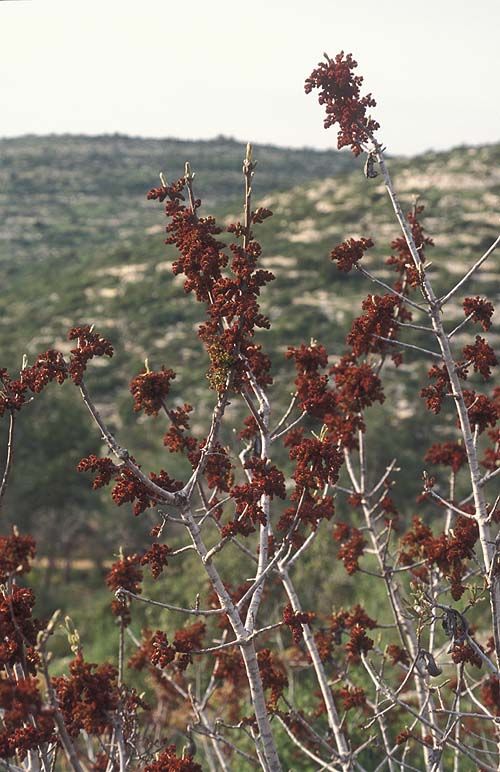
Tiny cream to yellowish-white flowers open in dense, fragrant terminal panicles during summer, corresponding to June–August in its native Northern Hemisphere setting. Fertilized flowers develop into clusters of small, downy drupes that turn reddish brown when ripe. These clusters remain on the shrub for much of winter and provide food for birds. 8 1
Useful taxonomy
POWO/WCVP accepts Rhus coriaria L. as the type species of Rhus. Several botanical variants have been described, without a separate horticultural status:
- Rhus coriaria var. longifolia Sennen, a named botanical variety
- Rhus coriaria f. longifolia (Sennen) Sennen, a named botanical form
- Rhus coriaria var. zebaria Shahbaz, the variety described from Iraq
Older classifications included the irritating species now assigned to Toxicodendron, among them Toxicodendron radicans, within Rhus. That taxonomic history helps explain persistent confusion between edible and poisonous sumacs. The genera have long been separated, but the common name sumac continues to be used across plants with markedly different properties. 1 6
Habitat and range
Mediterranean and Macaronesian populations extend eastward through North Africa, Anatolia and Iran to Afghanistan. Rocky ground, scrub and stony banks provide typical habitat, almost always on calcareous substrates. The species grows from sea level to about 600 m (1,970 ft), reflecting a preference for open, dry, rocky landscapes rather than damp woodland soils. 1 2
IUCN assesses Rhus coriaria as Least Concern. Its broad, continuous range supports that category despite local harvesting associated with commercial fruit collection. A global assessment of this kind describes the overall conservation picture; the cited account still recognizes that fruit gathering can affect particular populations. 5
French populations remain scattered, especially in Provence. Depending on the locality, their status ranges from naturalized or self-sown outside cultivation to rare and protected. Those local distinctions do not indicate invasive behavior, and the references report no large-scale naturalization beyond the native range. This regional context concerns France rather than establishing a status for every country. 4
Life cycle and reproduction
Summer bloom varies with climate, occurring from June to August in the native Northern Hemisphere range. Cream flowers cluster in terminal panicles and attract bees and other pollinators. After fertilization, the resulting drupe clusters ripen slowly into autumn. They then stay on the shrub through winter, extending the visible fruiting period well beyond ripening itself. 8 1
Propagation uses seed, soaked for 24 hours in hot water to break dormancy, or semi-ripe cuttings taken in summer. Established shrubs also produce abundant root suckers that can be divided. These methods offer different routes to new plants; separating an available sucker is straightforward in principle, although successful establishment still takes time. 2
Uses and risks
Cooking is the main use: dried fruits are stripped and ground to produce sumac powder with a sharp, lemonlike flavor. It seasons salads and grilled meat and forms part of za'atar mixtures. Some culinary traditions also prepare unripe fruits like capers. Dried ripe fruit remains the familiar commercial form of this Mediterranean spice. 8 7
Leaves and bark contain abundant tannins and were used for leather tanning, accounting for the species' leatherworking common name. More recent phytochemical studies confirm that fruits and leaves contain high concentrations of antioxidant compounds. These are separate botanical parts with different historical uses; the spice itself comes from the fruits. 2 7
Unlike poisonous Toxicodendron species, whose urushiol causes severe contact dermatitis, Rhus coriaria is nontoxic and lacks that irritant. Tests on embryos supported the safety of extracts from Sicilian fruits. Much of the confusion arises from the shared word sumac rather than a shared toxic compound, so the botanical distinction remains essential. 6 3
Varieties, look-alikes and related plants
Fruit production takes priority over ornamental cultivar selection, and no stable ornamental cultivar is recorded for the species. The Iraqi variety zebaria has a distinctive phytochemical profile that has been studied for antibacterial activity. Its documented variation should be distinguished from a named, established garden cultivar. 1
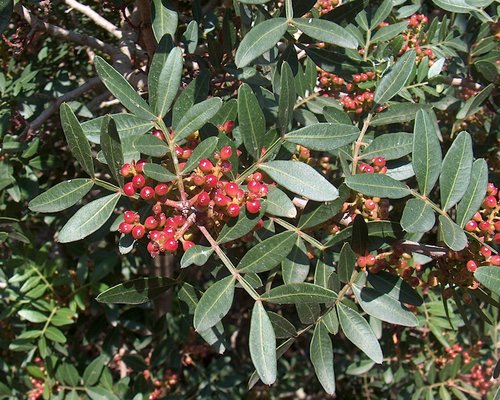
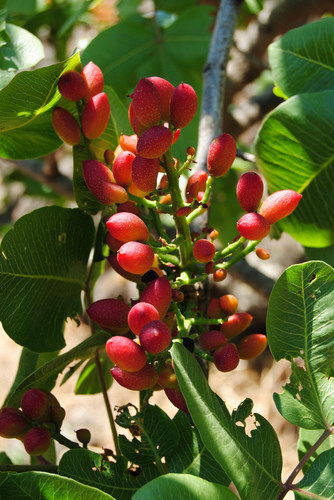
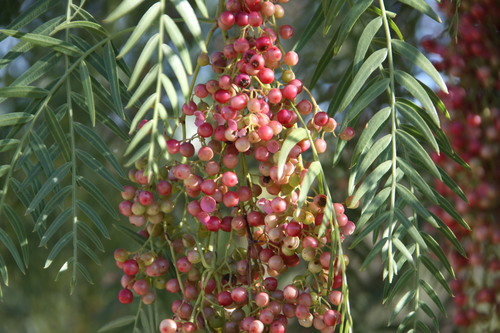
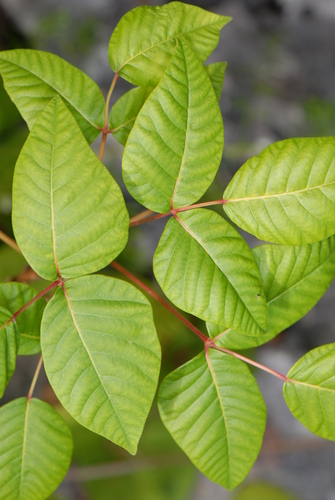
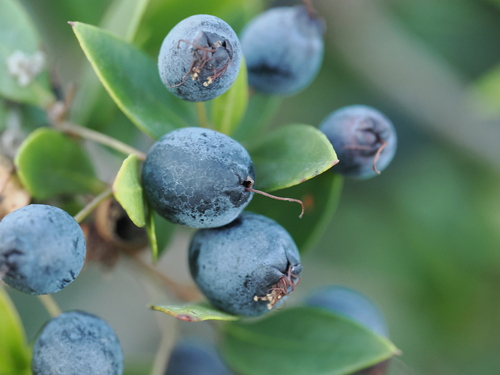
Poisonous Toxicodendron species, including Toxicodendron radicans, present the most serious identification risk. Their smooth white or cream fruits contrast with the fuzzy reddish-brown drupes of tanner's sumac. The difference is useful whenever fruit is present. Other Anacardiaceae, including Pistacia lentiscus, Pistacia vera, Cotinus coggygria and Schinus molle, may have foliage or fruits that look similar without sharing the same toxicity or culinary use.
Main sources
- Plants of the World Online / Kew, Rhus coriaria L.
- Plants For A Future, Rhus coriaria
- Tela Botanica / eFlore BDTFX, Rhus coriaria
- INPN / MNHN, Rhus coriaria L., 1753
- IUCN Red List, Rhus coriaria assessment (Rivers & Harvey-Brown, 2020)
- PMC, Chemical Characterization and Embryo Acute Toxicity of Rhus coriaria L. from Sicily
- PMC, Rhus coriaria L. (Sumac), a Versatile Food Spice with Cornucopia of Polyphenols
- Encyclopaedia Britannica, Sicilian sumac
Frequently asked questions
Does sumac spice come from Rhus coriaria?
Yes. Dried, ground Rhus coriaria fruits produce sumac powder, a staple tart spice in Levantine and Mediterranean cooking, often mixed with thyme in za'atar.
Is Rhus coriaria a poisonous sumac?
No. Rhus coriaria does not contain urushiol and does not belong to the poisonous sumacs now placed in Toxicodendron. Embryo tests support the safety of extracts from Sicilian fruits.
How can I tell Rhus coriaria from poisonous sumac?
Fruit color is the most reliable distinction. Rhus coriaria has fuzzy reddish-brown drupes, whereas Toxicodendron fruits are white or cream, smooth and glossy.
Can immature Rhus coriaria fruits be eaten?
Yes. Some culinary traditions prepare the green fruits like capers. Dried ripe fruit ground into powder remains the most widespread use.
Why is it called tanner's sumac?
The name refers to the old use of tannin-rich leaves and bark in leatherworking, including preparing hides before tanning.
Is Rhus coriaria hardy in France?
Yes, in Mediterranean regions with well-drained soil. Established plants tolerate frost, but young plants and those in cool, wet oceanic climates are more vulnerable.
Does Rhus coriaria need rich soil?
No. It is a pioneer species that thrives in poor, calcareous soil, provided it has good drainage and direct sunlight for fruiting.
Similar plants
If you are unsure about a plant’s toxicity, ask a botanist or veterinarian for advice.