
White sage (Salvia apiana, )
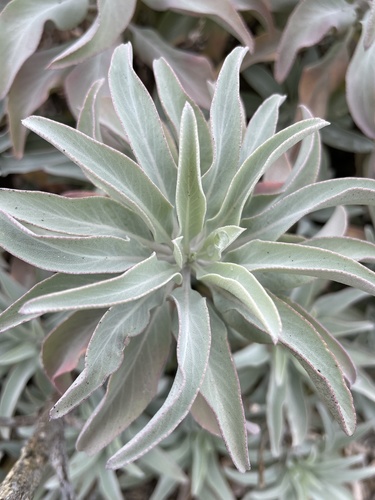
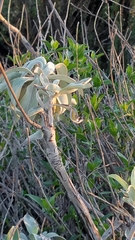
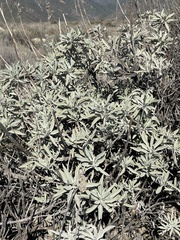
White sage (Salvia apiana) is an aromatic evergreen subshrub in the Lamiaceae family, native to coastal sage scrub in Southern California and Baja California. Its silvery foliage and tall spring flower stalks distinguish it from other sages. Several Indigenous nations use it in ceremonies, while commercial overharvesting threatens wild populations.
Read moreWhite sage, Sacred sage, Bee sage and Californian white sage
Place in full sun, with intense direct light all day long.
Full sun; barely tolerates light partial shade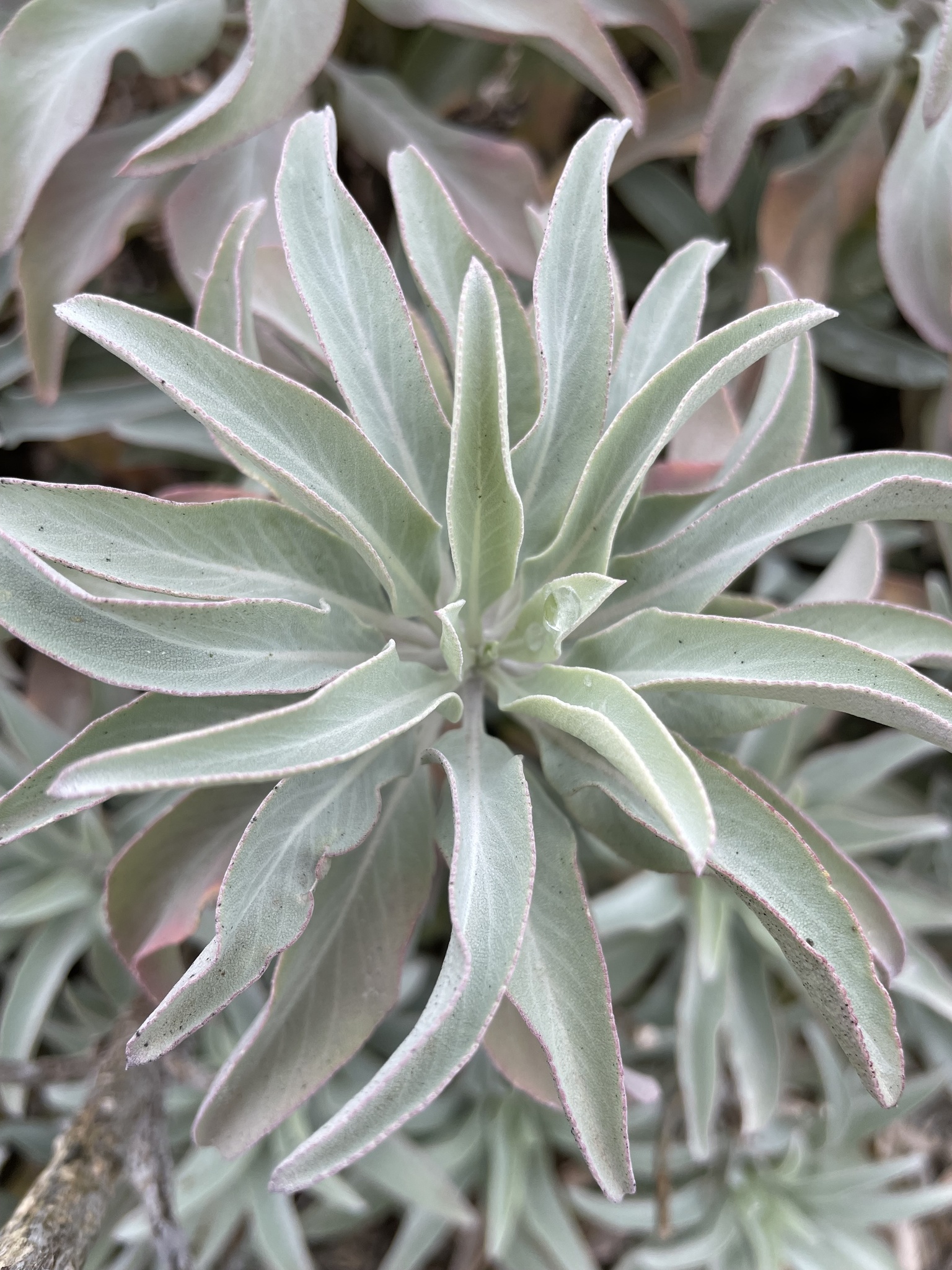

© photo
(c) soggyfroggy1, some rights reserved (CC BY-NC) · cc-by-nc
Dan Horowitz · cc0
Daniel Hetzel · cc0
Taken Apr 29, 2022 by Miguel Sanchez (cc-by-sa)
© copyright of the Board of Trustees of the Royal Botanic Gardens, Kew.




Global distribution
Salvia apiana is native to the southwestern United States (California) and northwestern Mexico (Baja California), in coastal sage scrub below 1,500 m (4,900 ft), along the western edges of the Mojave and Sonoran deserts. It is not naturalized in France, where it remains a cultivated dry-garden plant.
- Native2
- California (United States)
- Baja California (Mexico)
Hexagons: regions where the plant occurs. Green dots: native range.1
Identity
White sage (Salvia apiana Jeps., 1908), also called sacred sage or bee sage, is an aromatic evergreen subshrub in the Lamiaceae family. Californian botanist Willis Linn Jepson described it in the journal Muhlenbergia. Its gray-white to silver foliage and clump 1–1.5 m (3–5 ft) across distinguish it at a glance from garden sage, whose gray-green leaves are duller and less downy. 1 2
Jepson first named the plant Salvia californica in 1901. That name was illegitimate because botanist Brandegee had already used it for another species, so Jepson republished the plant as Salvia apiana in volume 3 of Muhlenbergia in 1908. 2
The epithet apiana comes from Latin apis, meaning bee, and highlights the plant's exceptional attraction for pollinators. “White sage” instead describes its silvery foliage, covered with dense hairs that release strongly scented resin when brushed. 4
Recognition
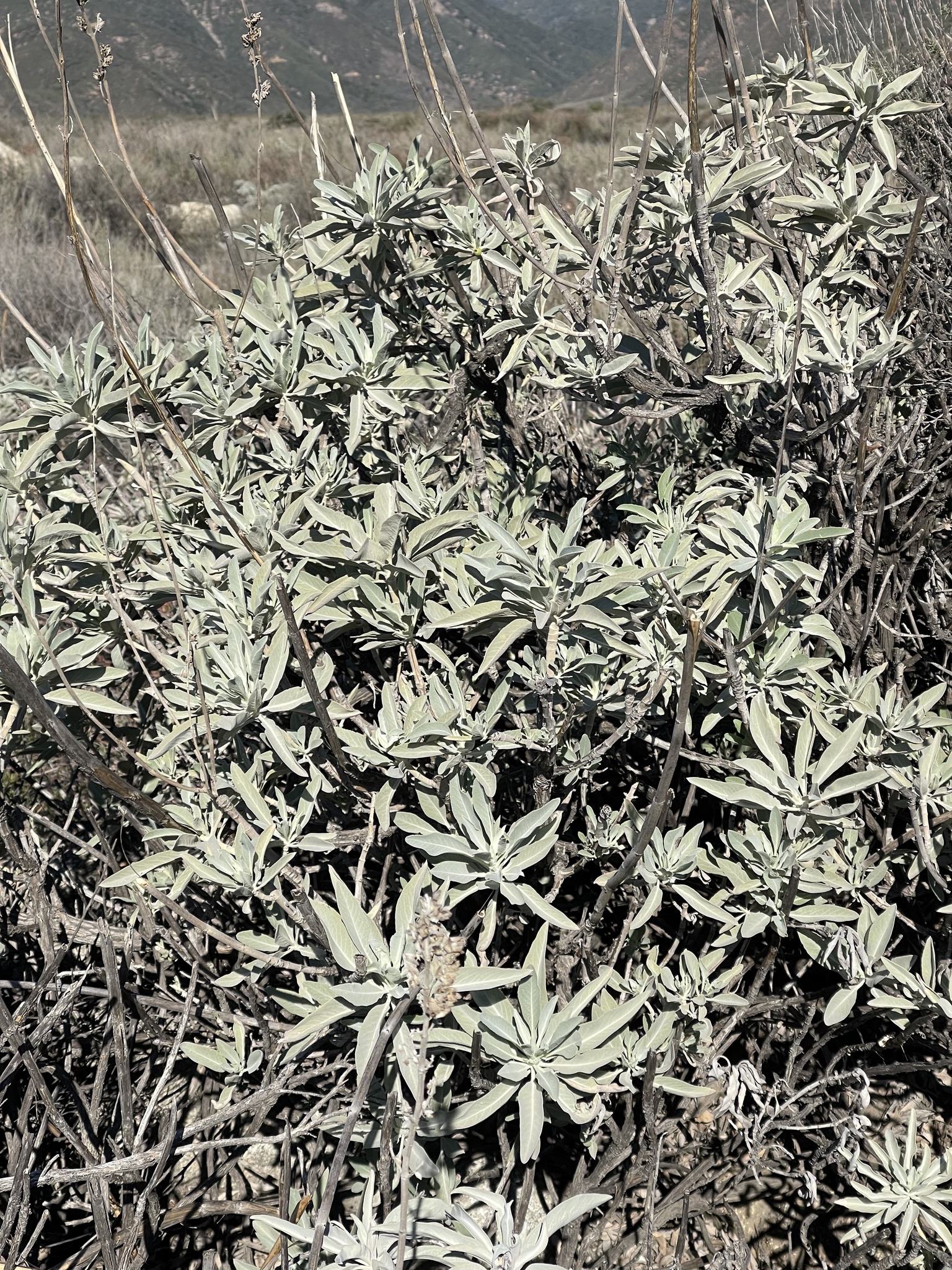
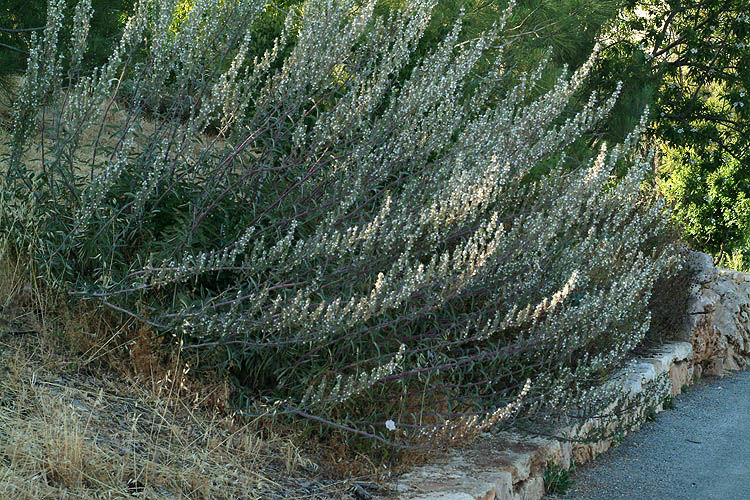
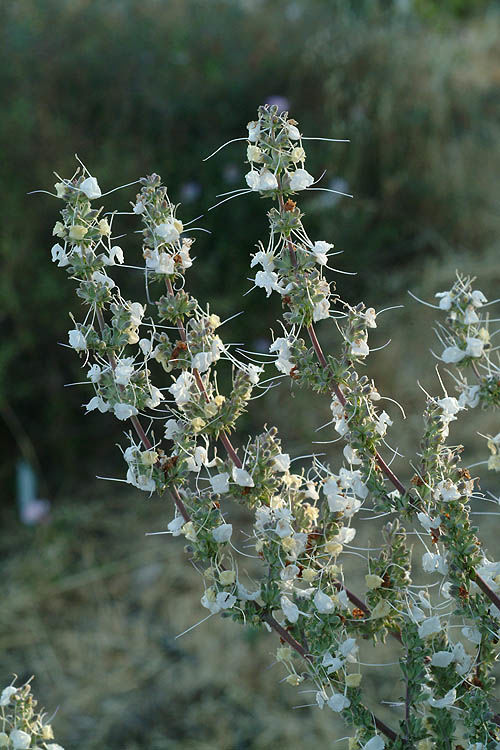
Evergreen, bushy growth forms a clump 1–1.5 m (3–5 ft) tall and wide. Upright flower stalks, initially pinkish, rise in spring and bring the plant's total height to nearly 3 m (10 ft). 4 3
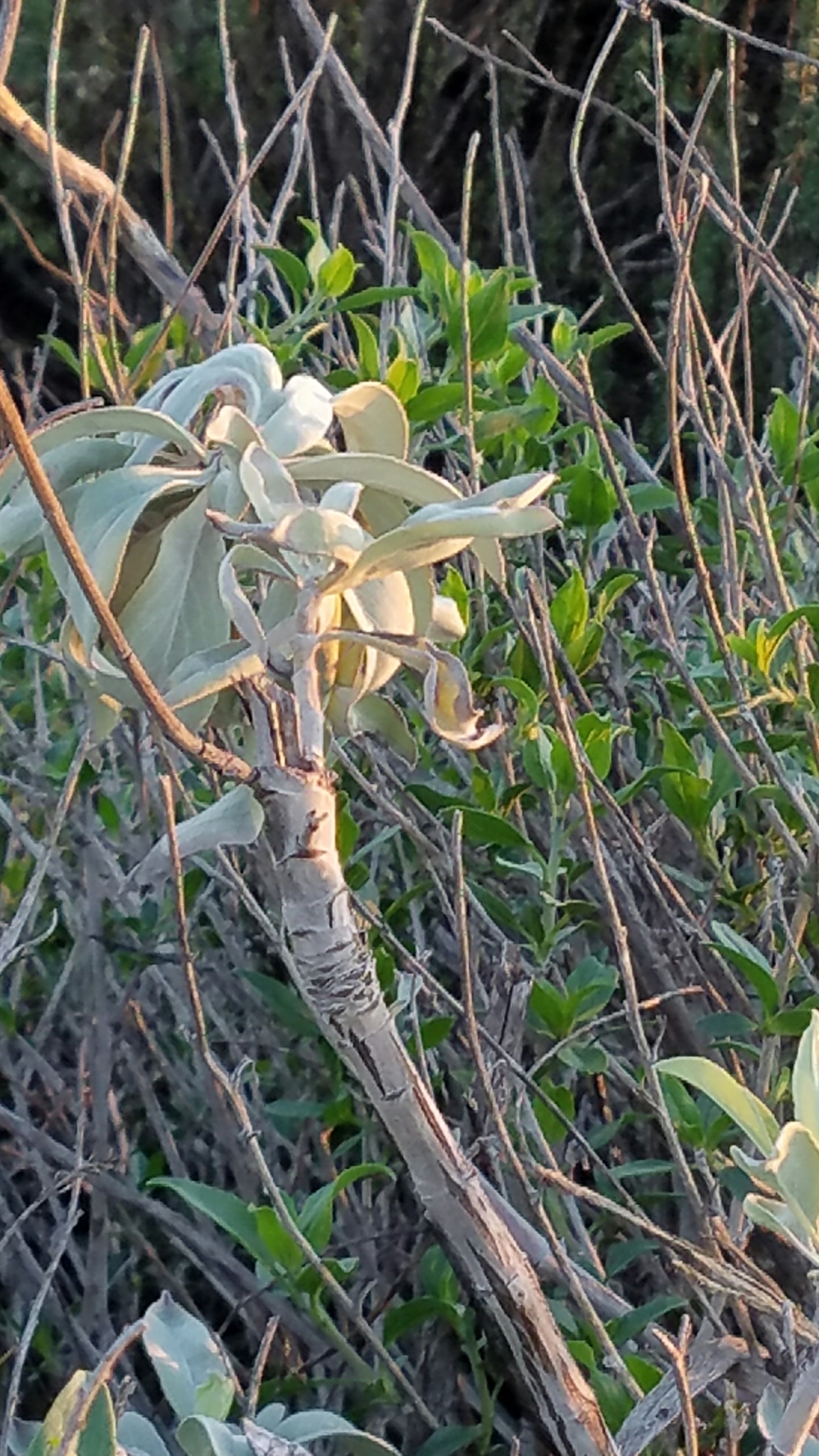
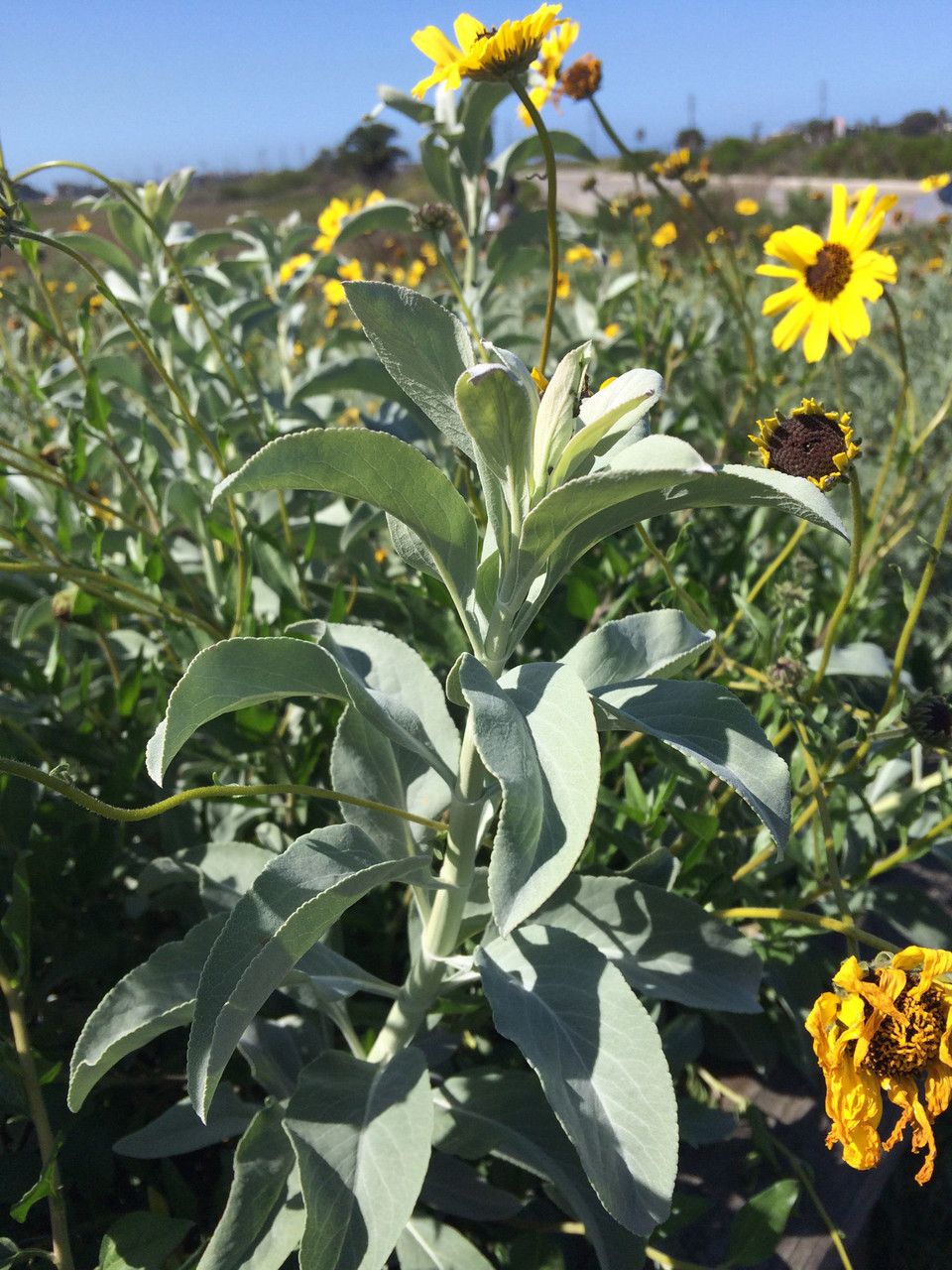
Oblong leaves measure 3–9 cm (1–3.5 in) long, with gray-white to silver surfaces and scalloped margins. Thick hairs trigger the release of oils and resins when rubbed. Foliage much whiter than that of garden sage remains the most reliable field identification feature. 4
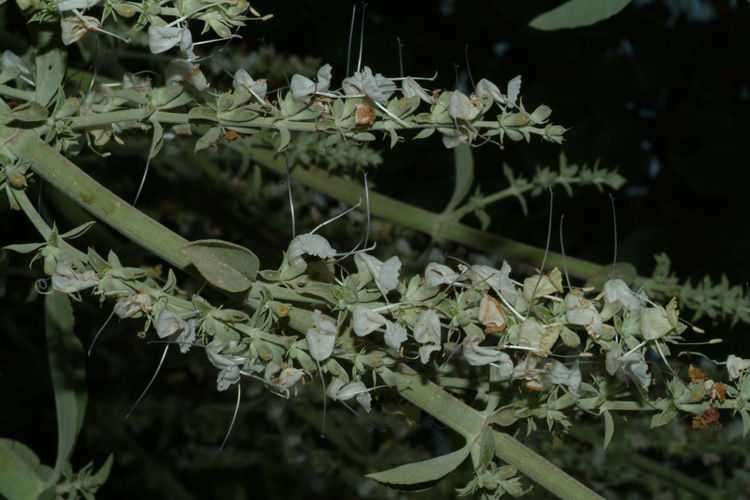
White to pale lavender flowers appear in widely spaced whorls along the stalks from spring into summer. A young plant without flower stalks can still be difficult to distinguish from a seedling of another scrub sage. 4 5
Useful taxonomy
Within Salvia, white sage belongs to subgenus Audibertia, a group of roughly twenty North American species. Their center of diversity lies in the California Floristic Province and adjacent Great Basin deserts. 8
Unlike most Salvia, Audibertia species have not developed the staminal lever mechanism characteristic of the genus elsewhere. In practice, only a few sufficiently heavy, strong bees, including carpenter bees and bumblebees, pollinate the flowers effectively. 8 4
The mint family, subfamily Nepetoideae, also includes mint, thyme and garden sage. These relatives do not share identical foliage, chemistry or uses. Checking the complete binomial helps distinguish a ceremonial plant from an ordinary kitchen herb. 1
Habitat and range
California and Baja California contain the native range of Salvia apiana, in the southwestern United States and northwestern Mexico. It inhabits coastal sage scrub below 1,500 m (4,900 ft), along the western edges of the Mojave and Sonoran deserts. 4 1
Dry, sunny slopes and banks with freely draining soil and little water provide its habitat. Outside its native range it remains a cultivated dry-garden plant rather than a naturalized one, notably in regions with Mediterranean climates. 4 3
Life cycle and reproduction
Spring sowing under cover produces germination in about two weeks. The young clump establishes slowly during its first year without flowering. Full bushy growth and abundant annual flowering generally develop over three to five years. 3
Spring and summer flowers attract bumblebees, carpenter bees, bee flies and hummingbirds. Effective pollination, however, depends on just three carpenter bee species and one bumblebee species strong enough to operate the flowers' reproductive structures. 4
A hive beside a dense white sage stand could produce around 45 kg (100 lb) of honey in a good season. This yield prompted Mexican authorities to encourage beekeepers to place their hives near the plant. 7
Cultivated plants are propagated by spring sowing or semi-ripe cuttings taken during the growing season. 3
Uses and risks
Ceremonial use is documented among several Indigenous nations of California and Mexico, including the Cahuilla, Chumash and Kumeyaay. They burn white sage foliage for purification, including in rites of passage. 7
Ground seeds form part of pinole, a preparation traditionally combined with wheat flour and sugar by the Cahuilla to make gruel and biscuits. Young stems are eaten raw, and small quantities of leaves are used as seasoning. 3 7
No notable food-related risk is documented for the plant itself, and ASPCA lists Salvia as non-toxic to dogs, cats and horses. The main caution concerns smoke and highly concentrated essential oil. Prolonged exposure is best avoided in people or animals with sensitive airways. 3 6
Commercial demand for smoke bundles has driven extensive poaching. The label “wildcrafted” often serves as a euphemism for unauthorized collection. In June 2018, four people were arrested in California for illegally harvesting nearly 180 kg (400 lb) of white sage. Respectful harvesting, as described by a practitioner, takes only a few leaves from each plant rather than uprooting it. 7 4
Despite this documented decline, white sage has no federal protection. It nevertheless appears on the United Plant Savers list of at-risk species. 7
Varieties, look-alikes and related plants
Garden hybridization readily occurs between Salvia apiana and Salvia clevelandii or Salvia leucophylla. The resulting horticultural crosses are sold under cultivar names that vary among nurseries. 4
Frequent look-alikes include the following plants:
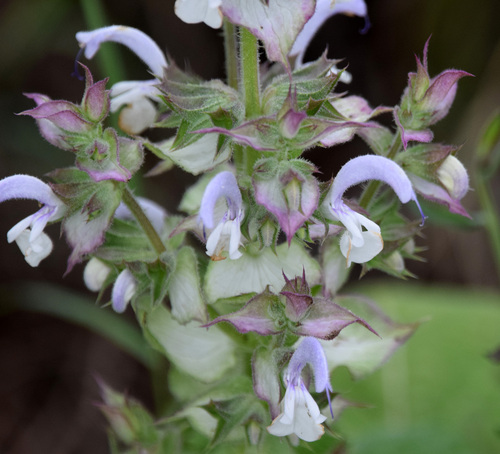
- Salvia clevelandii, with greener foliage and a more minty scent;
- Salvia leucophylla, often purple-tinged, with shorter flower stalks;
- Salvia officinalis, Mediterranean culinary sage, with less silvery gray-green leaves and no native California range;
- Artemisia californica, California sagebrush, with threadlike silver leaves but no two-lipped flowers, belonging to another family.
Pests generally cause few problems in gardens. Soil that stays too wet in winter chiefly encourages powdery mildew, verticillium wilt and root rot. 5
Main sources
- Plants of the World Online / Kew, Salvia apiana Jeps.
- International Plant Names Index, Salvia apiana Jeps.
- Plants For A Future, Salvia apiana
- Wikipedia EN, Salvia apiana
- Royal Horticultural Society, Salvia apiana
- ASPCA, Sage (Salvia officinalis) toxicity entry
- JSTOR Daily, Plant of the Month — White Sage
- Walker et al., 2015, phylogeny of Salvia subgenus Audibertia (California Floristic Province sages)
- Wikidata, Salvia apiana
Frequently asked questions
Is white sage toxic to cats and dogs?
No food-related risk is documented for Salvia apiana, and ASPCA lists Salvia as non-toxic to dogs, cats and horses. The main caution concerns smoke or highly concentrated essential oil; avoid prolonged exposure around animals with sensitive airways.
Can white sage grow in temperate gardens?
Yes, in very well-drained soil and full sun, especially in Mediterranean climates, or in a pot brought indoors for winter elsewhere. It withstands frost to about −9 °C (16 °F), but stagnant winter moisture is more damaging than dry cold.
Why is white sage threatened by overharvesting?
Commercial demand for smoke bundles has driven extensive poaching on public and private land in California, where unauthorized collection is illegal. The species has no federal protection but appears on the United Plant Savers at-risk list.
How does white sage differ from garden sage?
Salvia apiana grows wild in California and has much whiter, more silvery foliage. Salvia officinalis is Mediterranean culinary sage, with gray-green foliage and a long history of use in cooking and regulated herbal medicine.
How can you identify white sage among California scrub sages?
Its very white, downy leaves distinguish it from greener Salvia clevelandii and often purple-tinged Salvia leucophylla. Its pinkish stalks carry white to pale lavender flowers and may reach nearly 3 m (10 ft), well above the basal clump.
What does apiana mean?
The epithet comes from Latin apis, meaning bee, and emphasizes the plant’s strong attraction for pollinators. Jepson published it in 1908 after first naming it Salvia californica in 1901, a name already assigned to another species and therefore illegitimate.
Is white sage a protected species?
It has no US federal threatened or endangered status despite documented declines in wild populations linked to commercial poaching and its inclusion on the United Plant Savers watch list.
Similar plants

If you are unsure about a plant’s toxicity, ask a botanist or veterinarian for advice.