
Woolly hedgenettle (Stachys byzantina, )
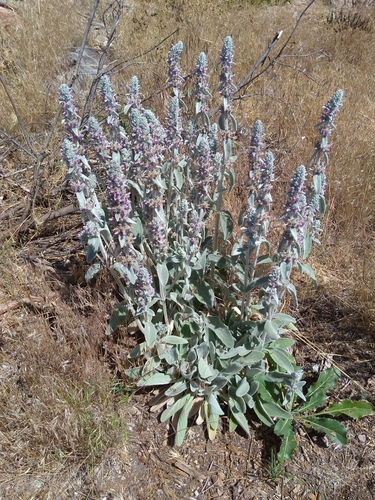
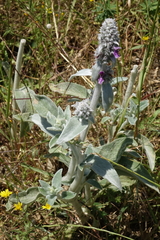

Woolly hedgenettle (Stachys byzantina) is a mat-forming perennial in the Lamiaceae family, native to rocky slopes in northern Turkey, Armenia, Iran and Crimea. Thick leaves covered with silvery-white hairs form a low carpet, overtopped in summer by long, equally woolly flower stalks.
Read moreWoolly hedgenettle and Lamb's ears
Allow a few hours of direct sun per day, preferably morning or evening.
Full sun; tolerates light afternoon shade in very hot climates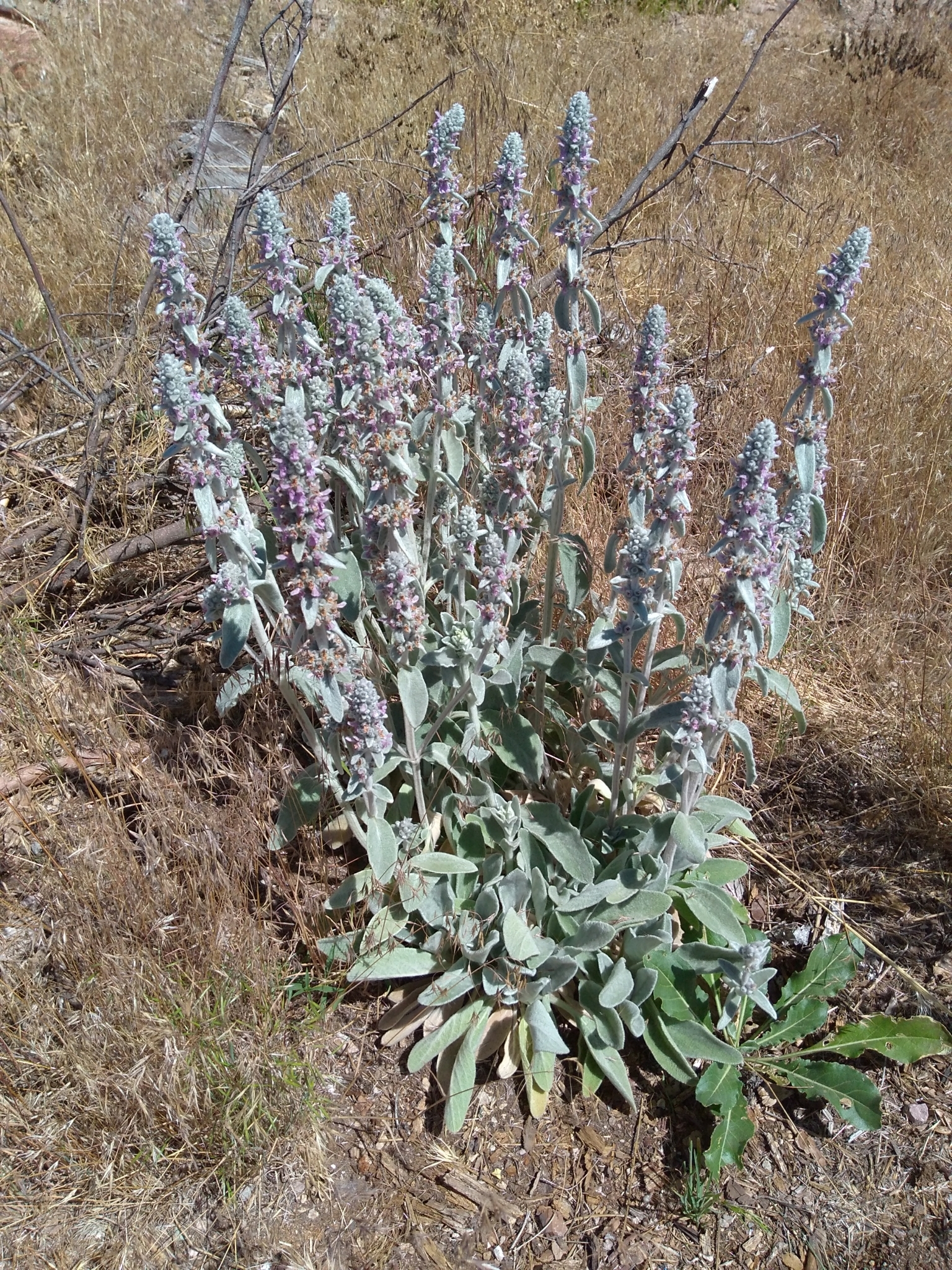


© photo
iNaturalist User · cc0
Oleg Kosterin · cc0
Wikimedia Commons · CC BY-SA or Public Domain
Taken Nov 8, 2022 by Fabrice Rubio (cc-by-sa)
Taken Mar 11, 2022 by Amandine BIGORGNE (cc-by-sa)
Taken Mar 10, 2022 by Druez Roland (cc-by-sa)
Taken Jan 9, 2022 by Annemarie Ahrens-Stehle (cc-by-sa)
Taken Dec 7, 2022 by Fabrice Rubio (cc-by-sa)
© copyright of the Board of Trustees of the Royal Botanic Gardens, Kew.




Global distribution
The native range of Stachys byzantina covers northern Turkey, Armenia, northern Iran and Crimea, toward the Caucasus. It is grown throughout almost the entire temperate world and sometimes escapes gardens without becoming truly invasive.
- Native4
- Introduced1
- Turkey
- Armenia
- Iran
- Russia (Crimea, Caucasus)
- United States
Hexagons: regions where the plant occurs. Green dots: native range.1
Identity
Woolly hedgenettle (Stachys byzantina K.Koch, 1849), also known as lamb's ears, is a perennial in the genus Stachys, family Lamiaceae. The name lamb's ears describes the leaf itself: thick, oblong and covered on both sides with white hairs that feel like a young animal's fur. This continuous coating across the whole blade distinguishes it from other hedgenettles whose leaves remain green and smooth. 1 2
The epithet byzantina refers to Byzantium, near the plant's Anatolian homeland. It does not establish that the species was specifically grown in the ancient city. The synonyms Stachys lanata and Stachys olympica also remain common in older horticultural catalogs. 7 6
Recognition
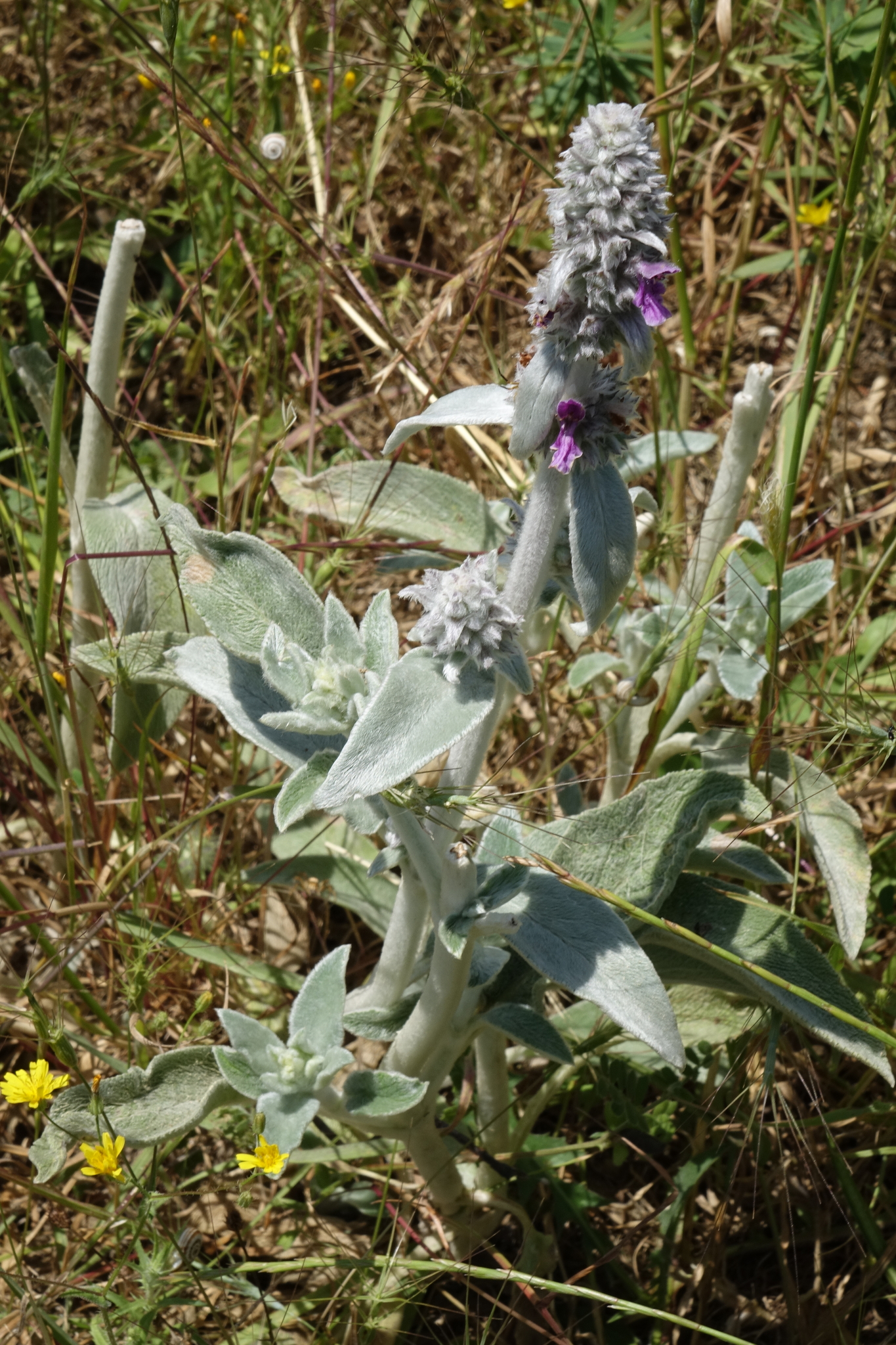
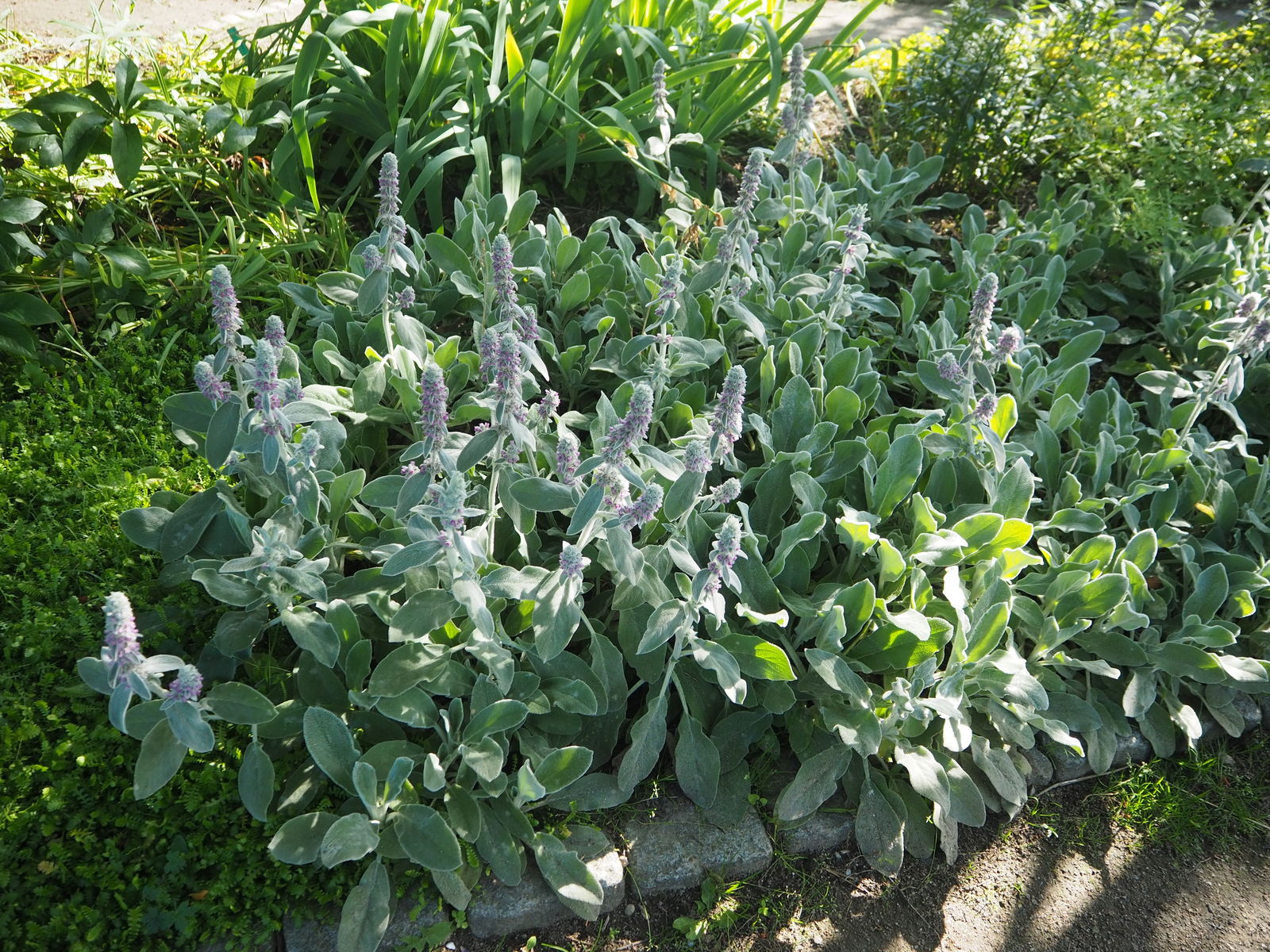
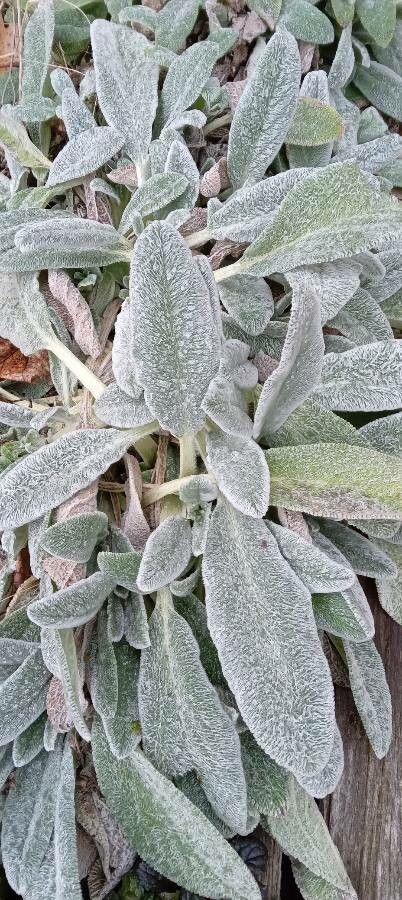
A low carpet of 15–30 cm (6–12 in) characterizes Stachys byzantina, which can spread 50 cm to 1 m (20–39 in) across. Leaves measuring 5–10 cm (2–4 in) long are completely covered on both surfaces with thick, silvery hairs. Their silky texture gives the foliage a softly matte appearance rather than a glossy one. 3 4
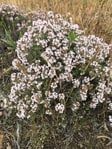
Summer brings upright, equally woolly flower stalks reaching 50 cm (20 in). They carry small purplish-pink flowers less than 1 cm (0.4 in) long, grouped in spaced whorls along an interrupted spike. Many gardeners cut the stalks as soon as buds appear because the silvery leaf carpet is the main attraction, rather than the modest flowers. 2 3
Foliage generally remains evergreen in mild climates. However, it may deteriorate noticeably during wet winters or after prolonged frost in the coldest parts of the plant's hardiness range. Its persistent habit therefore does not guarantee an unblemished carpet in every winter climate. 5
Useful taxonomy
Horticultural labels preserve much of this plant's naming history. The principal scientific synonyms worth recognizing are:
- Stachys lanata Jacq., an older name
- Stachys olympica Poir., a synonym
- Stachys germanica subsp. lanata Douin, a subspecies name
- Stachys taurica Zefir., a synonym
- Eriostomum lanatum Hoffmanns. & Link, a name in another genus
The accepted name is Stachys byzantina K.Koch, published in 1849. Stachys lanata Jacq. is now regarded as an illegitimate name rather than simply an equally ranked synonym. On an old nursery label or in an English-language catalog, Stachys lanata and Stachys olympica almost always mean the same plant under a name no longer accepted. 1 2
Habitat and range
Rocky hillsides and dry slopes in northern Turkey, Armenia, northern Iran and Crimea, toward the Caucasus, form the native habitat described for this species. Poor, well-drained soils in a continental climate with hot summers help explain its intolerance of stagnant moisture around the roots and foliage. 1 4
Long grown as an ornamental, Stachys byzantina has spread through France, the United Kingdom, the United States and Canada, as it has across almost the entire temperate world. It sometimes escapes from gardens and becomes locally naturalized at the edges of cultivated plots, without being considered an invasive species in the account cited. 7
Life cycle and reproduction
Late spring and summer flowering raises the spikes well above the leaf carpet. A clump generally takes 2–5 years to form a fully developed mat, with the rate depending on soil and exposure. The low leafy growth and the taller flowering shoots are distinct parts of the same perennial plant. 7 4
Vegetative spread also enlarges the clump: prostrate stems root spontaneously at their nodes. In cultivation, spring division produces a visible clump during the same season, whereas seed germinated at 18–20 °C (64–68 °F) takes several seasons to reach similar density. Sowing remains useful for producing many plants or when no parent clump is available to divide. 4 5
The wool carder bee (Anthidium manicatum) makes distinctive use of the leaves by scraping off their hairs to line its nest. Visibly scraped leaves without signs of a parasite often reflect this behavior rather than disease. The woolly surface is therefore more than an ornamental feature. 7
Uses and risks
Silvery ground cover is woolly hedgenettle's principal ornamental role. It is planted along borders, in rock gardens and in dry beds, often beside Mediterranean plants for the contrast between its silver foliage and their green leaves. 2 4
Common plant-safety databases do not list Stachys byzantina as poisonous to people, cats or dogs; the species is simply absent from the standard toxic-plant lists. In Brazil, its leaves are sometimes fried and eaten as peixinho-da-horta. This local culinary practice remains uncommon elsewhere. 4 7
Rot is the chief cultivation risk. Heavy soil or excessive watering can cause the woolly foliage to blacken and decay, sometimes accompanied by powdery mildew in late summer. The hairs that give the plant its appeal can retain moisture, making drainage a decisive part of keeping the carpet healthy. 3 4
Varieties, look-alikes and related plants
Several established cultivars are sold. Big Ears, also marketed as Countess Helen von Stein, has leaves twice the size of the typical species. Silver Carpet produces especially silvery foliage and rarely flowers. Cotton Boll bears sterile, cottony tufts rather than true flowers. Primrose Heron has golden-yellow spring foliage that turns green in summer. 7 5
Plants most likely to be confused with woolly hedgenettle include:
- Verbascum thapsus, common mullein, with woolly leaves but an upright habit and a single flower stalk;
- some velvety-leaved Plectranthus, whose overall shape and flowers differ;
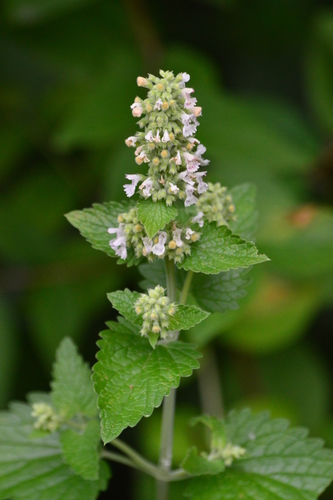
- Stachys officinalis, betony, an upright perennial with smooth green leaves, visually distinct despite sharing the genus.
Common mullein often exceeds 1 m (3.3 ft) on a single erect stalk, while Stachys byzantina reaches about 50 cm (20 in) above a low, spreading mat. Height already separates the two outlines before the leaf is examined. The most reliable combination remains a low carpet and a continuous white coating of hairs across the whole leaf, traits that few other sun-loving perennials share.
Main sources
- Plants of the World Online / Kew, Stachys byzantina K.Koch
- Royal Horticultural Society, Stachys byzantina
- Missouri Botanical Garden Plant Finder, Stachys byzantina
- NC State Extension Gardener Plant Toolbox, Stachys byzantina
- University of Wisconsin Extension, Stachys byzantina Big Ears
- Tela Botanica / eFlore BDTFX, Stachys byzantina K.Koch
- Wikipedia, Stachys byzantina
Frequently asked questions
Is woolly hedgenettle toxic to cats or dogs?
No. Woolly hedgenettle is not listed as poisonous in common plant-safety databases for cats, dogs or people. Prolonged chewing of its woolly leaves may nevertheless cause mild mechanical irritation.
Why are my woolly hedgenettle leaves rotting?
The dense hairs that protect the leaves also retain moisture. In rainy climates or heavy soil, this encourages rot and powdery mildew. Very free-draining soil is the solution; extra watering makes it worse.
Should I cut off the flowers of Stachys byzantina?
It is optional. Many gardeners remove the flower stalks to emphasize the carpet of silvery foliage, the main reason for growing the plant.
When should I divide Stachys byzantina?
Divide every 3–4 years in spring, when the center of the clump begins to thin. A rooted section taken from the edge can be replanted directly in the ground without a special establishment period.
How do woolly hedgenettle and common mullein differ?
Both have whitish, woolly leaves. Common mullein (Verbascum thapsus) forms an upright rosette followed by a single tall flower stalk, whereas Stachys byzantina stays low and spreading, with smaller, rounder leaves.
What soil suits Stachys byzantina?
Poor to moderately fertile, very well-drained soil, whether chalky or sandy. The plant tolerates drought and stony ground but struggles in heavy, permanently wet soil.
Similar plants


If you are unsure about a plant’s toxicity, ask a botanist or veterinarian for advice.