
Breckland thyme (Thymus serpyllum, )


Breckland thyme (Thymus serpyllum) is a mat-forming subshrub in the Lamiaceae family, native from temperate Europe to western Siberia. Its rooting stems form low, dense cushions covered with small pink to mauve flowers from spring into late summer. It tolerates extreme cold that few aromatic plants withstand.
Read moreBreckland thyme, Breckland wild thyme, Wild thyme, Creeping thyme and Elfin thyme
Place in full sun, with intense direct light all day long.
Full sun; barely tolerates light partial shade


© photo
(c) Viktoria, some rights reserved (CC BY-NC), uploaded by Viktoria · cc-by-nc
Wikimedia Commons · CC BY-SA or Public Domain
Wikipedia · CC BY-SA
Taken Jul 2, 2021 by Manuëlle (cc-by-sa)
Taken Jul 19, 2020 by Alain Bigou (cc-by-sa)
Taken May 17, 2022 by Zillah Zillah (cc-by-sa)
Taken Jun 29, 2019 by floska (cc-by-sa)
© copyright of the Board of Trustees of the Royal Botanic Gardens, Kew.


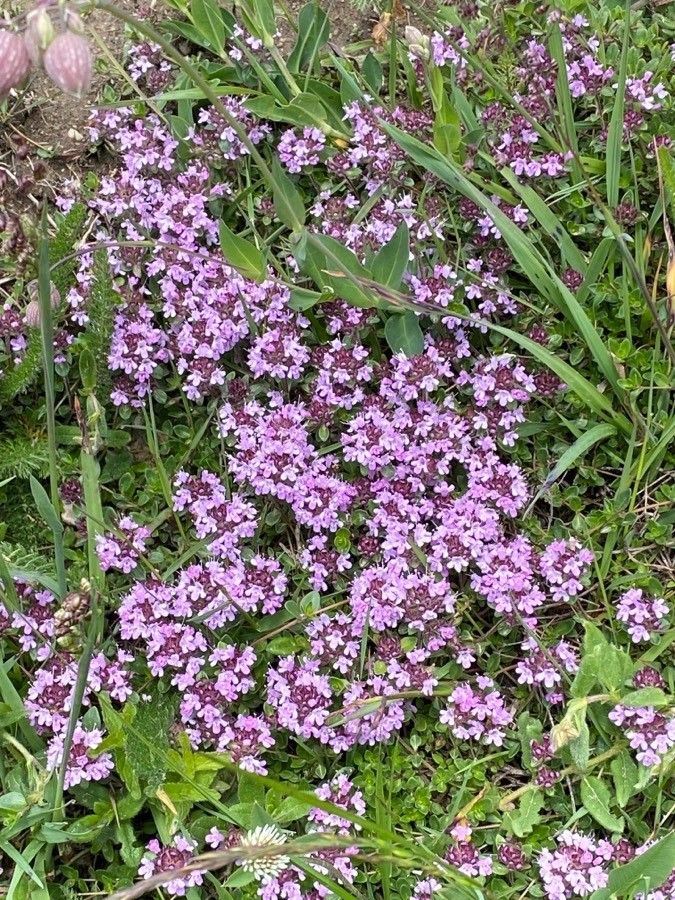


Global distribution
POWO gives a broad native range from temperate Europe to western Siberia. Horticultural sources sometimes extend this account to western Asia and North Africa. Breckland thyme is also widely introduced and cultivated as an ornamental ground cover outside this range, notably in North America.
- Native5
- France
- Germany
- Poland
- Western Russia
- United Kingdom
Hexagons: regions where the plant occurs. Green dots: native range.1
Identity
Breckland thyme (Thymus serpyllum L., 1753), also called wild thyme or creeping thyme, is a subshrub in the mint family, Lamiaceae. Kew accepts this Thymus species and records its native range from temperate Europe to western Siberia. Other established names include Breckland wild thyme and elfin thyme. 1 2
The epithet serpyllum comes from Latin, itself derived from Greek herpyllos, associated with creeping. It describes the plant's prostrate, spreading stems. The French name serpolet follows the same linguistic route through Provençal, linking the familiar vernacular name and the scientific epithet to the same growth habit. 4 6
Common thyme, Thymus vulgaris, differs in forming a small upright bush without rooting at its nodes. Breckland thyme spreads as a low mat, rooting where stems touch the soil. Both belong to the same genus and have similar growing requirements, but this difference in habit separates them before flowering. 4
Recognition
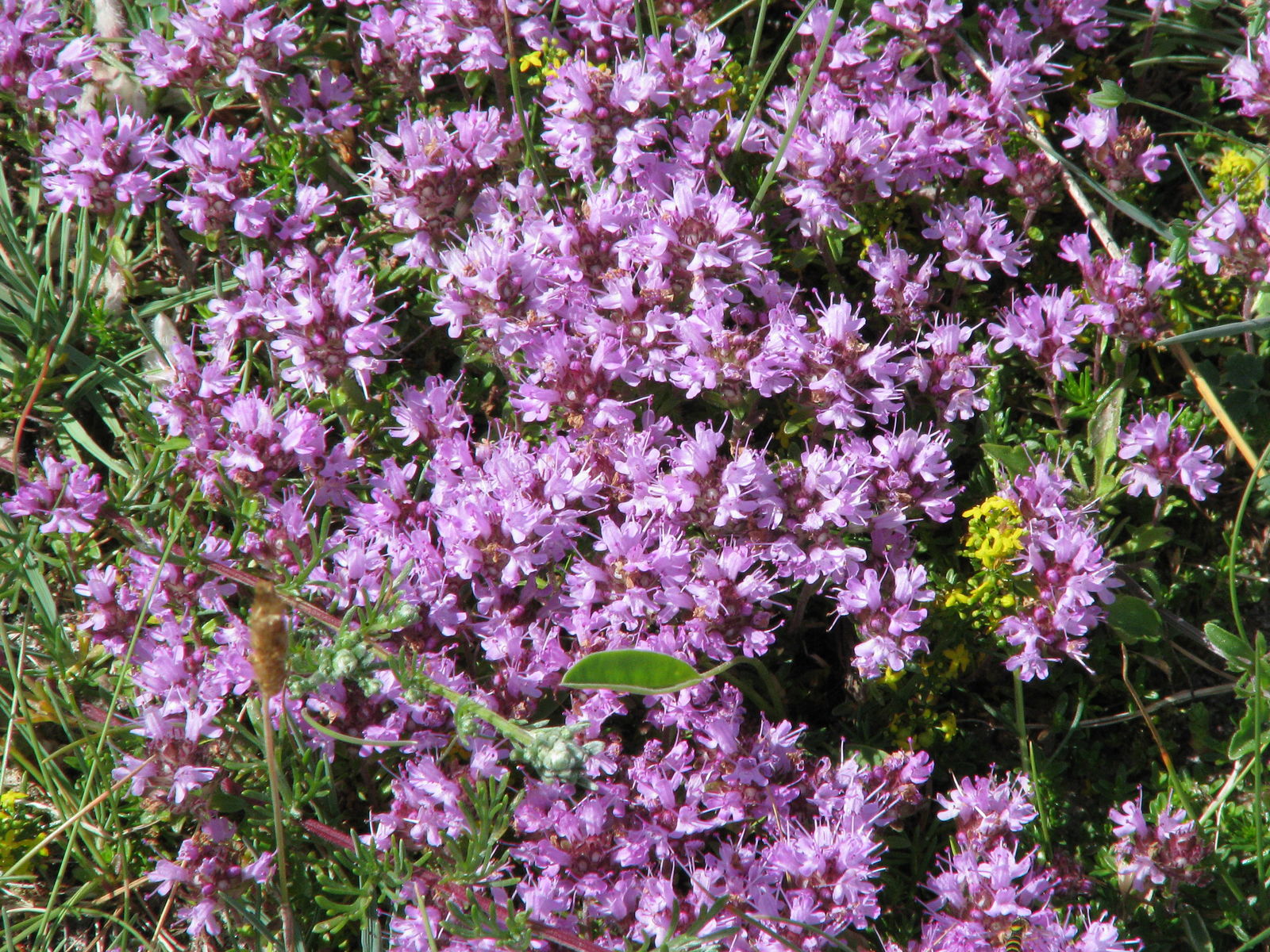
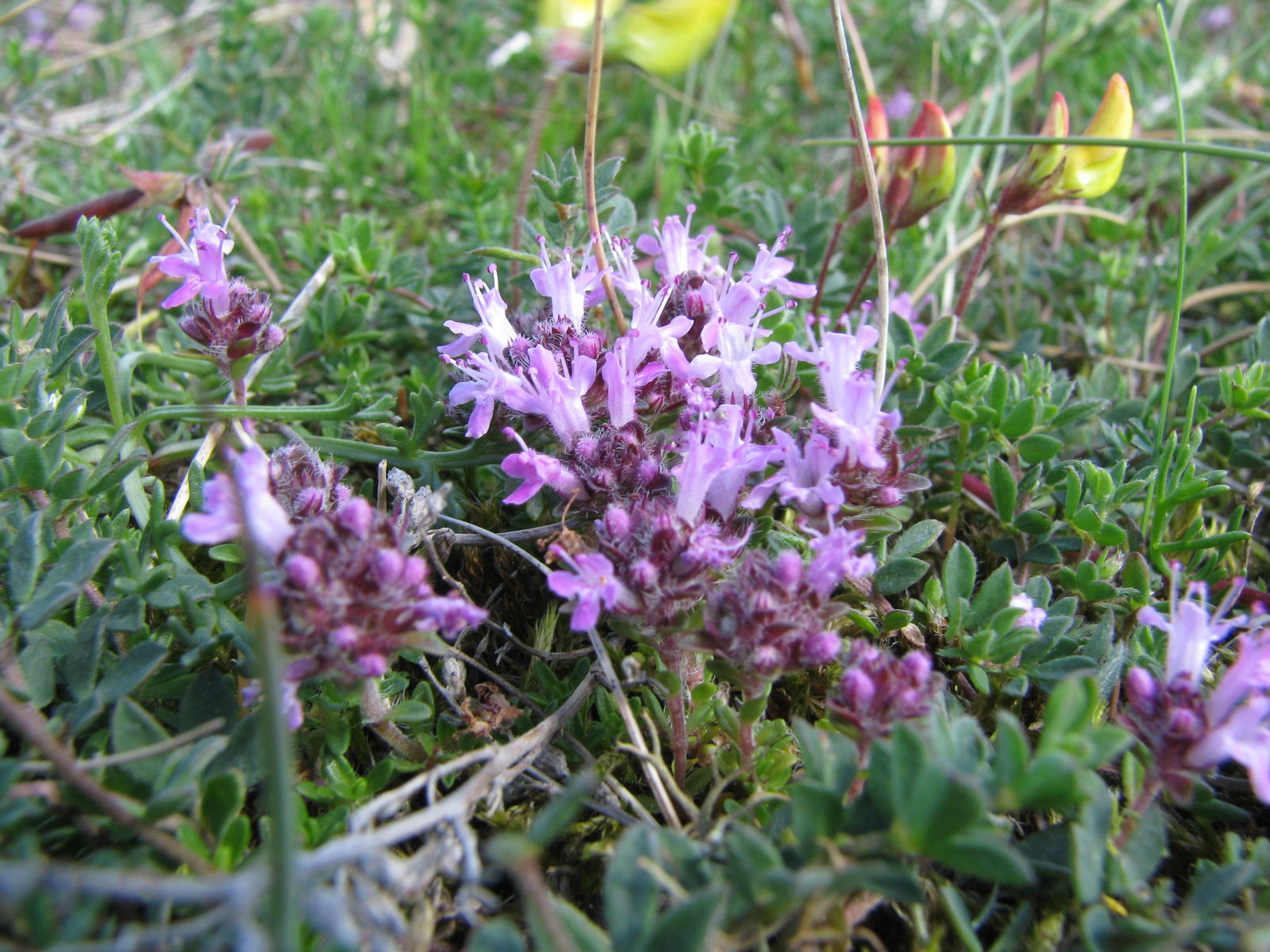
Fine hairs cover the prostrate stems, which root at the nodes when they touch soil. A typical mat stands 5–8 cm (2–3 in) high and spreads 8–30 cm (3–12 in), depending on growing conditions. This low woody framework is the foundation of its ground-covering habit. 6 7
Small opposite leaves, oval to lance-shaped, measure about 6 mm (0.24 in) long and remain evergreen through mild winters. Crushing them releases a pronounced aromatic scent, although it is less intense than that of common thyme. 6 4
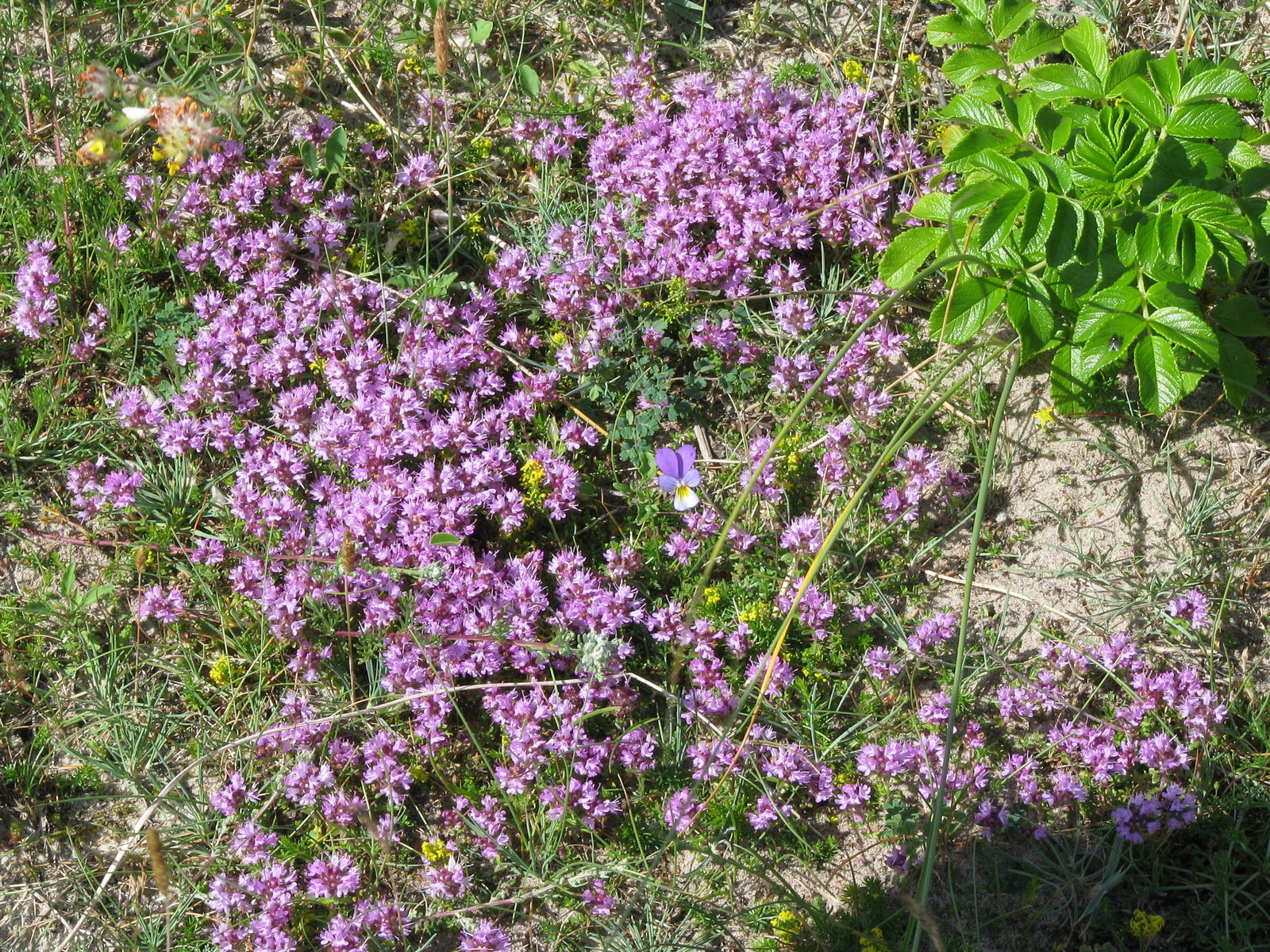
Flowers appear from late spring through summer and sometimes into early fall, depending on climate. Tiny tubular pink to mauve flowers, sometimes described as bluish, cluster in dense heads at the tops of short upright shoots rising from the mat. 6 4
A continuous, prostrate cushion is the most reliable visible clue. Healthy Breckland thyme does not develop the upright woody framework of Thymus vulgaris. Without full sun, or in overly rich soil, it grows taller and loses that characteristic carpet-like outline. 4
Useful taxonomy
The accepted Kew name is Thymus serpyllum L., published in 1753 in the Lamiaceae family. Frequently encountered synonyms include Serpyllum vulgare Fourr. and Origanum serpyllum (L.) Kuntze. A widely circulated illegitimate name is Thymus campestris Salisb. 1 3
Hundreds of historical names have been associated with this complex in Thymus, reflecting strong morphological variation among local populations. Buying a plant under an obsolete synonym such as Serpyllum vulgare can therefore result in receiving another thyme species. The accepted binomial provides the stable reference for identification and purchase. 5
Confusion often involves Thymus pulegioides, another low-growing thyme with similar requirements, and cultivated forms sold as lemon thyme. Rooting stems and a very low mat remain the most useful features when comparing Breckland thyme with these close relatives. 5
Habitat and range
Sandy heaths, dry grassland, scrub, dunes and sunny rocks provide typical habitat, from lowlands into mountain country. The low habit shields buds from radiative winter frost, helping explain tolerance down to −30 °C (−22 °F) and reported occurrence up to 3,000 m (9,840 ft) in some regions. 4 8
Breckland, in eastern England, gives this thyme its English name: its sandy heaths are typical wild habitat. Beyond its European native range, the species is now widely cultivated as an ornamental ground cover, particularly in North America. 6
On poor, dry ground it behaves as a mat-forming sand-loving plant, occupying open spaces left by more demanding perennials. Once established, its dense carpet helps limit weed growth around it. This combination explains its association with sparse, open vegetation rather than rich, shaded beds. 4
Cultivation
Full sun, sandy, sharply drained soil and no enrichment are the three central requirements. Rich soil loosens the mat, softens the leaves and weakens the fragrance. A pH outside 6–7.5 similarly limits growth, so the plant's preference for poor soil does not mean it tolerates every substrate. 4 6
Propagation mainly uses spring division or summer cuttings from healthy stems. Seed remains useful, especially for unselected forms, but takes longer to produce an established carpet. Division starts with an existing piece of mat and therefore provides a quicker route to dense coverage. 4 6
Light trimming after flowering keeps the cushion dense and delays bare patches in the center, which reflect natural woody aging rather than disease. Excess water in heavy soil remains the main cultivation risk, occurring much more often than cold damage. 6
Uses and wildlife
Bees frequently visit the nectar-rich flowers, and several butterflies use the plant as a larval host. The large blue (Phengaris arion) is one example: its caterpillars mimic ant larvae to gain acceptance into an ant nest, where they complete their growth. 4
Dried leaves contain essential oil dominated by carvacrol and thymol. Traditionally, they are used in infusions associated with digestive and respiratory complaints, often alongside rosemary or sage. No toxicity is reported for cats, dogs or people in the retained profile. 4
In the French Republican calendar, Serpolet named the ninth day of Prairial, around late May. Like other plants used to name calendar days, it reflects how familiar this herb was in the French countryside during the 18th century. 4
Varieties, look-alikes and related plants
Cultivated selections differ in leaf or flower color. Coccineus barely exceeds 5 cm (2 in) in height and forms a broad dark green mat with vivid pink to magenta flowers, useful between paving stones. Compact dwarf Elfin suits smaller spaces. Magic Carpet offers abundant magenta flowers, while Pink Chintz combines woolly foliage with salmon-pink blooms. 6 7
Useful comparisons include:
- Thymus vulgaris, upright and never rooting at the nodes, grown mainly for cooking;
- Thymus pulegioides, another low mat-forming thyme with similar soil and light requirements;
- horticultural lemon thymes, whose scent is distinctly citrus-like rather than typically thyme-scented.
Look first for the prostrate, rooting habit. This is more pronounced in Breckland thyme than in Thymus pulegioides or lemon-thyme forms: on poor soil it produces a dense, low mat well before flowers provide additional identification clues. 5
Main sources
- Plants of the World Online / Kew, Thymus serpyllum L.
- GBIF, Thymus serpyllum L.
- International Plant Names Index, Thymus serpyllum L.
- Wikipedia (French), Serpolet
- Wikipedia (EN), Thymus serpyllum
- NC State Extension, Thymus serpyllum - Creeping Thyme
- Royal Horticultural Society, Thymus Coccineus Group
- Missouri Botanical Garden, Plant Finder, Thymus serpyllum
Frequently asked questions
Is Breckland thyme toxic to cats and dogs?
No. The retained profile for Thymus serpyllum reports no toxicity to cats, dogs or people; its status for horses remains undocumented.
How does Breckland thyme differ from common thyme?
Breckland thyme (Thymus serpyllum) forms a low mat of prostrate, rooting stems. Common thyme (Thymus vulgaris) forms a small upright bush without rooting at the nodes. Breckland thyme is mainly a ground cover, while common thyme is mainly a culinary herb.
Can you eat Breckland thyme?
Yes. Its aromatic leaves are used like common thyme in cooking and infusions, although its scent is milder and its culinary use less widespread.
How do you propagate Breckland thyme?
Divide clumps in spring or take healthy stem cuttings in summer for the most reliable results. Seed also works but takes longer to form a dense mat.
Does Breckland thyme grow wild in France?
Yes. It occurs in sunny scrub, dry grassland, banks and rocky places, in lowlands and mountains, on poor, well-drained soil.
Does Breckland thyme attract pollinators?
Yes. Bees visit its nectar-rich flowers, and several butterflies use it, including the large blue. Its caterpillars feed on the plant before completing development in an ant nest.
Why is the center of my thyme mat thinning?
This is natural woody aging rather than a disease. Divide the clump or take healthy tip cuttings instead of trying to regenerate bare old wood.
Similar plants
If you are unsure about a plant’s toxicity, ask a botanist or veterinarian for advice.