
Red clover (Trifolium pratense, )
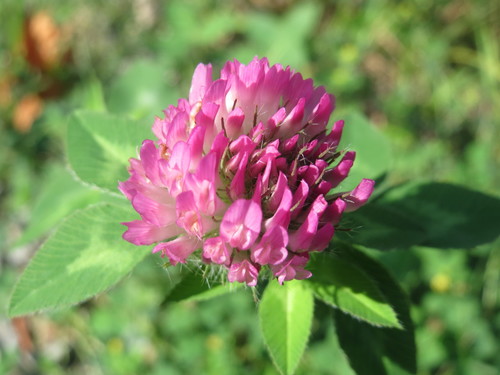
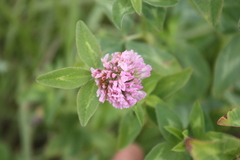
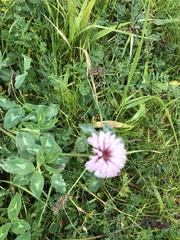
Red clover (Trifolium pratense) is an herbaceous perennial in the Fabaceae family, native to Europe, western Asia and northwestern Africa. Its trifoliate leaves with pale chevrons and rounded purple flower heads distinguish one of the most widely cultivated forage plants of temperate grasslands.
Read moreRed clover, Meadow clover, Purple clover, Common clover, Cow clover and Broad-leaved clover

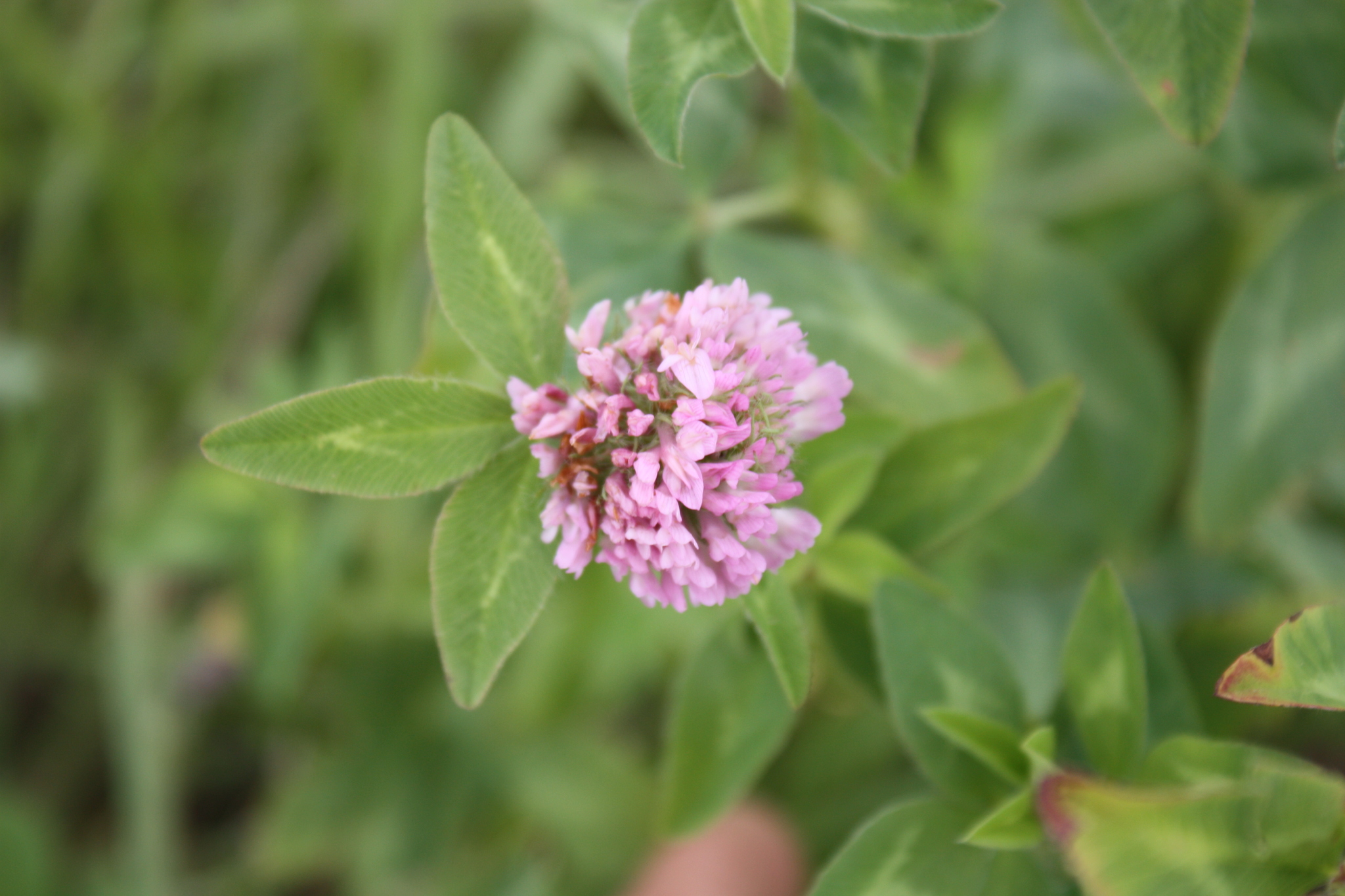
© photo
(c) Andreas Rockstein, some rights reserved (CC BY-SA) · cc-by-sa
Scott Loarie · cc0
iNaturalist User · cc0
(c) Tom Norton, some rights reserved (CC BY) · cc-by
(c) Mark Apgar, some rights reserved (CC BY) · cc-by

Global distribution
The native range of Trifolium pratense covers Europe, western Asia and northwestern Africa. Widely cultivated for forage, the species has naturalized on almost every temperate continent. These introduced populations remain distinct from its native Eurasian range.
- Native4
- Introduced4
- Mainland France
- Temperate Europe
- Western Asia
- North Africa
- United States
- Argentina
- Australia
- New Zealand
Hexagons: regions where the plant occurs. Green dots: native range.1
Identity
Red clover (Trifolium pratense L., 1753), also known as meadow clover or purple clover, is a perennial in the genus Trifolium, family Fabaceae. Its epithet pratense derives from Latin pratum, meadow, aptly describing its preferred habitat. 1 2
Trifoliate leaves and purple flower heads usually identify this species in temperate grassland. Unlike alfalfa, another forage legume often sown alongside it, red clover fixes atmospheric nitrogen from its first season through Rhizobium bacteria in its root nodules, without fertilizer. 4 5
Recognition
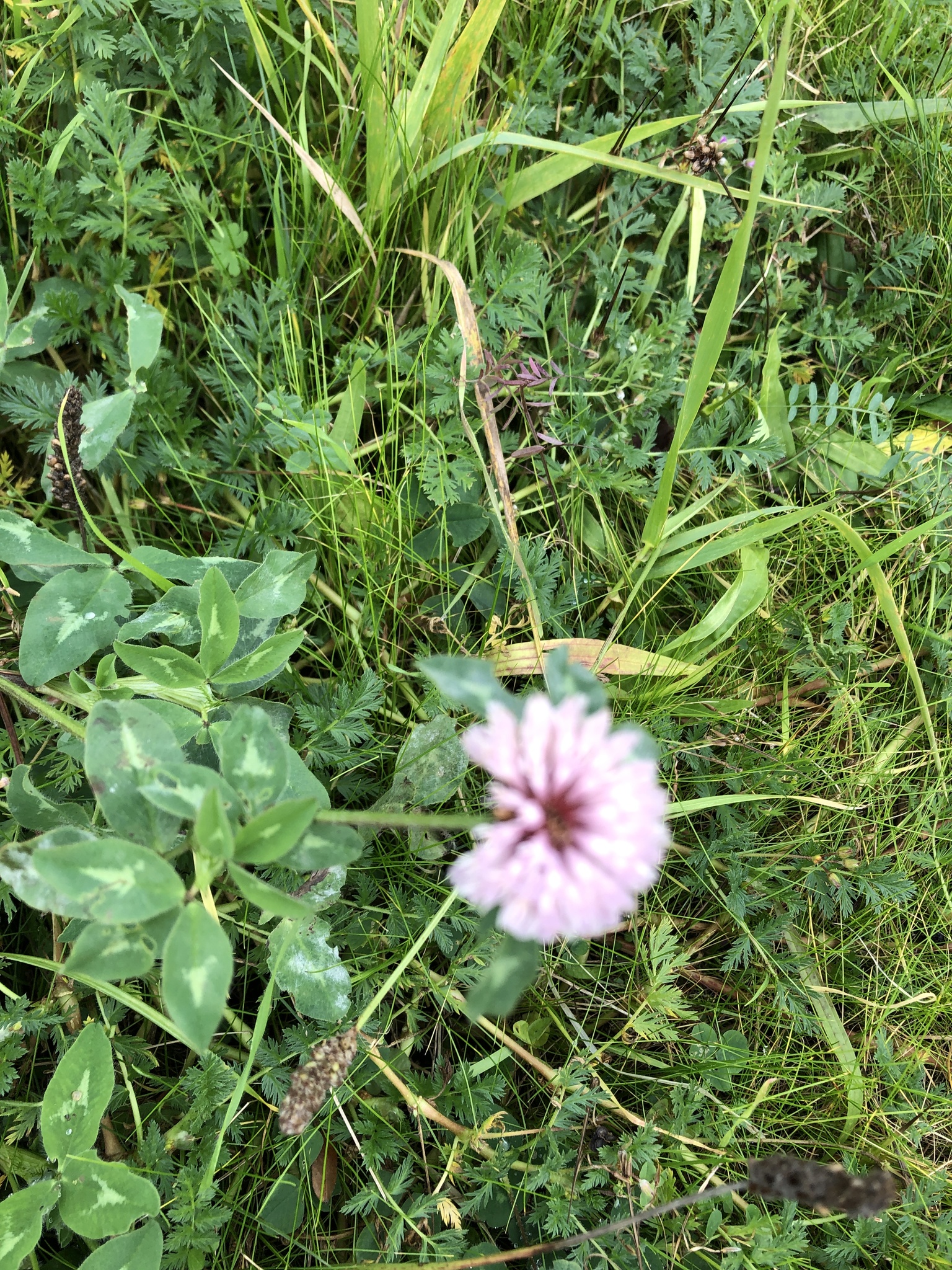
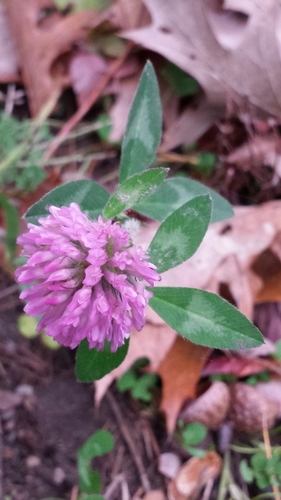
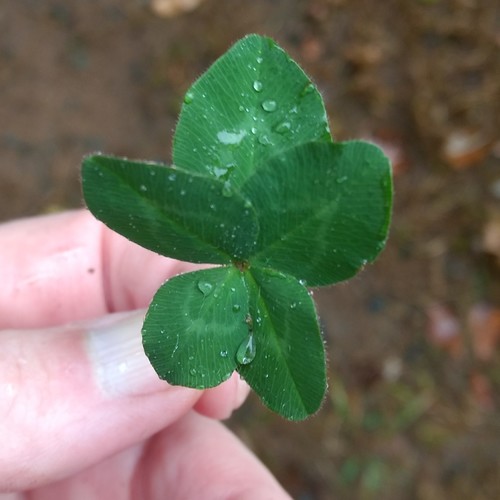
Upright to ascending clumps of Trifolium pratense reach 15–80 cm (6–31 in), depending on soil and climate. Selected forage varieties occupy the upper end of that range, while wild roadside populations are usually shorter and less densely flowered. Each leaf has three oval to elliptical leaflets, often with a pale chevron or crescent above, a useful recognition feature even without flowers. 4
Rounded flower heads measure 1.5–4 cm (0.6–1.6 in) across and occur singly or in pairs at stem tips. Individual flowers are deep pink to purple, paler at the base and rarely white, and measure 12–15 mm (0.5–0.6 in) long. Their hairy calyx has five narrow teeth. 1 2
Useful taxonomy
In Species Plantarum in 1753, Carl Linnaeus described the species as Trifolium pratense L., which remains its accepted name. Trifolium is one of the largest genera in Fabaceae, with several hundred species across the temperate Northern Hemisphere. 1
Botanists have described several forms and varieties within red clover, including:
- Trifolium pratense var. album Gray, a varietal name
- Trifolium pratense var. sylvestre Ducommun, another historical variety
- Trifolium pratense f. versicolor H.Lindb. ex Hiitonen, a named form
- Trifolium pratense subsp. pratense, the nominate subspecies
Historical varieties and forms describe differences in flower color or hairiness rather than separate species. The accepted name Trifolium pratense is therefore a more stable reference than these numerous older names. 1
Habitat and range
Across its native Europe, western Asia and northwestern Africa, red clover grows in meadows, pastures, roadsides and woodland edges. It generally favors calcareous to neutral soils. 3 4
Forage cultivation has carried red clover far beyond its original range. It has naturalized in North and South America, Australia and New Zealand, and has been established in Argentina for more than a century. These introduced populations remain distinct from its native Eurasian range. 2
A deep taproot gives established plants good drought tolerance. This rooting capacity has encouraged the use of red clover as both a forage crop and a green manure across many agricultural systems. 3
Protein-rich foliage also feeds grassland wildlife: deer, turkeys and rabbits readily browse it where abundant. The same nutritional value that encouraged agricultural cultivation makes it a useful food resource along woodland edges. 4
Life cycle and reproduction
Short-lived perennial growth characterizes red clover, which is often cultivated for two to three years before reseeding becomes necessary. In the temperate Northern Hemisphere, flowering runs from May to September and may begin in the first year on favorable soil. 3 2
Bumblebees provide most pollination, using their long tongues to reach nectar deep in the flower tube. Shorter-tongued honeybees have much greater difficulty reaching it. After fertilization, each flower forms a pod only a few millimeters long, generally containing one seed. 2
Root nodules house bacteria of the genus Rhizobium, which convert atmospheric nitrogen into a form the plant can use. This process makes red clover a valued green manure, able to enrich poor soil without chemical fertilizer. 4 5
Uses and risks
Forage is the principal agricultural use of Trifolium pratense. It is among the most widely sown legumes for feeding livestock and enriching soil with nitrogen. People also eat the flowers and young leaves, raw in salads or cooked, or dry them for herbal tea. 5 3
Isoflavones in the plant resemble estrogens and have long been studied in connection with the traditional treatment of hot flashes, without solid clinical evidence to date. Red clover also contains coumarins, which warrant caution during anticoagulant treatment, especially when forage has dried poorly. 2
Pastures too rich in fresh clover can expose livestock to bloat: rapid fermentation distends the rumen, particularly when intake is not increased gradually. Prolonged consumption of phytoestrogens also reduces herd fertility, and forage contaminated with black fungal mold causes excessive salivation in affected animals. 5 4
Varieties, look-alikes and related plants
Agricultural cultivars fall mainly into two groups: early diploid types, cut once, and late tetraploid types, allowing several cuts per season. The Spanish cultivar Redquin, selected for early growth, illustrates the first group. 5
Look-alikes within the genus include the following species:
- Trifolium medium, zigzag clover, distinguished by stipule shape and calyx hairiness;
- Trifolium repens, white clover, with creeping stems and white to pinkish flowers;
- Trifolium arvense, hare’s-foot clover, with much smaller, soft gray-pink flower heads.
Pale leaflet chevrons, upright stems and purple flower heads are more conspicuous guides than calyx hairiness or stipule shape. Those subtler features may be needed to confirm Trifolium pratense when comparing it with Trifolium medium or Trifolium arvense. 4 1
Main sources
- Plants of the World Online / Kew, Trifolium pratense L.
- Encyclopaedia Britannica, red clover
- Plants For A Future, Trifolium pratense
- NC State Extension, Trifolium pratense
- Feedipedia / INRAE-CIRAD-AFZ, Red clover (Trifolium pratense)
- University of Vermont Extension, red clover as the state flower of Vermont
- INPN / MNHN, Trifolium pratense L., 1753
- Tela Botanica, Trifolium pratense L.
Frequently asked questions
Is red clover toxic to animals?
Its overall toxicity is low, but pasture too rich in fresh clover can cause digestive bloat in cattle and sheep. Prolonged consumption of its phytoestrogens can also reduce herd fertility, and forage contaminated with black fungal mold may cause excessive salivation.
Can people eat red clover?
Its flowers and young leaves are edible raw in salads or cooked, and are sometimes dried for tea. The plant contains isoflavones traditionally used for hot flashes, although clinical evidence remains limited.
How does red clover fix nitrogen?
Its root nodules host Rhizobium bacteria that convert nitrogen from the air into a form the plant can absorb. This process makes red clover a valued green manure in agriculture.
How can I distinguish Trifolium pratense from Trifolium repens?
Trifolium pratense forms an upright clump with purple flower heads, whereas Trifolium repens creeps along the ground by stolons and has white to pinkish flowers. Growth habit is the quickest distinction.
Is red clover invasive in gardens?
It readily self-seeds but is a short-lived perennial that mowing can contain. In France it is not classified as an invasive plant.
Does red clover help with hot flashes?
Its isoflavones have long been studied for this traditional use, but available clinical trials remain too limited to establish clear effectiveness.
When and how should I sow red clover?
Sow in spring after soaking the seeds for 12 hours, either directly or under cover, in well-drained soil that is neutral to calcareous. Germination takes one to two weeks, and plants may flower in their first year.
Similar plants
If you are unsure about a plant’s toxicity, ask a botanist or veterinarian for advice.