
Copper alocasia (Alocasia cuprea, )


Copper alocasia (Alocasia cuprea) has thick, glossy leaves with deeply sunken veins and purple undersides. This member of the Araceae from Borneo is grown in a warm indoor space or greenhouse.
Read moreCopper alocasia
Caladium cupreum, Caladium metallicum, Alocasia metallica, Caladium veitchii and Gonatanthus cupreus
Give plenty of ambient light without direct sun on the leaves.
Bright, filtered light under cover; partial shade in horticultural cultivation.




© photo
Wikimedia Commons · CC BY-SA or Public Domain
Wikipedia · CC BY-SA
© copyright of the Board of Trustees of the Royal Botanic Gardens, Kew.


Global distribution
A species from Borneo, documented in Sabah and Sarawak in Malaysia, and in North Kalimantan in Indonesia.
- Native3
- Sabah, Malaysia
- Sarawak, Malaysia
- North Kalimantan, Indonesia
Hexagons: regions where the plant occurs. Green dots: native range.↗
Identity
Copper alocasia (Alocasia cuprea (K.Koch & C.D.Bouché) K.Koch, 1861) has glossy foliage whose raised surfaces resemble hammered metal. Its French names, oreille d’éléphant rougeâtre and alocasia de cuivre, refer to the same species, grown as a houseplant or greenhouse plant. 2 3
This perennial belongs to the Araceae, in the order Alismatales and the kingdom Plantae. The species does not have uniformly red foliage: silvery-green plants are also described. The horticultural name Red Secret must therefore be distinguished from the species name. 5 6 7
Identification
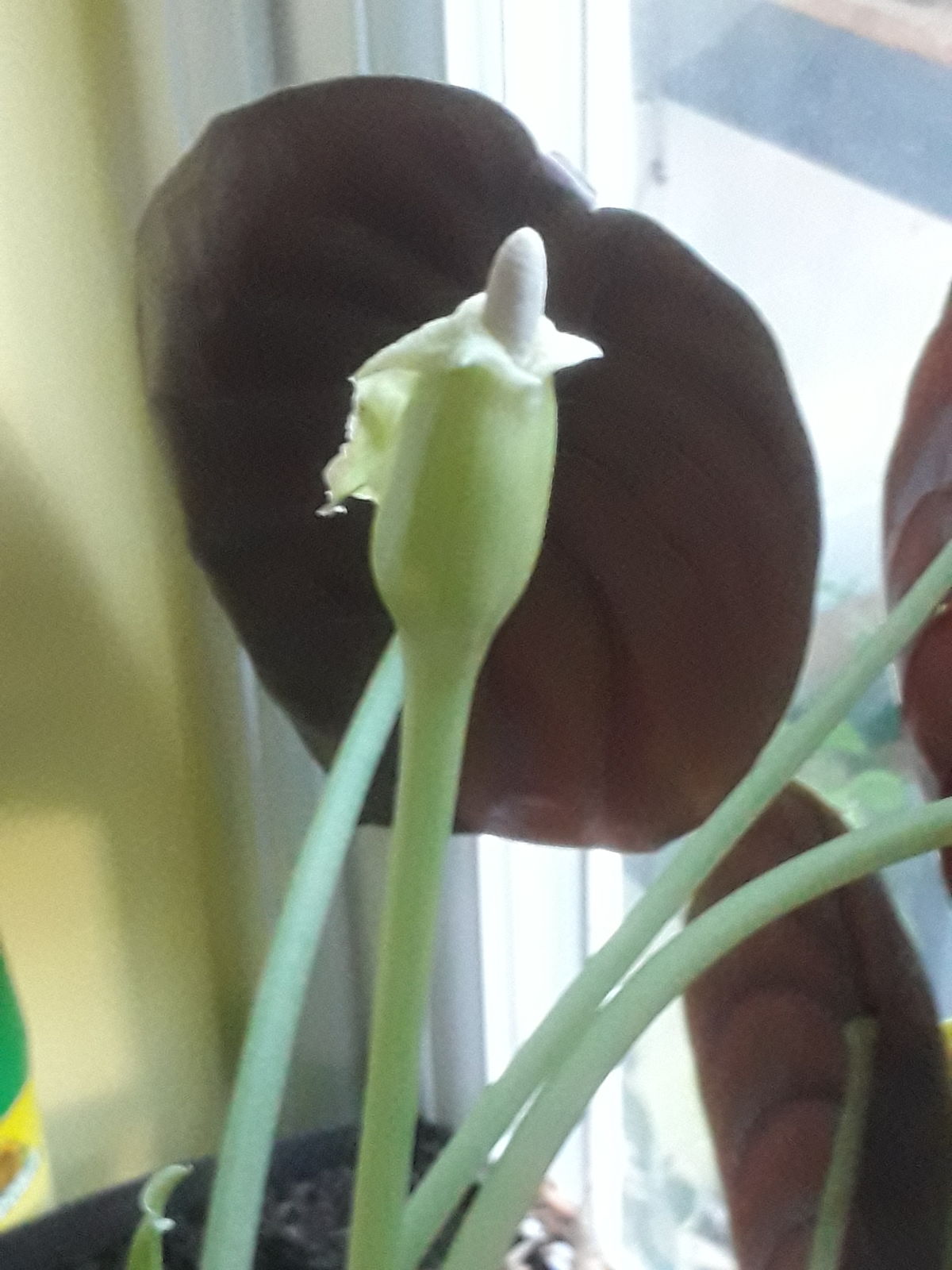
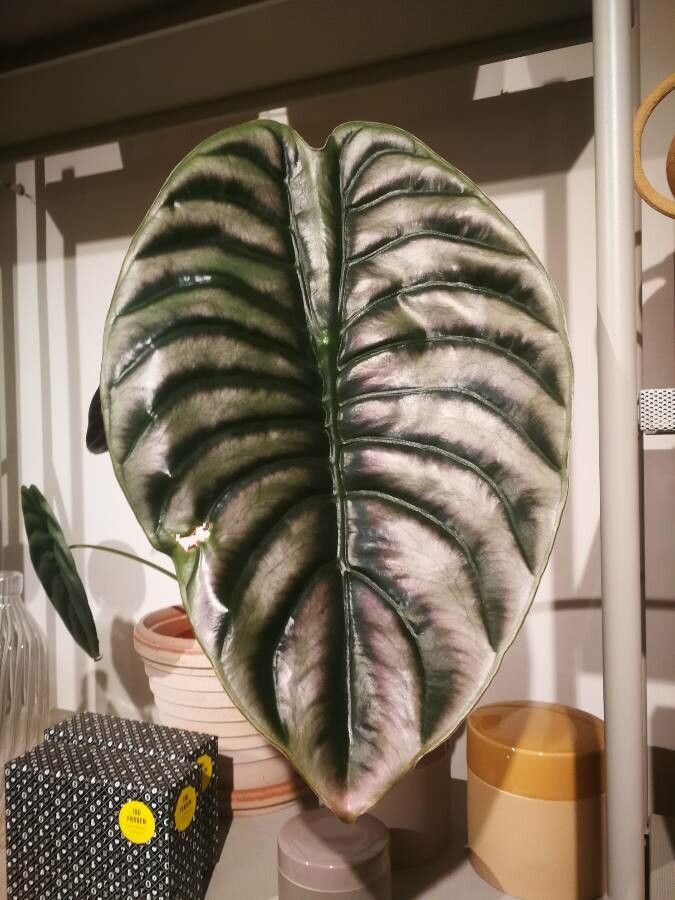
The leaves are peltate: the petiole attaches beneath the leaf blade, rather than simply at the edge of its base. Thick and oval, they bulge between the main veins, which appear deeply sunken. The upper surface is glossy, ranging from green to coppery bronze; the underside is dark purple. Young leaves may have a red tint. 6 3
When grown under cover, the leaves measure 20–60 cm (8–24 in). Horticultural height and spread are given as 50–100 cm (20–39 in) for indoor or greenhouse conditions; another description for cultivation under cover gives maxima of 85 cm (33 in) tall and 70 cm (28 in) wide. These whole-plant measurements are distinct from leaf length. 2 3
Color also varies between populations. Plants collected in North Kalimantan and then studied in a living collection in Bali had silvery-green upper surfaces and four to five main lateral veins on each side. Their identification rests on a combination of features, rather than coppery color alone. 6
Useful taxonomy
The current name, Alocasia cuprea, was published in 1861. 4 Its basionym is Caladium cupreum K.Koch & C.D.Bouché, whose publication is dated to 1855. 1 The seed catalog bears the year 1854, which is also cited in the 2022 botanical treatment. The combination in Alocasia came after the original name. 6
The synonymy includes Caladium metallicum K.Koch, Caladium veitchii Hend. ex Hook.f., and Gonatanthus cupreus (K.Koch & C.D.Bouché) H.Low ex Sankey. Alocasia metallica (K.Koch) Hook. is classified there as an illegitimate name. 1 The 2022 treatment cites a different author attribution, Gonatanthus cupreus C.Koch, as a name mentioned in synonymy. An old “metallica” label is not enough to identify a modern cultivar. 6
Habitat and distribution
Copper alocasia is a plant of Borneo, occurring in Malaysian and Indonesian territories. Long reported mainly from Sabah, it is also documented in Sarawak and North Kalimantan. A collection made in 2016 at Krayan, in Kayan Mentarang National Park, was described in a 2022 publication. 6
At Krayan, the plant grew at 1,005 m (3,297 ft) above sea level, from a stream bank to rocky slopes in montane forest. The soils observed ranged from sand to brown humus covered with leaf litter. This site does not define a single growing recipe: elsewhere in Borneo, the species has been reported on several kinds of substrate. 6
The soil at the Kalimantan site had a measured pH of 6.7. Habitats reported in Sabah and Sarawak also include kerangas forest on strongly acidic soils. The species is reported on ultramafic, limestone, and sandstone terrain. These field observations are not a recommended pH range for a pot. Above all, they show that a Bornean origin does not mean all of the plant’s habitats share the same forest soil. 6
Life cycle and reproduction
Copper alocasia has an upright rhizome and evergreen foliage under favorable growing conditions. Offshoots help the clump expand. In alocasias, dividing offshoots is a horticultural propagation method that preserves the characteristics of a selected plant. 6 2 7
The inflorescences may appear in pairs. Each spathe surrounds a spadix bearing the flowers; the spadix has female and male zones separated by a sterile zone. In the plants studied in the Bali collection, the spathe measured about 11.6 cm (4.6 in) and the spadix 8 cm (3.1 in). These are inflorescence dimensions, not the dimensions of an individual flower. 6
Uses and risks
Growing the plant in a pot brings its foliage to eye level. Under cover, bright, filtered light and a very airy growing medium are suitable. Keep the mix moist during growth; in temperate greenhouse or indoor conditions, let it dry between winter waterings. A moist growing medium should not become constantly waterlogged. 2 3
Copper alocasia is not edible. The risks described for the genus Alocasia concern calcium oxalate crystals: chewing can irritate the lips, mouth, and throat, and the sap can irritate the skin or eyes. These risks justify keeping the plant out of reach of children and pets. Genus-level data do not allow every serious complication described in other alocasias to be attributed to this species. 2 7
Varieties, look-alikes, and related plants
Red Secret is an attested horticultural name for deeply wrinkled leaves that are initially coppery green, then metallic red, with dark veins and burgundy undersides. Greenback is also recorded as a horticultural name for the species. These names do not designate separate botanical species. 7 8
The related species Alocasia baginda also has a strongly peltate, bulging leaf blade. The botanical key distinguishes its pale-green underside with brownish-purple veins from that of Alocasia cuprea, whose underside and veins are dark purple. The underside of the leaf therefore helps distinguish these two plants with textured foliage. 6
Main sources
- Kew, WCVP: dataset, official metadata, and the taxonomic snapshot consulted
- Floriscope, Alocasia cuprea, oreille d’éléphant rougeâtre (French common name)
- Royal Horticultural Society, Alocasia cuprea
- International Plant Names Index, Alocasia cuprea
- GBIF Backbone Taxonomy, exact match for Alocasia cuprea
- Asih and Lestari, 2022, Update on Alocasia cuprea distribution in North Kalimantan
- NC State Extension, Alocasia: genus-level risks and cultivars
- RHS, Alocasia cuprea Greenback
Frequently asked questions
How can you identify copper alocasia?
Copper alocasia has thick, glossy leaves that bulge between the veins and have purple undersides. The petiole attaches beneath the leaf blade, which is peltate.
Does Alocasia cuprea come only from Sabah?
No. The species is also documented in Sarawak and North Kalimantan. A study published in 2022 describes the collection made at Krayan in 2016.
Is Red Secret the name of the whole species?
No. Red Secret is a horticultural name associated with Alocasia cuprea. The species also includes plants with greener or more silvery foliage.
How large does copper alocasia grow indoors?
The horticultural description for indoor and greenhouse cultivation gives a height and spread of 50–100 cm (20–39 in). Leaves can reach 60 cm (24 in); their length does not represent the total height of the plant.
Can you eat copper alocasia?
No. This ornamental plant is classified as inedible. Alocasias pose an irritation risk associated with calcium oxalate crystals, particularly when chewed.
If you are unsure about a plant’s toxicity, ask a botanist or veterinarian for advice.