
Sweet vernal grass (Anthoxanthum odoratum, )
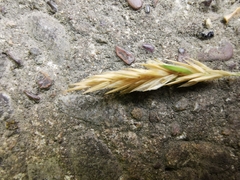
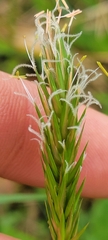
Sweet vernal grass (Anthoxanthum odoratum) is a small, early-flowering perennial in the Poaceae family. Its spike-like panicle rises above meadow tufts, and coumarin gives crushed or drying foliage the scent of freshly cut hay.
Read moreSweet vernal grass and Sweet vernal
Xanthonanthos odoratus and Anthoxanthum villosum
Allow a few hours of direct sun per day, preferably morning or evening.
Full sun; avoid dense shade.
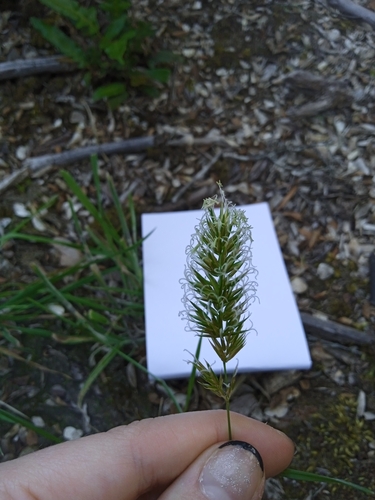
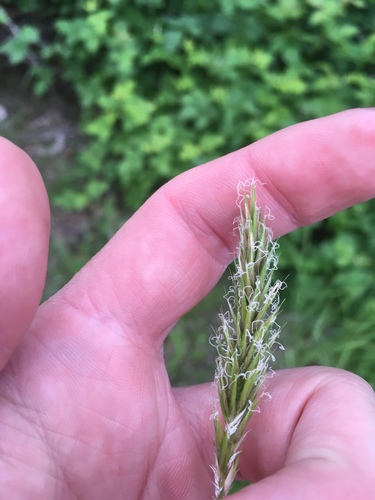
© photo
(c) Tom Norton, some rights reserved (CC BY), uploaded by Tom Norton · cc-by
iNaturalist User · cc0
Judson Collins · cc0
(c) Constanza Vargas Villegas, some rights reserved (CC BY) · cc-by
(c) Justin Felder, some rights reserved (CC BY-SA) · cc-by-sa
Global distribution
Native to Macaronesia, Europe east to Mongolia and northwestern Africa; widely introduced elsewhere.
- Native2
- Introduced1
- France
- Switzerland
- Australia
Hexagons: regions where the plant occurs. Green dots: native range.1
Identity
Sweet vernal grass (Anthoxanthum odoratum L., 1753) is a perennial grass containing coumarin, responsible for its freshly cut hay scent, especially when crushed or dried. The scent explains its name but cannot identify an isolated blade. It grows in tufts, with a narrow inflorescence appearing early in the season. The species belongs to Poaceae, the grass family. 4531
This is a meadow grass rather than a large architectural ornamental. In cultivation, its relatively short-lived tufts reach about 80 cm (31 in) at most. Habit varies with the site and the plant's age: a small nonflowering tuft does not show the same features as a plant at peak bloom. 43
Recognition
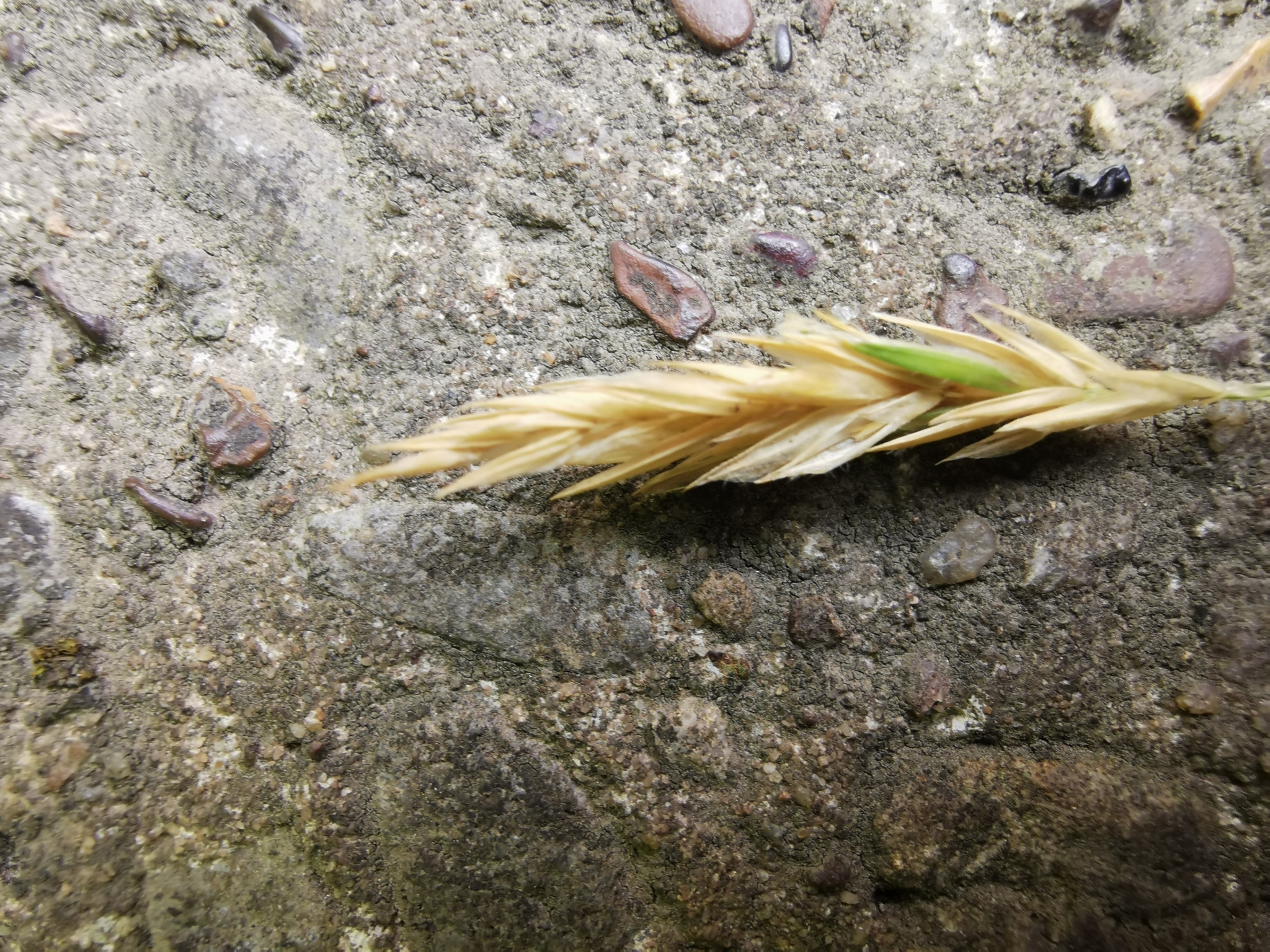
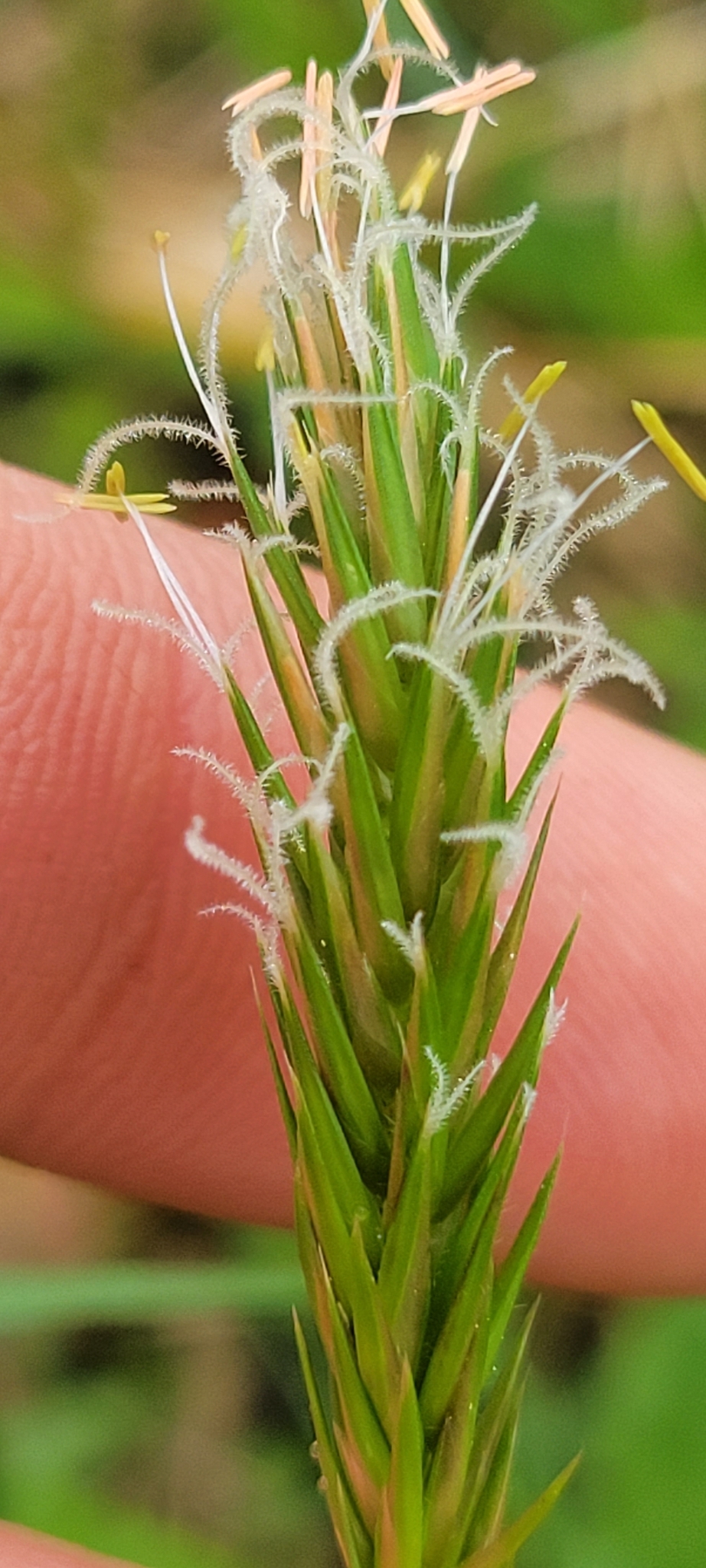
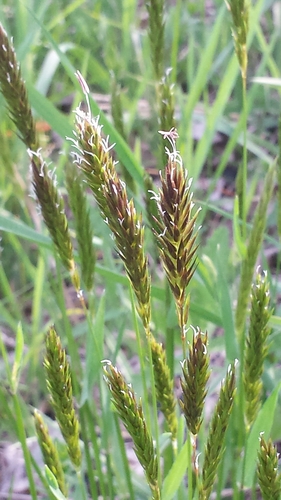
The shiny yellow-green spike-like panicle is 2–8 cm (0.8–3.1 in) long. Flat, gray-green leaves are dull on both sides and 3–7 mm (0.12–0.28 in) wide; plants usually stand 20–50 cm (8–20 in) tall. Together these features suggest an identification, to be checked against spikelet characters in a flora. 24
The ligule is the small membrane at the junction of leaf sheath and blade. Here it is blunt and 1–5 mm (0.04–0.2 in) long, while the young leaf is rolled in the bud. A close photograph of this junction complements a whole-tuft view. The panicle's spike-like appearance does not mean that every spikelet attaches directly to the main axis. 4
Useful taxonomy
Linnaeus published the accepted name in Species Plantarum, page 28, in 1753. The scientific name retains that form, with “L.” identifying its botanical author. Anthoxanthum belongs to Poaceae in the order Poales. Synonyms include Xanthonanthos odoratus (L.) St.-Lag. and Anthoxanthum villosum (Loisel.) Tinant. 1
Spikelet structure explains why identification sometimes needs a hand lens. The spikelets contain sterile florets and one fertile floret, with differently sized and textured lemmas and paleas: densely hairy on the sterile florets, smooth and hairless on the fertile one. A grass head is therefore not a single flower. Photograph several spikelets and record the date rather than relying on scent alone. 82
Habitat and range
The native range covers Macaronesia, Europe east to Mongolia and northwestern Africa. Introductions have carried it to many other regions; occurrence in Australia or the Americas does not establish native status there. 1 In metropolitan France it grows in meadows, woods and pastures throughout the country, including Corsica. On Réunion, where it was introduced, it is classified as invasive. 89
In Switzerland it occurs in meadows, pastures, fens and open woodland, from low elevations to alpine habitats. It is not restricted to mown lawns. Search meadows in local spring and examine the early inflorescences before taller grasses obscure them. Timing matters as much as location. 2
Life cycle and reproduction
Flowering runs from April to July in France, and April to June in Switzerland, making this an early grass in those northern temperate climates. Wind pollinates the flowers; seeds ripen from May to July. These inconspicuous flowers support sexual reproduction without showy petals. Seed-bearing heads no longer look exactly like the yellow-green flowering panicles. 825
Individual plants live for several years but can be short-lived. Self-sown seedlings renew populations, and sowing is carried out in local spring or fall. In a meadow planting, the disappearance of a tuft need not mean the habitat has become unsuitable: check whether young plants are replacing it. 3
Scent, uses and risks
The plant scents dried material, but fragrance does not establish food safety. Aromatic uses are documented, and pollen can irritate people with hay fever. Exposure during flowering therefore matters even without consumption. Taken internally, particularly dried, it can slow blood clotting. Reported traditional uses are not a medicinal prescription. 5
Spoiled forage can carry a hemorrhage risk. In a herd fed wrapped silage containing about 90% sweet vernal grass, three cows and eleven heifers died of dicoumarol poisoning. Molds can convert coumarin into dicoumarol, a vitamin K antagonist. Affected animals showed severe anemia and hemorrhage. This documented scenario establishes neither the safety of fresh forage nor identical toxicity in every animal species. 6
Cultivation and local variation
Cultivation chiefly requires ground that is not waterlogged and a sunny position. The grass accepts various soils and is rated RHS H7 for cold hardiness. A diverse meadow does not need every tuft treated as a container plant: watering follows local conditions, while retaining some panicles allows renewal by seed. 3
Sweet vernal grass also provides a model of local evolution. At a mine boundary, metal-tolerant populations and neighboring meadow populations maintained different flowering dates for more than forty years. This difference helps limit interbreeding between nearby populations. A seasonal difference can therefore reflect lasting biological variation, without a single observation being sufficient to name a new species. 7
Main sources
Sweet vernal grass is native throughout France. Spoiled silage rich in the species has caused hemorrhagic poisoning in cattle. 16
- Kew, Plants of the World Online
- InfoFlora, Flora Helvetica 2018
- Royal Horticultural Society, sweet vernal grass
- Royal Botanic Gardens Victoria, HortFlora (archived March 27, 2022)
- Plants For A Future, Anthoxanthum odoratum
- Runciman and colleagues, dicoumarol toxicity in cattle, 2002
- Antonovics, reproductive isolation at a mine boundary, 2006
- Tela Botanica, sweet vernal grass
- INPN, TAXREF, Anthoxanthum odoratum
Frequently asked questions
Why does sweet vernal grass smell like hay?
It contains coumarin, giving it the scent of freshly cut hay, particularly when crushed or dried.
When does sweet vernal grass flower?
In France, flowering runs from April to July; in Switzerland, from April to June, varying with local conditions.
Is sweet vernal grass safe for animals?
Safety has not been established for every species. Dicoumarol poisoning has been described in cattle fed mold-spoiled silage rich in this grass.
If you are unsure about a plant’s toxicity, ask a botanist or veterinarian for advice.