
Emerald fern (Asparagus densiflorus, )
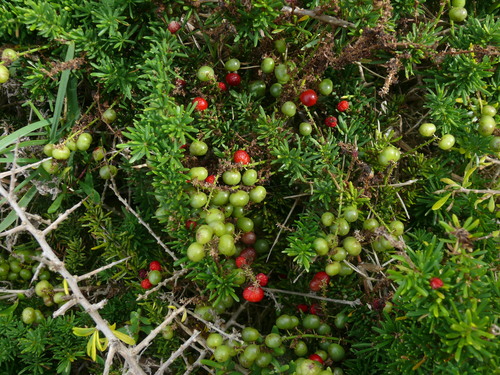
Emerald fern (Asparagus densiflorus) looks like a fern, but produces flowers followed by berries. Its fine foliage consists of cladodes; the true leaves are reduced to scales.
Read moreEmerald fern and Asparagus fern
Asparagopsis densiflora Kunth, Protasparagus densiflorus (Kunth) Oberm. and Asparagus myriocladus Baker
Give plenty of ambient light without direct sun on the leaves.
Bright light without direct sun indoors; partial shade in a sheltered position.


© photo
(c) Tony Rebelo, some rights reserved (CC BY-SA), uploaded by Tony Rebelo · cc-by-sa
Taken May 14, 2021 by Monteiro Henrique (cc-by-sa)
Taken Nov 27, 2019 by Harry Clegg (cc-by-sa)
Taken Sep 9, 2020 by freitas andrey1979 (cc-by-sa)
Taken Nov 17, 2008 by Tela Botanica − Yoan MARTIN (cc-by-sa)
Taken Jan 2, 2020 by carneiro brito Rafael (cc-by-sa)
© copyright of the Board of Trustees of the Royal Botanic Gardens, Kew.


Global distribution
Native from Mozambique to South Africa, including Eswatini; introduced in regions including Greece, Spain and eastern Australia.
- Native3
- Introduced3
- Mozambique
- Eswatini
- South Africa
- Greece
- Spain
- Australia, Queensland and New South Wales
Hexagons: regions where the plant occurs. Green dots: native range.1
Identity
Emerald fern (Asparagus densiflorus (Kunth) Jessop, 1966) looks like a fern, but is a flowering plant in the Asparagaceae family. The French name "asperge à fleurs denses" refers to this species; English names containing "fern" describe only its appearance. 714
Its apparent foliage consists of cladodes, stem-derived organs that perform the work of leaves. The true leaves are small, inconspicuous scales. This difference explains why the feathery branches are not fern fronds, even when the plant is not flowering. 4
Recognition
In cultivation, emerald fern forms a bright green evergreen clump, with branches that may arch downward as they age. Published garden dimensions are 10 to 50 cm (4 to 20 in) tall and 50 to 100 cm (20 to 39 in) wide. These figures describe a cultivated plant; they are not universal limits for all wild plants or cultivars. 3
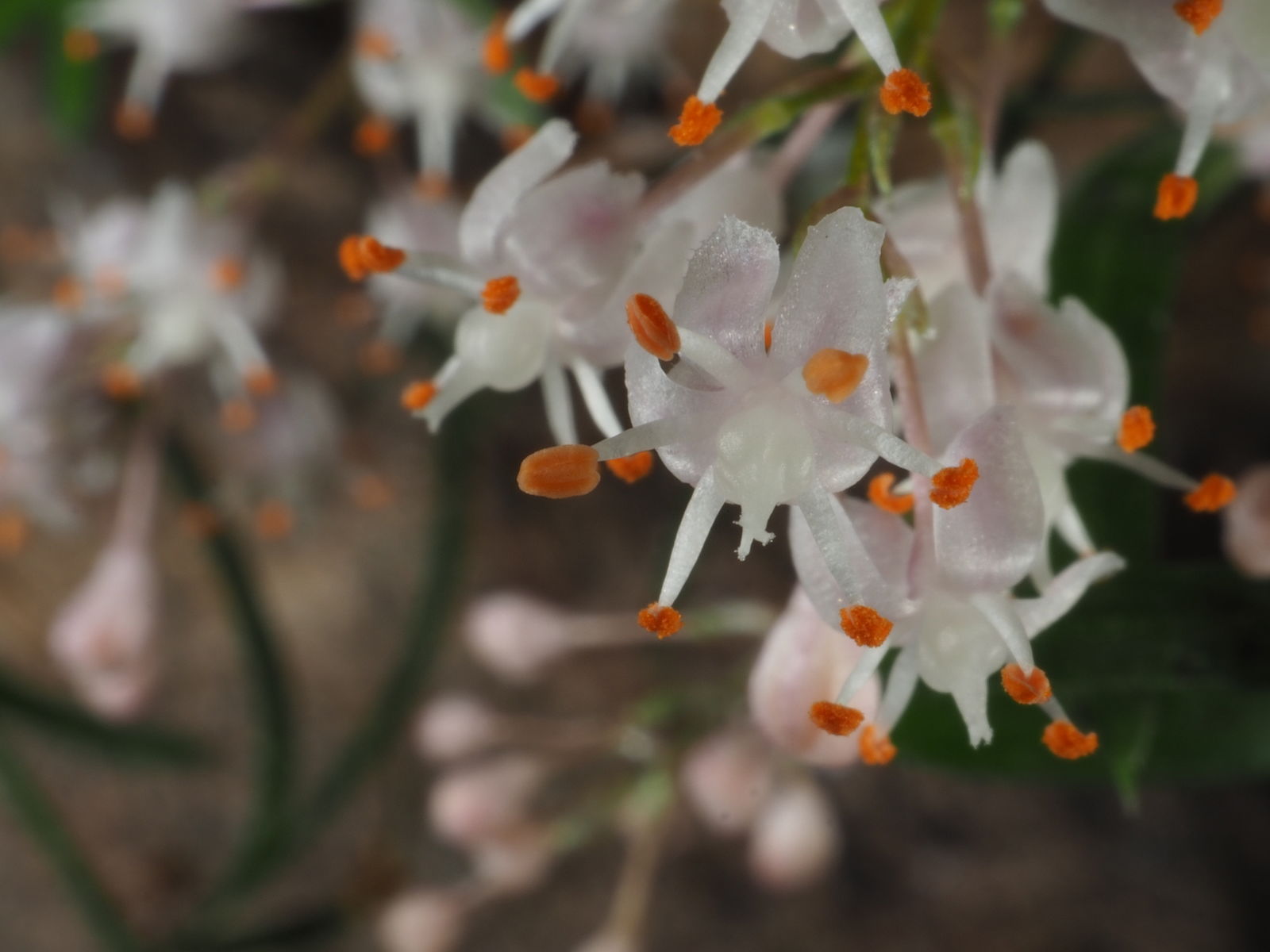
The small, inconspicuous white flowers are fragrant and borne in racemes. The fruits are red berries. Underground, tuberous roots form part of the root system: their presence does not make this asparagus an edible plant. Examining the flowers and fruit, along with the plant's overall shape, provides more evidence than an isolated branch. 8
Useful taxonomy
The accepted name, Asparagus densiflorus, was published by Jessop in 1966, in the journal Bothalia. The earlier name Asparagopsis densiflora Kunth dates to 1850. The parentheses around Kunth in the current author citation record this change of genus. Protasparagus densiflorus, published in 1983, is another combination based on the same nomenclatural type. 1
The names Asparagus densiflorus and Asparagus aethiopicus have been applied inconsistently to ornamental asparagus plants. Their genetic closeness does not justify systematically replacing one name with the other. A study of chloroplast genomes confirms a close relationship between A. aethiopicus and the cultivar 'Myers', while stating that it does not resolve the species origin of that cultivar. 2
Habitat and distribution
Emerald fern's native range extends from Mozambique to South Africa, including Eswatini. Mozambique includes the Inhaca islands here; in South Africa, the native range includes the Cape provinces and KwaZulu-Natal. The species is a perennial of the subtropical biome. Its geographic origins alone do not establish frost tolerance. 1
Emerald fern is also listed as introduced in Greece, Spain and eastern Australia, in Queensland and New South Wales. Other introductions include Pakistan and the Galápagos Islands. An introduced presence records arrival outside the native range; it does not, by itself, demonstrate invasive behavior in every region listed. 17
Life cycle and propagation
In a pot, provide bright light without direct sun and a moist but well-drained growing medium. Keep the plant frost-free. It can spend summer outdoors where nighttime temperatures remain above 5 °C (41 °F); this threshold for moving it outside is not an ideal growing temperature. 3
The growing rhythm of ornamental asparagus combines even moisture during growth with reduced watering in winter. Resume monthly fertilizer applications in spring and stop in winter. The calendar expresses this advice for container cultivation in the Northern Hemisphere. Yellowing foliage can indicate too little light or an overly dry growing medium: adding water without checking the light may therefore fail to address the cause. 4
Repot in early spring, before new shoots appear. Spring is also the preferred season for division. The plant can be grown from seed; germination is reported in 3 to 4 weeks at room temperature, without a guarantee that all seeds will germinate evenly. 4
Uses and risks
Emerald fern is an ornamental plant, grown indoors or in gardens where the climate is suitable. Its berries are listed as harmful if eaten; a risk of skin allergy justifies wearing gloves when handling it. 3
Toxicological classifications of Asparagus densiflorus differ. A veterinary reference describes the species as non-toxic, but reports saponins, notes that the literature it uses contains no described animal cases, and explicitly advises against using it as animal feed. This absence of recorded cases does not demonstrate safety. 8
Berries of ornamental asparagus are also reported as toxic to cats and dogs. A reference specifically covering the cultivar 'Sprengeri' describes digestive upset after eating the berries and dermatitis after repeated contact. These symptoms concern that identified cultivar; they do not prove that every animal is equally sensitive to every form. The status for horses remains undetermined here. 45
Varieties and lookalikes
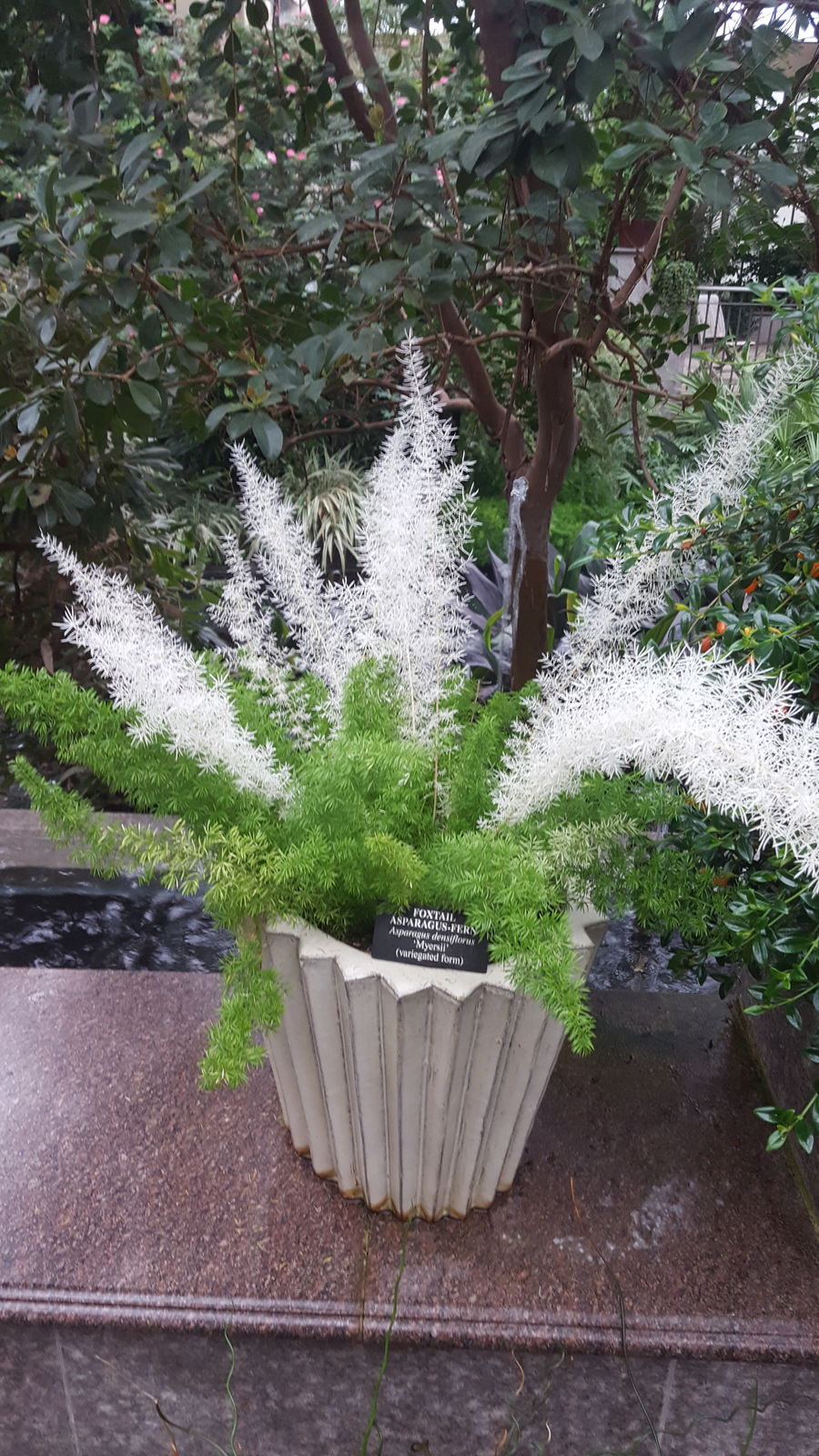
'Myersii' is a horticultural name, applied to a bushy form with fine foliage densely arranged along the stems. This form is described as around 0.6 m (2 ft) tall, with small white flowers and fruits that change from green to red. Its proportions should not replace those of the species as a whole. 6
The placement of the cultivar called 'Myers' remains debated. Its non-climbing habit supports placement under A. densiflorus, while other treatments place it under A. aethiopicus. The proposal to use simply Asparagus 'Myers' names the cultivar without claiming to resolve its origins. Labels such as "Sprengeri," "Myers" and "Myersii" therefore call for checking the plant being described, rather than grouping all these names as synonyms of the species. 2
Main sources
- Kew, Plants of the World Online: Asparagus densiflorus
- Wong and colleagues, 2022: phylogeny and nomenclatural confusion in Asparagus
- Royal Horticultural Society: Asparagus densiflorus
- University of Wisconsin–Madison Extension: ornamental asparagus
- ASPCA: Asparagus densiflorus cv sprengeri, cats and dogs
- NParks: Asparagus densiflorus ‘Myersii’
- EPPO Global Database: French name and taxonomy
- University of Zurich, CliniTox: Asparagus densiflorus
Frequently asked questions
Is emerald fern a true fern?
No. This member of the Asparagaceae is a flowering plant. The fine structures that look like leaves are cladodes, while the true leaves are reduced to scales.
Can you eat Asparagus densiflorus berries?
No. The fruits are listed as harmful if eaten and must be kept out of reach of children and pets.
Is Asparagus densiflorus toxic to horses?
The status for horses remains undetermined in the references used here. This ornamental plant should not be used as animal feed.
When should I repot emerald fern?
Early spring, before growth resumes, is a suitable time to repot. Spring is also the preferred season for dividing the clump.
If you are unsure about a plant’s toxicity, ask a botanist or veterinarian for advice.