
Rock cress (Aubrieta, )
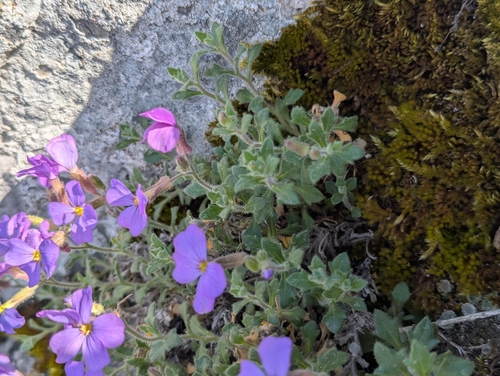

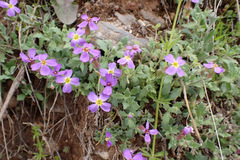
Aubrieta is a genus in the cabbage family, Brassicaceae, grown as a low ornamental ground cover. Its purple spring flowers spill over walls and soften rock gardens. Plants sold under this name are often cultivars or hybrids associated with Aubrieta deltoidea, rather than a single uniform species.
Read moreRock cress


© photo
Elias · cc0
Grzegorz Grzejszczak · cc-by-sa
Thomas Gyselinck · cc-by
© copyright of the Board of Trustees of the Royal Botanic Gardens, Kew.

Identity
Aubrieta Adans. is a genus in the Brassicaceae, the cabbage family. In gardens, however, its familiar role is that of a low ornamental ground cover for rock gardens. POWO, WFO and IPNI provide the botanical references for the genus. Its purple spring flowers explain its inclusion in Floralens’ selection of purple-flowering plants. 1 2 3
The name rock cress is used for low plants sold for walls, rock gardens and border edges. Much of the familiar garden display comes from Aubrieta deltoidea and hybrid cultivars. The broader name Aubrieta spp. includes these garden forms without assigning every plant to that one species. 4 5
A genus name and a species name offer different levels of identification. A plant labeled simply Aubrieta may be one of several garden forms; an identified Aubrieta deltoidea can be described more precisely at species level. The genus provides a useful starting point when the exact identity of a garden plant is not supplied. 8
Recognition
Low, tightly packed cushions distinguish aubrietas, with foliage that can remain evergreen or semi-evergreen depending on the winter and climate. Small leaves crowd along stems that readily trail over a wall. During spring flowering, the flowers can cover so much of the cushion that little foliage remains visible beneath them. 4 6
Small four-petaled flowers come in violet, mauve, pink, purple or white. Their effect comes from many flowers opening together, rather than from the size of an individual bloom. For a purple garden display, aubrieta supplies a spring carpet across stone and border edges rather than stems for a vase. 5 7
Growth habit matters as much as color. A well-grown aubrieta stays short, spreads over stone, covers an edge and softens a hard corner. Long, bare stems and sparse flowering often point to too much shade, excessively rich soil or a lack of trimming after the flowers fade. 6
Foliage continues to contribute after the flowers finish. A dense cushion covers bare patches between stones and gives a wall a neat, planted appearance. Variegated or golden-leaved forms are generally less vigorous, but their leaf color extends the decorative season beyond the main spring flowering period. 4 7
Rock garden cultivation
Light, free drainage and relatively lean soil suit Aubrieta. Cold is less troublesome than water standing around its roots. Heavy, sticky soil watered like a summer flower bed soon weakens the plant. A wall crevice, shallow trough or rock garden offers a more suitable setting for its small root system and spreading cushion. 6 7
Sun produces the densest flowering, although light partial shade is possible, especially in hot regions. Deep shade encourages longer stems and fewer flowers. To create a clear line or patch of purple, group several young plants along an edge or in a small drift rather than scattering isolated specimens. 4
A light trim after flowering keeps the cushion compact. Shorten the faded stems to encourage tidier new growth, while avoiding cutting down into dry, bare woody growth. Older mats can be divided or renewed from cuttings, depending on the cultivar. Regular attention after flowering helps prevent the center from becoming open and untidy. 6 7
Species, cultivars and uses
Garden centers often sell selected forms simply as aubrieta. Doctor Mules, Red Cascade and variegated selections offer different flower or foliage colors, while sharing the same basic garden role. They remain low, spring-flowering ground covers for well-drained soil, rather than tall border perennials or summer bedding plants. 4 5
Candytuft, arabis, small dianthus, saxifrages and species bulbs make suitable companions. Low tulips can rise above the carpet, then aubrieta covers part of the soil as the bulb leaves begin to yellow. The pairing uses plants at different heights without asking the aubrieta to compete with a dense canopy of taller foliage. 7
Strong-growing perennials can overwhelm such a small plant. A vigorous hardy geranium, dense ornamental grass or established lavender may smother the cushion. Aubrieta tolerates cold well, but it still needs enough open space for its low stems and leaves; competition from larger neighbors can close that space surprisingly quickly. 6
Containers work best when they resemble a rock-garden setting. Choose a low trough or very free-draining planter rather than a deep pot kept constantly moist. A mineral-based growing mix, a bright ledge and trimming after flowering help plants last. Watering it as frequently as a balcony annual is a common mistake and can promote decline around the crown.
Safety and limitations
Major garden toxicity comparable to lily of the valley, colchicums or strongly irritating members of the buttercup family is not known for this genus. Its ordinary role is ornamental, and the absence of a major recorded toxicity does not turn it into a food plant. Keep its decorative use separate from questions about eating it. 4
Many Brassicaceae are vegetables, but family membership alone does not establish edibility. Aubrieta is a rock-garden plant rather than a miniature cabbage. Some general gardening sources mention garnish uses for plants called “rock cress,” a shared common name; that does not provide a recommendation to eat garden aubrieta. 7
The main practical problems are horticultural: waterlogged soil, inadequate light, an aging cushion and competition from neighboring plants. Keep container mixes free draining. On a wall, watch for drying during the first summer while the new planting is establishing, even though mature plants are more tolerant of dry conditions. 6
Around animals, ordinary concern is low, although cushions can be scratched or pulled out during play. Planting into a stable crevice slightly above a walkway protects the plant better than placing it at the edge of a busy path. Its low habit leaves it exposed to traffic as well as to competition from taller vegetation.
Role in the purple-flower selection
Within the purple-flower selection, Aubrieta supplies an early, low-growing cascade for rock gardens and walls. Its position matters as much as flower color: a bright, well-drained edge allows the stems to spread and trail. The resulting display is a carpet of spring color rather than an upright block of purple flowers. 8 4
The genus Aubrieta remains the appropriate identity when no species is specified. That broad name accommodates the garden cultivars and hybrids commonly grown for this effect. When a plant is explicitly identified as Aubrieta deltoidea, the narrower species name can be used without treating every cultivated aubrieta as that exact species. 1 5
Main sources
If you are unsure about a plant’s toxicity, ask a botanist or veterinarian for advice.